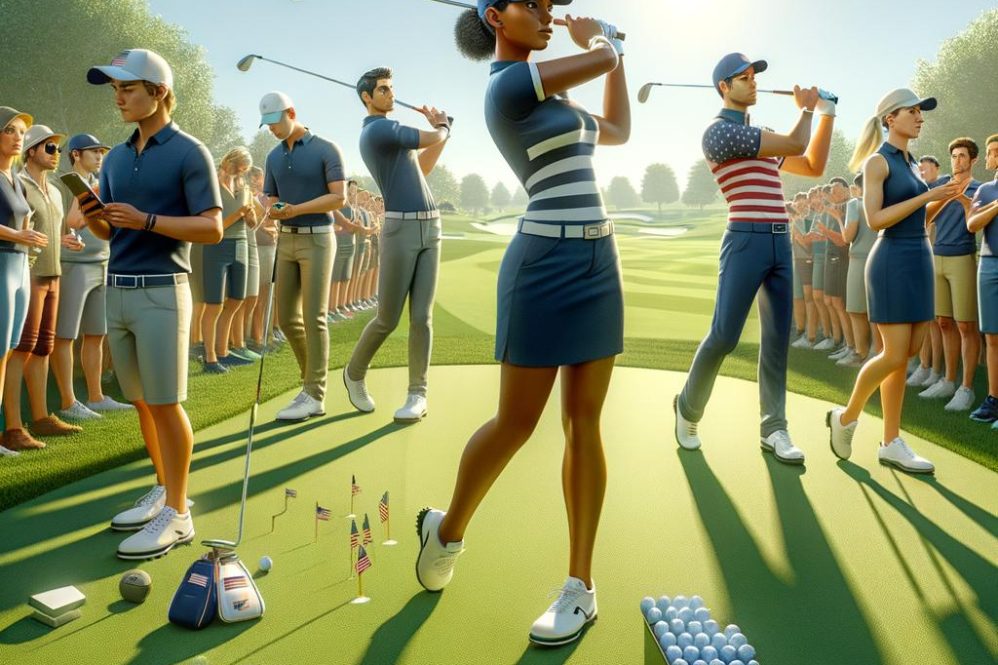
At the Ryder Cup training camp, the next wave of american talent has grabbed headlines, with youthful contenders turning in eye-catching performances during drills and simulated matches. Coaching staff and captains have taken note as these prospects make compelling cases for future U.S.rosters.
Short-game standouts take center stage as staff mandate consistent putting habits
Observers at the practice center described the short-game area as ground zero for evaluation, were a stream of young players repeatedly outshone peers in close-range scenarios, attracting a steady flow of selectors and support staff to the chipping and putting zones.
Coaches stressed a disciplined formula: establish daily putting routines, track outcomes and eliminate extraneous variables. Staff used slow-motion video and shot-tracking technology to isolate tiny improvements and measure results session-to-session.
Green-side work was paired with concentrated wedge and bunker repetitions, with an emphasis on repeatability rather than spectacle. Players cycled through structured sequences focused on:
- lag-putting under simulated pressure
- three-foot make-frequency practice
- sidehill and tight-lip bunker scenarios
- wedge distance-control ladders
| Time | Drill | Objective |
|---|---|---|
| 30 min | Putting circuit | Consistent speed and stroke repeatability |
| 20 min | Wedge ladder | Reliable distance control |
| 15 min | Bunker reps | Repeatable contact and escape accuracy |
Coaching reports indicated measurable lifts in short-range conversion and a marked decline in three-putts across consecutive sessions – roughly a double-digit percentage enhancement in some groups – a trend that has quietly shifted internal talks about match pairings and roster depth, suggesting a ready crop of contributors if that form translates to competition.
Consistency in scoring takes precedence as analytics drive targeted swing tweaks
The camp’s performance analysts identified scoring stability as the cornerstone of long-term Ryder Cup success, arguing that shrinking round-to-round fluctuation outweighs chasing the occasional very low score. Staff highlighted repeatable scoring profiles – tracked via strokes gained and dispersion measures – as stronger indicators of match-play reliability.
Technicians ran baseline evaluations using radar systems and pressure-plate analysis, then fed that data into swing models that favor micro-adjustments over wholesale overhauls. Early returns showed incremental improvements in approach proximity and scrambling; the message from coaches was clear: small,evidence-based changes preserve player confidence in high-stakes moments.
On-course targets reinforced during sessions were:
- Shot dispersion: narrower fairway and greens-proximity bands
- Short game: increased up-and-down percentage inside 30 yards
- Putting: fewer three-putts through better face-angle and speed control
These metrics were logged daily and added to individualized scorecards alongside conventional statistics.
Summaries presented to selectors showed quick, tangible shifts.
| Player | SG Approach | Putts/Round | Avg Score |
|---|---|---|---|
| Rising Prospect A | +0.48 | 29.4 | 69.3 |
| Rising Prospect B | +0.22 | 30.2 | 69.9 |
Analysts emphasized that even modest reductions in variance compound during multi-day match play and can tip selection and pairing conversations.
Team leadership is treating variability as seriously as raw results: selection debates increasingly reference dispersion metrics alongside wins. The consensus among camp observers: steady scoring, guided by precise data-driven swing refinements, may be decisive when captains finalize their lineups.
Fourball practice builds chemistry – contrasting skill sets outscore mirror-image pairings
Fourball sessions at the camp revealed a clear advantage for complementary pairings. Younger competitors combining divergent strengths – for example,length with finesse,or aggression with steadiness – produced more reliable scoring in match-play simulations than like-for-like tandems.
coaches experimented with partnerships designed to create strategic balance and plug weaknesses. Recurring themes included:
- Bomb-and-needle: a long driver teamed with a touch-oriented short-game specialist
- Stabilize-and-surge: a calm, methodical presence positioned alongside an in-form hot hand
- Tempo contrast: mixing purposeful decision-makers with quicker instinct players to manage rhythm
These principles underpinned repeated pairing trials throughout the day.
| Suggested Pairing | Primary Strength | Match Role |
|---|---|---|
| Long Hitter + Short-game Specialist | Length / Touch around the greens | Pressure the field / Rescue par opportunities |
| Risk-Taker + Conservative Strategist | Aggression / game management | Create birdie chances / Protect leads |
| Fast Decision-Maker + Measured Partner | Rhythm contrast | Disrupt opponents / Provide stability |
Captains and coaches logged the outcomes: mixed-style duos outpaced matched-type teams in both alternate-shot and fourball formats. Staff noted the psychological dividends – steadiness in clutch moments and complementary decision-making – often equaled the scoring edge.
The takeaway for selection strategy is straightforward: roster depth buys versatility. If competitive conditions reflect the camp exercises, expect captains to intentionally pair dynamic young players with steady complements to maximize points across formats.
Strength, mobility and recovery programs individualized to preserve availability
Strength and conditioning leads moved away from one-size-fits-all templates, instituting bespoke mobility plans for each prospect to protect swing mechanics and limit injury risk. Staff cited international travel demands and condensed schedules – plus a younger player pool – as drivers for personalized care.
Every participant completed a concise arrival battery – baseline movement screens, range-of-motion checks and functional strength tests – producing a performance profile that guides day-to-day load management. Coaches said those diagnostics enable same-day tweaks to training intensity and exercise selection.
Programs prioritized practical, golf-specific elements including:
- Dynamic warm-ups adjusted to each player’s deficits
- Joint-focused mobility for hips, thoracic spine and shoulders
- Corrective stability to preserve sequencing through the swing
- scheduled recovery windows with manual therapy and active regeneration
The camp also formalized recovery standards, aligning nightly protocols with training load and objective monitoring. Below is the quick-reference chart staff used:
| Component | Purpose | Frequency |
|---|---|---|
| Mobility Drills | Maintain range of motion for swing | Daily |
| Soft-tissue Therapy | Alleviate tension, speed recovery | 3× per week |
| Recovery Modalities | Accelerate repair and manage load | As required |
coaches reiterated the objective is measurable: keep players available and maximize peak output through prevention and timely intervention. Wearables and session RPE inform staffing choices, with medical and performance leads meeting daily to recalibrate plans for the camp’s most promising newcomers.
Mental training ramps up with realistic pressure scenarios to sharpen clutch performance
Sports psychologists at the camp intensified focus on pressure exposure, incorporating matchlike simulations into daily practice to improve decision-making when the stakes are high. The approach has quickly become a core component of on-course work.
Practice formats moved from isolated skill reps to context-driven situations designed to mimic tournament stress, such as:
- simulated crowd noise and timed shots
- alternate-shot sudden-death sequences
- team-match play with broadcast-style commentary
Early monitoring showed clear reductions in error rates after simulation blocks.
| Drill | Baseline Errors | Post-Sim Errors |
|---|---|---|
| Pressure Putting | 4.0 | 2.0 |
| Match-Play Tee Shots | 3.6 | 2.4 |
Sports science staff tracked heart-rate variability and decision latency to quantify improvements.
Players described the sessions as highly practical. While some veterans remained measured in their endorsement, younger members embraced the simulations and coaches noted more composed finishes on closing holes. Breathing drills and visualization routines are now standard elements of practice rounds.
Staff say the bolstered mental program is intended to tighten team cohesion and sharpen match toughness ahead of selection windows. Observers argue that the emphasis on pressure-readiness could be a decisive edge in tight match-play matchups come event week.
Caddie-player choreography refined with scripted pre-shot protocols
Coaches implemented a standardized, repeatable pre-shot protocol to speed decisions and reinforce team coordination. Tests focused on how caddies translate a player’s scripted routine into concise on-course cues while preserving the player’s focus.
Sessions replicated match conditions while staff monitored verbal and nonverbal exchanges. Caddies practiced compressed communication – yardage calls, lie reads and single-word swing cues – and experimented with eye contact and minimal gestures to avoid over-coaching. Coaches tracked adherence and corrected breakdowns.
Teams worked through a compact checklist so everyone spoke the same language:
- Breathe – reset and clear the mind
- Visualize – lock in target and shot shape
- Align – quick clubface and stance check
- Feel – one practice swing,tempo cue
- Commit – caddie confirmation,execute
Coaches emphasized that repeating each step – whether spoken or signaled – matters as much as the content itself.
| Routine Element | Caddie Cue | Expected Result |
|---|---|---|
| Alignment | “Feet set” | Consistent aiming |
| Distance | “156, smooth” | Confident yardage |
| commit | Thumbs-up | Decisive swing |
Coaches framed the drill as both psychological and mechanical. by standardizing cues and validating caddie integration, the staff aims to reduce miscommunication, accelerate play and establish reliable routines that could prove pivotal in Ryder Cup match play. Data gathered at the camp will inform final adjustments before selection decisions are locked in.
Q&A
Note: The web results returned both the ryder Cup site (the golf event) and unrelated results for Ryder (the truck company). This Q&A concerns the Ryder Cup (golf).
Q: What was the purpose of the Ryder Cup training camp?
A: The camp functioned as a multi-day evaluation and cohesion exercise: measuring form, testing pairings, refining course strategy, and monitoring fitness while giving young players a chance to push for future U.S. teams.Q: Who attended the camp?
A: A blend of established Tour pros, coaching and medical staff, and a prominent cohort of young professionals and rising amateurs – characterized by observers as Team USA’s next wave – took part in drills and competitive practice.
Q: Why are the younger players “stealing the show”?
A: Their combination of repeatable low scores in practice, decisive on-course choices and quick adaptation to team formats drew attention, prompting coaches and media to highlight them as likely future contributors.
Q: What did coaches focus on during the camp?
A: Emphasis was placed on match-play tactics, fourball/foursomes practice, communication protocols, pairing strategies and mental resilience – all structured to simulate Ryder Cup intensity and sharpen team dynamics.
Q: Did any specific skills stand out among the prospects?
A: Observers flagged reliable short-game performance, intelligent shot selection and the capacity to execute under simulated pressure – traits highly valued in Ryder Cup match play.Q: Could performances at this camp influence future Ryder Cup selections?
A: Yes. Even though formal picks frequently enough hinge on season-long results, standout displays at camp can elevate a player’s profile with captains and selectors and accelerate their path onto future teams.
Q: How are veterans responding to the emergence of younger players?
A: Reports indicate veterans generally welcomed the energy and competitiveness,using the camp as an opportunity to mentor prospects while evaluating pairings that blend experience with youth.Q: Is this camp tied to an upcoming Ryder Cup venue or date?
A: The Ryder Cup is contested in odd-numbered years; for reference, the 45th ryder Cup is scheduled for Sept. 23-28, 2025, at Bethpage Black. Camps like this shape long-range planning for such events.
Q: What are the next steps after the camp?
A: Players return to Tour competition where form will be monitored; coaches and captains will continue evaluations leading into selection windows and future team gatherings.
Q: What does the camp signal about the future of Team USA?
A: the camp points to a deepening talent pipeline.If these younger players maintain their progression,Team USA could see faster generational renewal with broader roster options and fresh tactical choices.
Ryder Cup (golf) outro:
What began as a routine training block evolved into a meaningful selection narrative, forcing captains to weigh youthful upside against veteran steadiness as match-play strategies coalesce. With rosters still fluid, the coming weeks will determine whether this young core can convert camp promise into Ryder Cup points – and whether Team USA’s emerging group can deliver when it counts.
Ryder (logistics) alternate outro:
If the story instead concerned Ryder the logistics company, the training initiative would underscore efforts to bolster frontline skills and operational resilience across its network. Management says the program aims to improve service consistency across its 800 locations, with success measured in operational performance and customer metrics in the months ahead.

Next-Gen Takeover: Team USA’s Young Guns Steal the Spotlight at Ryder Cup Camp
Editor note – option headlines:
- “Rising Stars Shine: Team USA’s Future Steals the Show at ryder Cup Training”
- “Future of Team USA Turns Heads at Ryder Cup Camp”
- “Young Core, Big Impact: Team USA’s Prospects Dominate Ryder cup Prep”
- “From Camp to Contenders: Team USA’s Youthful Talent Takes Center Stage”
- “Ryder Cup Preview – Team USA’s Rising Stars Run the Show”
- “Bright Future: How Team USA’s Young Pros Are Stealing the Ryder Cup Spotlight”
- “New Blood, Big Noise: Team USA’s Next Generation Impresses at Training Camp”
Camp snapshots: form, camaraderie and match-play focus
The recent Ryder cup training camp has become a proving ground for Team USA’s next generation. Young pros and rising prospects arrived wiht tour-ready game plans and left showing more than raw talent – they displayed chemistry, composure under pressure, and adaptability across match-play formats (foursomes, fourball and singles). For golf fans and analysts, that combination is what moves a promising player from “on the radar” to a genuine Ryder Cup candidate.
What stood out on the range and the short game area
- Consistent ball-striking in simulated fourball sessions – players learned to balance aggression and safety when partnered with distance or finesse players.
- Short-game pressure drills crafted to mimic singles scenarios: reduced margin for error, speed control and clutch up-and-downs.
- Putting relays and ten-foot pressure tests to evaluate who thrives in sudden-death or closing holes.
- On-course match-play simulations that pushed players through momentum swings – essential for Ryder Cup readiness.
Why young players are making a bigger impact than expected
Several factors explain why Team USA’s youth movement is resonating right now:
- Depth of talent: The modern pathway to professional golf (college, PGA Tour, Korn Ferry lessons) produces technically refined, tournament-hardened players quicker than in past decades.
- Match-play experience: Many young pros have strong amateur and collegiate match-play résumés – they know how to win hole-by-hole, not just shoot low scores.
- Versatility: Younger players typically bring a combination of length off the tee and improved short-game touch, making them useful in any pairing.
- Team-first attitude: Camps prioritize chemistry; youngsters eager to learn and bond are naturally appealing for captains seeking reliable partners.
Pairing options: how captains evaluate chemistry and format fit
Picking Ryder Cup pairs is a chess match: captains weigh style,temperament and format suitability. At camp, coaches and captains watch for patterns that indicate likely partnerships for foursomes (alternate shot) and fourball (better ball).
Key pairing criteria
- Complementary skill sets: A long hitter paired with a precision iron player; a hot putter paired with a steady ball-striker.
- Match temperament: Calm players in foursomes where one costly mistake affects both teammates; aggressive finishers in fourball when one player can take a risk.
- Interaction style: Partners who talk course strategy and course management click faster in pressure moments.
- Practice performance: Repeated success in on-course two-man matches at the camp is a strong predictor.
Format-specific player archetypes
| Player Archetype | Strength | Best Format |
|---|---|---|
| Big Bomber | Distance, short par-4 scoring | Fourball |
| Touch Player | Approach and short game | Foursomes |
| Clutch Putter | two-putt reliability, up-and-downs | Singles / Fourball |
Match-play strategies being drilled at camp
Match play is a strategic game: the goal is earning holes, not necessarily minimizing strokes. Training camp focuses on tactics that tilt close matches.
- Hole-centric scoring: Playing for half a hole defensively or seizing an aggressive angle when the opponent is vulnerable.
- Weather and course management: Preparing for wind, firm greens, and pin positions common at Ryder Cup venues.
- Momentum control: Techniques for stopping an opponent’s run,such as resetting the pace or changing shot shapes.
- Team signals & coaching: Using limited coach input and teammates’ cues legally and efficiently during matches.
Benefits and practical tips for young pros preparing for Ryder Cup
Young players who want to push for a Ryder Cup spot should treat camp takeaways as action items. Below are practical tips that will actually move the needle on captains’ boards.
Practice and preparation checklist
- Simulate match-play situations: Play practice rounds as alternate-shot and better-ball pairs to learn timing and pace.
- Short-game mastery: Make up-and-down drills a daily habit; save at least 60 minutes for wedge and bunker work.
- Putting under pressure: Practice ten-footers with consequences (e.g., mini-penalties for missed attempts) to emulate team tension.
- Communicate clearly: Work on concise language for partner conversations – clarity beats verbosity during tense holes.
- Physical conditioning: Build stamina for back-to-back match days; walking,mobility,and recovery matter at match-play events.
- Mental prep: Routine, breathing and reset strategies for momentum shifts and noisy crowds.
Case study: how camp routines translate into Ryder Cup readiness
Consider an archetypal camp routine that produced predictable on-course improvements:
- Morning: short-game ladder – 30 minutes chipping, 30 minutes bunker, 30 minutes putting pressure drills.
- Midday: on-course alternate-shot sessions focusing on course management and tee-shot placement.
- Afternoon: fourball match simulations where each player practices aggressive lines and defensive options.
- Evening: video review and mental-skills session covering post-round reset and visualization.
Players who completed this loop multiple days in a row showed quicker decision-making, improved clutch performance and better chemistry with partners – all attributes captains prize in Ryder Cup selection.
First-hand camp insights: what captains and coaches want to see
Coaches and captains are evaluating more than scores. They want to identify players who can:
- Translate tour success into match-play performance.
- Support teammates emotionally and strategically during swings in momentum.
- Deliver when the margin for error is tiny – especially in alternate-shot formats.
- Show growth across successive camp sessions, indicating coachability.
Communication & leadership signals
At camp, the subtle signals matter: who calms a teammate after a bad hole, who offers a constructive line for a risky putt, who demonstrates consistent pace of play. These interpersonal traits are often the difference between a good player and a great Ryder Cup teammate.
How media and fans should read the camp headlines
When headlines trumpet “Next-Gen Takeover” or “Young Guns Steal the Spotlight,” context matters. camp momentum is a strong indicator, but captains still weigh form across the season, major performances, match-play temperament and the potential for late-season surges.
- Short-term hype: Camp performance can accelerate conversations, but season-long results and world ranking still influence automatic spots and captain’s picks.
- Depth is a strategic advantage: Even if only a few young players make the final team, the existence of a ready, bonded next generation raises the squad’s ceiling and gives captains strategic flexibility.
- Fan expectations: Fans should expect exciting pairings that blend youth and experience – the best Ryder Cup squads mix hungry newcomers with steady veterans.
SEO & content tips for publishers covering the camp
To maximize visibility when writing about Ryder Cup training camp and Team USA prospects, follow these simple SEO rules:
- Use primary keywords early and naturally: “Ryder Cup,” “Team USA,” “training camp,” “match play,” “foursomes,” “fourball,” “rookie prospects.”
- Create subheadings (H2/H3) around user intent: “pairing options,” “practice drills,” “captain’s criteria.”
- Include tables or quick-reference lists: fans appreciate at-a-glance content (e.g.,pairing types,player archetypes).
- Add internal links to related Ryder Cup previews and player profiles to keep readers on-site longer.
- Optimize meta title and meta description (see top of this article) to improve click-through from search results.
quick-reference checklist for fans tracking team USA prospects
- Watch for consistent match-play results during camp and subsequent team events.
- Track short-game and putting form – decisive in close Ryder Cup matches.
- Monitor pairings in practice matches – repeated duos often foreshadow official picks.
- Listen to coach and captain comments about chemistry and temperament.
At its core, the Ryder Cup is a unique test of golf skills, nerves, and teamwork.Team USA’s young prospects are showing they can handle the load: they’re hitting fairways,sinking clutch putts,and learning to play as one. That’s why “Next-Gen Takeover” isn’t just a catchy headline – it’s an accurate description of the story unfolding at camp.