
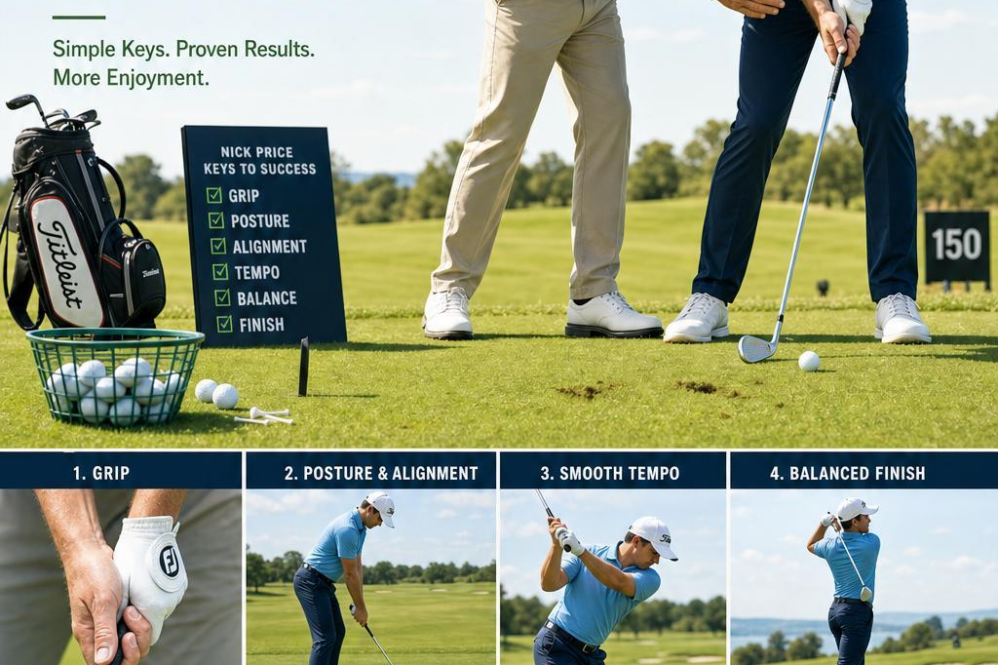
Discovering Nick Price’s Approach to Building a Consistent and Powerful Swing
Nick Price’s approach to building a consistent and powerful swing emphasizes establishing a solid technical foundation through precise setup and repeatable mechanics. Central to his method is maintaining a balanced and athletic posture with a slight knee flex and a spine angle around 30-35 degrees tilted forward from the hips, promoting stability and enabling efficient rotation. Golfers should focus on achieving a square clubface at address while ensuring their hands are positioned just ahead of the ball, fostering a natural forward shaft lean for crisp ball striking. A key drill Price recommends to develop consistency is practicing half-swings with a focus on maintaining a steady head position and rhythm, which can be measured by tempo ratios close to 3:1 (backswing to downswing). For beginners, this drill builds muscle memory to prevent early lateral sway, while advanced players refine timing and sequencing of the hips and shoulders, critical for generating power without sacrificing control. Incorporating tailored equipment fitting aligned with Price’s principles-such as shaft flex matched to swing speed and a driver loft between 9-11 degrees for optimal launch angle-complements technical mastery and aids in maximizing distance and accuracy.
In addition to technical proficiency, Price’s swing beliefs integrates strategic course management to elevate scoring consistency. He advocates for a methodical selection of clubs and shot types based on situational analysis, such as favoring controlled fades or draws to navigate doglegs or avoid hazards. Practicing intentional shot shaping drills-like hitting high fades under 100 yards or low punch shots into the wind-prepares golfers to adapt to varying conditions and course layouts. Furthermore, Price stresses the importance of understanding yardage via rangefinders or GPS and factoring in elements like wind speed, lie angle, and green slopes when choosing targets. Mental discipline also plays a crucial role; approaching each shot with clear intent and visualizing the desired ball flight can reduce swing tension and improve execution. for all skill levels, incorporating pre-shot routines inspired by Price’s playstyle helps in maintaining focus and confidence, bridging the gap between technical execution and strategic decision-making essential for lowering scores on competitive rounds.
Unlocking the Art of Precision Putting with Nick Price’s Proven Techniques
Mastering precision putting begins with Nick Price’s essential emphasis on setup alignment and stroke consistency. Golfers should first focus on establishing a square stance,aligning feet parallel to the target line,with the ball positioned slightly forward of center in the stance to encourage a slight upward strike on the ball. This setup facilitates a smooth, controlled roll essential for accurate distance and direction. Price advocates for a pendulum-like putting stroke-leveraging the shoulders rather than the wrists-to maintain a stable putter face angle throughout the stroke. Players should incorporate the “clock drill”, where the takeaway and follow-through mimic the hands moving between the 7 o’clock and 5 o’clock positions on a clock face, providing a measurable guide to consistency. By practicing this drill, golfers can develop muscle memory for a repeatable stroke that minimizes unwanted side spin and keeps the ball rolling true. Additionally,golfers should be mindful of grip pressure; Price recommends a lighter grip to promote fluidity while maintaining control,which reduces tension-induced jerks.
Beyond stroke mechanics, putting precision also demands acute green reading skills and strategic course management-two areas where Nick Price’s insights are especially impactful.Players need to assess subtle breaks and grain directions by observing the slope angles and grass texture, ofen reading putts from multiple angles to map the ball’s projected path accurately. when confronted with challenging reads or long putts, Price emphasizes the value of visualizing the intended line and pace before execution, a critical cognitive technique that enhances focus and confidence. Practically, this can involve using intermediate targets on the green, such as a blade of grass or a shadow, to guide the putter along the correct line. Incorporating these mental routines into practice drills, like the “two-putt challenge,” encourages both technical execution and situational decision-making, leading to lower scores. Furthermore, golfers should adapt to course conditions-such as wet greens slowing ball speed or fast, dry surfaces increasing roll-by adjusting stroke length and pace accordingly. ultimately, integrating Price’s proven methods empowers golfers at all levels to unlock greater control, read greens more effectively, and optimize their performance under competitive pressure.
Driving with Confidence Understanding nick Price’s Strategy for Distance and Accuracy
Nick Price’s approach to driving exemplifies a harmonious balance between maximizing distance and maintaining pinpoint accuracy, a skill set essential for any golfer aiming to lower their scores through strategic tee play. Central to Price’s method is the emphasis on a solid, repeatable setup that prioritizes consistency. By positioning the ball just inside the lead heel and ensuring a slightly wider-than-shoulder-width stance,golfers create a stable base that promotes an upward strike on the ball,crucial for optimizing launch angle and reducing spin rates. Price advocates a tee height that allows the clubface to make contact with the ball on its upswing, typically placing the ball so that half of it sits above the driver’s clubface at address. This technical adjustment enhances carry distance without sacrificing control. To replicate Price’s success, golfers should focus on a smooth tempo, avoiding the common mistake of over-swinging, which frequently enough leads to loss of balance and errant shots. Practicing with alignment sticks on the range can help train proper shoulders and hips alignment,reinforcing the habit of starting the downswing from the ground up,a pivotal element in Price’s delivery.
Beyond mechanics, Price’s strategic mindset elevates his driving to a competitive advantage through meticulous course management and shot shaping. Rather than overpowering the course, he reads each hole’s layout-factoring in wind direction, hazards, and pin placement-to dictate the ideal shot shape, often employing controlled fades and draws. This nuanced control over ball flight allows for safer navigation around trouble spots while maximizing scoring opportunities.Golfers can cultivate this skill by experimenting with grip pressure adjustments and varying clubface angles at impact, learning to intentionally induce side spin and trajectory changes. Drills such as the ‘gate drill’-placing tees slightly wider than the driver’s head and practicing hitting without contacting the tees-develop both swing path awareness and face control. These technical refinements, paired with mental visualization techniques emphasized by Price, enable players of all levels to approach tee shots with confidence, translating into lower stroke averages and an elevated competitive mindset. Embracing both the physical precision and psychological preparedness championed by Nick Price equips golfers to drive longer, straighter, and smarter on any course condition.
Bringing It All together Tips to Integrate Swing, Putting, and Driving for Your Best Game Yet
Mastering the integration of your swing, putting, and driving involves more than isolated skill enhancement; it requires a holistic approach that synchronizes each aspect into a seamless performance. Begin by focusing on setup fundamentals: ensure your stance is balanced with a 40-50 degree knee flex and a shoulder alignment parallel to the target line. For driving, establish a consistent ball position slightly inside the front heel to promote an upward strike and maximize launch angle, targeting a 10-14 degree loft for optimal carry distance. In contrast, your iron swings should prioritize a descending blow with the ball positioned centrally or slightly back in your stance to achieve crisp contact. Applying Nick Price’s insight on swing tempo, use a controlled 3:1 back-to-through ratio to maintain rhythm across all clubs, reducing tension and improving shot consistency. Transitioning to putting,focus on a pendulum stroke,maintaining your shoulders as the primary movers and keeping wrists stable to create a smooth path. Practice drills such as the “clock drill” will develop speed control and green reading skills, essential for adapting to different turf conditions and breaks.
Effective course management ties these techniques together by encouraging deliberate decision-making and situational awareness. For example, when facing a challenging hole, rather than always opting for maximum distance off the tee, use a fairway wood or hybrid to prioritize accuracy and position for a safer approach shot. This strategy minimizes risk and taps into your practiced swing mechanics under pressure. Utilize shot shaping skills-drawing or fading the ball intentionally-to navigate around hazards or exploit favorable green contours,a technique Nick Price emphasizes for lowering scores. In your practice routine, incorporate drills that simulate real-course scenarios, such as hitting controlled fades to avoid bunkers or executing a low punch shot against windy conditions. Align your mental game by visualizing each shot’s trajectory and landing spot, boosting confidence and focus. By consciously integrating swing mechanics with putting precision and driving strategy, you lay the groundwork for measurable score improvements and a more enjoyable, strategic golf experience.




