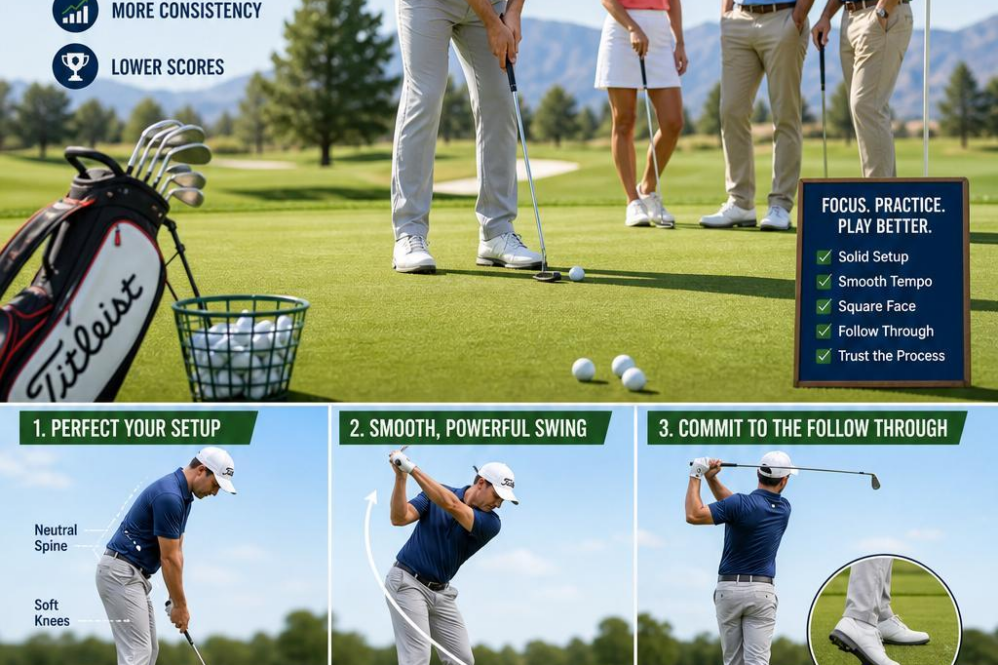
Master Your Putting with Precise Alignment and Tempo Control
Effective putting hinges on the convergence of precise alignment and consistent tempo, which together create a reliable stroke capable of reading greens accurately and sinking putts under pressure. Start by ensuring your eyes are positioned directly over the ball or slightly inside the ball-target line to promote sighting accuracy. Your setup should feature a cozy stance width, typically shoulder-width apart, with a slight knee flex and forward tilt from the hips to maintain balance and promote a pendulum motion. Align the putter face square to your intended target line, as even the slightest open or closed angle can cause the ball to miss the hole by several inches on short putts. To develop a repeatable tempo, use a metronome or count “one-two” during the backswing and forward stroke, aiming for a smooth acceleration thru impact rather than a sudden jerk. Practicing with a chalk line or alignment sticks on the practice green can reinforce these fundamentals by providing immediate visual feedback on your setup and putter path.
Incorporating course strategy comes into play when adjusting your stroke based on green slopes, speed variations, and wind conditions. For example, on faster greens, controlling the length of your backswing is critical-using no more than a 6- to 8-inch arc on short putts helps prevent overshooting the target. Integrate drills such as the “Gate Drill” to improve face alignment and the “clock Drill” to calibrate distance control and tempo. Additionally, recognizing grain direction and subtle breaks allows you to plan the ideal line, while practicing lag putting from 20 to 40 feet enhances your skill in getting the ball close enough to secure a routine second putt. Advanced players should experiment with stroke tempo variations to compensate for uphill or downhill putts, understanding that slowing the stroke slightly uphill and accelerating downhill supports consistent pace control. By mastering these technical and strategic elements, golfers at every level can reduce three-putts, increase confidence on the green, and ultimately lower their scores.
unlock the Secrets to a Powerful and Consistent Golf Swing
Developing a powerful and consistent golf swing begins with mastering the fundamentals of setup and biomechanics. Start by positioning your feet shoulder-width apart with the ball placed slightly forward of center for irons and at the inside of your front heel for drivers. Maintain a spine angle of approximately 45 degrees and ensure your weight is distributed evenly between the balls of your feet and heels. From this foundation, focus on engaging your core muscles to initiate the backswing, pivoting your hips and shoulders smoothly while keeping your lead arm straight but not rigid. Avoid common errors like lifting the head or collapsing the wrist angle, which disrupt club path and reduce swing consistency. For measurable improvement, incorporate drills such as the “pause at the top” to rehearse transition timing and use video analysis to track swing plane deviations. These biomechanical principles, combined with a deliberate tempo of roughly a 3:1 ratio between backswing and downswing, foster a repeatable motion that maximizes clubhead speed and ball striking precision.
once the swing mechanics are honed, integrating course-specific strategies can significantly elevate scoring potential. For example, when facing elevated greens or wind-affected conditions, adjust your ball position and club selection to adapt the launch angle and trajectory, such as tuning your setup for a higher tee shot or a softer landing with wedges. Putting improvement goes hand-in-hand with swing mastery; to enhance distance control, practice the “clock drill,” placing balls at varying distances (3, 6, 9 feet) around the hole to build feel and confidence, emphasizing a pendulum stroke with minimal wrist movement. Additionally,reading greens by assessing slope and grain direction allows for precise aim adjustments that reduce three-putts. Consistently recording strokes gained statistics during rounds provides valuable feedback for identifying strengths and areas needing targeted practice. Weather a beginner focusing on solid contact or an advanced player refining shot dispersion, these actionable techniques bridge physical skills with mental acuity to unlock a more powerful, reliable golf swing adapted to real-course challenges.
Drive Longer and Straighter by Perfecting Your Stance and Follow Through
Achieving longer and straighter drives starts fundamentally with mastering your stance and follow through, as these elements directly influence swing path and clubface alignment at impact. Begin by positioning your feet shoulder-width apart, ensuring weight is evenly distributed to maintain balance throughout the swing.For right-handed golfers, a slight flex in the knees paired with a *1 to 2-inch* gap between your back foot and the ball promotes optimal stability and power transfer. Align your shoulders parallel to the target line to encourage a square clubface, and tilt your spine about 3 to 5 degrees away from the target to facilitate an upward angle of attack-crucial for maximizing carry distance while minimizing spin. During practice, use alignment sticks or visual markers to confirm consistent setup and to promote muscle memory for this balanced stance. Common errors include a closed stance that promotes hooks or an open stance that creates slices; recognizing these tendencies is essential in correcting your baseline posture.
Once your stance is dialed in, the follow through completes the motion by maintaining clubhead speed and directional control. A full, balanced finish-with the weight shifted smoothly onto the front foot and the hips rotating toward the target-ensures energy is efficiently transferred from the ground through the ball. Focus on a high hands position, as this encourages a wider swing arc and better leverage, translating to increased clubhead speed and distance. To build consistency, incorporate drills such as swinging to a fixed finish position against a wall or recording your motion to analyze hip rotation and weight transfer. For golfers aiming to optimize their course management, understanding that a controlled follow through helps maintain shot shape inside the boundaries reduces the risk of errant drives that lead to challenging lies or penalties. Additionally, practicing in various weather conditions, such as into headwinds or on firm fairways, trains adaptability in your follow through to maintain trajectory and control. Adopting these techniques will not only improve your tee shots but also contribute significantly to lowering your overall score by setting up easier approach shots.
Integrate Course Strategy to Turn Your practice into Lower Scores
To effectively transform your practice sessions into lower scores, it’s essential to embed strategic course management into every shot decision. Prosperous golfers don’t just execute good swings; they think several shots ahead by assessing hazards, pin location, and wind conditions. Start by developing the habit of visualizing your target and the safest route to get there, especially on par-4s and par-5s. For example, rather of always aiming for maximum distance off the tee, consider using a 3-wood or hybrid to keep the ball in play and avoid trouble spots. This emphasizes the concept of playing to your strengths and minimizing risk. Additionally, incorporate pre-shot routines that include a brief course evaluation: note the slope of the fairway, bunker positions, and the green’s contour to choose the ideal landing area. As part of your practice, simulate these real-course decisions by setting up practice rounds where you intentionally select conservative targets and analyze the outcomes. Drills focusing on shot placement accuracy within 10-yard zones can significantly improve your ability to execute strategic plays under pressure.
Integrating course strategy also means refining your approach shots and short game with intentional practice aimed at specific scenarios. When practicing wedges and chips, implement drills that mimic common course challenges such as uphill lies, tight pin placements, or short-sided greens. Use alignment rods or markers to create target zones within a 15 to 30-foot radius around the hole to build precision and confidence. Additionally, mastering green reading can elevate your scoring dramatically-develop your feel for green speed by measuring putt distances against green speeds (measured in Stimp values) during practice rounds.Learning to recognize subtle breaks and grain direction helps you plan your putts more effectively. For all skill levels,combining these technical skills with sound strategic thinking enables smarter club selection and shot execution,thereby reducing needless strokes. Remember, the goal is to make informed, data-driven decisions on the course that complement your swing mechanics and short game proficiency, resulting in consistent score reduction over time.