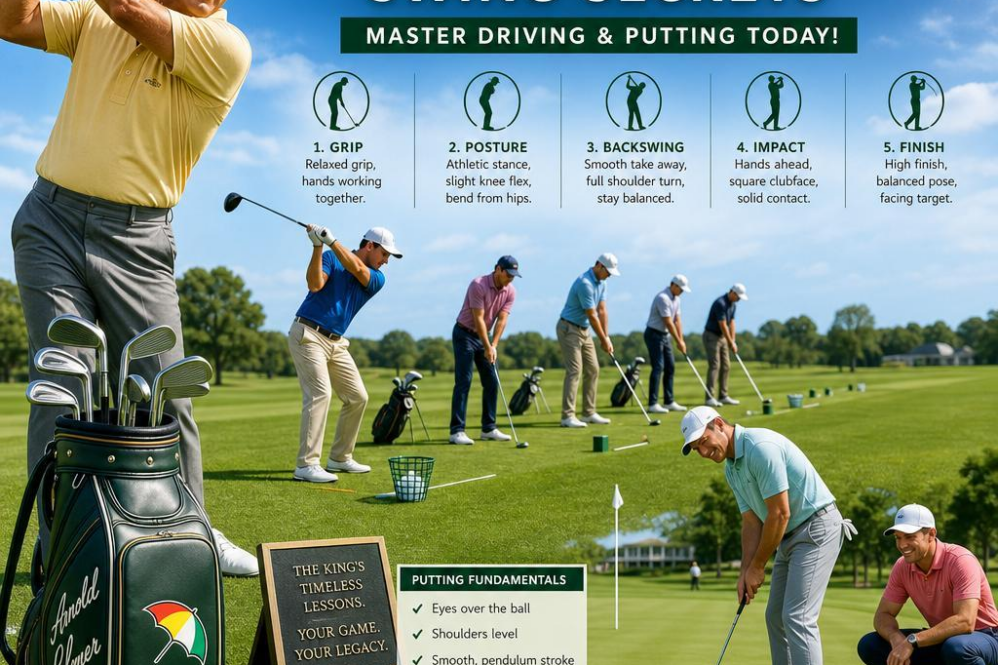
Discover the Rhythm Behind Arnold Palmer’s Effortless Swing
Arnold Palmer’s swing rhythm is a masterclass in fluidity and consistency, grounded in the seamless balance of tempo and timing. To emulate his effortless motion, start with a strong setup: position the ball slightly forward of center for your driver and maintain a relaxed but firm grip pressure-about 5 on a 1-to-10 scale-to prevent tension that disrupts flow. Palmer’s backswing is defined by a smooth, deliberate takeaway; he would initiate the clubhead gently along the target line while keeping the wrists unhinged until roughly waist height. this gradual hinge creates a natural, rhythmic coil supported by a slight shoulder turn of approximately 90 degrees-which can be practiced with a mirror drill to ensure your shoulders and hips coil synchronously without overswinging. Transitioning into the downswing, Palmer’s secret lies in the controlled acceleration: shifting weight from the trail foot to the lead foot through impact, fostering a powerful yet balanced release of the club. Incorporating this weight shift into your practice drills can be as simple as performing slow-motion swings with a golf alignment stick placed along your hips to monitor lateral movement. By focusing on the fluid transition and measured acceleration, golfers enhance clubhead speed while maintaining the precision vital to scoring well under diverse course conditions.
Beyond mechanics, Palmer’s calculated approach to shot selection illustrates the marriage of rhythm and course strategy-underscoring how swing tempo influences decision-making. For example, on a tight fairway requiring precision over power, replicating Palmer’s mid-tempo swing tempo helps maintain control, reducing dispersion and enabling targeted tee shot placement. A practical drill for this involves counting rhythm (e.g.,“1-2” for takeaway and downswing) to internalize tempo changes between aggressive and controlled shots. Additionally, Palmer was adept at adapting shot shape, frequently employing subtle fades or draws by adjusting clubface alignment and swing path at address-typically setting the clubface slightly open or closed by 2-3 degrees and aligning feet accordingly.This tactical manipulation can be practiced on the range by using alignment rods to visualize angles and implementing half-swings emphasizing wrist hinge timing. Such precise shot shaping combined with consistent rhythm empowers golfers across skill levels to navigate hazards, varying weather conditionsand diverse course layouts with confidence. Ultimately, mastering Arnold Palmer’s rhythmic swing provides not only a mechanical blueprint for efficiency but also instills the mental composure necessary to execute strategic shots that lower your stroke count.
How Arnold Palmer Mastered Driving for Distance and Accuracy
Arnold Palmer’s mastery of driving for both distance and accuracy stemmed from a finely tuned combination of setup fundamentals and swing mechanics that any golfer can learn from. At address,Palmer emphasized a slightly wider stance than shoulder width to promote balance and power transfer,allowing a stable base crucial for consistent ball striking. His ball position was deliberately placed just inside the left heel – an effective position to launch the ball on an ascending path, maximizing carry distance while maintaining control. A subtle but vital aspect was his grip pressure; he maintained firm yet relaxed hands, preventing tension that can stifle clubhead speed and promote erratic shots. Swing mechanics were centered around a smooth, single-plane takeaway with the clubhead moving low and slow away from the ball, followed by a full shoulder turn achieving about 90 degrees of shoulder rotation. this coil stores immense energy, which Palmer released through a controlled hip rotation and a well-timed hip slide, culminating in a square clubface and a powerful yet accurate impact. For golfers seeking to emulate Palmer’s technique, practicing with a drill that emphasizes slow, intentional takeaway followed by a smooth transition into the downswing helps develop muscle memory to maintain sequencing. combining these key points with video analysis or swing sensors can provide immediate feedback and measurable progress.
Beyond mechanics, Palmer’s strategic approach to driving illuminated the importance of bright course management and shot visualization. He frequently enough tailored his tee shots to course conditions, factoring in wind direction and hazards, demonstrating tactical versatility by shaping shots-fading or drawing the ball as needed to access tighter landing zones. This ability to manipulate ball flight was rooted in his grip and wrist action at impact,subtly adjusting clubface angle and path to generate precise spin and curvature. For golfers at all levels, developing shot-shaping skills can be broken down into focused practice sessions where they intentionally hit fades and draws on the driving range, adjusting grip pressure and swing path while maintaining balance and tempo. Furthermore, Palmer’s mental routine included visualizing the exact shot shape and target before every tee shot, which helped reinforce confidence and reduce decision-making pressure on the course. Incorporating pre-shot visualization combined with situational drills-like aiming for targets under varying wind speeds or simulating hazard avoidance-can considerably boost driving accuracy and strategic thinking. Ultimately, integrating Palmer’s blend of disciplined mechanics, strategic ball flight manipulationand mental planning equips golfers to enhance both distance and precision, rendering the driver an effective scoring catalyst rather than a liability.
Putting Like a Legend Tips Straight from Palmer’s Green Reading Playbook
Mastering the art of green reading like Arnold Palmer demands a blend of keen observation, precise alignmentand strategic visualization. Start by developing a consistent pre-putt routine where you assess the green’s slope, grain directionand any subtle undulations from multiple angles-walking around the putt if possible. Palmer emphasized the importance of reading the putt from both behind the ball and behind the hole; this dual viewpoint helps golfers detect breaks that might be invisible from just one viewpoint. To translate these observations into action, focus on establishing a reliable reference line using your putter face or an alignment aid. When standing over the ball, aim to position your eyes directly over or slightly inside the ball’s line to improve depth perception. In practice, use drills such as placing tees or coins along a perceived break line to train your eye for subtle green contours, progressively extending the length of your putts. This approach can help beginners build confidence in reading breaks, while advanced players refine their feel for complex slopes. In all conditions, consider grain direction especially on faster, drier greens as it can accelerate or slow the ball, impacting your stroke speed and line selection.
Implementing Palmer’s strategic mindset, integrate course management and putting routine adjustments tailored to varied situations for immediate score improvement. For example, when facing a downhill or severely sloped putt, adopt a softer stroke with a slightly shorter backswing to maintain control, as Palmer frequently enough advised-this reduces the risk of overshooting. Conversely, on uphill putts, increase your stroke length and pace to compensate for the added resistance. A key tip from Palmer’s playbook is also to read the surrounding environment such as wind or green firmness; on extremely firm greens, expect less ball roll and adjust your aim accordingly. To refine technique and build consistency, incorporate practice drills focusing on speed control using distance gates or tee markers set at 10, 15and 20 feet targets. Besides technical refinement, Palmer’s approach highlighted the mental component-maintain calm focus and envision the ball tracking into the hole before each stroke to build confidence. By combining these technical adjustments, mental strategiesand observation skills, golfers can dramatically enhance putting precision, reduce three-puttsand ultimately lower scores through smarter green reading and stroke execution.
Simple Drills to Bring Palmer’s Precision to Your Game Today
To emulate Arnold Palmer’s trademark precision,begin by focusing on setup alignment and consistent swing plane. Palmer famously emphasized the importance of a square clubface at address, with feet, hips, and shoulders aligned parallel to the target line. Start your practice by placing alignment rods or clubs on the ground during your warm-up to ensure your stance is calibrated precisely each time. Incorporate a simple drill where you execute half-swings while concentrating on maintaining your wrist hinge and a smooth tempo – ideally around a 3:1 backswing-to-downswing ratio. This promotes rhythm and consistency,two hallmarks of Palmer’s swing. Additionally,focus on keeping the shaft leaning forward at impact to ensure crisp ball contact and maximize control over trajectory. From shorter irons to mid-irons, aim to strike the ball first, followed by a divot approximately 1 to 2 inches beyond ball position, which signals clean, penetrating strikes akin to Palmer’s style.
Translating Palmer’s precision to course management demands intelligent shot selection and a well-rounded short game routine. For example, when navigating narrow fairways or strategically bunkered holes, adopt Palmer’s mantra of “play smart, not just hard” by selecting tee shots aimed deliberately toward safer landing areas instead of purely going for maximum distance. Practice situational drills where you intentionally shape shots-such as a gentle fade or draw-to negotiate wind conditions and natural course contours, simulating Palmer’s adept use of shot-shaping. On the greens, improve your lag putting by replicating Palmer’s emphasis on reading subtle breaks and pacing speed, focusing on delivering putts within a 3-foot circle from the hole to reduce three-putt frequency. Incorporate drills where you practice controlling backswing length and follow-through to enhance distance control under varied green speeds. These focused exercises, paired with mindful course strategy, cultivate a precision-driven mindset that empowers golfers of all levels to consistently lower scores and approach every round with the confidence of a legend.