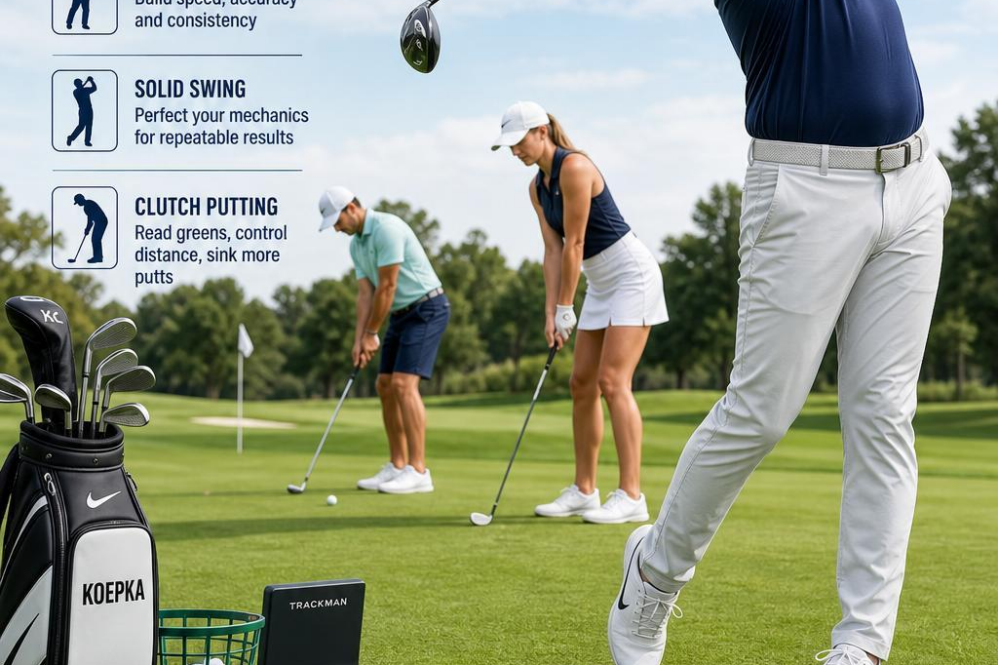
Discover How Brooks Koepka’s Swing Technique Adds Power and Precision
Brooks Koepka’s swing technique exemplifies a powerful blend of athleticism and precision that golfers at every level can study and emulate. Central to his effectiveness is a compact yet forceful hip rotation that generates tremendous clubhead speed without sacrificing control. Aspiring players should focus on achieving a hip turn of approximately 45 to 50 degrees on the backswing, which Koepka uses to store elastic energy while maintaining balance. This allows for a smooth transition into the downswing, where sequencing the arms, hips, and shoulders correctly maximizes power delivery. To practice this, try the “hip rotation drill” by placing a chair behind you and rotating your hips against the chair without moving your upper body excessively; this trains proper separation and torque. Additionally, maintaining a stable spine angle of around 45 degrees through impact ensures solid contact and precision. Koepka’s technique discourages over-swinging, rather emphasizing that controlled acceleration through the ball produces both distance and accuracy. Incorporating this into your game means focusing on consistent tempo and rhythm in your practice sessions, as Koepka’s intentional cadence helps him adjust strokes according to course conditions and shot requirements.
Beyond pure mechanics, Koepka’s swing strategy integrates situational awareness and clever equipment choices that reinforce his power and precision. For example, pairing a driver with a low-spinning head and a 9 to 10 degree loft allows him to optimize launch conditions, especially in windy environments common on tour courses. Practicing with variable wind and turf conditions, you might perform controlled fades or draws by adjusting your grip pressure and clubface angle at address, techniques Koepka uses to fit the hole layout. His short game also benefits from deliberate setup fundamentals like aligning the body square to the target and distributing weight evenly (around 50/50) for chip and pitch shots, promoting crisp, consistent contact. To improve, incorporate drills such as the “gate drill” with alignment sticks to ensure your clubface path stays on line during the swing arc. Linking thes swing refinements to course management-like choosing lower flight punch shots under tree branches or selecting the right club to avoid hazards-helps golfers translate practice improvements into scoring advantages. Ultimately, mirroring Koepka’s blend of technical skill and strategic adaptability can substantially elevate your performance under pressure.
Uncover the putting Strategies That Make koepka a Tough Competitor on the Green
Brooks Koepka’s putting prowess is deeply rooted in a foundation of **consistent setup and stroke mechanics**, which any golfer can emulate to improve green-side performance. Start by focusing on a **square clubface at address**, ensuring the putter face is perpendicular to the target line-this is critical for accurate roll and reduces side spin.Koepka emphasizes a **relaxed grip pressure around 3-4 on a 10-point scale**, to promote a smooth pendulum motion through impact. Align your eyes directly over the ball to aid depth perception and visualize the intended line more clearly. Incorporate a slight forward shaft lean, roughly **5 degrees**, to engage the leading edge for a better “strike” that minimizes skidding. Additionally, practice a smooth tempo with a backswing and follow-through length that mirror each other, fostering rhythm and encouraging repeatable stroke patterns. For measurable betterment, use alignment aids and clock drills-where the putter swings back and forth between 8 and 4 o’clock positions-to build muscle memory and consistency.
Course management on the green is where Koepka’s strategic mindset shines, and golfers should adopt a similar pragmatic approach. He adapts his putting depending on the green’s grain, slope, and speed, always analyzing the ideal line before committing. When faced with challenging breaks, Koepka visualizes the ball’s curve before aiming-this mental rehearsal improves feel and confidence. Beginners should first develop comfort by practicing putts from varying distances-**3 feet, 6 feet, and 10 feet**-to build stroke confidence and touch. Advanced players benefit from incorporating drills that simulate pressure, such as “make 5 out of 6 putts from 6 feet,” replicating tournament stakes. Koepka also demonstrates smart risk assessment; when the break is severe or green speeds are fast, he opts for controlled pace over aggressive aiming, prioritizing minimize three-putts rather than gambling for birdies. Integrating these tactics,alongside maintenance of composure and positive self-talk,allows golfers to lower scores through disciplined,mentally resilient putting strategies that withstand all course conditions.
Master Driving Like Koepka to Gain Distance Without Losing Control
Achieving increased driving distance like brooks Koepka hinges on mastering the balance between power and control through efficient swing mechanics. Start by focusing on a solid setup: align your feet shoulder-width apart with a slight flex in your knees and tilt your spine forward about 5 to 7 degrees from the hips. this posture encourages a full shoulder turn, essential for generating clubhead speed without losing balance. Koepka emphasizes the importance of a wide takeaway to create leverage; initiate the backswing by extending your arms away from the body, promoting a smooth arc and maintaining wrist hinge to store energy. As you transition into the downswing, shift your weight from your back foot to your front foot while rotating your hips aggressively but in a controlled manner – this sequencing allows powerful transfer of torque through the ball. Incorporate drills like slow-motion swings with a focus on hip rotation and wrist hinge retention, aiming to achieve a peak clubhead speed increase of about 10-15% over baseline measurements. Avoid common mistakes such as early wrist release (“casting”) or swaying laterally, as these reduce control and consistency.
Incorporating Koepka’s course management strategies reinforces the technical aspects of driving to maximize scoring opportunities while minimizing risk. Before every tee shot, assess course conditions such as wind direction, fairway width, and hazards to decide on the optimal target corridor instead of always aiming for maximum distance. As an example,on a narrow fairway with trees or water hazards,dialing back your driver from the tee or opting for a 3-wood can enhance control and accuracy-key to Koepka’s methodical play. practicing specific drills like placing alignment sticks on the ground and visualizing a “drive box” of 15 yards wide can definitely help you consistently orient your shot shape and trajectory. Additionally, simulate pressure scenarios during practice by introducing target zones and counting strokes to build mental resilience, enabling you to stay calm and execute under tournament-like stress.Using regularly calibrated launch monitor data to track ball speed, spin rate, and launch angle (ideally between 12°-15° for driving) further refines your setup and club selection, leading to long, accurate drives that set up birdie opportunities. By blending these elements-mechanical precision, strategic decision-making, and mental toughness-golfers at all levels can elevate their tee game with the confidence and control that define Koepka’s dominance off the tee.
Practical Tips to incorporate Koepka’s Secrets Into Your Game Today
To effectively integrate Brooks Koepka’s swing mechanics into your own game, start by focusing on his balanced and powerful setup. Koepka emphasizes a neutral spine angle around 30 degrees with a slight tilt away from the target, which promotes a consistent swing plane and optimal weight transfer.Begin your practice sessions by addressing the ball with feet shoulder-width apart and ensure your weight is evenly distributed, aiming for approximately 50-50 balance. This foundation allows for a controlled hip rotation, which Koepka masters by initiating his backswing with a slow coil, hinging the wrists at roughly 90 degrees to create potential energy. Incorporate drills such as the “pause at the top” to build awareness of this wrist hinge and maintain a smooth tempo throughout. As a notable example, try swinging back slowly, holding the top position for two seconds, then progressing into a controlled downswing; this helps prevent common errors like casting or early release, which can rob distance and accuracy.Consistent practice of this routine not only builds muscle memory but also enhances the kinetic chain efficiency, translating into more powerful and precise ball striking under varied course conditions.
Beyond swing mechanics, Koepka’s strategic prowess on the course serves as a crucial lesson in smart golf management that all levels can adopt. He approaches each hole with a clear plan to minimize risk and capitalize on scoring opportunities,particularly by analyzing wind direction,hazards,and pin placement. When facing tricky wind conditions, emulate Koepka’s method of selecting clubs that produce a lower ball flight to reduce the effect of gusts-consider using a three-quarters swing with a 7-iron to maintain control rather than forcing a full swing that can be unpredictable.Moreover, practice visualization drills by pacing off distances to key landmarks and calculating safe landing zones rather than aiming directly at pins tucked behind bunkers or water hazards. Incorporate short game drills focusing on pitch and chip shots with a variety of wedge lofts, especially 56 and 60 degrees, to sharpen your touch around the green. This comprehensive approach combining physical technique with tactical decision-making builds not only a technically sound game but also boosts confidence and mental resilience, crucial components that Koepka exemplifies when navigating challenging tournament conditions.