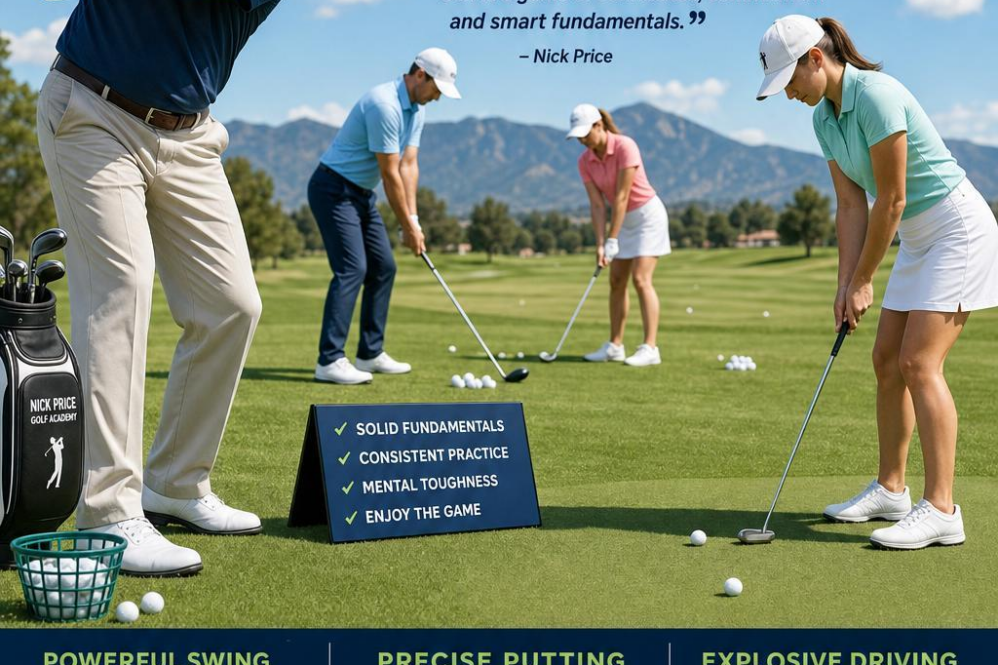
Understanding Nick Price’s Swing Mechanics and How They Build Consistency
Nick Price’s swing mechanics provide an excellent model for golfers aiming to build consistency thru a controlled yet powerful motion.At the core of his technique is a fundamentally sound setup characterized by a neutral grip that promotes clubface control and accuracy. His stance is shoulder-width apart, with a slight knee flex to ensure balance, and his spine tilt creates an optimal angle of attack-typically around 5 to 7 degrees forward, which helps drive through the ball rather than scooping it. Price’s takeaway emphasizes a smooth one-piece motion where the arms,shoulders,and club move together,reducing early wrist breakdown and promoting a wide,stable arc. This translates to a club path that is slightly inside-to-square-to-inside, which minimizes slices and hooks, fostering reliable ball flight. Golfers of all skill levels can start by practicing these basic positions during setup and employing slow-motion drills to ingrain coordination, such as swinging with a weighted club or performing half swings while focusing on maintaining that solid connection between body and club.
Beyond the basics,Price’s swing incorporates a well-timed transition from backswing to downswing,emphasizing the use of ground forces for power generation.By initiating the downswing with the lower body-specifically a subtle pelvic rotation followed by uncoiling of the torso-he creates a kinetic sequence that maximizes clubhead speed without sacrificing accuracy. A critical aspect of his approach is maintaining lag through impact, which means holding the leading wrist firm to store energy and release it just past the ball, optimizing distance and consistency. Incorporating drills such as the “pump drill,” where golfers pause midway through the downswing to focus on lag retention, can help develop this feel. Additionally,Price’s commitment to course management is evident in his shot selection and trajectory control; he often adjusts ball position in his stance and clubface angle to shape shots around hazards or windy conditions,making strategy a key component of his repeatable success. For players looking to emulate these patterns, incorporating yardage control exercises with variable lies and practicing multiple trajectories during range sessions will translate tech improvements into better scoring on course.
Breaking Down Nick Price’s putting Technique to Lower Your Scores
To emulate Nick price’s precise putting technique, start by focusing on a consistent setup that promotes a square putter face at impact-a fundamental principle that underpins his accuracy on the greens. Begin by positioning the ball slightly forward of center in your stance, ensuring your eyes are directly over the ball or just inside the target line; this alignment aids in better depth perception and allows for a straighter stroke path. Nick Price’s stroke is characterized by a smooth pendulum motion, primarily driven by the shoulders rather than the wrists, reducing unwanted wrist breakdown that often leads to off-line putts. Practice the “gate drill” by setting two alignment sticks parallel to your target line about a putter head’s width apart to groove a path that keeps your putter moving straight back and through. Additionally, focus on maintaining a steady head and minimal lower-body movement throughout the stroke. On the course,adjust your setup to factors like green grain,slope,and wind; for instance,if the grain is running heavily against the putt,increase your stroke length by about 20-30% to compensate for slower green speed. Implementing these setup fundamentals and stroke mechanics will build muscle memory, improve distance control, and reduce the chance of mis-hits that inflate your score.
Developing an effective green-reading strategy is equally critical in lowering scores, and Price’s method highlights the importance of combining visual assessment with strategic practice. before each putt, study the green’s break by crouching behind the ball to observe subtle slopes and gathering information about surface speed, which fluctuates with moisture and temperature. Nick Price emphasized trusting the initial read but also advocated for testing your feel during practice rounds by rolling short putts from varied slopes to calibrate your touch and confidence. To translate this into practice, incorporate the following drills into your routine:
- “Circle Drill” putting from multiple distances within a 3-foot radius to sharpen consistency on short, pressure putts.
- The “Distance Ladder” drill, where you putt to markers at incremental distances-say 5, 10, 15, and 20 feet-reinforcing control over your pace and speed judgment.
- Reading short-breaking putts by adjusting your stance slightly open or closed to align with the curve of the break, simulating Price’s adjustments on undulating greens.
Moreover, embrace mental routines that keep you composed, such as a deep breathing technique before every stroke and a single, confident practice stroke to build rhythm. By integrating these elements-technical precision, smart green reading, and mental focus-you can considerably lower your putting averages and move closer to emulating the excellence that defined Nick Price’s short game mastery.
Driving Like a pro: Strategies and Tips Inspired by nick Price
Mastering the driving technique inspired by Nick Price begins with a fundamentally sound setup that promotes consistency and power. Start by positioning the ball just inside your left heel (for right-handed golfers), which encourages an upward strike on the ball-critical for maximizing launch angle and carry distance off the tee. Price’s swing is renowned for its smooth tempo and efficient weight transfer,so focus on achieving a balanced stance approximately shoulder-width apart,with a slight knee flex to maintain athletic stability.Key to replicating his success is initiating the downswing with your lower body, allowing the hips to clear before the upper torso unwinds; this sequencing creates stored energy that’s transferred into the clubhead at impact.Practice this by performing slow-motion swings emphasizing hip rotation and finish with your belt buckle pointing toward the target. Additionally,integrating drills such as the “pause at the top” will help solidify control over transition,reducing common errors like early casting or loss of lag. For golfers ranging from beginners to low handicappers, measuring progress through launch monitor feedback-tracking launch angle around 12-15 degrees and spin rates near 2200-2600 rpm-can guide refinements that enhance both distance and accuracy.
Strategically, Price’s approach to driving emphasizes course management and shot placement over sheer distance, a principle that every golfer should adopt to lower their score. He famously advocates for aiming at wider landing areas on the fairway,avoiding hazards deliberately rather than attempting risky shots with maximum power. When planning tee shots, consider prevailing wind conditions and pin positions-adjust your target line slightly off-center to account for wind drift and favor a shot shape you control reliably, such as a controlled fade. Incorporate course-specific tactics like using a 3-wood or hybrid off tight fairways to ensure precision and minimize the penalty for missed shots. To deepen your strategic mindset, practice visualization exercises where you mentally map out each hole’s driver shot, focusing on where a well-placed drive will leave the highest percentage approach shot. This habit not only enhances confidence but also integrates the mental game with technical execution, mirroring Price’s calm decision-making under pressure. By applying these setup and tactical driving principles consistently, golfers can transform their tee shots into reliable scoring opportunities, improving overall stroke count and course management prowess.
Putting It All Together for Your Best Game Yet
Mastering the integration of swing mechanics, short game finesse, and strategic course management is essential for any golfer aiming to lower scores and elevate overall performance.start by establishing a solid setup-emphasizing a consistent ball position slightly forward of center for mid-irons and centered for wedges, coupled with a balanced posture and relaxed grip pressure between 4-6 on a 10-point scale. Incorporate drills such as the “gate drill” to improve swing path consistency, focusing on maintaining a square clubface through impact to promote accurate shot shaping.Nick Price’s lesson insights highlight the importance of a smooth tempo, typically around a 3:1 ratio of backswing to downswing, which fosters both power and control.Transitioning to the short game, work on green reading by learning to assess slopes and grain direction-using your feet to feel the tilt and observing the grass’s texture can provide crucial cues. Practice lag putting drills that involve controlling a putt’s speed over varying distances,aiming for a target circle of 3 feet around the hole to reduce three-putts.
Effective course management elevates your strategic play by encouraging decisions that align risk and reward, vital when navigating hazards or challenging pin placements. Begin by analyzing yardages rigorously using rangefinders or GPS devices, always accounting for elevation changes and wind-factors Nick Price often stresses as game changers, especially when selecting clubs. Adapt your shot selection to situational demands; for instance, favoring a controlled 7-iron over a driver off the tee on tight fairways reduces potential penalty strokes. Incorporate mental visualization techniques pre-shot to reinforce confidence and clarity in your strategy. Regularly perform pre-round routines that include rehearsing target lines and rehearsing controlled breathing to manage stress and maintain focus. For intermediate and advanced golfers, refining these elements through on-course simulations during practice rounds offers the best transfer of skill to competition. Embrace versatility by incorporating shaped shots-fade, draw, low punch-to navigate various course conditions, making use of ball flight laws and adjusting your stance and clubface accordingly. This comprehensive approach ensures measurable improvement, combining technical precision with smart decision-making for your best game yet.