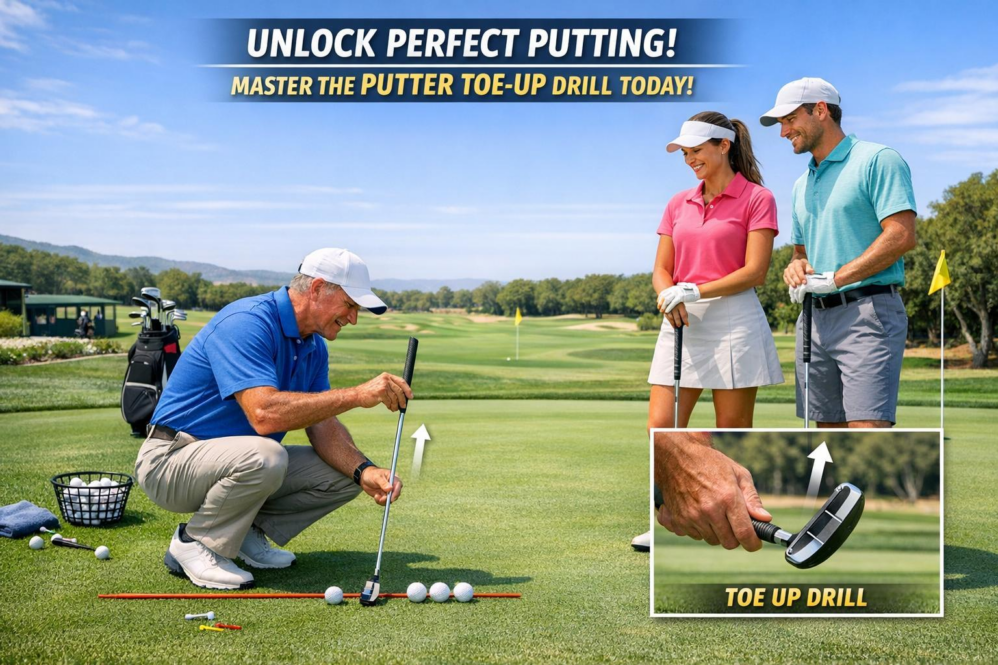
unlock Perfect Putting with the Putter toe-Up Drill Understanding the Science Behind the Toe-up Movement How to Practice the Toe-Up Drill for Consistent Stroke and Better Aim
Understanding the biomechanics behind the putter toe-up drill is essential for refining putting stroke consistency and precision. This drill emphasizes the controlled rotation of the forearms, resulting in the putter toe moving upward through the backswing and downswing, which promotes a naturally square clubface at impact. Maintaining a slight wrist hinge ensures that the putter head does not flare open or close, thus preventing common errors such as toe hanging or a scooping motion. The ideal toe-up angle reaches approximately 45 degrees at the top of the backswing, allowing for optimal leverage and momentum.For golfers aiming to master this movement, understanding that the forearm rotation-not wrist breakdown-drives the toe-up motion is key to achieving a consistent, pendulum-like stroke that results in true roll and improved distance control.
To practice the toe-up drill effectively,start by adopting your normal putting stance with feet shoulder-width apart and a slightly forward ball position to promote a downward strike. Using a mirror or video feedback, focus on the forearm rotation that causes the putter toe to lift upward during the backswing. Incorporate drills such as slow-motion toe-up swings that exaggerate the toe lift, allowing you to feel the correct motion without accelerating prematurely. Additionally, practice strokes from 3 to 10 feet help ingrain a rythm where the putter head remains on plane. Key setup checkpoints include a relaxed grip pressure to avoid tension, eyes positioned directly over the ball for better alignment, and ensuring the putter shaft stays slightly forward throughout the stroke. Regularly integrating this drill into your practice routine can lead to measurable improvements in both stroke consistency and putting accuracy, especially on fast or undulating greens where face control is paramount.
Applying the insights gained from the toe-up drill in on-course scenarios can considerably enhance your scoring potential. When faced with breaks or subtle slopes, the naturally square clubface resulting from a toe-up motion allows for more predictable ball roll paths, enabling you to better judge line and speed. Moreover, this technique complements strategic green reading by combining visual alignment with a biomechanically sound stroke. For example, on slower greens or in slippery conditions, maintaining a smooth toe-up pattern helps produce a cleaner, more controlled strike, reducing skidding and enhancing distance control. for advanced players, tailoring the toe-up drill by adjusting the tempo or stroke length can fine-tune feel and responsiveness, while beginners benefit from the clear, replicable movement pattern. By incorporating this drill into your short game regimen, you create a foundation for confident putting that supports lower scores and enhanced course management.