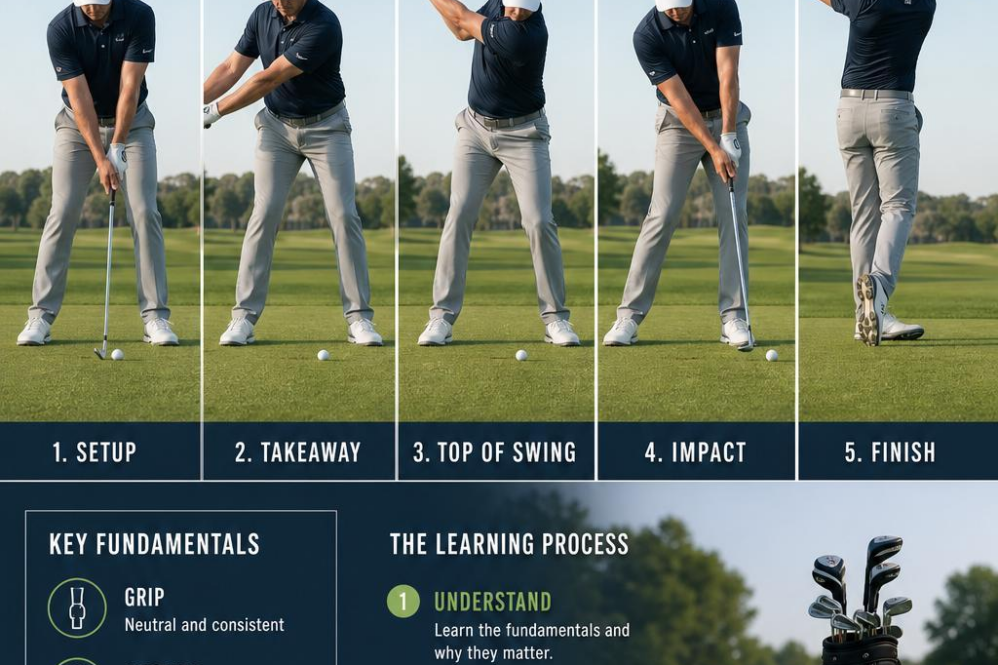
Unlock the Secrets to a Powerful and Consistent Swing
Developing a powerful and consistent golf swing begins with mastering the fundamentals of setup and biomechanics. Start by establishing a balanced stance with feet shoulder-width apart and a slight knee flex to promote stability throughout the swing. Optimal posture involves a spine tilt of approximately 30 degrees forward with a relaxed but firm grip pressure, commonly around 5-6/10 on the grip tension scale, ensuring fluid wrist hinge without tension. From here, focus on initiating the backswing with a smooth rotation of the shoulders around a stable spine angle, maintaining a shallow swing plane near 45 degrees to maximize clubhead speed and control. Effective rotation creates torque that translates into power at impact, so emphasize a synchronized coil of the hips and shoulders while keeping the head steady-taking care to avoid common errors such as an early sway or over-the-top move, which frequently result in slices or pulls. Padraig Harrington’s approach to the swing underscores the importance of a wider arc and purposeful tempo, encouraging golfers of all levels to use a two-count rhythm (“1-2”) in the takeaway followed by a gradual acceleration through impact to increase consistency and distance without sacrificing accuracy.
Building on these technical foundations, extensive improvement also involves intentional practice drills and on-course strategy that integrate swing mechanics with situational awareness. For developing repeatability, use a “pause-and-go” drill-pause for one second at the top of your backswing before initiating downswing-to cultivate better timing and control. Another valuable exercise is the impact bag drill, which reinforces correct wrist positioning and solid contact by simulating the compression zone at impact. Measuring progress can be aided by video analysis or launch monitor data, focusing on key metrics like clubhead speed, attack angle (ideal around 3 to 5 degrees for irons), and dynamic loft. Moreover, adapting your swing to real course conditions, such as adjusting ball position and club choice in windy situations or slower greens, can dramatically influence shot outcome. Harrington’s emphasis on integrating mental resilience with technical skills reminds golfers to stay present, managing pressure by focusing on process goals like a smooth takeaway rather than fixating on score. Whether you’re a beginner establishing muscle memory or a low handicapper honing precision, consistently applying these biomechanical insights paired with strategic practice fosters enduring improvements in swing power, accuracy, and overall scoring potential.
Master the Art of Putting with Padraig’s Proven Techniques
To excel in putting,Padraig Harrington emphasizes the critical role of consistent setup fundamentals and stroke mechanics. Begin by ensuring your eyes are directly over or just inside the ball line, promoting accurate visualization of the target line. Harrington advocates a slightly open clubface paired with a square stance to encourage a smooth, pendulum-like stroke. Maintaining a steady lower body during the stroke is essential to avoid lateral movement that disrupts contact quality. Implement a practice routine focusing on the 1:1 tempo ratio-where the backswing and follow-through durations are equal-to foster rhythm and control. Incorporate drills such as the “gate drill,” positioning tees on either side of the path to train the putter head to swing straight, and the “ladder drill” to develop distance control by progressively putting to targets placed at increasing increments of 3, 6, and 9 feet. these corrective techniques help identify and eliminate common mistakes like deceleration through the ball or excessive wrist breakdown, which can lead to inconsistent speed and direction.
Beyond the mechanics,Harrington’s course management insights reveal how strategic thinking elevates putting performance under varying course conditions. For example,on greens with a subtle green slope of 2-3%,he stresses reading the grain texture and using peripheral reference points to judge breaks accurately. Adjusting your aim point a few inches downhill or uphill, depending on green speed measured with a Stimp meter reading between 8-11 feet, can markedly improve hole-outs. Harrington also encourages tailoring your routine to weather influences-recognizing that wind or rain subtly affects ball roll and pace. For golfers of all levels, adopting the “three-putt avoidance” mindset-prioritizing lagging long putts close rather than aggressive attempts at the hole-can decrease scores significantly. Combine this with mental strategies like pre-putt visualization and deep breathing for calm focus. By integrating these nuanced technical adjustments and practical on-course decision-making tips,players gain a comprehensive skillset that transforms putting from a guessing game to a controlled,repeatable art form.
Transform Your Practice Routine to Build Confidence on the Green
Building confidence on the green starts with a deliberate and focused practice routine that hones both your stroke mechanics and your ability to read subtle breaks and slopes. Begin by setting up with a consistent posture-feet shoulder-width apart, eyes positioned directly over the ball, and a slight forward tilt at the hips. Padraig Harrington emphasizes the importance of maintaining a steady head position and a pendulum-like stroke to improve distance control and accuracy. Incorporate drills like the “clock drill,” where you practice short putts around the hole from 3, 6, 9, and 12 o’clock positions to develop a repeatable stroke path. Work progressively from three feet out to ten feet, aiming to make at least 80% of putts from each distance. This approach not only master your stroke but also builds essential muscle memory that can withstand the pressure of on-course situations. Adjust your grip pressure so it’s firm but relaxed-too tight and you risk tension that disrupts the smooth tempo of the putt, too lose and control is compromised.
Enhancing green confidence also requires integrating course management tactics that allow you to read greens like a pro and select the optimal line. Harrington’s insight into green reading includes visualizing the putt from behind the hole to see the overall slope and identifying the “fall line” where the ball naturally wants to roll downhill. Utilize practice sessions to simulate different green speeds-particularly if you commonly face slower or grainier courses in your region-by adjusting your backswing length and tempo accordingly. Additionally, leverage drills that incorporate alignment aids, such as putting with a chalk line or laser guide, to reinforce proper aim and stroke path. Don’t overlook the mental game: practice “routine blocks” where you rehearse your pre-putt routine to build confidence and reduce anxiety-this includes checking your stance, re-confirming the line, and rehearsing your stroke. Transitioning these habits onto the course will help you read varied terrains, adjust for wind conditions, and confidently execute each putt, ultimately lowering your scores and turning pressure-filled moments into scoring opportunities.
Discover Mental Strategies to Stay Focused and Calm Under Pressure
Mastering the mental game is as crucial as refining the physical swing when confronting high-pressure situations on the golf course. Drawing from insights shared by Padraig Harrington, one of golf’s most disciplined competitors, mental resilience begins with controlled breathing techniques and pre-shot routines designed to maintain focus and calm. Before addressing the ball, take a deep breath and visualize the intended shot shape and target landing zone; this visualization anchors your mind and mitigates distractions.Maintain a consistent tempo in your swing by aligning your breath with your backswing and downswing, which inherently slows rushed movements.When facing challenging greens or tight fairways, breaking down the shot into smaller components-club selection, alignment, swing length-helps keep attention on process over outcome. For beginners, practicing slow, rhythmic swings under timed breathing drills can ingrain calm mechanics, while experienced players can experiment with pre-shot cues and trigger words that bolster confidence under tournament stress.
Effective mental strategies intertwine seamlessly with course management and technique adjustments to reduce unneeded pressure on each stroke. Harrington emphasizes a keen awareness of situational variables such as wind direction, green firmness, and pin placement to inform smarter shot choices rather than purely relying on maximum distance or aggressive shot shapes. As a notable example, on a breezy day, opting for a lower trajectory shot with a three-quarter swing can enhance control by minimizing ball spin and responsiveness to gusts. practicing diverse shot shapes-fade, draw, flop shots-in controlled environments also equips golfers to adapt fluidly when the moment demands creativity and precision. To reinforce these skills, incorporate drills that simulate pressure scenarios, such as “must-make” putt challenges or committing to a target line with no mulligans during practice rounds. This holistic approach not only improves technical execution but cultivates an adaptive mindset, empowering golfers across all skill levels to stay composed, make strategic decisions confidently, and ultimately lower their stroke average.