Understanding the Fundamentals of Johnny Miller’s Swing Technique
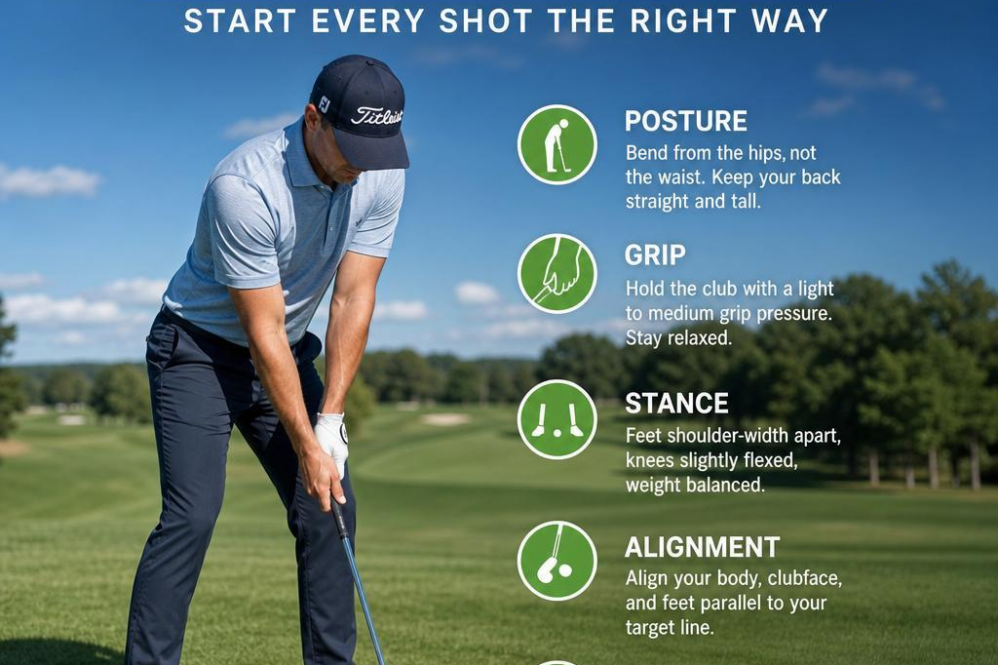
Mastering Johnny Miller’s swing technique begins with a solid foundation in setup and alignment, crucial for consistent ball striking. Miller emphasizes maintaining a neutral grip and a balanced posture, where the golfer’s spine angle tilts slightly forward, promoting a natural hinge through the backswing. His instruction advocates for a clubface square to the target line at address,which sets the stage for delivering the clubhead on an optimal inside-out path. Golfers should focus on initiating the takeaway smoothly, allowing the arms and shoulders to move in unison while keeping the clubhead low to the ground in the early portion of the swing. An effective drill to internalize this is the “pause at waist height” practice, where players halt the club halfway back momentarily, ensuring the shaft remains parallel to the target line and fully connected to the body’s rotation.This helps eliminate common faults like casting or an overactive hands release. Incorporating a defined 45-degree wrist hinge and maintaining a controlled, rhythmic tempo aid in generating consistent lag, which is vital for maximizing clubhead speed and accuracy.
Building upon these fundamentals, Miller’s approach integrates practical course management principles that influence how golfers tailor their swing to varying conditions. For instance,in windy play or firm fairways,he recommends adjusting ball position slightly back in stance to promote a downward strike,reducing spin and increasing control. On the practice range, golfers can use the “gate drill” to refine club path, placing tees just outside the toe and heel of the clubhead to prevent excessive slicing or hooking. From a mental standpoint,Miller encourages players to engage in strategic shot planning,assessing hazards,wind direction,and pin placement before committing to a shot shape or club choice. this mindset reinforces the physical technique by aligning execution with situational awareness, helping players lower scores through smarter decisions rather than just brute power. By consistently applying these swing mechanics alongside thoughtful course strategies, golfers at any level can expect measurable improvements such as tighter dispersion, increased greens in regulationand enhanced scoring consistency under pressure.
How Johnny Miller Tailors Lessons to Fit Every Skill Level
Johnny Miller emphasizes a tailored approach by first establishing solid setup fundamentals that serve as the cornerstone for every skill level. For beginners, he focuses on a balanced stance with feet shoulder-width apart and a slight knee flex, combined with a clubface alignment square to the target. This ensures consistent ball striking and builds confidence from the ground up. As players advance, Miller introduces refined elements like adjusting the shaft lean to enhance launch angle and optimal wrist hinge angles-typically around 90 degrees at the top of the backswing-to maximize clubhead speed and control. Importantly, he addresses common faults such as coming over the top or casting the club early, offering corrective drills like the “pump drill” to promote proper sequencing and synchronization of the lower and upper body. Incorporating these technical nuances across various practice routines encourages repeatable swings while integrating real-course scenarios, such as adapting shot shape and trajectory to wind conditions or tight fairways, making each lesson feel highly relevant and actionable.
to complement technical skill development, Miller integrates strategic course management and short game mastery tailored to each golfer’s ability. He encourages novices to focus on fundamental chipping techniques, stressing a narrow stance with minimal wrist breakdown and a controlled, pendulum-like stroke to consistently land the ball softly near the hole. For low handicappers, he expands on advanced tactics like manipulating spin by varying clubface loft and adjusting attack angles to negotiate different grass types and slopes encountered on the greens. Additionally, Miller trains golfers to read and respond to situational factors-such as wind shifts, pin placementsand recovery shots from sand bunkers-by practicing targeted drills like trajectory control with partial wedges or controlled punch shots. Across levels, he recommends maintaining an adjustable pre-shot routine to cultivate mental focus, which complements technical execution and enhances course strategy, ultimately leading to measurable scoring improvements and a more enjoyable, confident golf experience.
Breaking Down Common Swing mistakes and How to Fix them
Consistently delivering a powerful and accurate golf swing requires attention to fundamental mechanics and thoughtful corrections of common errors. One prevalent mistake is an inconsistent clubface angle at impact, frequently enough caused by improper wrist hinge or over-rotation through the ball. To address this, golfers should focus on achieving a square clubface by maintaining a steady lead wrist angle through the downswing-ideally close to 10° of dorsiflexion. A practical drill involves practicing half-swings with alignment sticks placed just outside the target line,helping to develop a feel for a neutral face.Additionally, golfers must balance their weight correctly; a shift of approximately 60% of body weight onto the lead foot at impact fosters proper sequencing and power transfer.Johnny Miller’s teaching highlights the advantage of a smooth transition from the top of the swing, avoiding excessive force that leads to swing flaws like casting or early release.By integrating drills focusing on tempo and controlled hip rotation, players reinforce a reliable swing path and improve ball contact consistency. Emphasizing setup fundamentals such as proper ball position-generally centered for irons and forward in stance for drivers-also prevents common mishits like hooks or slices, enhancing overall shot accuracy and distance control.
Beyond mechanics, effective course management and mental planning are essential to applying swing improvements under pressure. When addressing short game contexts,as an example,golfers should practice controlled thrusts for chips and embedded pitches,where controlling clubface loft and attack angle impacts trajectory and spin. For putting and driving, tailored practice drills featuring measurable metrics like putts per round or average driving accuracy can guide focused betterment efforts. Incorporating level-specific routines-including weighted club swings or tempo trainers for advanced players-helps refine fine motor skills and reinforce muscle memory. On course, understanding situational variables such as wind direction or green speed enables strategic adjustments aligning with technical strengths, reducing risk and saving strokes. Importantly, adopting Johnny Miller’s advocacy for pre-shot routines promotes consistency, composureand confidence. together, these elements form a holistic approach where biomechanical precision, equipment setupand mental strategies unite, empowering golfers of all abilities to master their swing, optimize puttingand maximize driving effectiveness for better scoring and confidence on every round.
Incorporating johnny Miller’s Drills into Your Practice Routine for Lasting Improvement
integrating Johnny Miller’s teaching drills into your practice regimen begins with mastering the fundamentals of his swing mechanics, which emphasize consistent impact and clubface control. Start by focusing on Miller’s recommended setup checkpoints: maintain a shaft lean of about 5 degrees forward at address to promote a descending blow, essential for crisp ball striking. Employ the “impact bag drill” to ingrain this feel-place a padded bag or cushion where the ball would normally be and practice swinging to a firm, balanced finish with your hands ahead of the clubhead at impact. This drill helps develop the correct low point and eliminates common mishits caused by flipping or scooping the club.Gradually incorporate alignment rods during your setup to ensure your feet,hips,and shoulders are square or slightly open relative to the target line,a subtle adjustment Miller advocates to facilitate accurate ball flight. Consistency in these setup fundamentals not only builds muscle memory but also creates a reliable foundation that unlocks more advanced techniques in your swing progression.
Once the full swing mechanics are ingrained,transition Miller’s approach to the short game,where precision and touch dictate scoring success. His stop-and-go putting drill is a powerful exercise for controlling distance and rhythm-practice stroking the ball to a target circle at varying lengths, focusing on accelerating through impact and halting the follow-through to gauge pace effectively. This cultivates the feel necessary for lag putting, especially on undulating greens where speed control is paramount. For chip shots, mimic Miller’s technique of setting up with a narrow stance, weight favoring the front foot at 60/40 distribution, and using a slightly open clubface to create consistent loft and spin. Integrate course management strategies into your practice by simulating up-and-down scenarios from different lies and grass types, such as tight fairway lies or thick rough, to prepare mentally and physically for real tournament pressure. By consistently rehearsing these targeted drills, golfers of all levels can achieve tangible improvements in stroke consistency, approach precisionand ultimately, lower scores on any course.