Unlock the Fundamentals of a Smooth and Powerful Golf Swing
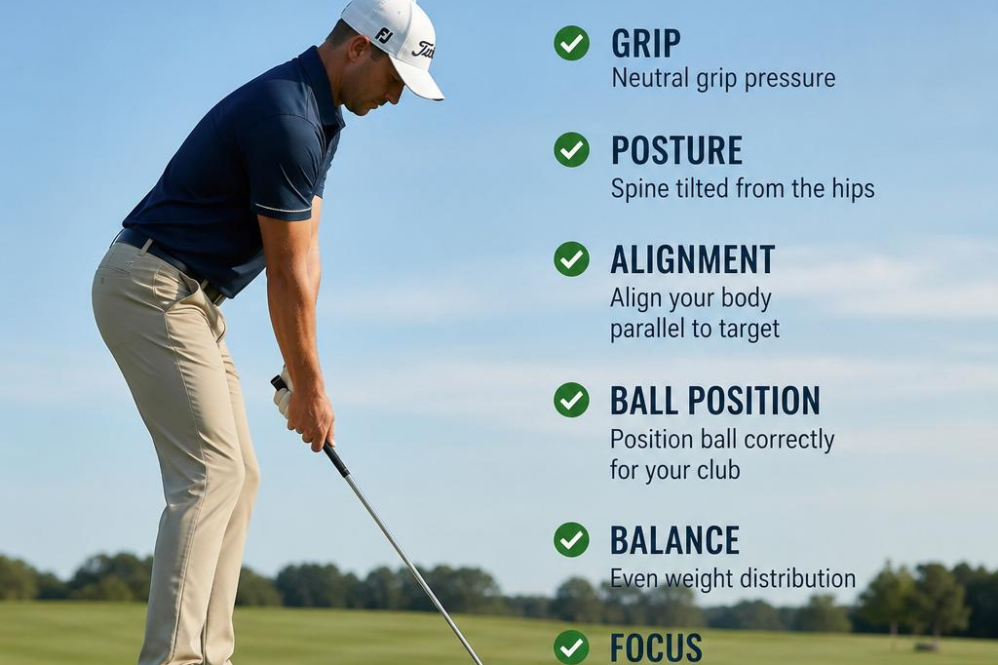
developing a smooth and powerful golf swing begins with establishing a solid setup and understanding key biomechanics. Start with your stance width-generally shoulder-width apart-to ensure balance and stability throughout the swing. your grip pressure shoudl be firm yet relaxed, allowing for natural wrist hinge without tension. Align your body parallel to the target line, with the ball positioned just inside the lead heel for full irons and a slightly more forward position for drivers to optimize launch angle. Cary Middlecoff emphasized the importance of a fluid takeaway, encouraging golfers to initiate the backswing with a one-piece shoulder turn, maintaining the clubhead low to the ground for the first few feet. This encourages a proper swing plane and helps generate lag, which is critical for power. Incorporate drills such as the “Pause at Halfway” backswing to build muscle memory and enhance control. By focusing on these fundamentals, golfers can avoid common errors like casting or over-the-top swings that dissipate energy and reduce accuracy.
To transfer technical improvements into real-course success, integrate strategic shot shaping and adaptable game plans. For example, understanding when to manipulate trajectory by adjusting ball position or clubface angle can navigate windy conditions or uneven lies effectively. Practice routines should include targeted drills like the “Gate Drill” for path correction and “Step-through” exercises to promote weight shift and balance. for short game refinement, especially putting, understand green reading principles coupled with solid stroke mechanics-maintaining a smooth pendulum motion with minimal wrist breakdown. Cary Middlecoff’s lessons highlight the importance of tempo consistency, which can be practiced with metronome timing or counting rhythms. By combining these biomechanical and strategic elements, both beginner and advanced players can create measurable improvements in swing efficiency and lower scoring, while cultivating confidence during pressure situations on the course.
Discover Cary Middlecoff’s Proven Techniques for Precise and Confident Putting
Begin your putting mastery by focusing on Cary Middlecoff’s methodical setup routine, which forms the cornerstone of precise and confident strokes. Start by aligning your eyes directly over the ball, a critical setup detail that enhances depth perception and reduces misreads of the green’s slope. Middlecoff emphasized a shoulder-width stance to establish balance while keeping the putter face square to the intended line.incorporate a subtle forward press with your hands to promote a smooth, pendulum-like stroke driven primarily by the shoulders rather than the wrists, thereby minimizing unwanted wrist breakdowns that cause inconsistent contact and direction. Experiment with a putter face angle of zero degrees at address and maintain this through impact to optimize roll and reduce skidding. For beginners, practice this alignment routine using chalk or string lines on flat surfaces to train visual accuracy, while advanced players should integrate subtle arc strokes where the putter path gently moves inside to inside, matching their natural biomechanics for enhanced feel.
Building on setup, Middlecoff’s putting beliefs intertwines technical skill with strategic green reading and mental focus, essential for navigating varied course conditions. Use his technique of reading breaks by walking around the putt’s perimeter and observing the grass grain, slope, and moisture, which influence ball speed and break severity. Pay attention to external factors such as wind direction and green firmness-especially on fast greens where a higher ball roll speed demands exact distance control. Integrate drills that simulate pressured situations, like the “three-putt avoidance” challenge: place tees one, threeand five feet from the hole and practice holing out consistently under timed conditions. Middlecoff also advocated for mental rehearsal; visualize triumphant putts to reinforce confidence and reduce anxiety. For mid- to low-handicap players, refining your lag putting by controlling backswing length relative to the distance (for example, a backswing arc of roughly 45 degrees for a 20-foot putt) can dramatically lower stroke count. by systematically combining setup precision, environmental readingand mental resilience, golfers can transform their short game from tentative to unshakably confident, echoing Middlecoff’s legacy of profound putting excellence.
Master Driving Distance and Accuracy with Expert Tips from Cary Middlecoff
Increasing driving distance without sacrificing accuracy begins with mastering your setup fundamentals and swing mechanics-elements Cary Middlecoff highlights as critical to translating power into controlled ball flight. Start by ensuring your stance width is about shoulder-width apart to promote balance and stability. Align the ball slightly forward in your stance, approximately off the inside of your left heel for right-handed golfers, to encourage a sweeping, upward strike that maximizes launch angle and reduces spin. Middlecoff advocates focusing on a smooth transition from backswing to downswing, emphasizing a shallow angle of attack around 3 to 5 degrees upward to optimize driving carry distance. Incorporating a gradual hip turn with a firm but not rigid lead wrist encourages consistent clubface square at impact, which is essential for accuracy. Practicing with a launch monitor can definitely help you target the ideal spin rate-around 2500 to 3000 rpm for most drivers-and an initial ball speed above 150 mph for longer drives. Drills such as “tee height variation” and “pause at the top” cultivate timing and sequencing, crucial to controlling swing tempo and driving dispersion under pressure.
Beyond mechanics,Middlecoff insists on integrating strategic course management to maximize effective driving outcomes. Assess the hole layout, wind direction, and fairway width before every tee shot-decisions that separate skilled golfers from high handicappers. For instance, when facing a tight dogleg or wind that favors a fade, deliberately opening the clubface slightly and adjusting your feet alignment can produce a predictable shot shape fitting the hole’s demands. Employing a “target circle” visualization drill helps refine alignment and enhances shot confidence. Additionally, cary recommends blending power with precision through controlled practice sessions focusing on different tee heights, ball positionsand grip pressures to simulate varied on-course conditions. Regularly tracking fairways hit percentage alongside driving distance builds measurable goals you can improve. Lastly,remember that savvy driving is not about sheer distance but consistent,repeatable accuracy that sets up easier approach shots,lowers score potential,and heightens mental resilience. By applying these principles and drills within your routine, players at any level can expect tangible improvements both technically and strategically.
Transform Your Game with Practical Drills and Personalized Practice Strategies
Enhancing your golf swing begins with mastering the fundamentals of setup and biomechanics. Start by ensuring a balanced stance with your feet shoulder-width apart and knees slightly flexed, promoting stability through the motion. Focus on maintaining a 15-degree forward tilt from the hips, which aligns the spine angle optimally for consistent ball striking. During the takeaway, initiate a smooth, one-piece movement by rotating your shoulders directly around your spine, avoiding excessive wrist breakdown to preserve clubface control. A crucial checkpoint is the top of the backswing, where your lead arm should be nearly straight and the club shaft approximately parallel to the ground and pointing toward the target line.Incorporate drills such as slow-motion swings with video feedback or alignment sticks to reinforce proper swing plane and arm extension. Addressing common errors like early casting or an overactive lower body can be achieved through focused weight transfer exercises that encourage shifting pressure onto the lead foot during the downswing, thus maximizing power and accuracy.
when transitioning to the short game and course management, practical drills play a vital role in honing precision and strategy.For putting, practice controlling distance with drills such as the “ladder drill,” which uses incremental targets at 3, 6and 9 feet to develop consistent stroke length and speed control under varying green speeds.Integrate Cary Middlecoff’s insight to visualize each putt as a two-part task: line reading followed by stroke execution-this helps golfers anticipate break and pace rather than relying solely on feel. For driving and longer approach shots,leverage course management techniques by assessing wind direction,hazards,and pin placement during practice rounds. Use pre-shot routine drills to develop mental resilience and routine consistency, focusing on a calm, rhythmic tempo measured at approximately 60-70% of maximum swing speed to balance power and control. Equipment considerations such as optimizing your driver’s loft and shaft flex based on swing speed can further refine trajectory and distance.Implementing these tailored practice strategies will help golfers of all levels build confidence, lower scoresand enjoy measurable improvement on diverse course conditions.