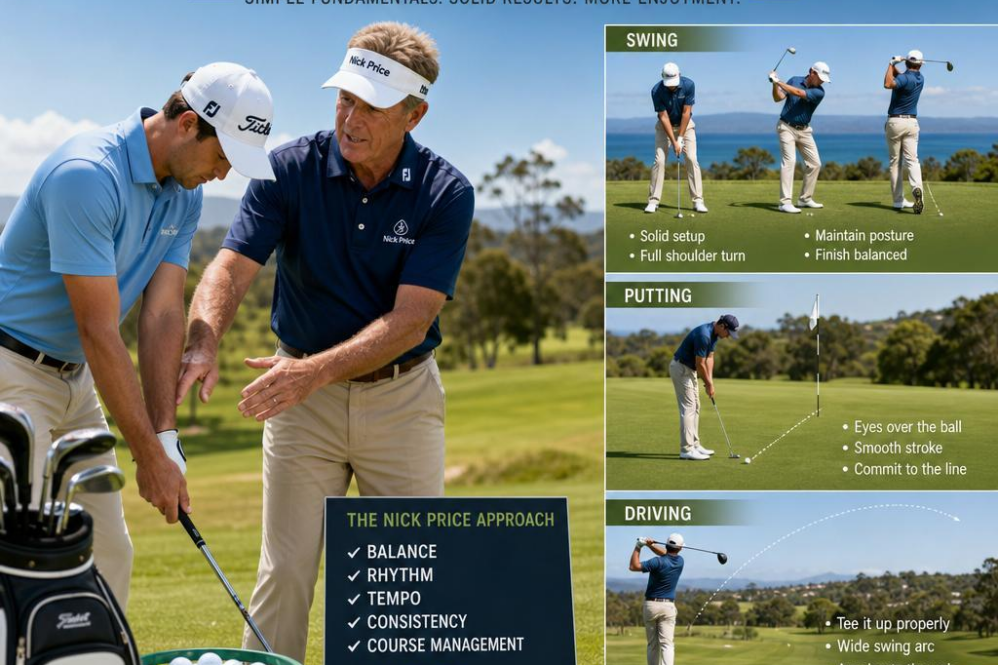
Mastering Nick Price’s swing Mechanics for Consistent Power and Accuracy
To build consistent power and accuracy like Nick Price, start with a focus on basic swing mechanics. Price’s swing is renowned for it’s smooth tempo and solid sequencing,characterized by a controlled backswing reaching approximately 90 degrees of shoulder turn while maintaining a stable lower body. This limited turn helps create an efficient transfer of energy from the ground up. Golfers should emphasize keeping the arms and club on plane throughout the takeaway and into the transition, preventing early casting or overswinging-common faults that reduce clubhead speed and precision. A practical drill is the “pause at the top” swing, where you momentarily hold your position at the transition to build body awareness before initiating the downswing. This cultivates the proper sequencing of hips leading the downswing, followed by torso rotation and releasing the clubhead through impact, essential for maximizing both accuracy and distance.
Short game refinement is another cornerstone of Price’s approach, critical for translating technical mastery into lower scores. His chipping and pitching techniques prioritize a controlled, rhythmic stroke with firm wrists and a consistent low point just ahead of the ball to ensure clean contact. Beginners should focus on setup fundamentals: weight slightly favoring the front foot, hands ahead of the ball at address, and an open clubface for loft adjustment. Advanced players can incorporate drills like the “landing spot” exercise, which involves aiming for a precise target area on the green to improve trajectory control and spin. These practices help golfers adapt to varying course conditions, be it tight pins on fast greens or uphill chips, empowering smart shot selection that minimizes scrambling. Remember,flawless swing mechanics combined with reliable short game strokes translate to fewer penalty strokes and enhanced scoring potential.
Effective course management is the strategic lens through which Price’s swing mastery materializes into tangible results. Beyond technical skill, choosing the right club and shot shape for each situation is crucial-something Price excelled at by reading wind, green slopesand hazards meticulously. A key takeaway is the importance of conservative aggression: identify high-percentage plays that reduce risks but still position you for scoring opportunities. For instance,instead of tackling a narrow fairway over water,consider a 3-wood or long iron layup to keep the ball in play and set up an easier approach. Practice routines should integrate simulated course scenarios where golfers plan shot sequences mentally before execution, enhancing decision-making under pressure.By connecting swing mechanics with strategic play, golfers not only improve ball striking but also develop a trusting mental game that combats course challenges and fluctuating weather conditions effectively.
Unlocking the Secrets Behind Nick Price’s Strategic Driving Approach
Building a strategic driving approach starts with consistent setup fundamentals that Nick price champions. Begin by aligning your feet, hipsand shoulders parallel to the target line, using a club or alignment stick during practice to reinforce this critical habit. Price emphasizes a slightly wider stance than your regular iron shots - roughly 1.5 to 2 times shoulder width – to stabilize your base for powerful, controlled swings. Maintaining a shallow tee height that allows the driver’s clubface to strike the ball just below its center helps promote a sweeping angle of attack, optimizing launch conditions. Focus on positioning the ball just inside your front heel to encourage a natural upward strike, maximizing carry distance without sacrificing accuracy. These setup elements serve as a foundation for consistent shot execution, which is crucial when navigating varying course layouts and wind conditions.
Once the setup is dialed in, refining your swing mechanics should center around generating smooth, repeatable tempo-Nick Price’s hallmark. Instead of trying to force extra distance with aggressive swings,aim for a rhythm that integrates gradual coil of the upper body along with minimal lateral hip sway. Price teaches golfers to initiate the downswing with a deliberate shift of weight from the back foot to the front foot while maintaining an extended arm structure through impact. This method helps maintain clubhead lag and encourages a square clubface at contact, reducing common mishits such as hooks and slices. For actionable improvement, practice drills like the “pause at the top” or “step-through drills” can develop better sequencing and balance. Pay close attention to the angle of attack; a slight upward path of 2 to 4 degrees will not only increase carry but also help the ball launch higher with optimal spin rates, a key for maximizing distance on tight or elevated tee shots.
Integrating clever course management elevates driving from mere power to strategic advantage. Price advises golfers to assess the risk-reward ratio for every tee shot by factoring in hazards, fairway widthand prevailing wind-a concept beginners frequently enough overlook. For example, on narrower fairways, prioritizing accuracy over distance by employing a three-quarter swing or opting for a 3-wood off the tee might yield more consistent scoring opportunities. He encourages visualizing target zones rather than pin-point aiming to accommodate slight ball flight variations. Additionally, practicing shot shaping techniques such as controlled fades and draws broadens your tactical toolkit for adjusting to different hole layouts and pin placements. Incorporate situational drills like alternating shot shapes or practicing drives with simulated wind using fans to prepare for varying conditions. Ultimately, coupling technical execution with foresight ensures every drive serves your scoring goals, transforming approach shots into manageable opportunities for pars and birdies alike.
Putting Like a Pro with Nick Price’s Step-by-Step Systematic Techniques
Mastering the art of putting starts with a consistent and well-balanced setup that Nick Price emphasizes as foundational to his step-by-step system. Begin by positioning your feet shoulder-width apart, ensuring your weight is evenly distributed, typically favoring a slight 55/45 split towards your lead foot to enhance stability. Your eyes should be directly over or just inside the ball line to improve depth perception, an angle that Nick highlights as crucial for accurate green reading. The putter face must be square to the target line at address, with the grip held lightly yet firmly to promote smooth acceleration through impact. This setup not only cultivates repeatability but also encourages a pendulum-like stroke, reducing wrist breakdown and fostering precise distance control. Practicing these fundamentals regularly,using alignment aids or chalk lines on the practice green,helps ingrain muscle memory,crucial for consistent execution under pressure.
Improving stroke mechanics is the next critical step where nick Price’s insights shine, notably in mastering the rhythm and release of the putter through the ball. Focus on a smooth backswing of approximately 12 to 18 inches, depending on distance, with the takeaway initiated by the shoulders-not the hands-to maintain a one-piece stroke. The follow-through should mirror the backswing in length and tempo, promoting a square impact and optimal roll. To refine this technique, incorporate drills such as the “gate drill” using tees to ensure the putter’s path remains straightand the “clock drill” to develop a consistent stroke arc at varying distances. Nick also advocates reading subtle green breaks by observing the grain direction and slope, adjusting aim accordingly rather than merely relying on visual line alone. This tactical approach can decrease your average putting strokes by enhancing both pace and directional control.
Lastly, integrating mental strategy and situational awareness elevates your putting from mechanical execution to confident course management. Nick Price encourages players to focus intently on the targeted rollout area beyond the hole, aiming to control the ball’s pace so it either drops in or stops just past the cup without aggressive braking, which can reduce three-putts. Adjust your strategy based on green conditions; such as, on faster greens, reduce the backswing length and emphasize softer contact to prevent overshooting. Incorporate pre-putt routines to establish focus and calm nerves, such as deep breathing or visualization techniques pioneered by many low handicappers. whether faced with a short, downhill putt or a lengthy, breaking one, use these mental tactics combined with mechanical consistency to make sound decisions. By systematically applying these integrated technical and psychological skills from Nick price’s teachings, golfers at all levels can substantially enhance their proficiency, lower scoresand enjoy greater confidence on the greens.