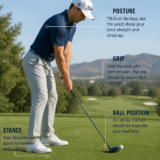

Mastering Sir Nick Faldo’s golf swing can substantially improve your game. Faldo’s success is rooted in his meticulous approach and precision, which are valuable lessons for golfers of all levels. A proper setup is the first step towards emulating Faldo’s form on the course. Position the ball correctly based on the club you’re using, and grip the club in your fingers rather than your palms, ensuring a firm but relaxed hold. For beginners, focusing on setting up square to the intended target line and understanding the basic angles of your address position can make a meaningful difference.
Once you’re set up correctly, pay attention to the backswing. Keep your hands and wrists in sync with your body’s rotation, aiming to reach 90 degrees with your right elbow (left-handed players, reverse this) when the club is parallel to the ground. Avoid lifting your shoulders too high, as this reduces power.A common mistake is over-swinging, which can lead to fatigue and inconsistency. Keep it smooth and compact, maintaining arm-to-body angle at the top of your backswing and focus on transitioning into the downswing efficiently.
During the downswing, maintain the relationship between your arms and body by allowing your hips to lead, followed by your shoulders, armsand club. A smooth transition from top to bottom is critical, as this sequence ensures a powerful hit without overstraining your muscles. One of Faldo’s key insights is to focus on striking the ball near the inside of the swing path. This means aiming to impact the ball from the inside of your desired swing plane, ensuring a solid strike and maximum transfer of energy.
Practicing on the course, especially on greens and in bunkers, is essential for rounding out your game.For chipping and pitching, Faldo suggests visualizing the perfect shot and then focusing on making small adjustments based on the lie and turf conditions. For those in the sand, Faldo’s technique emphasizes a shallow entry angle to avoid deep ruts and maintain control over your shot direction and spin.Incorporating these elements, especially in course-specific settings, helps fine-tune your skills and ensures they are adaptable to various situations. Remember, improving your swing doesn’t just make you a better player; it also enhances your enjoyment of the game by delivering consistent results and lower scores.
From Drive to Green: Master the Art of Faldo’s Complete Swing
Mastering Faldo’s complete golf swing is about more than just copying his mechanics. His meticulous approach and precision are instructive to golfers at every level. A proper setup is the first step towards emulating Faldo’s form on the course. Position the ball correctly based on the club you’re usingand grip the club in your fingers rather than your palms, ensuring a firm but relaxed hold. For beginners, simply focusing on setting up square to the intended target line and understanding the basic angles of your address position can make a significant difference.
Once the setup is squared away, the focus shifts to the swing itself, particularly the critical backswing and downswing phases. Pay close attention to the angles of your arm and shoulder alignment during the backswing. As Faldo advises, think about reaching your peak hip rotation before shifting your weight to maximize the power you transfer to the ball. An essential tip is to maintain a stable head position during the swing, avoiding excessive movement that can disrupt your timing and consistency. Beginners can start by practicing the backswing and pause, taking slow-motion swings to feel the correct position before moving into the downswing.
The transition from backswing to downswing is frequently enough the most challenging part for golfers to get right. Faldo emphasizes the importance of a fluid transition to avoid any sudden jerks that could cause loss of balance or power. During this phase, focus on making a smooth, downward motion from your upper body to initiate the downswing, rather than just using your hands. Advanced players might benefit from experimenting with slightly adjusting the timing of leg drive and shoulder rotation to fine-tune their speed and club face alignment at impact. For beginners, repetitive practice with a focus on these aspects can lead to noticeable improvements in ball flight and consistency.
Moving beyond the technical execution of swings, Sir Nick Faldo’s approach to the game includes strategic planning and course management. Understanding the terrain, choosing the right club for the situationand predicting wind direction and weather conditions are all part of the game. On a course, consider the lay of the land and adjust your stance and swing accordingly. For instance, a right-to-left wind might necessitate a more open club face and a stance that caters to a right-handed approach. Whether you’re a beginner or a seasoned player, incorporating these strategic elements can elevate your game and help you lower your scores. By integrating Faldo’s wisdom into your practice sessions and rounds, you’ll be well on your way to developing a complete game that can handle any challenge the golf course throws at you.
Enhancing Distance and Accuracy Through Faldo’s Driven Approach
To enhance your golf game with the precision and distance of Sir Nick Faldo’s approach, we’ll dive into the detailed mechanics that make his shots so effective. Faldo’s success on and off the golf course is largely attributed to his understanding of the fundamentals. He emphasizes the importance of setup-proper stance, gripand alignment-before the actual swing begins. A critical aspect here is ensuring that your feet are grounded,your body aligned to the target line,and your clubface square to the target. This setup is crucial for both distance and accuracy,which are the twin pillars of a successful golf shot.
Once you’re set up correctly, focus on the transition phase of your swing. This is when the club moves from backswing to the downswing. A smooth and efficient transition leads to a powerful and accurate strike. Faldo recommends feeling the shift in your weight as you initiate the downswing. Imagine your hips rotating first, creating a chain reaction that involves your torso and arms, but most importantly, your club head connecting solidly with the ball at the bottom of your swing arc. This connection is vital for energy transfer and ultimately drives distance and accuracy. To practice this, try hitting balls into a small target about 30 yards away. Focus on making clean, centered strikes and paying attention to the rotation of your body as you deliver the club to the ball.
Beyond just execution, Faldo also emphasizes the importance of course management and shot selection. Understanding the nuances of where to aim depending on wind direction or slope requires a mental framework as much as it does physical skill. As an example, when facing a strong gust of wind coming from the side, Faldo suggests playing the wind instead of against it. Aim slightly left of your target (for right-handers), allowing the wind to push your ball toward the pin. This strategy not only helps in managing the elements but also keeps your shots in play, which is key for low scores. Practicing this approach on the driving range can significantly improve your adaptability on the course.
Faldo’s disciplined practice routine is something any golfer can learn from.He believes in the quality of practice over the quantity. Rather than hitting a hundred random shots, focus on a few specific drills that address your swing flaws or that help refine your technique. A useful drill involving a towel under your feet can aid in focusing your weight shifts and hip rotation, essential components for maximizing club speed. Place a towel between your feet during your backswing and hold it tightly during the downswing and follow-through. This drill ensures your weight is transferring correctly,a principle Faldo embodies in his swing for distance and accuracy. Incorporating these practice sessions into your routine will not only improve your physical game but also your mental approach.