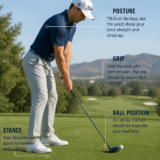

Finding Your Sweet Spot: Mastering the Perfect Swing Every Time
Mastering the perfect swing every time hinges on understanding and repeating the fundamentals that make a well-executed golf shot possible. Begin by ensuring your setup is correct, placing the ball in the ideal position for the club you are using. For most drivers, this means sitting the ball forward in your stance, slightly ahead of the middle. For shorter clubs like the pitching wedge, the ball should be about an inch back from the center.Using the right ball position is crucial, as it aligns your body and club face properly at impact. A common mistake among golfers is setting up too far back, which leads to an upward hitting trajectory that limits both distance and precision.
In terms of mechanics, focus on having a consistent angle between your lead arm and the club shaft during your backswing and downswing. This angle should remain nearly constant throughout, ensuring clubface alignment and consistent impact positions. Beginners often struggle with the transition from backswing to downswing, as the timing and flow are critical here. To improve, practice using a mirror to visualize the angle of your lead arm and the clubshaft at various points of your swing. This visual feedback is invaluable for beginners learning proper swing mechanics,while more advanced players can use this to fine-tune their setup and maintain a consistent swing path.
Transitioning to course management, the ability to adapt your swing based on the lie, wind directionand distance to the green is crucial for scoring. Imagine a scenario where you need to hit a high soft draw to land softly on an elevated green.To achieve this, start by adjusting your grip to ensure the club face is slightly open at address. Your stance should be wider than usual to aid in generating torque and controlling direction. Incorporate a smooth backswing with a slightly more open shoulder rotation to prepare for a more pronounced downswing. At the transition point, your hands should lead the clubhead, initiating a powerful follow-through aimed to the left of your target (for a right-handed player). The goal here is to create spin for better control and touch upon landing.
Practicing different swing adjustments on the range can help solidify these principles. Start with an alignment stick in the ground to represent your target and gradually increase the distance and complexity of your shots. For example, move to a downhill lie and practice your high draws, then transition to a narrow fairway and focus on hitting straight shots with precision. The key is repetition to build muscle memory and confidence. A good drill to enhance this adaptation is the Baby Powder Low Point Drill, which helps you control your divot and improve your swing’s low point consistency.Placing baby powder on the ground and ensuring your club brushes it after hitting the ball trains you to understand and replicate the right impact position over and over again.
linking your mental state to physical execution is critical for mastering the perfect swing every time. Trust your setup and practice routine to establish a pre-shot routine that cues you into your best swing mechanics. Take a deep breath, visualize the shotand execute with confidence. This mental clarity can override physical mishaps,such as flinching or rushing your swing. Whether on the range or during a round, maintaining focus and patience is as vital as technical practice. Keep your goals realistic and incremental. For instance, a low-handicapper might aim to hit 90% of greens in regulation in a round, while a beginner might strive to hit more fairways in a series of practice rounds. By aligning your mental approach with practical goals, you can build a consistent swing that performs under all conditions.
Putting Like a Pro: Secrets for a Rock-Solid Stroke on the Green
Golfers often say that putting is 75% of the gameand when it comes to mastering this crucial element, there are several fundamental steps to achieve a rock-solid stroke. One of the first things to consider is your setup. Begin by aligning your body and shoulders parallel to your intended line of putt. This alignment is critical as it dictates the direction in which your ball will travel. If you’re struggling to maintain this alignment, a simple drill involves placing a club on the ground along your intended path, as a visual cue to keep you on track.
Once you’re set up, focus on your grip and the way you hold the putter. A neutral grip, where both hands work together equally, promotes a more consistent stroke. Golfers frequently enough mistakenly grip the putter too strongly or with too much cupping, leading to variations in their stroke. A good exercise to work on this is to hold the grip with a light grip, similar to shaking someone’s hand.This gentle touch helps engage your hands and forearms, reducing the influence of your arms and shoulders.
The actual putting stroke should then flow naturally from your setup and grip. Start with the weight evenly distributed between both feet and focus on a smooth, pendulum-like motion with the putter face square at impact. A common mistake is over-swinging or jerking the putter head, leading to inconsistent contact. To practice controlling the length and speed of your stroke, set up a few feet from the hole with different distances marked on the ground. Start by putting to three feet, then progressively work your way out to ensure your tempo and control remain consistent.
Weather conditions can also greatly affect your putting performance. On wet or windy days, focus more on the low point of your stroke-the part of your swing where the putterface touches the ball. This contact point can influence the roll and direction of the ball. A key to success in these conditions is to use your imagination and visualization techniques. Before each putt, picture the ball rolling into the cup. This mental rehearsal can be incredibly helpful for building your confidence. try putting from varying distances with different slopes and conditions to understand how subtle changes in your setup can impact your results.
Lastly, practice makes perfect. Incorporate putting drills into your regular routine-like the “1-putt green” challenge, where you attempt to make all putts from within ten feet in one stroke. This drill is beneficial whether you’re at the driving range or on the course. Regular repetition and focus on your fundamentals will improve not only your putting but also your overall scoring. Remember, the best putters not only master the technical aspects but also develop a keen awareness of the golf course’s subtle quirks and challenges. With consistent practice and patience, you’ll find your scores improving and your enjoyment of the game growing.
Driving for Distance and Direction: Tips to Smash Drives Consistently
To consistently drive the ball both long and straight, it’s essential to master a few key components of the golf swing.The first step involves understanding and implementing proper setup fundamentals that cater to your body type and swing mechanics. Begin by setting up with your feet shoulder-width apart and addressing the ball slightly inside the front heel. This setup is crucial for generating a solid base that will transfer energy more effectively through the ball.
From the setup, the focus shifts to the swinging motion.A common mistake is rushing the backswing, which can disrupt timing and reduce power. Rather, concentrate on making a smooth, controlled backswing that reaches a position where your hands are higher than your shoulders. This is a critical measurement for generating ample clubhead speed and maintaining control over the club. Think of your backswing as an unfolding process that extends naturally from your setup position.
As you transition from the backswing to the downswing, your goal should be to create a powerful and efficient shoulder rotation.Many golfers lose distance here as they rely too heavily on arm strength. A strong rotation of the shoulder and hips through the ball is what really drives the clubhead into the optimal hitting zone. To foster this, practice drills that reinforce the importance of maintaining your spine angle and turning your hips aggressively through impact. A good drill to remember is to imagine your torso and hips acting like a door hinge, opening and closing around the spine’s axis to create clubhead speed.
Another crucial aspect for achieving distance and accuracy is the follow-through. When the ball is struck cleanly,your follow-through should naturally extend your swing path toward the target. This extension is vital for two reasons: it confirms a solid impact position and helps you hold your shot line longer. By focusing on a full, balanced finish, you’re reinforcing the correct muscle memory, which can lead to improved consistency over time. To work on this, set up a target line on the range and practice aiming your follow-through towards it, ensuring your body follows through in a balanced fashion.
Finding the right balance of driver length, weightand shaft flexibility is just as important as developing your swing mechanics. Experiment with slight adjustments to find the optimal driver that provides both the distance you desire and the accuracy needed for control.For beginners, a lighter shaft can enhance the ability to swing faster, leading to increased distance.Meanwhile, experienced golfers might benefit from a heavier shaft that provides a more precise trajectory.Remember, the goal is to use technology to enhance your natural swing, not dictate it.