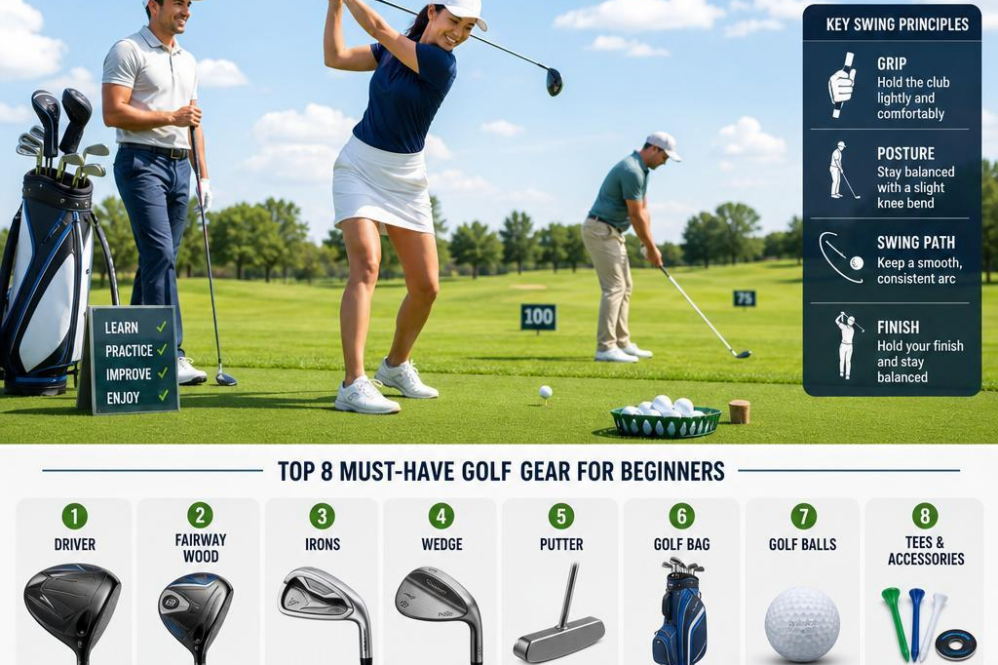
mastering the Basics with the right Clubs for Your Swing
Selecting the right clubs is foundational to developing a consistent and effective golf swing, as each club’s design influences your mechanics and shot outcome. For beginners and low handicappers alike, understanding club specifications such as loft angle, shaft flex, and clubhead design allows for tailored equipment choices that complement individual swing tempos and strength. For instance, a driver with a 9 to 12-degree loft typically benefits players seeking optimized launch angles and reduced spin rates, fostering greater carry distance. When addressing the irons, ensure proper lie angle alignment, as an incorrect lie can cause directional errors like pulls or pushes; a fitting session should include measuring the dynamic loft at impact and adjusting shaft length to maintain balanced posture throughout the swing. Integrating putters that match your preferred stroke style-be it a classic blade or mallet design with alignment aids-can drastically enhance short-game accuracy, especially under varied green speeds. During practice,adopt a routine that emphasizes grip pressure and stance width,using drills such as the “toe-tap” or “pause at the top” swing to establish muscle memory and improve tempo. incorporate coaching technology like launch monitors or swing analyzers to obtain real-time feedback on clubhead speed,attack angle,and ball flight,thereby facilitating evidence-based adjustments.
Translating proper club selection and swing fundamentals to course strategy is equally crucial for lowering scores and managing mental focus. Employ a setup checklist before each shot: verify ball position relative to your stance (typically forward in the stance for drivers and central for irons),maintain a balanced spine angle near 15 degrees forward tilt,and position your feet shoulder-width apart to ensure stability. when approaching driving zones or tight fairways, prioritize precision over power by selecting a 3-wood or hybrid with higher loft rather than the driver, which reduces risk while maintaining carry. Short game proficiency demands adapting to various lies and slopes; practice chipping drills from uneven lies or rough texture using wedges with higher bounce angles to avoid digging and improve contact consistency. Additionally, focus on reading green contours and wind conditions to adjust putting stroke pace and aim, reinforcing the mental discipline critical for scoring under pressure. Implementing measurable goals such as reducing three-putts by 30% or increasing fairway hit percentage through focused drills helps track progress. By combining correctly fitted equipment with refined mechanics and contextual course management strategies, golfers can cultivate a repeatable, confident game that translates to lower scores regardless of playing conditions.
Choosing the Perfect Golf Balls to Improve Your Accuracy
Selecting the right golf ball can significantly impact your accuracy and control on the course, so it’s essential to consider how ball construction interacts with your swing mechanics and course management strategy. For beginners, a ball with a lower compression rating (around 70-80 compression) offers more forgiveness and helps maximize distance at slower swing speeds, which promotes better consistency. Conversely, advanced players with faster swing speeds (above 100 mph) benefit from higher-compression balls (above 90 compression) that provide more spin control and responsiveness around the greens, allowing for precise shot shaping. Additionally, understanding the ball’s core design and cover material-such as urethane covers for enhanced greenside spin or surlyn covers for durability-enables golfers to better manage approach shots, especially under varying course conditions like wind or wet turf. When practicing, try hitting shots with different ball types to assess how they affect your trajectory, spin rateand feel; tracking these variables can guide you in choosing a ball that harmonizes with your unique swing dynamics.
incorporating ball selection into your setup routine aligns closely with refining your short game techniques and overall course strategy. For example, when facing tight pin placements or tricky slopes on the green, a ball that yields more consistent backspin can definitely help you stop the ball quickly, preventing it from rolling past the target. To build this skill, use drills focusing on partial wedges shots with various golf balls, noting which provide the softest landing within your effective scoring range of 50-100 yards. Also, consider how weather and course conditions affect ball performance-for instance, in cooler temperatures, balls with softer cores maintain better compression and feel, which can aid in distance control. Practicing these variations not only improves your technical abilities but also enhances your course management by informing smarter shot selection and risk assessment. Remember,combining the right equipment with deliberate practice routines creates measurable improvements in accuracy and scoring,setting a foundation for consistent performance whether you’re navigating tight fairways or challenging greenside scenarios.
Essential Accessories That Boost Your Putting Game
Elevating your putting accuracy begins with the right selection and understanding of equipment designed specifically to enhance feel and precision on the greens. A high-quality putter with proper lie angle (typically between 70°-72° depending on your height and arm length) ensures your face is square at impact, promoting a truer roll and better directional control. Consider putters with alignment aids such as contrasting sightlines or dots, which help visually confirm your target line during setup, crucial for consistent aim especially on breaking putts. Additionally, investing in soft, low-compression golf balls can improve your tactile feedback, allowing for better distance control on delicate lag putts. Alongside the equipment, using a putting mirror during practice routines can significantly enhance your setup by ensuring your eyes are directly over or slightly inside the ball, your shoulders are parallel to the target lineand your putter path follows a smooth, pendulum-like motion. These fundamentals minimize common errors like deceleration or unwanted wrist breaks, promoting a more repeatable stroke and improved green reading confidence under various course conditions.
Beyond gear,incorporating specific drills tailored to different skill levels enables golfers to better interpret greens and strategize shot execution under pressure. For beginners, the “gate drill” using alignment sticks or tees can reinforce a straight-back-straight-through stroke by providing immediate feedback on putter path, fostering muscle memory and consistency. Intermediate players should practice “distance control drills” by putting to progressively distant targets with the goal of landing balls within a 3-foot radius from the hole-this sharpens feel for pace adjustments essential on firm or fast surfaces. Advanced golfers benefit from “break reading exercises,” where they study subtle slopes and grain direction,practicing putts from varying angles to internalize how subtle elevation changes influence ball break and speed. Complement these drills with course management tactics such as choosing safer aim points on multi-break greens or factoring in wind direction and moisture levels, both of which can alter roll and break. By integrating the proper accessories with targeted practice regimes and strategic thinking, golfers across all skill levels can dramatically reduce three-putts and consistently lower their scores through enhanced green-side performance.
How to Fit Your Gear for Maximum Driving Distance and Control
To maximize driving distance and control, it’s crucial to start with properly fitted gear that complements your unique swing mechanics and physical attributes. Begin by assessing your driver’s loft angle,which typically ranges between 8° and 12°. Higher lofts assist beginners and those with slower swing speeds by optimizing launch conditions and promoting a higher ball flight, while low handicappers with faster swings frequently enough benefit from lower lofts to reduce spin and increase roll. Shaft adaptability is another critical factor; a shaft that matches your swing tempo, whether it’s regular, stiffor extra stiff, can help maintain clubhead stability through impact and enhance shot consistency. When fitting your driver, pay keen attention to the club’s lie angle, as a lie that’s too upright or too flat can cause hooks or slices, respectively. Incorporating a launch monitor session during your fitting allows you to track ball speed, launch angle, spin rateand carry distance, providing measurable data to fine-tune your setup. Practical drills include varying tee heights and performing swing tempo exercises, such as the “slow tempo drill,” to maintain steady clubhead speed and improve timing, directly translating into longer, straighter drives on the course.
In addition to driver-specific adjustments, overall gear fitting extends to your golf balls and gloves, which significantly influence distance and control. Selecting a ball that matches your swing speed and playing style-usually a low compression ball for beginners to maximize distanceand a high compression ball for advanced players seeking enhanced spin and control-plays a vital role in optimizing performance off the tee. Moreover, ensuring your glove fits snugly without restricting wrist movement enhances grip security, reducing tension and promoting a more fluid swing. During course play,be mindful of environmental factors like wind and temperature,adjusting your setup accordingly; for example,in windy conditions,a lower launch and reduced spin can help maintain control,which you can simulate by adjusting your driver’s loft or opening the clubface slightly to encourage a fade. Common mistakes to watch for include over-swinging, which sacrifices accuracy for distanceand improper weight transfer, both of which can be corrected by working on a balanced takeaway and finished position in your swing routine. Incorporate practice drills such as hitting drives with a tempo metronome or performing partial swings focused solely on weight shift to solidify these fundamentals. Ultimately, the synergy between well-fitted equipment and refined technique fosters improved driving performance, lowering scoresand building confidence from the tee box.