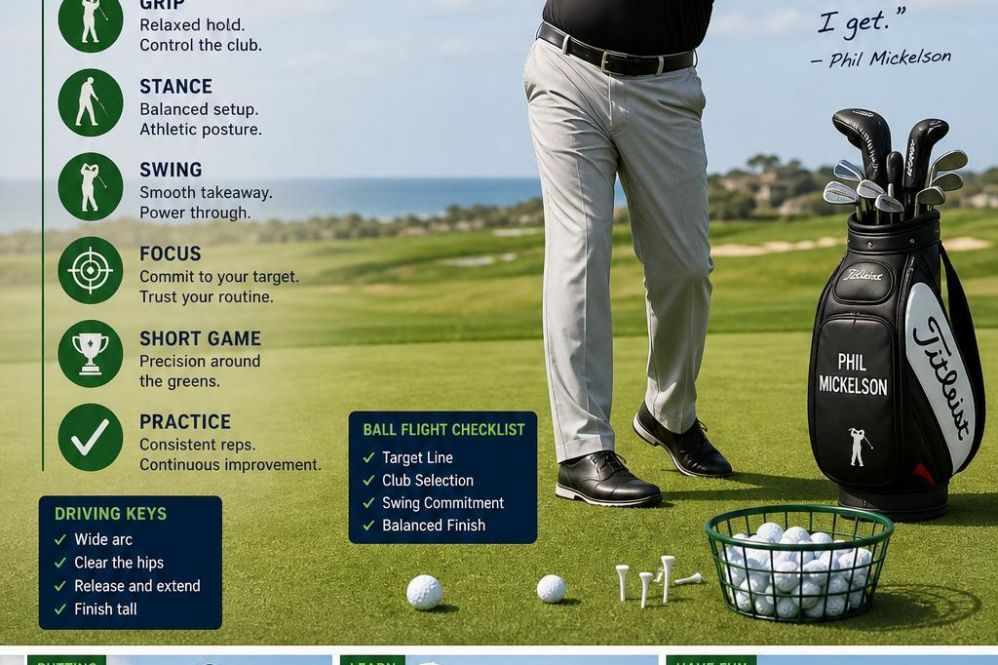
Understanding Phil Mickelson’s Unique Swing Mechanics and How They Improve Consistency
Phil Mickelson’s swing mechanics are distinctive for their fluidity and adaptability, qualities that contribute significantly to his remarkable consistency on teh course. Central to his method is a strongly hinged wrist set at precisely 90 degrees during the backswing,which creates lag and stores power efficiently without sacrificing control. This angle not only promotes a more compact swing arc but also reduces the tendency to over-rotate the shoulders, a common issue that causes inconsistent ball striking. For practical application, golfers of all levels should focus on developing a smooth takeaway, allowing the wrists to hinge naturally rather than forcing the clubhead. Practise drills such as the “pause at the halfway point” backswing drill help ingrain this sensation by encouraging players to halt their swing when their leading wrist reaches a 90-degree angle, reinforcing muscle memory. Additionally, refining setup fundamentals-like aligning the feet parallel to the target line and flexing the knees slightly at about 15 degrees-creates a stable base that supports the swing’s dynamic motion.
Another key element in Mickelson’s swing that boosts his consistency is his controlled weight transfer from the trail foot to the lead foot, synchronized perfectly with the downswing tempo. Instead of rushing this transition or keeping weight static, Mickelson achieves an ideal balance by moving about 70% of his body weight onto the front foot at impact. This weight shift generates kinetic energy that flows through the clubhead,enhancing ball speed and precision. Beginners can benefit from drills such as the “step-through drill,” which encourages stepping forward with the lead foot after impact, ingraining proper weight distribution and promoting solid contact.On the course, this technique aids in maintaining shot consistency even under pressured situations or when forced to adjust for uneven lies. Furthermore, mickelson’s grip pressure is deliberate yet relaxed-excessive tension often leads to tension in the arms and loss of fluidity-so players should experiment with lighter grip pressure during practice rounds to find their optimal tension that facilitates accuracy and feel.
Lastly, Mickelson’s swing mechanics are enhanced by his tactical use of clubface control and trajectory management, essential for adapting to diverse course conditions and strategic challenges. By setting the clubface slightly open or closed at address and manipulating the angle of attack, he consistently shapes shots-whether drawing around a tree or fading to avoid hazards. golfers aiming for measurable betterment can incorporate the “gate drill,” placing two tees just wider than the clubhead to encourage a square and precise club path through impact, minimizing slices or hooks.Incorporating various ball positions in the stance, from forward to middle, allows players to explore different spin rates and launch angles, effectively tailoring shots to pin locations or wind conditions. Understanding these subtle adjustments not only improves scoring potential but also builds confidence in decision-making, as golfers learn to interpret the course and whether intelligently while executing technically sound swings.
Unlocking the Secrets of Phil Mickelson’s Putting Technique for Better Precision
Phil Mickelson’s putting technique exemplifies a blend of precision mechanics and adaptive strategy,vital for golfers aiming to lower their scores. A key instructional focus is his setup,which emphasizes a slight forward press with the hands to promote a smooth,pendulum-like stroke.Beginners should start by positioning the ball just inside the left heel to encourage an inside-to-square-to-inside path, while more advanced players might adjust the ball slightly back for more control on upslope greens. Additionally, Mickelson’s stance features feet shoulder-width apart with minimal knee flex, enabling stability without restricting natural wrist hinge. Incorporating this setup habitually helps golfers maintain consistent contact and distance control, foundational elements frequently enough overlooked in putting practice.
Beyond setup, his stroke mechanics reveal a seamless integration of body and wrist movements, crucial for consistent roll and accurate aim. Mickelson employs a controlled shoulder-driven stroke with minimal wrist breakdown through impact, reducing the tendency to decelerate and chunk or sky putts. Practicing the “gate drill,” where golfers place two tees just wider than the putter head to promote a square clubface path, effectively mimics this motion. For those struggling with tempo, using a metronome set between 50-60 beats per minute can definitely help establish a rhythmic stroke similar to Phil’s smooth cadence. Moreover, understanding greens’ slopes and speeds allows golfers to apply subtle adjustments in backswing length and forward press, enabling precision even on challenging contours, a hallmark of Mickelson’s superior course management.
Integrating mental resilience into putting strategy is a defining aspect of Mickelson’s mastery and directly ties into execution under pressure. He advocates a pre-shot routine centered on visualization and controlled breathing,which calms nerves and sharpens focus-particularly useful on long,tricky putts or crucial match-play situations. For practice, simulate on-course pressure by setting up tournament-like scenarios where each putt counts, reinforcing confidence and routine consistency. Equipment choices also matter: Mickelson’s preference for a heel-toe weighted mallet putter assists with alignment and forgiveness on off-center hits, benefiting players prone to toe or heel strikes. Ultimately, translating these components into tangible improvements requires deliberate practice through drills like distance ladder putting and reading varied green breaks, resulting in better precision, lower scores, and a more enjoyable short game experience for golfers across skill levels.
Driving Like a Pro How to Adopt Phil Mickelson’s Power and Control on the Tee
Achieving Phil Mickelson’s signature blend of power and control off the tee begins with a basic address position that maximizes balance and torque. Mickelson emphasizes a slightly open stance with feet shoulder-width apart, which allows for a fuller hip rotation while maintaining stability. The ball position should be just inside the lead heel to promote a sweeping, upward strike on the driver’s face, optimizing launch angle and minimizing spin. Maintaining a slight flex in the knees and a relaxed grip pressure around 40-50 pounds helps generate fluid clubhead speed without tension. For beginners,focusing on feeling the weight distributed evenly on the balls of the feet sets a solid foundation-while advanced players should incorporate a deliberate shoulder turn of approximately 90 degrees to create maximum coil and stored energy for the downswing.
Mickelson’s swing mechanics highlight the importance of a lagging wrist angle and controlled release to produce both distance and directional accuracy. As the club reaches the top of the backswing, the trail wrist maintains a hinged “set” position, creating stored power that is unleashed during the transition to the downswing. This technique is reinforced with drills such as the pump drill, where the club is partially swung down and paused to feel the lag before completing the swing. Furthermore, Mickelson advocates for a smooth, rhythmic tempo-often around a 3:1 ratio between backswing and downswing-avoiding early casting that leads to loss of power and slices. Utilizing impact tape during practice sessions can help identify the center of the clubface strike, encouraging consistent contact which is crucial to maximizing distance and keeping drives in the fairway.
Strategically, Mickelson combines his technical skills with smart course management to drive like a pro under various conditions. He advises golfers to tailor tee shots not just for maximum distance but also for optimal positioning based on hole layout,hazards,and prevailing wind. For example, on a narrow fairway with water hazards, adopting a controlled fade or draw by slightly adjusting the grip pressure and swing path can enhance accuracy and confidence. Incorporating simulated pressure scenarios during practice, such as setting target zones or using pre-shot routines, improves mental resilience and shot execution on the course. By integrating this approach, players of all levels learn to harness power with purposeful control, ultimately lowering scores and elevating overall performance.