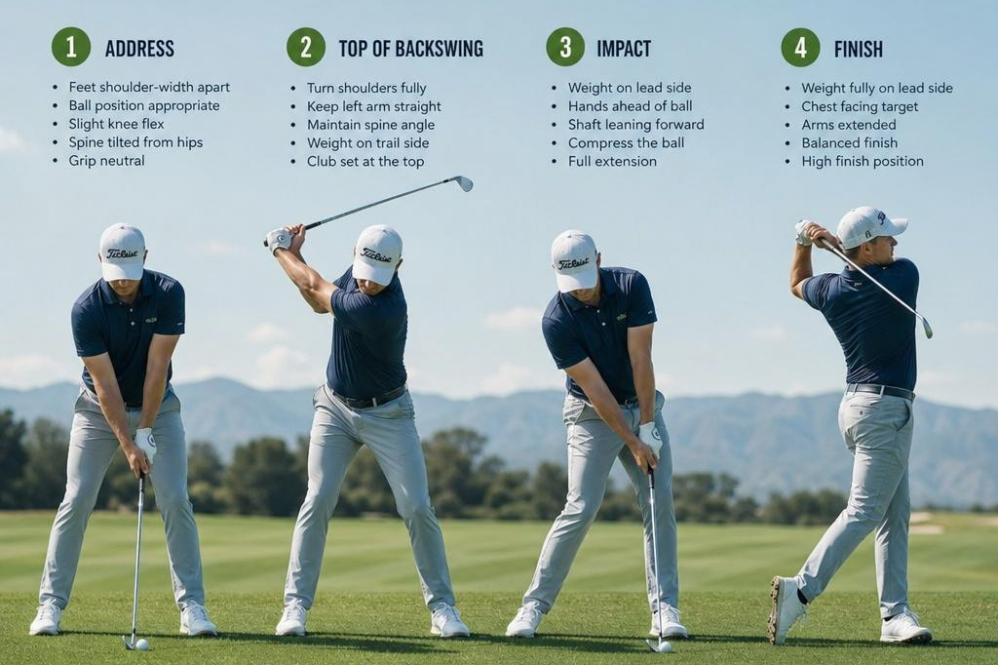
Mastering the Basics with the Right Clubs for Your game
Selecting the appropriate clubs for your game lays the foundation for mastering swing mechanics and improving consistency on the course. for beginners, investing in a forgiving set that includes cavity-back irons with a wider sole and a hybrid club in place of long irons can substantially enhance ball-striking confidence. These clubs help reduce mishits by increasing the moment of inertia, allowing for straighter shots even on off-center contact. Meanwhile, golfers aiming to lower their handicaps should focus on refining their setup fundamentals by ensuring their stance width matches shoulder width and that their ball position aligns correctly with each club’s loft.For example, place the ball just inside the lead heel for a driver (around 4 inches from the inside of the left foot for right-handed players)and progressively move it closer to center for shorter irons. This setup promotes optimal launch angles and improves energy transfer.Regularly practicing with alignment sticks can also help maintain proper clubface orientation and swing path, mitigating common faults like slicing or hooking. Incorporating these adjustments not only enhances swing efficiency but also builds essential muscle memory, which is pivotal when transitioning to shot-shaping techniques and strategic course management.
Integrating your choice of clubs into a comprehensive practice routine with targeted drills cultivates both technical skill and intelligent course strategy. To sharpen short game proficiency,use wedges with varying lofts between 52° and 60° to develop feel and control for different shot trajectories-an invaluable asset for navigating tight lies and challenging greens. practice drills such as the “clock drill,” which involves hitting chips to targets at progressively increasing distances from 3 to 12 feet, help improve distance control and touch. Simultaneously occurring, mid- and long-iron players should emphasize altering swing tempo and wrist hinge to shape shots effectively-learning to fade or draw the ball can be the difference between avoiding hazards or setting up birdie opportunities. Additionally, when managing course conditions like wind or firm fairways, selecting a lower-lofted club to keep the ball flight under the wind or employing a controlled punch shot reduces risk and improves accuracy. Developing an intuitive understanding of how each club performs under various weather and terrain scenarios empowers golfers to make precise club selections and execute confident shots. Ultimately, consistent practice paired with thoughtful equipment use transforms foundational skills into winning strategies, driving continuous betterment across all skill levels.
Finding the Perfect Training aids to Sharpen Your Swing
When selecting training aids to sharpen your swing, it’s essential to focus on equipment that reinforces proper mechanics while providing immediate feedback. Start by incorporating alignment sticks or swing trainers that help establish a consistent setup and correct swing path. Proper alignment is crucial; ensure your feet, hips, and shoulders are parallel to the target line to avoid common mis-hits. Additionally, weighted clubs or tempo trainers encourage rhythm and balance, two essential aspects of a repeatable golf swing. Experiment with devices like impact tape or swing sensors to visually confirm where contact occurs on the clubface, aiming consistently for the centered strike, frequently enough referred to as the sweet spot. For beginners,using a simple chipping net or putting mat at home can improve short game touch,while more advanced players might benefit from launch monitors to analyze ball flight and launch conditions under variable weather or course scenarios.
Integrating these aids into your practice routine with targeted drills dramatically accelerates skill progress across all levels. For example, create a drill routine that alternates between full swings focusing on a 45-degree takeaway and half swings emphasizing wrist hinge and clubface control. Use alignment sticks to ensure your swing plane remains on trackand measure progress by recording smash factors and dispersion patterns with launch monitors. incorporate setup checkpoints such as maintaining a slight knee flex, a spine tilt of roughly 5 degrees away from the targetand a balanced weight distribution around 55%-45% (front foot to back foot) to optimize power and control. Remember, consistent practice combined with strategic use of these aids enhances muscle memory and sharpens your shot shaping capabilities, enabling you to navigate tricky course layouts and reduce score volatility. Lastly,remain mindful of common pitfalls like over-rotation or insufficient follow-through,and adjust your training aids accordingly to reinforce a smooth,controlled finish.
Unlocking Consistency Through Key Performance Metrics
To develop consistent golf performance, tracking and refining key metrics such as swing tempo, clubface angleand shot dispersion is essential.Such as, maintaining a swing tempo ratio close to 3:1 (backswing to downswing) fosters rhythm and power without sacrificing control. Golfers should use training aids like metronomes or tempo-specific drills, such as swinging to a count “one-two-three” on the backswing and “one” on the downswing, to internalize this balanced rhythm. Similarly, understanding the clubface angle at impact-where even a few degrees of open or closed face can dramatically influence ball flight-allows players to make conscious corrections in their grip, stanceor release. utilizing impact tape or launch monitors during practice can provide instant feedback for making data-driven adjustments. By focusing on these measurable elements, golfers can enhance not only their swing mechanics but also the predictability of their shots under varying conditions, such as wind or uneven lies.
Incorporating strategic course management into your performance routine adds another layer of consistency by optimizing club selection and shot choice to match both your technical strengths and external factors. For instance, a first-time golfer equipped with the Top 8 Essential Gear should prioritize irons like a 7-iron or 9-iron for approach shots, emphasizing alignment, ball position just forward of center, and a controlled, 56° wedge for short-game precision around the green. Practice drills focusing on partial swings and controlled trajectory help golfers refine distance control and avoid costly mishits. Strategically, choosing safer routes-such as laying up short of hazards instead of aiming directly at a narrow green-aligns with the principle of playing to one’s strengths while minimizing risk. By regularly evaluating shot outcomes and course conditions,including factors like firmness of the fairway or wind direction,golfers can develop adaptive strategies that lead to lower scores and enhanced confidence throughout rounds.
Choosing gear That Fits You Like a Glove for Better Results
Selecting equipment that suits your unique swing characteristics and physical dimensions is foundational for unlocking consistent results on the course. As a notable example, shaft flex, lengthand clubhead design must align precisely with your swing speed and release point to optimize launch conditions and ball flight. Begin by evaluating your driver’s loft angle – generally between 9° and 12° for most amateur players – to ensure it complements your attack angle, which ideally should be slightly upward for maximum distance. Additionally, pay close attention to grip size measured in circumference; a grip too large or small can cause tension in your hands, disrupting clubface control during impact. To tailor your setup, consider working with a professional club fitter who can analyze your swing tempo and provide data-driven recommendations including lie angle adjustments. This precision fitting allows golfers of all skill levels to reduce unwanted slices or hooks by promoting a more neutral clubface rotation through the hitting zone, ultimately enhancing shot accuracy and consistency.
Beyond woods and irons, shorter game equipment such as wedges require particular attention to bounce and grind options based on course conditions and turf interaction.For example,choosing a sand wedge with a higher bounce angle,around 12° to 14°,helps players who tend to take steep divots or play in soft bunkers,preventing the club from digging excessively into the ground. Practicing shot shaping drills with these wedges can improve your ability to execute precise chips and flop shots around the green, vital for lowering scores effectively. Incorporate targeted practice sessions that focus on varying clubface angles at address and controlling swing path to produce draws, fadesand trajectory control. Using a launch monitor or video feedback, track your shot dispersion pattern and adjust your technique or equipment accordingly. Remember, well-fitted gear paired with intentional practice routines not only improves biomechanics such as wrist hinge and weight transfer during the swing but also reinforces strategic course management by enabling confident execution of a wider variety of shots under differing weather and lie conditions.