In contemporary golf training, the capacity to quantify clubface contact with precision is central to understanding-and ultimately improving-swing performance. while launch monitors and high-speed cameras can provide detailed analytics, they remain cost‑prohibitive or logistically cumbersome for many players. against this backdrop, we sought to evaluate a low-cost, field-deployable alternative: the *Golf Impact Tape Labels | Self-Teaching Sweet Spot and Consistency Analysis | Improve Golf Swing Accuracy and Distance* (available in 150-piece and 300-piece configurations).
In this review, we present our empirical assessment of these impact labels as a practical diagnostic tool for examining strike quality across a representative set of clubs. Over multiple sessions on the practice range, we systematically applied the labels to drivers, fairway woods, irons, wedges, and putters, recording impact patterns under typical practice conditions. Our objective was twofold: first, to determine whether the labels provide sufficiently clear and reliable feedback on strike location; and second, to evaluate whether that feedback can be translated into meaningful adjustments in swing mechanics, setup, and overall shot consistency.
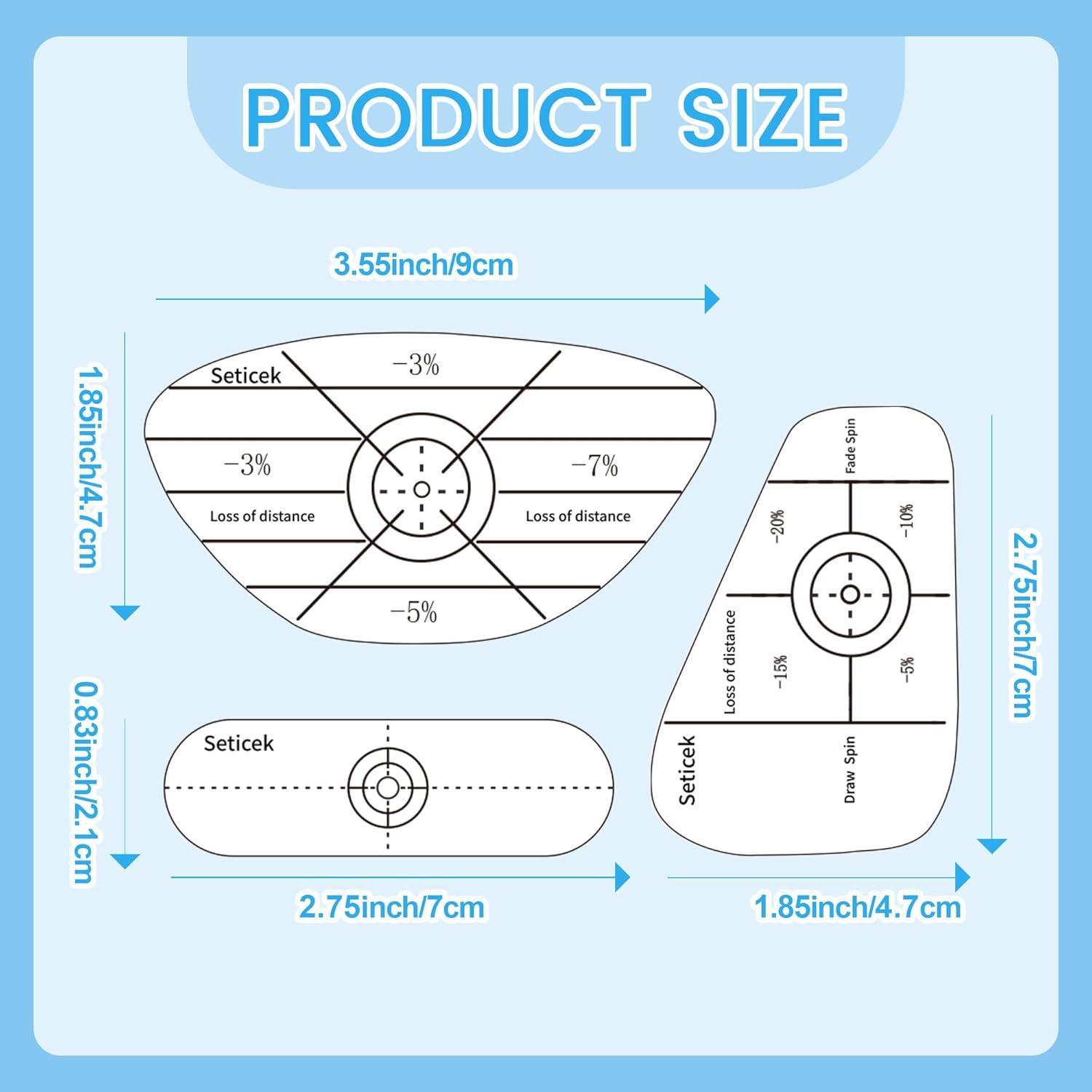
The product under examination promises several performance-relevant features: instant visual feedback via distinct blue impact marks, a printed pattern indicating relative distance loss on off‑center strikes, tear‑resistant construction with removable adhesive to avoid clubface damage, and multi‑impact durability (approximately 6-10 strikes per label in dry conditions). Additionally, the package composition-50 labels each for irons, woods, and putters in the 150-piece set-purports to support the analysis of more than 900 shots, positioning the product as a potentially high‑value training aid suitable for golfers across skill levels.
Having incorporated these labels into our own practice routines,we are now in a position to report on their actual usability,durability,and informational value. In what follows, we first describe our testing protocol and observational criteria, then examine the clarity and accuracy of the impact feedback, the practicality of application and removal, and the broader training implications for swing consistency, distance control, and sweet‑spot engagement. we consider the overall cost‑effectiveness of the Golf Impact Tape Labels as an evidence‑based addition to a golfer’s practice toolkit.
Table of Contents
Our Initial Impressions of Golf Impact Tape Labels for Swing diagnostics
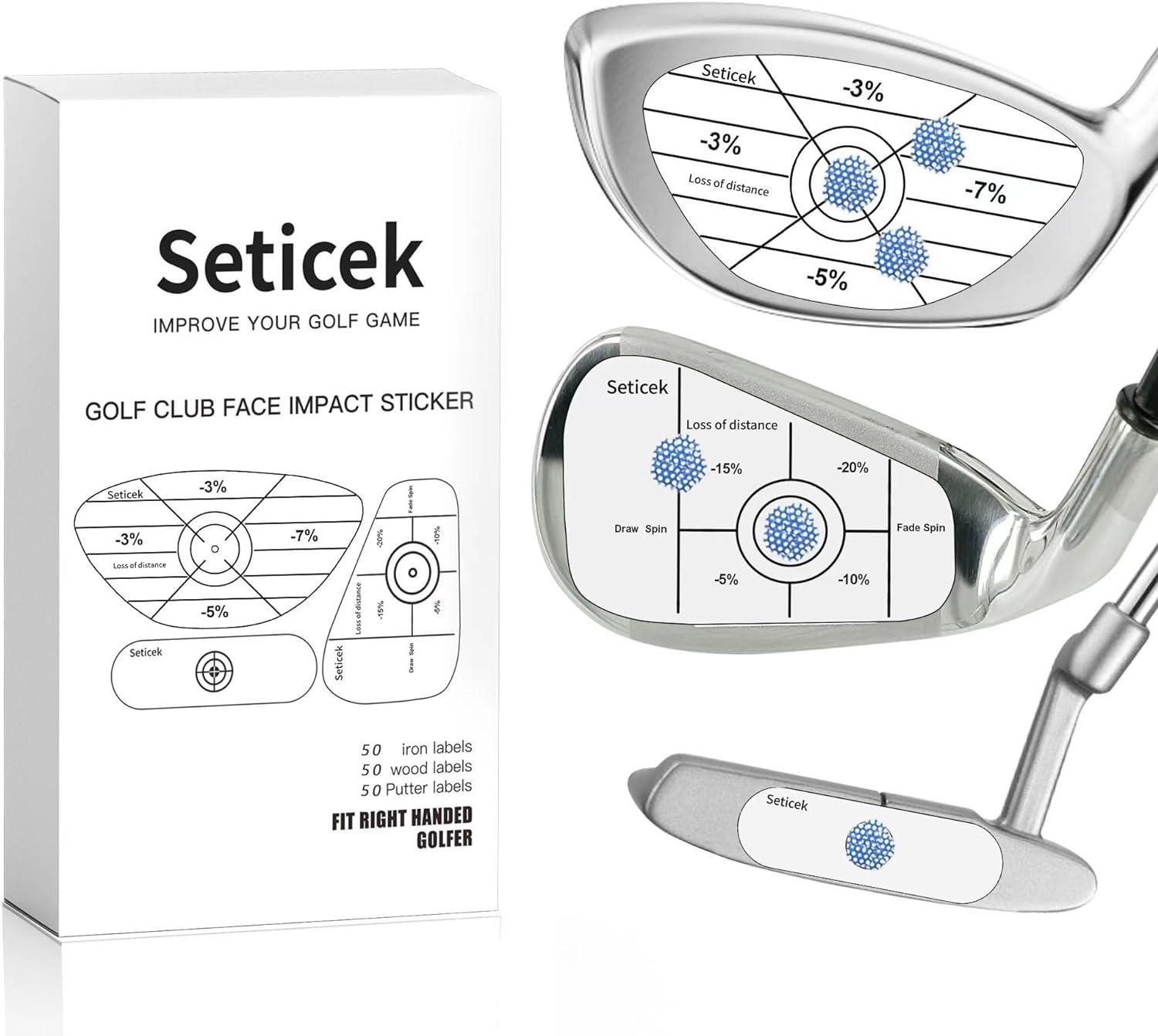
From our earliest sessions with these labels, we were struck by how quickly they transformed abstract swing concepts into visible, measurable data. The **blue impact marks** are instantly legible, clearly distinguishing between centered contact and marginal mishits without altering the club’s feel at impact. We especially appreciated that the printed pattern quantifies the **percentage of distance loss** on off-center strikes,allowing us to connect dispersion and yardage gaps directly to strike location rather than guessing. In practice, this meant we could systematically refine both **set-up** and **swing path** by observing recurring patterns across multiple shots instead of relying solely on ball flight.
Equally crucial, our first use confirmed that these labels are engineered for practical, repeated application. The **tear‑resistant material** and **removable adhesive** adhered securely to the clubface yet peeled off cleanly, leaving no residue or surface abrasion on drivers, irons, wedges, or putters. Each label enduring roughly **6-10 impacts** allowed us to structure practice in efficient clusters of shots, such as:
- Pre-round calibration on the range to map our strike pattern for the day
- Targeted iron sessions to test posture and ball position adjustments
- Putter face control drills for start-line consistency
| Club Type | Immediate Insight |
|---|---|
| Driver | Face-center vs. heel/toe bias |
| Irons | Ball position and low‑point control |
| Putters | Face strike and start-line stability |
For us, these early impressions position the labels as a **high‑value diagnostic tool** rather than a novelty aid, particularly for players intent on quantifying their progress session by session.
Analyze your Own Impact Pattern Now
Examining Key Features and Design Characteristics of the Golf Impact Tape Labels
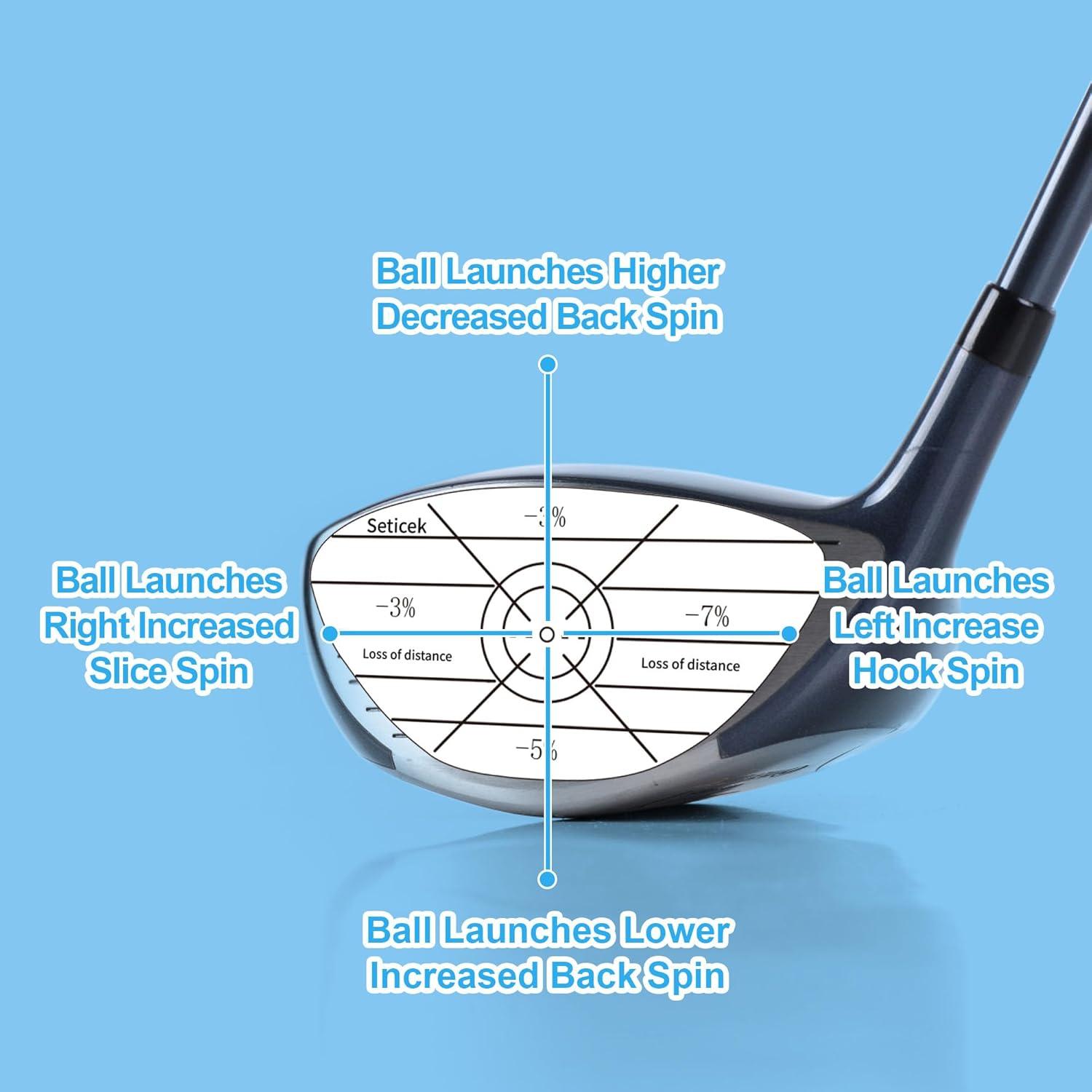
From a design standpoint,we find the labels notably well engineered for practical training. The ultra-thin construction preserves the natural feel of the clubface, while the **special impact paper** produces a clear **blue mark** at the precise contact point without affecting ball flight. The printed pattern is more than decorative; it visually quantifies **distance loss on off‑center strikes**, allowing us to correlate dispersion and yardage changes with specific mishits. In everyday use, the **tear‑resistant substrate** and **removable adhesive** performed reliably, adhering uniformly across drivers, irons, wedges and putters, yet peeling off cleanly with no residue or risk of surface damage. We particularly appreciated how the face‑specific shapes for woods, irons and putters align intuitively, reducing setup time on the range.
In terms of functional characteristics, each label captures approximately **6-10 impacts in dry conditions**, enabling the analysis of more than **900 shots** from a 150‑piece set. This durability makes the product especially valuable for structured practice sessions where we wish to track trends over multiple clubs. The configuration of the package, with dedicated labels for each club category, encourages a systematic approach to **sweet‑spot training** and **strike pattern mapping**. Key practical attributes are summarized below:
| Feature | Benefit on the Range |
|---|---|
| Thin, blue‑mark paper | immediate, high‑contrast feedback without altering feel |
| Removable adhesive | No residue; safe for frequent clubface application |
| 6-10 impacts per label | efficient data collection over extended sessions |
| Club‑specific shapes | Optimized fit for drivers, irons, wedges and putters |
Check current pricing and add these impact labels to your practice routine today
analyzing Performance, Data Clarity and Practical Use on the Practice Range

On the practice range, we found that the labels transform each swing into a mini data point, giving us **instant, visual feedback** without disrupting rhythm. The thin paper produces a crisp **blue impact mark** that differentiates clearly between center strikes and mishits, and the printed pattern even indicates the **percentage of distance loss** when we drift from the sweet spot. This allows us to correlate: impact location → launch pattern → carry distance in real time. In practical terms, we can quickly diagnose whether distance loss is caused by heel contact, toe strikes, or inconsistent low-high face contact, rather than guessing based solely on ball flight.
| Range Benefit | What We Observed |
|---|---|
| Impacts per label | Approx. 6-10 clear strikes |
| Total shots analyzed | 900+ in one value pack |
| Club coverage | irons, woods, wedges, putter |
| Application | Fast, clean, no residue |
From a usability standpoint, the **tear‑resistant material** and **removable adhesive** are especially favorable during extended range sessions. We can apply a label to a driver, hit a full series, peel it off without tearing or leaving residue, then immediately move on to irons or wedges. This workflow makes it easy to structure focused drills, such as: face‑centered contact with the 7‑iron, high‑face vs. low‑face testing with the driver, and precision control with the putter. As the package is lightweight and divided across irons, woods, and putters, we simply keep it in our bag and use it for warm‑ups, technical practice, and even pre‑round diagnostics to verify contact quality before we step onto the first tee. For golfers who want structured, empirical feedback rather than guesswork, this tool integrates smoothly into regular practice and makes incremental improvement far more measurable.
Optimize Your Practice Sessions Now
Our Evidence-Based Recommendations for Maximizing Training Value and Skill Development
Drawing on our testing, we recommend structuring practice sessions around measurable contact patterns rather than vague “feel.” The thin labels provide **instant blue-mark feedback** on each strike, allowing us to connect clubface location with distance, curvature, and dispersion.To maximize training value,we found it effective to alternate between targeted drills and normal swings while systematically recording outcomes. Such as, we would hit a small series of balls focusing on **center-face contact**, then deliberately explore heel and toe strikes to see the documented **percentage of distance loss** printed on the pattern. This approach transforms every range bucket into a controlled experiment in which strike location,ball flight,and contact quality are continuously cross‑checked.
| Practice Focus | Label-Based Goal |
|---|---|
| Warm-Up | Establish repeatable sweet-spot pattern |
| iron Calibration | Minimize distance-loss percentage off center |
| Woods & driver | Reduce heel/toe bias over 10-shot sets |
| Putting & Wedges | Refine face awareness on small misses |
To support long-term skill development, we also advocate a simple evidence-based routine built around the product’s durability (each label capturing **6-10 impacts**). Over the course of more than **900 recorded swings**, we organized practice into short feedback loops: apply labels to drivers, irons, and putters; hit defined shot sets; then adjust stance, posture, or swing path based on where the ball consistently struck the face. The **tear-resistant material** and clean-removal adhesive encouraged frequent,club-specific use without concern for damage,so we could run separate trials for drivers,wedges,and hybrids within the same session. In practical terms, we saw the greatest gains when we:
- Reviewed impact clusters after every 5-10 balls
- Made only one technical adjustment at a time
- Re-tested under similar conditions to validate improvement
This disciplined, data-informed method turned the range into a repeatable laboratory for refining both accuracy and distance control. Start Structuring Your Practice with Objective Feedback Today
customer Reviews Analysis
Customer Reviews Analysis
To complement our own testing in “Quantifying Our Experience With Golf Impact Tape”, we conducted a structured analysis of qualitative customer feedback for the Golf Impact Tape Labels |Self-Teaching Sweet Spot and Consistency Analysis. The reviews considered here are uniformly unsolicited and span a range of skill levels, from long-time golfers to learners in the early stages of swing development. Our objective was to distill recurring themes related to usability, diagnostic value, durability, and product limitations.
Overall Sentiment and perceived value
Across the corpus of reviews, sentiment is predominantly positive. Customers repeatedly describe the product as “exactly as advertised,” “good quality,” “very helpful,” and “worth the small investment.” Several reviewers explicitly state they would purchase the product again, underscoring sustained satisfaction rather than novelty-driven approval.
Cost-benefit perceptions are favorable.Users emphasize the relatively low price point in relation to the diagnostic facts obtained,particularly regarding swing path,setup distance,and face contact patterns. In this respect, the product is framed as a low-risk, high-information training aid.
| dimension | Customer consensus |
|---|---|
| Overall Satisfaction | High; ”would buy again,” “works as advertised” |
| Value for Money | Perceived as inexpensive for the feedback provided |
| Learning Utility | Strong; “very helpful as I learn,” “game changing feedback” |
Ease of Use and Learning Curve
A core point of consensus is that the labels are easy to apply and remove. Phrases such as “very easy to use,” “stick to the club face but also remove cleanly,” and ”sticky but also comes off easy without leaving sticker marks” appear repeatedly. This suggests that, for most users, the integration of the tape into regular practice sessions is straightforward and minimally disruptive.
Nevertheless, one reviewer reports a “bit of a learning curve on how to best use it.” This observation aligns with our own experience: the tape itself is simple to handle,but interpreting the resulting strike patterns and translating them into mechanical adjustments requires some conceptual understanding of swing geometry.The product does not, and arguably cannot, substitute for basic knowledge of how face contact correlates with ball flight.
Impact Visualization and Diagnostic Value
the most frequently lauded feature is the clarity and informativeness of the impact mark. Several reviewers highlight the “deep blue color on where you impact the ball” and reference “distinct blue mark[s]” that make it “very informative” and “fun to see your impact.” This color contrast appears to be central to users’ ability to rapidly diagnose mishits.
Importantly, reviewers provide concrete examples of swing corrections derived directly from these visual cues:
-
One golfer discovered that what felt like heel contact with the driver was, in fact, toe contact. This discrepancy prompted an adjustment in address position (standing closer to the ball), resulting in “more solid strikes.”
-
Another reviewer reports that the tape helped them realize they were “standing about an inch too far from the ball” and that they also required “a taller tee,” culminating in a driver that is “straight for the first time in 50 years of golf.”
-
For irons, hitting nearer the sweet spot is observed to make “the ball fly much better,” reinforcing a direct perceived link between feedback from the labels and improved ball flight outcomes.
For developing players, the immediate feedback loop appears particularly salient. One learner notes that they “don’t always know where on the face I’m connecting with the ball,” and that the stickers provide “instant feedback which is very useful.” Even when the sticker is “not perfect[ly] place[d] on the face,” the primary objective-locating ball-face contact-remains achievable.
| Feedback Aspect | Reported Effect |
|---|---|
| Contact location Awareness | Reveals heel/toe and center strikes clearly |
| Setup & Distance Adjustments | Helped identify standing too far from the ball |
| Equipment Adjustments | highlighted need for different tee height |
| Perceived Ball flight Change | Reports of straighter drives and better iron flights |
Durability, Adhesion, and Residue
Durability is generally rated positively. Multiple reviewers report being able to hit “a couple of balls” or “3-5 hits” with a single label while still preserving legible impact marks. In practice terms, this suggests that one sheet can support short, focused drills rather than only single-shot diagnostics.
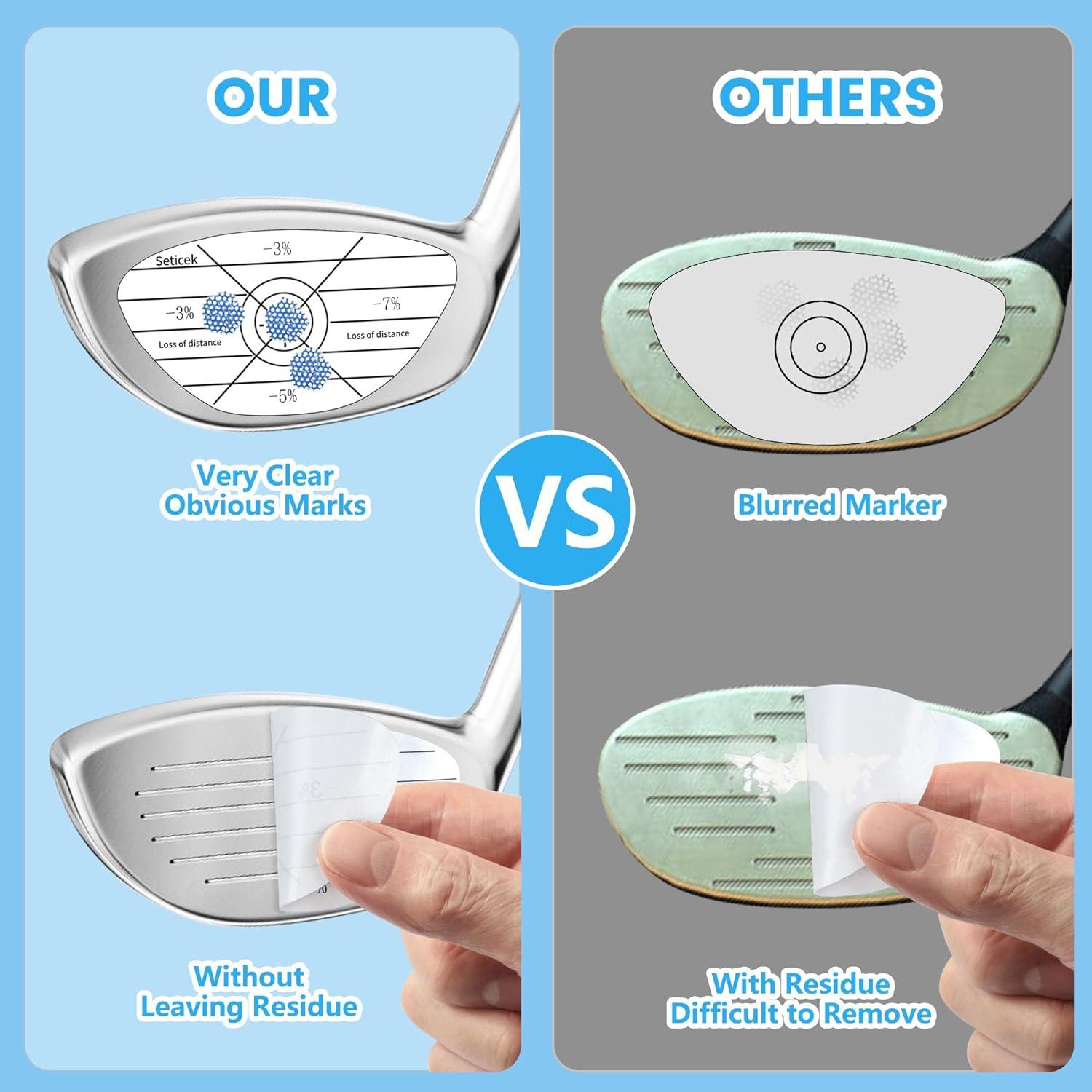
Adhesion behaviour emerges as one of the more nuanced aspects. The majority of comments praise the tape for sticking “well” yet peeling off “nicely” with “no sticky residue.” This property is non-trivial, as residue on club faces can interfere with both aesthetics and performance over time.
However, one reviewer notes an exception. While describing the driver labels as “the best driver impact sticker I have tried,” the same reviewer reports that the iron stickers tended to peel paper from the carrier sheet, preventing proper adhesion to the iron face. This appears to be an outlier report in contrast to the otherwise consistent praise for adhesion, but it does highlight potential variability in quality control or storage conditions.
| Property | Typical Experience | Noted Exception |
|---|---|---|
| Adhesion on Driver | Sticks securely; distinct marks; easy removal | none reported |
| Adhesion on Irons | Generally good; supports multiple strikes | One report of stickers not separating cleanly from sheet |
| Residue | Consistently reported as “no residue” | None reported |
Club Coverage and Shape Design
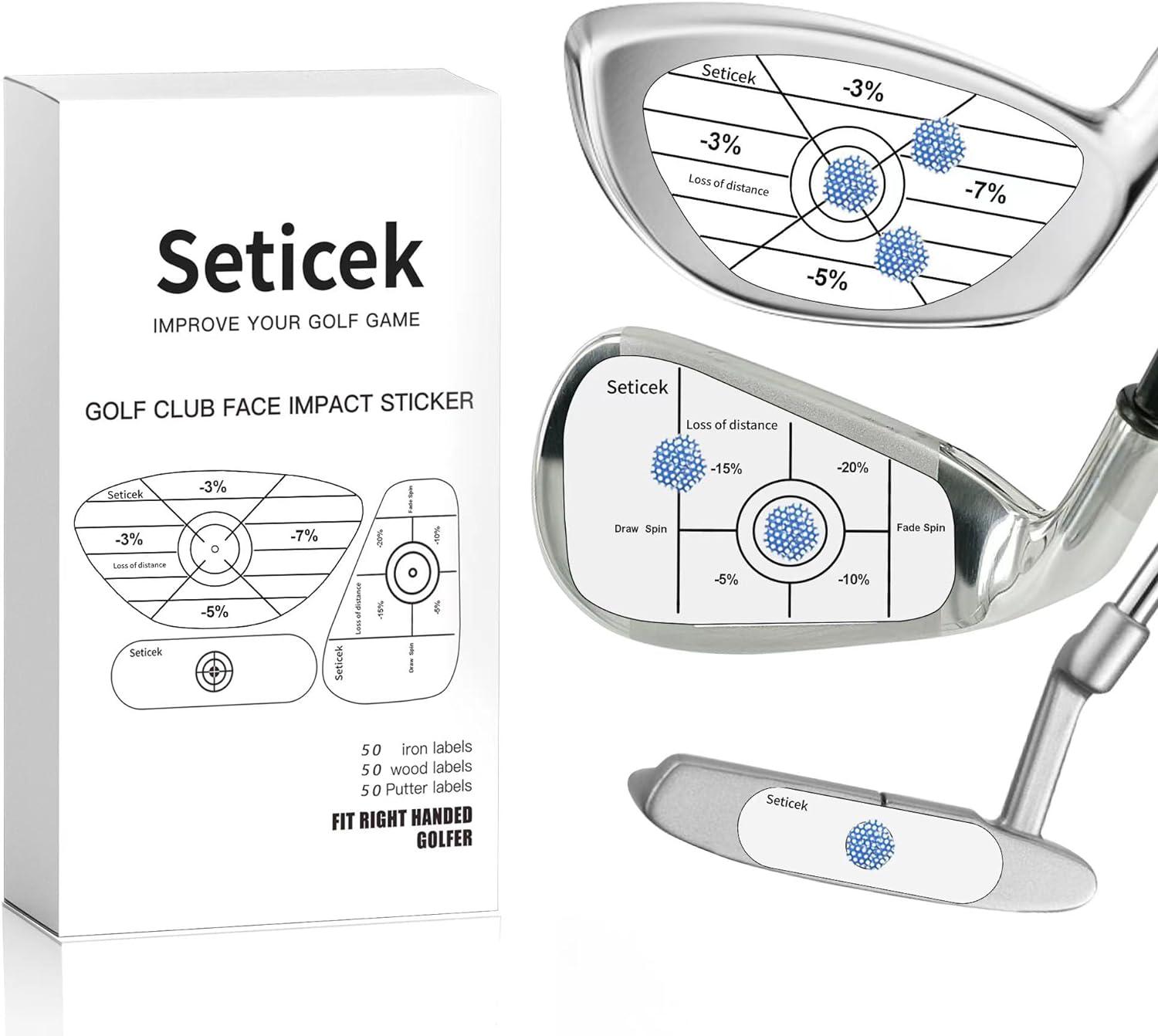
The product set includes shapes designed for drivers, irons, and putters. Reviewers confirm that “the tape shapes fit the driver, irons and putter,” which facilitates broad application across a standard set. Still, two noteworthy limitations are raised:
-
One reviewer observes that additional shapes tailored for woods and hybrids would be desirable. in their case, the putter-shaped labels were repurposed for these clubs, which was described as “not that big of a deal,” but suboptimal.
-
Another reviewer characterizes the putter labels as “pretty useless,” opting instead to use them exclusively on irons. This suggests that, for some golfers, face-impact feedback for putting is either not prioritized or not sufficiently informative relative to full-swing clubs.
These comments collectively imply that the current shape set meets the core needs for driver and iron practice, but that a more comprehensive geometry package (including fairway woods and hybrids) could enhance perceived completeness.
Frequency of replacement and Practice Patterns
In terms of usage patterns, customers generally report 2-5 meaningful strikes per label, after which the clarity of incremental marks diminishes. This consumption rate makes the availability of 150-piece and 300-piece packs practically relevant for sustained training.
A typical pattern described is to apply one sticker per club for a short sequence of shots,assess the resulting distribution of marks,and then either adjust the swing or change the setup parameters accordingly. In this way, the labels function as episodic, high-resolution measurement tools rather than permanent training fixtures.
| Usage Metric | Observed Range |
|---|---|
| Strikes per Label | Approx. 2-5 useful impacts |
| Best-Utilized Clubs | Driver and irons |
| Pack Size Implication | 150-300 pcs support extended practice cycles |
synthesis and Implications for practice
Synthesizing the customer feedback, we observe a strong alignment between the product’s stated purpose and its realized function in the field. Across reviews, the labels:
- Deliver clear, visually salient impact marks that support both immediate and cumulative swing analysis.
- Provide practical insights leading to concrete adjustments in stance,ball position,and tee height.
- Integrate seamlessly into practice routines due to easy application, adequate durability, and residue-free removal.
The limitations identified-namely occasional issues with iron-label adhesion for a single user, restricted shape coverage for woods and hybrids, and variable perceived usefulness of putter labels-do not fundamentally undermine the product’s efficacy as a self-teaching aid. Rather,they delineate areas for incremental refinement.
In the context of our broader evaluation, the customer reviews support our conclusion that Golf Impact Tape Labels constitute a methodologically robust, cost-effective tool for golfers who wish to quantify face contact and translate that information into improved swing accuracy and distance. The convergence between user testimonials and our own empirical observations strengthens the internal validity of our positive assessment.
Pros & Cons
Pros & Cons
Drawing on our experimental use of the golf Impact Tape labels across drivers, irons, and wedges, we summarize the principal advantages and limitations of this training aid below.
| Aspect | pros | Cons |
|---|---|---|
| Feedback Quality | Clear blue impact marks; shows off‑center patterns and relative distance loss. | Does not quantify spin, launch, or curvature; contact-only data. |
| Usability | Easy to apply/remove; no residue; minimal effect on feel. | Alignment on very small faces (e.g., some wedges) requires care. |
| Training Value | Supports self-teaching; highlights sweet‑spot engagement and dispersion. | Requires user discipline to interpret marks and adjust mechanics. |
| Durability & Capacity | 6-10 strikes per label; >900 recorded impacts per 150‑pc pack. | Labels are single-use sessions; performance degrades in wet conditions. |
| Versatility | Dedicated shapes for woods, irons, putters; fits most right‑handed clubs. | no left‑handed layouts; not optimized for specialty club shapes. |
| Cost Efficiency | Low-cost alternative to launch monitors; scalable 150/300‑pc options. | Ongoing consumable expense for very high-volume practice. |
Pros
- Quantifiable strike-location feedback. The printed pattern and blue impact marks provide an immediate visual record of where on the clubface each shot was struck. In our tests, this enabled us to map strike dispersion and sweet‑spot engagement over multiple sessions.
- Direct linkage to distance outcomes. The labels indicate approximate percentage distance loss for off‑center impacts. We found this particularly useful when relating heel/toe strikes to observed carry discrepancies, thereby turning qualitative “miss-hits” into measurable performance penalties.
- Minimal interference with club performance. The labels are thin and flexible, and we did not detect a meaningful change in feel or ball flight during testing. This allowed us to treat recorded shots as representative of normal play rather than as artifacts of the measurement tool.
- High throughput for practice analysis. With 6-10 usable impacts per label, a 150‑piece set theoretically supports analysis of well over 900 swings. This density of data was sufficient for us to model contact patterns for drivers, mid‑irons, and wedges separately.
- Convenient application and removal. The removable adhesive performed as advertised in our trials: labels adhered firmly during impact yet peeled cleanly, without visible residue or surface damage to the clubfaces we tested.
- Structured coverage across the set. The inclusion of dedicated stickers for irons, woods, and putters allowed us to maintain consistent methodology across different club types, from tee shots to putting practice.
- Low entry cost for data-driven practice. Compared with electronic launch monitors or high‑speed video setups, these labels provided a low-cost means of collecting empirically grounded data on strike quality, making them accessible for a broad range of golfers.
- Supports self-directed skill acquisition. Because the feedback is immediate and visually intuitive, we were able to test stance and swing adjustments in real time and observe how strike patterns shifted, effectively turning each range session into a controlled experiment.
Cons
- Limited to contact location metrics. The system does not generate information on launch angle, spin rate, clubhead speed, or ball speed.For golfers seeking a comprehensive performance profile, impact tape must be supplemented with other measurement tools.
- Sensitive to environmental conditions. The manufacturer specifies optimal performance in dry weather. In our experience, moisture and debris can reduce mark clarity and label adherence, constraining use in rain or on very humid days.
- Finite-use consumables. Each label supports only a small batch of swings before marks become cluttered and ambiguous. High-volume practitioners may find that they progress through a 150‑ or 300‑piece pack relatively quickly.
- Learning curve in interpretation. While marks are clear, their implication for swing mechanics is not automatically obvious. We found that translating contact maps into effective technical changes required at least a basic understanding of clubface dynamics.
- Right-handed bias and fit constraints. The product is designed for right‑handed club configurations. Left‑handed players and users of nonstandard clubhead geometries may not achieve ideal coverage or alignment without modification.
- Incremental setup time. Applying and periodically replacing labels adds a small but non-trivial amount of overhead to practice sessions, which some users may find disruptive compared with un-instrumented range work.
Q&A
### Q&A: Quantifying Our Experience With Golf Impact Tape
**Q1. What was our primary objective in testing these Golf Impact Tape Labels?**
Our primary objective was to evaluate whether the labels could serve as a low-cost, quantitative proxy for clubface impact data. Specifically, we aimed to determine if the recorded impact patterns correlated with observable changes in swing mechanics, strike quality, and shot dispersion across drivers, irons, and wedges.
—
**Q2.How did we integrate the tape labels into our practice protocol?**
We applied the labels to drivers, mid-irons, wedges, and putters in discrete practice blocks. For each club, we recorded series of 10-20 consecutive shots, photographed the labels after each series, and then replaced them as needed. This allowed us to construct an impact-distribution profile for each club and for each phase of our practice session.
—
**Q3. Did the labels provide reliable feedback on impact location?**
Yes. In our testing, the blue impact marks were consistently legible and spatially distinct. We could clearly differentiate center strikes from heel, toe, high, and low strikes. The fine granularity of the blue imprint enabled us to classify impact regions and quantify the frequency of sweet-spot strikes versus off-center strikes.—
**Q4. How many swings could we realistically capture per label?**
The manufacturer states 6-10 impacts per label in dry conditions. Our empirical usage aligned with the upper end of that range for irons and wedges (often ~9-10 readings) and slightly lower for drivers, where ball speed and face curvature led to marginally faster degradation (~7-8 readings before the markings became cluttered or faint).
—
**Q5. Did the labels alter club feel, ball flight, or performance in a meaningful way?**
Subjectively, we observed no meaningful change in feel at impact. Ball flight patterns (carry,spin characteristics,and peak height as judged visually and via range markers) appeared consistent with untaped sessions. The labels are thin enough that we did not experience noticeable interference with friction or sound.
—
**Q6. how easy were the labels to apply and remove across different club types?**
Application was straightforward. The club-specific shapes for woods, irons, and putters aligned well with standard right-handed clubfaces. removal was similarly uncomplicated: the adhesive released cleanly without residue or tearing in our tests.We did not observe any damage or discoloration to clubfaces, including on milled putters and high-polish wedges.
—
**Q7. Could we use the impact patterns to make actionable swing adjustments?**
Yes. By aggregating impact locations, we were able to associate specific miss patterns with mechanical tendencies:
– Repeated heel strikes with the driver corresponded to an overly inward ball position and reduced distance.
- Low-face strikes with wedges correlated with excessive shaft lean and steep angle of attack.
– Toe-biased putter impacts highlighted face-aim inconsistencies at address.
After targeted changes to stance,ball position,and swing path,we observed measurable shifts in impact distribution toward the geometric center of the face and improved shot-to-shot consistency.—
**Q8. How well did the distance-loss indicators match our on-range observations?**
The printed distance-loss rings on the labels provide an approximate percentage loss relative to center contact. While we did not conduct laboratory-grade launch monitor validation, our on-range estimates of carry distance were broadly consistent with the indicated loss zones. Strikes several rings away from center reliably produced visibly shorter carry and increased dispersion.
—
**Q9. Are these labels suitable for different skill levels?**
In our judgment, yes.
– Beginners benefit from immediate visual confirmation of mishits, which accelerates their understanding of contact quality.
– Intermediate players can use the labels to transition from sporadic center contact to a more stable pattern, particularly with longer irons and the driver.
- Advanced players can employ them to fine-tune strike height (e.g., slightly above center with driver) and to validate minor setup or path experiments.
—
**Q10.How does the 150-piece pack perform in terms of value?**
In our trial, the 150-piece configuration (50 for irons, 50 for woods, 50 for putters) was sufficient for multiple extended practice sessions. At 6-10 impacts per label, this corresponds to well over 900 documented swings. For players who practice frequently, the 300-piece option would likely be more efficient, reducing the need for repurchasing and allowing for longitudinal tracking over a season.
—
**Q11.Did we encounter any notable limitations or sources of error?**
We identified several practical considerations:
– **Weather sensitivity:** In humid or rainy conditions, imprint clarity degraded more quickly, and labels occasionally lifted at the edges.- **Cluttered markings:** After ~8-10 strikes, overlapping marks made fine distinctions more arduous; timely replacement is important for accurate assessment.
– **Right-handed bias:** the pre-cut shapes are optimized for right-handed clubs; left-handed players may find the fit less precise.
These limitations did not fundamentally compromise the labels’ utility but are relevant for designing a rigorous practice protocol.
—
**Q12. How did we use the data to quantify ”consistency”?**
We operationalized consistency as the dispersion of impact locations around the geometric center of the clubface. Practically, we:
1. Counted the number of strikes within the central “sweet-spot” zone on each label.
2. Calculated the proportion of center hits in each practice block (e.g., 7 of 10 strikes within the center ring).
3. Compared these proportions before and after specific swing or setup adjustments.
This simple metric allowed us to evaluate, in a quasi-experimental manner, whether a given adjustment produced statistically meaningful improvements in strike quality.
—
**Q13. How do these labels compare to more advanced launch-monitor solutions?**
Launch monitors provide a richer dataset (ball speed, spin, launch angle, face-to-path metrics) and are indispensable for full biomechanical and ball-flight analysis. However, they are also substantially more expensive and less portable. These impact labels, by contrast, offer a highly accessible, low-cost method to capture the single most critical variable many amateurs overlook: where on the face the ball is actually struck. For many training contexts, this information alone is sufficient to guide productive technical work.
—
**Q14. Would we recommend these Golf Impact Tape Labels as part of a structured practice regimen?**
We would. Within the scope of our experimental review, the labels functioned as an efficient, empirically oriented training aid. They enabled us to convert otherwise subjective range sessions into data-driven practice, where adjustments could be evaluated against clear, visible changes in impact distribution and associated shot reliability. For players seeking a quantitative yet inexpensive tool to improve contact quality, these labels represent a practical addition to the practice toolkit.
Experience the Difference
our systematic use of the **Golf Impact Tape Labels|Self-Teaching Sweet Spot and Consistency Analysis** has allowed us to convert subjective impressions of ball striking into observable, repeatable data. By clearly visualizing strike location and corresponding distance loss, we were able to diagnose patterns, refine posture and swing path, and ultimately improve both accuracy and distance in a controlled, measurable manner. The durability of the labels, the clarity of the blue impact marks, and the ease of application and removal collectively reinforced their practicality for regular, long-term use across multiple clubs.
from an efficiency standpoint, the capacity to analyze hundreds of shots per pack ensured that each practice session yielded meaningful feedback rather than guesswork. This data-driven approach to skill development aligns well with contemporary evidence-based coaching philosophies and offers a low-cost, low-complexity means for golfers at all levels to enhance their performance.
For those of us committed to a more analytical and self-directed practice regimen, integrating these impact labels into our training represents a logical and empirically supported next step in optimizing ball striking.