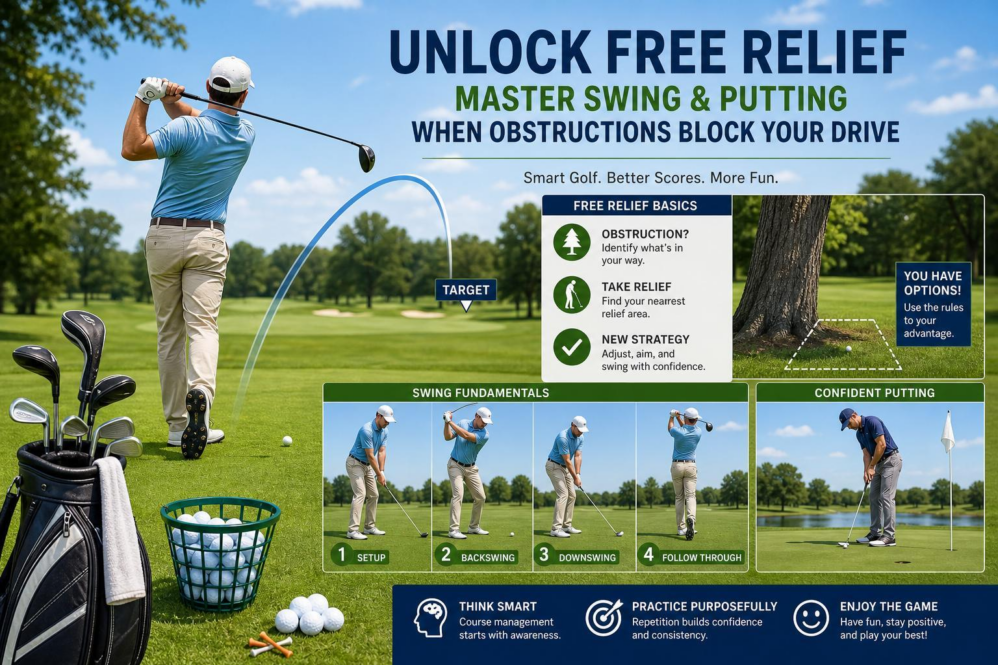
Unlocking Your Swing Potential When Trees and Bushes Get in the Way
Navigating shots when trees and bushes impede your path requires a blend of technical skill and strategic course management. Frist, assess your lie and the obstruction carefully. If your ball rests near an immovable obstruction like a tree trunk or dense bush, you may be entitled to free relief under the Rules of Golf (Rule 16.1). This allows you to drop the ball within one club-length of the nearest point of relief, no closer to the hole. Use this rule to avoid unnecessary risk while maintaining your scoring potential. When a direct shot is blocked, consider shaping your shot-executing a controlled fade or draw-to curve the ball around the obstacle. To master shot shaping, practice adjusting your clubface alignment and swing path: setting up with your feet, hips, and shoulders slightly open can promote a fade, whereas a closed stance encourages a draw. Incorporating this skill increases your versatility and confidence when confronting challenging lies near natural course features.
Improving your swing mechanics is basic when negotiating tight spaces near trees and bushes. Focus on maintaining a compact backswing and controlled tempo to prevent clipping branches or losing balance. A shorter, more purposeful swing reduces the risk of interference and promotes crisp contact. Setup fundamentals should emphasize a narrow stance and ball position slightly back in your stance to encourage a steeper angle of attack, which helps clear low-hanging limbs. Additionally, using a club with more loft-such as a hybrid or high-lofted iron-can aid in launching the ball higher and softer, ideal for clearing obstacles and stopping quickly on the green. Regular practice drills like swinging with a towel under your arms help reinforce connection and prevent excessive hand manipulation, critical for maintaining precision in confined spaces. Over time, these mechanical adjustments enhance your shot consistency and control under pressure.
Strategic course management plays an equally important role when trees and bushes threaten your shotmaking options. Before executing a risky attempt at clearing an obstruction, consider playing a safer layup shot to an open area of the fairway or rough, setting up a clean approach for your next stroke.Visualize alternative target lines and evaluate the wind direction and speed, which can greatly influence your ball flight around vegetation. Employing pre-shot routines that incorporate mental rehearsals helps manage nerves and sharpens focus, both vital for executing delicate shots amid natural obstacles. For golfers of all skill levels,learning to recognize when to take the aggressive route versus the conservative one leads to smarter decisions and consistently lower scores. Implementing these techniques gradually into your rounds ensures steady progress and builds the confidence necessary to handle any tree-lined hole with poise and skill.
How to Adapt Your Putting Technique for Obstructed Shots
When faced with an obstructed putt, adjusting your putting technique starts with a careful assessment of the line and any immovable obstructions, such as sprinkler heads or cart paths. According to the Rules of Golf, if an immovable obstruction interferes with your stance or the area of your intended swing, you are typically entitled to free relief within one club-length, no closer to the hole. Start by determining your target line as if the obstruction were not there, then identify the closest point where you can drop your ball without penalty. This adjustment ofen requires a slight modification of your stance and alignment. Focus on maintaining your putting setup fundamentals-feet shoulder-width apart,eyes over the ball,and a relaxed grip-while incorporating the new stance position. Practicing these alignments regularly will help you become agreeable with stance changes and build confidence in managing tricky greens.
Next, modify your stroke mechanics to accommodate the altered setup and to effectively navigate any sloped terrain near the obstruction. Since your typical straight-line stroke path may no longer be feasible, emphasize a smooth, pendulum-like motion with controlled acceleration through the ball. Pay attention to the face angle of the putter at impact; small adjustments here can help you gently curve the ball around the obstruction when a direct line isn’t possible. Such as, opening the putter face slightly combined with a slightly inside-out stroke path can produce a reliable draw shape, while closing the face creates a fade.Incorporate short-range drills where you practice these shot shapes using alignment sticks or chalk lines to train your muscle memory and feel for the correct face angles and swing arcs. This focused practice will refine your touch and improve your green-reading capabilities.
integrate course management strategies into your approach by thinking beyond the immediate shot. Sometimes the smartest play when confronting an obstruction is to accept a longer,more straightforward putt rather than attempting a risky curved shot. Visualize alternative landing spots on the green where speed and break are more manageable, factoring in grain direction, moisture level, and green speed-especially on fast or undulating greens.Additionally, manage your mental game by staying patient and confident; visualizing success can reduce tension and promote a fluid stroke.For beginners, emphasize developing a consistent pre-putt routine that includes practice strokes aimed at gauging speed and direction. Advanced golfers might incorporate video analysis or launch monitor feedback to fine-tune these adaptive techniques. Over time, mastering the interplay between setup adjustments, stroke modifications, and strategic thinking will elevate your putting performance under all conditions, ultimately leading to more consistent scoring and lower scores.
Smart Strategies to Regain Confidence and Control Around Obstacles
regaining confidence and control around obstacles begins with understanding how to effectively manage your stance, alignment, and shot selection in challenging positions. When faced with uneven lies, thick rough, or trees obstructing your swing path, adjusting your setup fundamentals is crucial. Start by stabilizing your lower body, widening your stance approximately an additional 1-2 inches to improve balance. Align your shoulders parallel to the intended swing path, but open your clubface slightly to help navigate around obstacles without sacrificing distance. Incorporate a controlled, abbreviated backswing during practice to maintain rhythm and minimize over-swinging, which often leads to mishits.A practical drill involves placing alignment sticks on the ground to simulate the swung club path and rehearse swinging on plane while avoiding imaginary obstructions-this builds muscle memory and spatial awareness critical for obstacle navigation.
Course management also plays a pivotal role when obstacles threaten your stroke count. Recognizing when to take a %22safe shot%22 versus attempting a riskier trajectory can save valuable strokes. For example, if a low-hanging tree branch blocks your standard follow-through plane, consider a punch shot or a knockdown shot, which entails reducing loft by gripping down the club and employing a shorter, more penetrating swing. this technique decreases ball height and spin, allowing control through limited clearances. Additionally, familiarize yourself with the local rules regarding immovable obstructions-if a cart path or sprinkler interferes with your stance or swing area, you are entitled to free relief by dropping the ball within one club length without penalty. Practicing such deliberate tactical decisions helps build strategic patience and reinforces a methodical mindset that combats impulsivity often triggered by tough lies.
On the mental front, overcoming frustration and maintaining composure amid obstacles is just as vital as technical proficiency. Incorporate pre-shot routines that focus on visualization and controlled breathing to calm nerves,especially after errant shots. Adopt the mantra of “play %22to%22 a target, not %22away from%22 a hazard,” which shifts focus from fear to purposeful action, fostering positive confidence. Emphasize drills such as the %22clock drill%22 around the greens to enhance precision in delicate chip and pitch shots near bunker lips or thick rough, where control around hazards is indispensable. By gradually increasing the difficulty of these practice scenarios-varying lie conditions and obstacle proximity-you create a resilient mindset paired with refined short game skills, directly translating to better scoring opportunities and a more fearless approach to obstacles on the course.