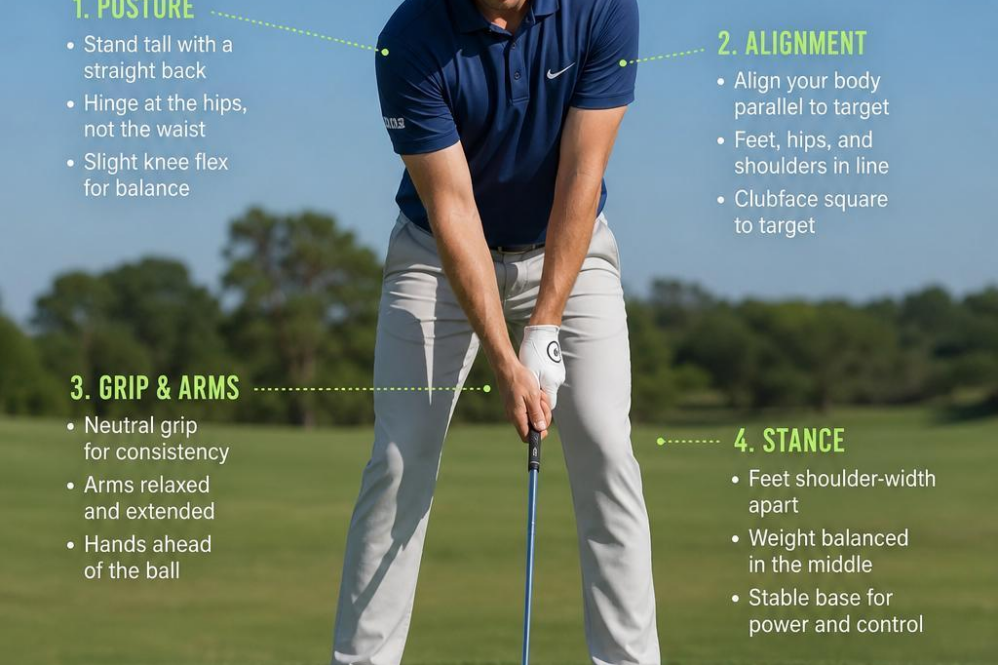
Understanding the Fundamentals of a Powerful and Consistent Swing
Mastering a powerful and consistent golf swing begins with a solid setup and basic mechanics. Start by positioning your feet shoulder-width apart to create a balanced base,with your weight evenly distributed between the balls of your feet. The spine angle should be tilted slightly forward from the hips-about 20 to 25 degrees-to maintain proper posture throughout the swing. Grip pressure plays a crucial role; hold the club with a firm yet relaxed grip,avoiding tension that can inhibit fluid motion.When addressing the ball, ensure your hands are positioned slightly ahead of the clubhead through impact, promoting a downward strike essential for crisp contact, especially with irons. A common mistake to watch for is an over-the-top swing path,which often leads to slices. To correct this, focus on initiating the downswing from your lower body, allowing your hips to rotate naturally while maintaining the club on an inside path. Incorporate drills such as the “pause and go” to build tempo,where you pause briefly at the top of your backswing before smoothly accelerating through the ball. This helps develop timing and prevents rushing the swing, key to repeatable power and accuracy.
Beyond the mechanics,understanding how to apply your swing effectively in various course conditions will enhance your overall performance. For example, when navigating windy conditions or tight fairways, a controlled swing with a slightly abbreviated backswing of 3/4 length can increase accuracy without sacrificing too much distance. Additionally,mastering trajectory control-altering your ball flight by adjusting the clubface and ball position-can give you an edge around hazards. Positioning the ball slightly back in your stance with a more closed clubface can produce a penetrating low ball flight, ideal for windy days or approach shots that need to run out. Moreover, integrating a focused short game routine that emphasizes both distance control and finesse will dramatically improve scoring. practice drills such as chipping to progressively smaller targets and varying your stroke speed to simulate different lies will help build touch around the greens. Remember, every technical adjustment and practice session should be complemented by course management strategies: know when to play conservatively versus aggressively based on hole layout, pin placement, and your swing confidence. The synergy between technical mastery and strategic decision-making will transform your game from inconsistent to consistently competitive on any course.
Navigating the Course with Smart Driving strategies That Boost Accuracy
Optimizing your driving strategy begins with mastering your setup fundamentals and swing mechanics to enhance accuracy off the tee. Start by assessing your stance width-generally, placing your feet about shoulder-width apart offers a stable base for balance and power transfer. Align your body parallel to the intended target line while incorporating a slight open or closed stance depending on desired shot shape. During the swing, focus on a smooth takeaway to initiate a controlled backswing, emphasizing a wide arc formed by extending your lead arm fully. This promotes consistent clubhead speed and better contact at impact. Incorporating drills such as the “gate drill,” where tees are placed just wider than the clubhead to train an exact swing path,helps both beginners and advanced players eliminate common errors like hooking or slicing. Additionally, adjusting ball position slightly forward in your stance-typically just inside your front heel for a driver-enables optimal launch angle around 10 to 14 degrees with moderate spin, crucial for maximizing carry distance while maintaining control.Understanding these technical elements empowers golfers to drive with precision, reducing errant shots and setting up easier approach shots.
Once the mechanics are dialed in, integrating strategic course management elevates your driving effectiveness under various conditions. Evaluate hole layout, hazards, wind direction, and turf firmness to select the appropriate club and shot shape. For example, when facing a narrow fairway guarded by water on the left, opting for a controlled fade with a slightly open clubface can safely steer the ball away from danger, whereas a downwind tee shot may favor a penetrating draw for added roll. Incorporate target visualization by identifying precise landing zones-such as the widest section of a fairway or a flat lie-to improve confidence and shot selection. Practice routines like hitting shots to specific targets at varying distances during range sessions help solidify these decision-making skills. Remember, striking a balance between aggression and caution based on your skill level and course conditions will lower scores effectively. Low handicappers might routinely utilize shot shaping and trajectory control, whereas beginners benefit from mastering consistent, straight drives within their comfort zone before advancing to more complex strategies.
Putting Secrets Every Golfer Should Know to Lower Their score
Mastering the art of putting requires a blend of precise setup, confident stroke mechanics, and keen green reading skills. Start by focusing on your stance and alignment: position your feet shoulder-width apart, with the ball centered or slightly forward in your stance to promote a smooth, pendulum-like stroke. Your eyes should sit directly over the ball or just inside the target line, which helps create a consistent putting line. Next, emphasize a controlled tempo rather than force; a steady, rhythmic stroke encourages better distance control and reduces tension in the wrists. Incorporate drills such as the “gate drill,” where two tees set slightly wider than your putter head ensure a square path through impact,helping eliminate common mistakes like pushing or pulling putts. Additionally, practice varying distances-both short, lag putts and 10- to 15-footers-to build adaptability under pressure. To enhance green reading, learn to assess slopes by viewing putts from multiple angles, allowing subtle breaks and undulations to inform your aim point. Understanding how grain direction affects ball roll, especially in different weather conditions, also refines your touch. For example, putts downhill with the grain will speed up considerably, demanding softer strokes and heightened focus on distance control.
Integrating course strategy into your putting routine transforms it from a mechanical skill into a scoring weapon. Before each putt, take time to visualize your target line and incorporate the pace as part of your routine. On faster greens, commit to accelerating through the ball to avoid deceleration that skews distance. conversely, on slower or damp surfaces, increase your follow-through slightly to reach the hole effectively. An effective mental approach involves pre-shot visualization and positive self-talk, helping reduce anxiety and maintain confidence on crucial putts. Equipment choices, too, impact performance-select a putter head style that complements your stroke arc, whether blade, mallet, or high-MOI designs, and consider grip thickness to control tension. Remember, course management extends to knowing when to “give up on the hole” and focus on minimizing three-putts by lagging safe if a long birdie opportunity feels risky. Incorporate routines such as the clock drill (putting from various points around a hole) to build precision under pressure, and regularly evaluate your average putts per green as a measurable metric to track progression. By combining technical mastery with strategic courseplay, you’ll steadily lower your scores through smarter, more confident putting.
Progressive Drills to Build Confidence and Master Your Game Step by step
Begin your progression by focusing on swing mechanics through controlled, incremental practice sessions. Start with half swings emphasizing correct wrist hinge and clubhead path to ingrain muscle memory, gradually extending to full swings while maintaining balance at a 45-degree shoulder turn for rotational power. Employ alignment rods during setup to ensure your feet, hips, and shoulders are square to the target line-a fundamental that significantly reduces directional errors. Incorporate drills such as the “gate drill,” where two tees are positioned just wider than the clubhead near the ball to improve swing path and prevent slicing or hooking. As you refine your driving, practice tee shots focusing on target-specific placement-aiming toward fairway corridors that maximize birdie opportunities and reduce risk, such as avoiding out-of-bounds areas set by course markers. This approach couples mechanical precision with strategic shot planning, enabling you to manage varying tee-box positions and wind conditions effectively, a crucial skill in tournament play. Common mistakes to watch for include over-rotation leading to loss of control and inconsistent grip pressure, which can be remedied by slow-motion drills and grip adjustments using a Towel Drill to build tactile feedback.
Transition your practice to the short game by mastering pitching, chipping, and green reading techniques that can shave critical strokes off your score. Begin with a focus on weight distribution, ideally 60% on the front foot during chip shots to promote crisp contact. Use the “clock drill” around the green,placing balls at varying distances and angles to simulate course variety and improve versatility in trajectory control. To enhance your putting, train with visual aids like the “gate drill” for stroke alignment and the “ladder drill” to develop distance control across different green speeds, which fluctuate notably due to weather and mowing patterns under USGA rules.Integrate routine green reading by assessing slope percentages and grain direction, which affect ball roll significantly, enabling you to predict breaks and speeds more accurately. when confronted with uneven lies or gusty conditions, adjust stance width and clubface angle to modulate spin and shot shape, practicing intentional shot shaping exercises such as fades and draws with mid-irons to sharpen wind navigation. Reinforcing mental focus through pre-shot routines and visualization techniques links your technical skills with decision-making prowess, ensuring that progressive drills cultivate not only physical mastery but also on-course confidence and adaptability.