
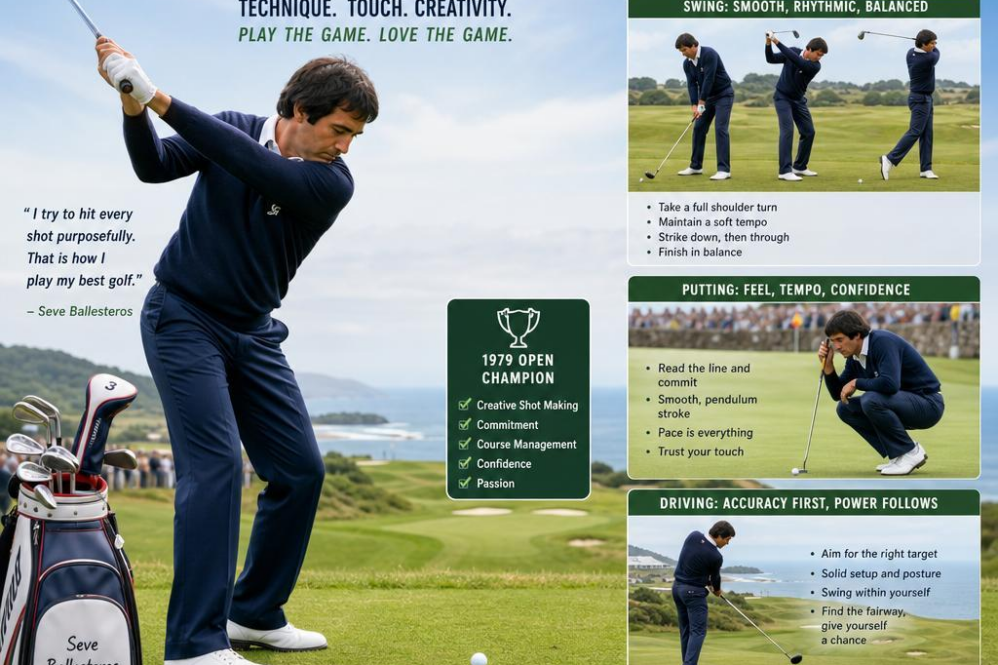
Uncovering the Magic Behind Seve’s Swing That Dominated The 1979 Open
Seve Ballesteros’ swinging prowess during the 1979 Open Championship was a blend of natural flair and highly refined mechanics, which every golfer can learn from.At the heart of his swing was a compact takeaway with the clubhead staying close to the ground for the initial six inches, promoting consistent contact and control. He maintained a slight forward shaft lean through impact, which encouraged a crisp ball strike and a penetrating ball flight ideal for the firm links conditions of Royal Lytham & St Annes. To emulate Seve’s success, golfers should focus on drills that emphasize maintaining a consistent swing plane-such as swinging with alignment rods or using slow-motion swings in front of mirrors. Attention to the setup fundamentals-feet shoulder-width apart, balanced weight distribution at about 55% on the lead leg, and a relaxed grip pressure-can also stabilize the swing and improve shot reliability across various lies and wind conditions.
The short game was where Seve truly distinguished himself, demonstrating exceptional creativity and touch around the greens. One notable element was his mastery of the open-faced wedge technique which allowed him to produce high-spinning chips and delicate flop shots. This technique involved opening the clubface by about 15 to 20 degrees, widening the swing arc for added precision and control over trajectory.For golfers striving to lower their scores, practicing this shot from different turf conditions is essential-repetitive drills that partner controlled distance wedges with varying degrees of loft can dramatically improve shot versatility. Additionally, Seve’s strategic use of bump-and-run shots under windy conditions showed how understanding how to adapt trajectory can reduce risk around links-style greens. Players should also be aware of common errors like excessive wrist breakdown or closed clubface during these shots and focus on keeping the lead wrist firm through impact for cleaner contact.
Strategically, Seve’s course management during the 1979 Open highlighted his ability to leverage risk-reward scenarios effectively.While many challenged the links’ daunting hazards head-on, Seve often opted for precise positioning, opting to place shots safely in the center of fairways and greens with a controlled draw or fade depending on pin placement and wind direction. This approach minimized penalties and set him up for easier up-and-downs, ultimately reducing score volatility. Golfers can adopt this strategic mindset by proactively assessing conditions before each shot and prioritizing targets that fit their shot shape tendencies-the implementation of a simple pre-shot routine incorporating visualization and wind assessment can facilitate this process. For those aiming to improve on-course decision-making, practicing simulated course management scenarios during practice rounds, including forced carries and recovery shot options, helps ingrain smart play habits that translate directly to scoring improvements.
How Seve’s Putting Technique Transformed Pressure Into Precision
Mastering Seve Ballesteros’s putting technique begins with fundamental setup principles that foster consistency under pressure. Seve advocated a slightly open stance with feet shoulder-width apart, enabling more fluid hip rotation and natural arm pendulum motion.Positioning the ball just ahead of center in the stance promoted a subtle forward stroke, helping to reduce skidding and encourage a clean, controlled roll.Beginners should focus on establishing a repeatable routine,including a smooth takeaway using the shoulders rather than the wrists,ensuring the face remains square through impact. For intermediate and advanced players, refining the loft interaction by experimenting with a putter loft around 3 to 4 degrees can enhance feel, particularly on fast, undulating greens typical of links courses like Royal Lytham & St Annes where Seve triumphed in 1979.
Seve’s prowess at transforming pressure into precision can largely be credited to his nuanced control of pace and line, critical for effective trajectory management on complex greens. His putting strokes were subtly adapted to green firmness and slope, emphasizing judgment over brute force. To emulate this,golfers can practice distance control drills where the goal is to lag putts within a 3-foot circle from varying lengths,thus minimizing three-putts. Moreover, readying the mind to “commit” to the intended line and speed improves execution under tournament stress. For example, during the 1979 open, Seve’s ability to read subtle grain directions allowed him to aggressively target pins while maintaining confidence in uphill and sidehill breaks. Intermediate players should incorporate drills involving different green speeds and slopes, while low handicappers may benefit from video analysis to fine-tune stroke arc and face angle at address and through impact.
Strategically, Seve’s putting instruction extended beyond mechanics to include mental grit and course management, helping golfers adapt swiftly to changing conditions. His advice to stay mentally agile includes focusing on the process rather than results-mentally rehearsing each putt’s pace and line to reduce anxiety. Practically, this can be reinforced through pre-putt routines such as visualizing the ball’s path and focusing on smooth acceleration through the ball to ensure optimal roll. On fast greens or windy days, he adjusted the strike to a softer touch while maintaining face stability to avoid skidding. Advanced golfers can incorporate routine evaluation of green topography combined with controlled practice of different putting speeds, improving both confidence and scoring consistency. For beginners, understanding that consistency comes from purposeful practice and mental focus is the first step toward replicating Seve’s calm and calculated putting mastery under pressure.
Driving with Confidence Understanding Seve’s Approach Off The Tee
Seve Ballesteros revolutionized tee shots with his unique blend of creativity and precision, demonstrating how confident driving can dramatically shape scoring opportunities. Central to his approach was a balanced setup: feet shoulder-width apart, weight distributed evenly but slightly favoring the lead foot (about 55% weight), and the ball positioned just inside the lead heel to promote an ascending strike. This alignment facilitated a controlled yet powerful swing path, reducing slices and hooks. For modern golfers, whether beginners or low handicappers, adopting this setup ensures a more consistent strike pattern and improved dispersion. A key focus is maintaining a smooth tempo-Seve’s fluid rhythm allowed him to accelerate through impact without tension. Try practicing with a metronome app set to around 60 bpm to internalize this steady tempo.
Driving with confidence also requires strategic visualization and shot planning, areas where Seve excelled during his victorious 1979 Open Championship rounds under variable wind conditions. He frequently adjusted his ball flight by controlling the clubface angle and swing path, promoting a controlled fade or draw as needed to navigate tight fairways. To emulate this tactical edge, golfers should incorporate pre-shot routine drills, including aiming lines, wind assessmentand shot shape rehearsals. Equipment choices also play an essential role; as an example, experimenting with shaft flex and clubhead loft (typically 9°-11° for drivers) can help optimize launch angle and spin rate for your swing speed. Practicing these variations on the driving range encourages adaptability and trust in your shot-making decisions during competition or casual play.
cultivating confidence from the tee demands a consistent practice regimen that blends technical refinement with mental focus. Incorporate drills such as tee-to-target alignment checks with alignment sticksand use video analysis to identify and adjust swing plane deviations-aiming to maintain a clubhead path within ±5° of the target line at impact. Address common errors like early extension or casting by incorporating hip hinge drills and pause-and-restart swings to build muscle memory.Equally important is nurturing positive self-talk and visualization exercises to reduce anxiety and enhance execution under pressure, mirroring Seve’s resilient mindset on championship days. By integrating these mechanical, strategicand psychological elements, golfers can drive off the tee with greater control, distanceand scoring potential across varied course conditions.
Bringing It All Together Crafting Your Game Inspired by Seve’s Championship Style
Seve Ballesteros’s masterful performance at the 1979 open Championship offers timeless lessons in combining swing mechanics with strategic course management. One of the key takeaways is his exceptional ability to shape shots-both fades and draws-to navigate tricky fairways and greens. To emulate this, start by focusing on your grip and stance alignment: position your feet, hipsand shoulders slightly closed to encourage a drawor open them subtly for a fade. Practice these shot shapes with a mid-iron at the range using incremental ball position adjustments-about 1-2 inches forward for draws and slightly back for fades. Incorporate drills like swinging with an alignment stick to promote the correct swing pathand use launch monitors to track shot shape consistency. By mastering these fundamentals, from setup to release, you develop the versatility to adapt to changing course layouts and wind conditions, much like seve’s intuitive on-course adaptations.
Beyond swing mechanics, Seve’s brilliance lay in his unwavering commitment to intelligent course management. He frequently enough played conservatively off the tee to set up high-percentage approaches, a strategy every golfer should adopt regardless of skill level. Before each hole, analyze hazards, pin positionsand prevailing wind conditions, then select the club and shot shape that minimize risk while maximizing scoring opportunity. For instance, when facing a narrow fairway with water hazards, choose a reliable fairway wood or hybrid instead of a driver to maintain control and reduce the chance of penalty strokes. Practice this decision-making by simulating various course scenarios-use target flags at different distances and intentionally avoid aiming for the center with driver; instead, steer toward safer zones. this deliberate approach reduces strokes per round and builds confidence in your shot selection under pressure.
integrating a precise short game and putting routine inspired by Seve’s flair can transform your scoring ability. His touch around the greens, particularly his deft bump-and-run chips and imaginative putts, demonstrates the value of developing multiple shot options for delicate situations. Begin by refining setup fundamentals like a narrow stance and lower hands at address to promote crisp contact and better control. Experiment with various wedges to find the right bounce and loft combination for different lies-soft sand versus tight turf demands different clubface angles and swing speeds. Incorporate drills such as the clock drill around the practice green to improve distance control and green reading. moreover, nurture your mental game by visualizing the exact trajectory and landing spot before each shot, just as Seve did in high-stakes moments. This holistic, practiced approach to your short game and putting will directly translate into fewer three-putts and more up-and-down saves, charting a clear path toward lower scores.




