Unlocking the Mechanics Behind sir Nick Faldo’s Powerful and Precise Swing
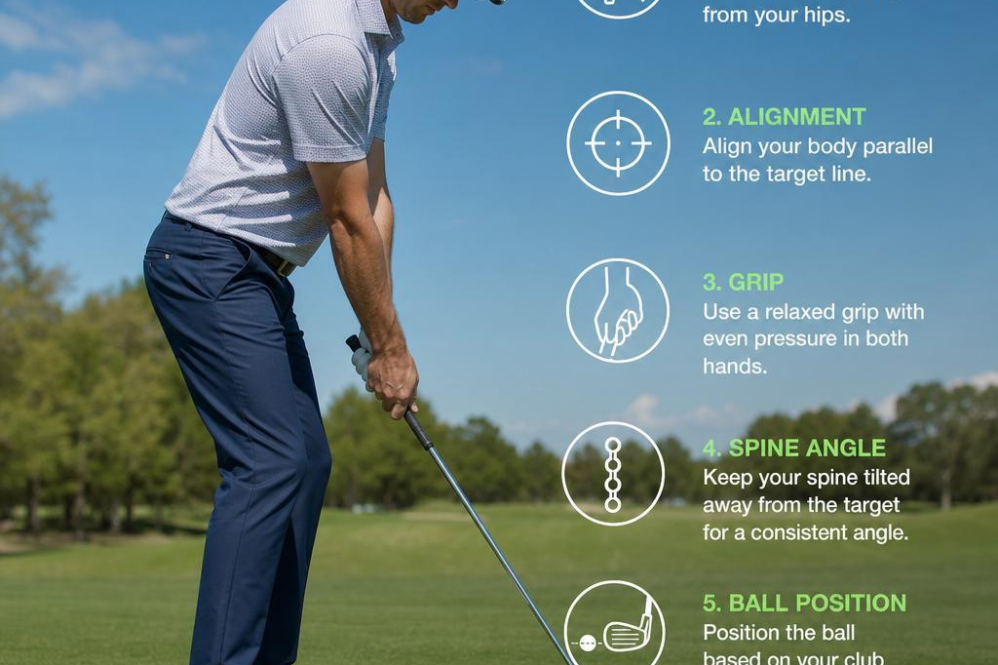
Sir Nick Faldo’s swing is renowned for its precision and repeatability, rooted in a flawless foundation of setup and mechanics.Begin by focusing on a neutral spine angle with a subtle tilt away from the target, establishing balance and rotational freedom. Faldo emphasized a slightly narrower stance than many amateurs assume, roughly shoulder-width apart, to promote stability while allowing efficient weight transfer. A key takeaway is maintaining a consistent hand position just ahead of the ball at address, creating the ideal forward shaft lean for crisp contact. As you initiate the backswing, strive to complete a full shoulder turn to approximately 90 degrees, ensuring yoru left arm remains straight but relaxed-this builds the coil that powers the downswing without sacrificing control.Practicing this setup and backswing in slow motion, using alignment sticks to verify shoulder and hip positions, can ingrained the biomechanics essential to Faldo’s crisp, powerful delivery.
Transitioning from the top of the swing through impact,Faldo’s technique shines in its blend of timing and release,which produces both distance and precision. He mastered the principle of lag-maintaining the wrist hinge as the arms begin to descend-generating significant clubhead speed while preserving control. To replicate this, practice the “pump drill,” where you stop halfway down and hold the lag, reinforcing muscle memory for delayed release. At impact, ensure your hips have rotated open towards the target about 45 degrees ahead of your shoulders, promoting an inside-out club path that helps prevent slices and encourages straighter shots. another crucial component is a firm left wrist, avoiding early cupping that leads to inconsistent contact and loss of power. Integrate impact tape or foot spray on the clubface into practice sessions to receive instant feedback on strike quality, aiming for that sweet spot consistently. Applying these mechanics during on-course scenarios-such as executing tee shots into tight fairways or long approaches under pressure-fosters better shot shaping and trajectory control.
Beyond the physical execution, Faldo’s golf mastery includes meticulous course strategy that leverages his swing’s strengths while managing risk intelligently. For beginners learning from Faldo, understanding how to visualize shot placement based on your swing tendencies and club distances is critical.Faldo advised setting target zones rather than just focusing on maximum distance; for example, aiming for the center of a fairway bunker to leave a clear approach shot rather than trying to clear the green completely. Practice routines that combine full swings with purposeful partial shots to simulate a variety of course conditions enhance adaptability.For low-handicap players,analyzing wind,lie,and pin positions to adjust trajectory and club choice underscores the strategic layer behind Faldo’s consistent scoring. embracing a routine that incorporates mental rehearsal of shots, staying committed to your pre-shot routine, and adapting your swing tempo per conditions connect technical proficiency with championship-caliber decision-making.
How to Translate faldo’s Driving Techniques into Your Game for Consistent Distance
Sir Nick Faldo’s driving technique centers on achieving a harmonious blend of power and precision, rooted in a fundamentally sound setup.To translate this into your game, begin by establishing a stable base with your feet shoulder-width apart and ensuring your weight is balanced evenly across both legs. Faldo’s swing emphasizes a slightly tilted spine angle, leaning just enough to promote an upward strike on the ball with a driver-a key to maximizing launch angle and minimizing spin. Focus on maintaining a ball position just inside your left heel (for right-handed golfers),which allows the clubhead to ascend through impact,promoting optimal distance. To develop this setup consistently, incorporate these checkpoints in your routine:
- Maintain relaxed but firm grip pressure to avoid tension;
- Keep your chin raised slightly to allow a full shoulder turn;
- Ensure your front shoulder is lower at address, encouraging an upward strike.
This foundation sets the stage for a repeatable swing that harnesses Faldo’s trademark mechanical efficiency.
building on this foundation, the mechanics of Faldo’s swing revolve around a deliberate, methodical tempo combined with precise sequencing of the body’s movements.Unlike an overly aggressive driver swing, Faldo advocates a smooth takeaway, with the clubhead moving slowly at first to allow the arms and shoulders to sync perfectly. As you progress to the downswing, focus on initiating with the hips, creating torque by coiling the torso against a planted lower body. This enables a powerful yet controlled release through impact, where the clubface squarely meets the ball with minimal deviation.To practice this, try the following drills which cater to all skill levels:
- Use a tempo metronome set around 60-70 beats per minute to synchronize your takeaway and downswing;
- Practice slow-motion swings focusing on hip initiation and wrist retention until the impact zone feels natural;
- Hit half shots ensuring the clubface remains square at impact-use alignment sticks placed parallel to your ball-target line for feedback.
Integrating these techniques gradually will enhance your control and generate consistent distance while avoiding common errors like casting or early release.
Faldo’s approach to driving transcends pure mechanics by embracing strategic course management and mental focus,which are crucial for converting swing improvements into real scoring gains.Understanding when to prioritize accuracy over sheer distance can transform round outcomes-this means selecting the right tee placement and club based on hole layout, wind direction, and course conditions.Faldo frequently enough leveraged target-oriented visualization combined with pre-shot routines to maintain confidence and composure under pressure.Incorporate these concepts by practicing situational drills such as:
- Playing “pressure tee shots” during practice rounds where you simulate narrow fairways or hazards;
- Visualizing intended ball flight shapes (fade,draw,or straight) before each drive;
- Adjusting grip pressure or stance width to accommodate windy or wet conditions.
Through these mental and strategic adaptations, you connect your technical improvements with your overall game, fostering a resilient mindset that helps maximize distance without sacrificing control or consistency on the course.
Putting Like a Pro with Faldo’s Strategic Approach and Simple Yet Effective Drills
Start by mastering your setup fundamentals, a cornerstone of Sir Nick Faldo’s strategic putting approach. Align your eyes directly over the ball to establish true target line visualization, and position your feet shoulder-width apart for stability, ensuring your putter face is square to the intended line. Faldo advocates for a slightly narrower stance on longer putts to encourage a smoother pendulum stroke. Consistent setup eliminates common flaws such as deceleration or off-line starts, which can drastically affect distance control and aim. Practice this alignment daily by placing two alignment rods parallel to your target line, then make repeat strokes focusing on maintaining that precise eye-ball-putter relationship. Not only does this foundation build confidence, but it also fosters muscle memory essential for consistent roll and improved green-reading accuracy.
Building on your setup, Faldo emphasizes the integration of controlled tempo and rhythmic stroke mechanics, which are pivotal for executing high-percentage putts under pressure. employ a smooth backswing that is equal in length and speed to the follow-through, roughly translating into a pendulum motion driven by the shoulders rather than the wrists.To refine this motion, include drills such as the “clock drill,” where you visualize the face of a clock on the putting green and make strokes back to the 10 o’clock position and forward to 2 o’clock, promoting even-paced tempo and consistent striking. This drill enhances your ability to regulate distance through precise swing length and impact control,essential when factoring in green speed variations and slope breaks. Integrating the mental discipline of focused breathing during pre-putt routines will also steady nerves, reinforcing shot execution confidence in tournament scenarios or challenging course conditions.
Faldo’s method incorporates advanced course management tactics by reading greens with a strategic mindset, turning potential three-putts into scoring opportunities. learn to assess break intensity by observing grain direction, sunlight, moisture, and slope gradient, using tools like the plaque Method-anchoring your perspective at the ball, midway flag position, and overall green contour. Faldo encourages golfers to visualize the ball’s path from multiple vantage points and to play the percentage shot, favoring slight conservative aim points on downhill putts or fast surfaces to avoid aggressive misses. Practice drills such as lag putting from varying distances with a focus on smooth acceleration, aiming to reduce three-putts by at least 20%. This holistic approach-combining setup mastery, stroke refinement, and green-reading intelligence-not only sharpens your short game precision but ultimately lowers your scoring average by turning putting into your competitive advantage.