
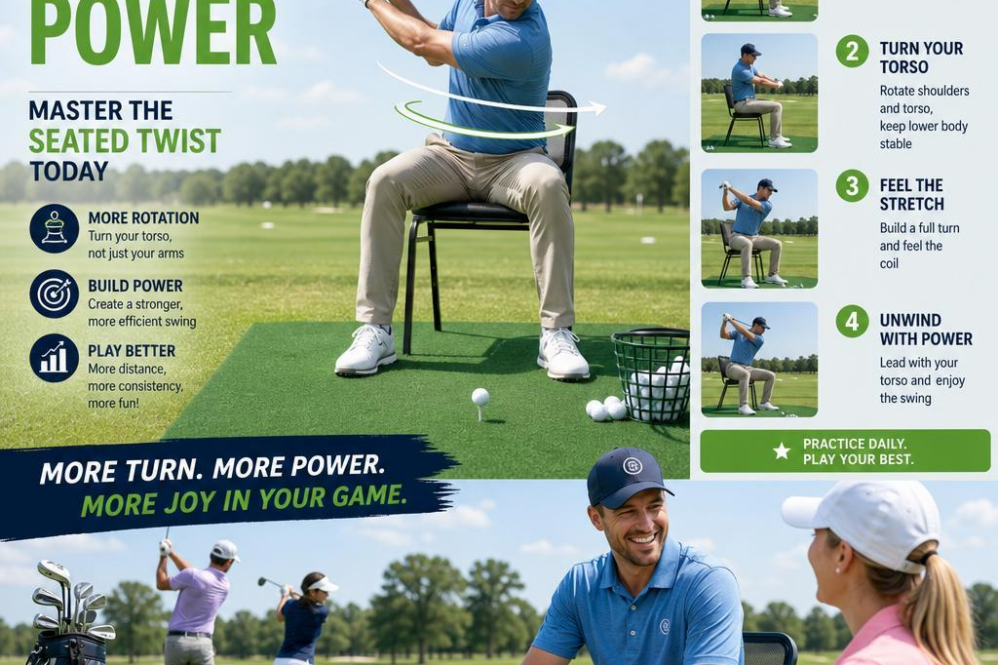
Unlock Your Golf Swing Power by Enhancing Core Mobility with the Seated Twist
Building core mobility is essential for generating powerful and consistent golf swings, and the seated twist exercise is a highly effective method to develop this crucial aspect. By focusing on controlled torso rotation while maintaining a stable pelvis,golfers can improve their swing’s coil and uncoil mechanics. To perform the seated twist properly, sit upright on a chair with feet flat on the ground, hips squared forwardand hands gently clasped in front of the chest. From this position, rotate your upper body to one side, aiming for a torso rotation of approximately 45 to 60 degrees without moving your hips.This stretch not only increases spinal adaptability but also mimics the dynamic rotation of the backswing and follow-through phases, ultimately contributing to greater clubhead speed and power in driving and iron play. For beginners, the focus shoudl be on slow, deliberate twists to avoid overstretching, while advanced players can incorporate resistance bands or medicine balls to enhance rotational strength.
Integrating the seated twist into your practice routine directly supports refining swing mechanics, especially the transition from backswing to downswing, where energy transfer peaks. By regularly emphasizing core rotation control, golfers can achieve a more synchronized hip and shoulder turn, which reduces common faults like over-swinging or sliding the hips laterally. Key setup fundamentals to reinforce during the seated twist include maintaining a neutral spine, engaging the abdominal muscles, and keeping the head steady to simulate optimal swing posture. Additionally, when on the course, applying improved core mobility helps golfers adjust to varying lies and wind conditions by enabling adaptive swing plane modifications without compromising balance. Practicing drills such as slow-motion swings combined with seated twists can help identify and correct inconsistencies in timing and sequencing, providing measurable improvements in swing tempo and shot accuracy.
beyond technique, the seated twist builds not only physical capacity but also mental awareness crucial for effective course management. Developing a dependable rotational range allows players to better control shot shape and trajectory, especially in pressure situations where precision putting and driving consistency dictate scoring potential. To maximize benefits, incorporate a series of progressive repetitions-starting with sets of 10 twists per side holding each for 5 seconds-into your warm-up or cool-down phases. Monitor progress by tracking improvements in range of motion and perceived ease during full swing drills. Golfers should be mindful of common mistakes such as twisting too quickly, which can lead to loss of postureor neglecting breath control that maintains fluid movement. by linking the mobility gained from the seated twist to tactical choices around the course, players from novice to advanced levels can enhance both their physical execution and strategic resilience, ultimately transforming their golf performance.
Discover How Proper Seated Twist Technique Builds Strength for a More Explosive Swing
The seated twist exercise serves as an essential drill to enhance rotational strength and flexibility, critical components for a powerful and consistent golf swing. When performed correctly, this technique trains the core muscles-particularly the obliques, transverse abdominisand erector spinae-to create a more explosive and controlled coil.Golfers should focus on achieving a torso rotation of approximately 45 to 60 degrees from the neutral seated position, mimicking the dynamic range necessary during the backswing and follow-through phases. maintaining a stable pelvic alignment throughout this motion is crucial; it prevents compensatory movements that can misalign the swing plane and cause inconsistency. For beginners, starting with slow, controlled reps emphasizing form provides a safe foundation, while advanced players can intensify resistance or add a medicine ball to increase power development. Strong core engagement gained through such seated twists directly translates into enhanced clubhead speed and improved shot distance, particularly on drives and full swings.
Integrating the seated twist into your regular practice routine not only builds physical strength but also reinforces proprioceptive awareness, which helps golfers improve sequencing during their swing mechanics. Such as, a well-executed twist promotes efficient energy transfer from the lower body through the torso to the upper body, reducing tension and lagging in the downswing. This biomechanical optimization leads to more precise strike location and better control over trajectory and ball flight, especially when combined with consistent grip and stance fundamentals. A recommended drill involves sitting on a golf ball or balance disc while performing controlled twists; this challenges stability and simulates the subtle pelvic rotations experienced on uneven course terrain. Additionally,golfers should emphasize hip-to-shoulder separation of at least 20 degrees to maximize torque,which is a key factor in generating powerful drives and crisp iron shots. By practicing seated twists alongside putting drills and driving exercises, players will develop a holistic approach that balances power with finesse.
From a course management perspective, understanding the benefits of core strength and rotational power achieved through seated twisting can influence strategic decisions under various conditions. For instance, stronger torso rotation helps maintain swing tempo and posture during windy or uneven lie scenarios, allowing for more confident shot execution without compromising accuracy. It also supports a more reliable short game by stabilizing the upper body during delicate putting strokes and chip shots,where minimizing extraneous movement is essential for precision. Golfers should aim to include at least three to five sets of 12 to 15 controlled seated twists in their warm-up or strength training sessions to condition the muscles progressively.Furthermore, combining these physical gains with mental focus enhances a player’s ability to visualize swing sequences, improving consistency and lowering scores. By embedding this technique into daily training, golfers across all skill levels can build a stronger foundation for both powerful drives and refined putting, leading to sustained on-course success.
Integrate Seated twist exercises into Your Routine for Better Drive Distance and Accuracy
Incorporating seated twist exercises into your golf fitness routine can significantly enhance your drive distance and accuracy by improving core rotational strength and flexibility. The golf swing depends heavily on the efficient transfer of power from the hips and torso to the clubhead, and seated twists isolate these muscles without putting undue strain on the lower back. To perform the exercise correctly, sit upright on a stable chair or bench, feet flat on the ground and hip-width apart. Hold a golf club or weighted object across your shoulders, keeping your arms relaxed. Rotate your torso to one side, aiming for a controlled twist of approximately 45 degrees, then return to center and repeat on the other side. By regularly practicing sets of 10 to 15 controlled twists per side, golfers build the rotational mobility necessary to achieve a fuller backswing and maintain proper sequencing during the downswing, leading to more consistent drive contact and increased clubhead speed.
Beyond physical benefits,integrating these twists into your pre-shot routine or warm-up can enhance your feel for the rotational dynamics of the swing.Such as, before standing over a long drive, performing a series of slow seated twists helps activate the core muscles engaged when rotating through the ball. This mind-body connection reinforces the feeling of coiling and unloading energy efficiently, which is critical for maintaining drive accuracy, especially under pressure. Golfers should focus on keeping the hips stable while allowing the upper torso to rotate smoothly, simulating the separation between hip and shoulder turn seen in professional swings like Vijay Singh’s. A common mistake is letting the hips move prematurely during the twist,which mimics early hip thrust in the swing and leads to loss of power and directional control-issues that this exercise aims to correct.
For golfers across all skill levels,adapting seated twists to individual needs ensures practical request on the course. Beginners may start without additional resistance, focusing on establishing proper posture and control, while advanced players can gradually add light weights or increase twist velocity to mimic the explosive nature of the swing’s rotation.In addition, pairing seated twists with drills such as the “step-through” swing drill or impact bag practice reinforces the connection between core rotation and club path, ultimately contributing to improved launch angles and reduced slice or hook tendencies. Make it a habit to integrate seated twists 3-4 times weekly, measuring progress by noting increases in agreeable rotational range of motion and smoother swing transitions during practice rounds. This systematic approach supports strategic course management by enhancing your reliability off the tee, allowing more aggressive positioning into favorable fairway angles while minimizing costly penalties caused by errant drives.




