
Finding Your Sweet Spot: How to Position the Ball for Optimal Distance and Accuracy
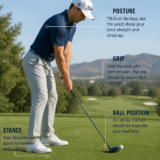
Positioning the golf ball correctly is one of the most basic but often overlooked aspects of the game. Your ball position influences everything from the size and direction of your swing to the consistency and distance of your shots. A proper setup begins with understanding the ideal ball position for each club in your bag. Such as, with fairway woods, starting with the ball closer to your front foot allows for a more effective sweeping motion as you swing.
Mastering ball positioning begins with a clear understanding of what the ball should be doing at different stages of your swing. For instance, with a driver, the ball should be forward in your stance, allowing your hands to be slightly ahead of the ball at impact. This forward ball position encourages a fuller shoulder turn and promotes a sweeping motion through impact. As you move down to the shorter irons, the ball gradually moves back in your stance, ensuring that you make solid contact and impart the necessary spin for control.
One common mistake many golfers make is not adjusting their ball position for changes in course conditions,like wet or sandy areas. As an example, when facing a tricky downhill lie with a fairway wood, positioning the ball slightly more toward your front foot can definitely help you catch the ball on the upswing, adding loft and helping to lift the ball back into the air. This adjustment can be vital for escaping trouble and maintaining your score.
Another critical aspect of ball position is consistency. Once you’ve found the right ball position for each club,make a conscious effort to replicate that setup in your round. Consistency comes not just from where you place the ball, but also from how you align your body and address the ball, whether you’re hitting approach shots, pitchingor chipping.
To refine your ball position, it helps to spend time on the driving range experimenting. Take a few clubs and hit shots from different ball positions,observing how your swing changes. Notice the impact location, the trajectory of each shotand the sound at impact. Adjustments should be subtle; a minor shift can have a significant effect on your shot-making, making your ball positions more deliberate and effective.
think about integrating ball position into your practice routine. Instead of just hitting balls,focus on setting up correctly for each club before you swing. You might use markers to remind yourself where to place the ball,or consult with a coach on the driving range to get personalized tips. By making ball position a priority,and continually refining your technique,you can achieve better distance control,accuracy,and overall performance on the course.
The Secret to Consistency: Techniques for Maintaining Your Drive’s Rest Position Through Your Swing
One of the most critical aspects of maintaining a consistent drive in golf is ensuring that your ball remains stable and不动词组,我将继续这段内容而不涉及之前重复的标题。
The key to maintaining your drive’s rest position lies in the delicate balance of your setup and the stability of your swing. A consistent setup is crucial, as it sets the tone for the quality of your shot. Begin by placing your feet shoulder-width apart, ideally on a stable base. Your weight should be evenly distributed to prevent any accidental shifting during your swing. This stability is not only about your feet but also extends to your wrists and hands, which should remain connected to the club throughout the swing.
Another crucial point is the grip on the club, as it influences the clubface’s position throughout the swing. A death grip often leads to a loss of feel and control. Rather, hold the club with a relaxed grip, as though the club is hanging effortlessly from your fingers. This allows for a more natural release and a consistent trajectory for your drive. For beginners, focusing on this aspect can lead to a noticeable improvement in ball striking and overall consistency.
During your swing, the transition from backswing to downswing is often where the drive’s stability can waver. Avoid the common mistake of bringing the clubhead through the ball from the outside-in, which can cause the ball to start left (for right-handed players). This swing path frequently enough results in a pushed or sliced shot.Instead, work on swinging along your target line, maintaining a straight, smooth transition to ensure the clubface meets the ball cleanly from square.
Practicing with a mirror or video analysis can definitely help you visualize your swing and identify any inconsistencies early on.A simple drill involves setting up two tees, approximately six inches apartand practicing hitting the ball from between them. The goal is to keep the club close to the ground and avoid hitting either tee. This drill helps reinforce proper swing mechanics and emphasizes the importance of maintaining a consistent clubface angle through impact.
For low handicappers aiming to fine-tune their game,incorporating subtle adjustments in your setup can make a significant difference. Adjust the clubface slightly closed or open at address to compensate for your natural swing tendencies. Such as, if you tend to slice the ball, a slight closed face at address can definitely help counteract this tendency.Understanding the nuances of your swing and making slight adjustments can lead to a more predictable ball flight and improved scores.
Maintaining consistency is as much about physical technique as it is about mental discipline. Focus on your breathing and rhythm to keep your mind calm and your movements steady. Visualize every aspect of your swing before starting, from the grip and stance to the arc and finish. This mental planning can enhance your ability to execute under pressure and maintain consistent drives throughout a round. Remember,the secret to consistency lies not just in mastering the physical technique but in integrating it with a strong mental game.
This comprehensive approach to ensuring the ball’s rest position remains stable through your swing will pay dividends in terms of your overall performance and satisfaction on the course. By combining expert advice with practical drills, every golfer can improve their game and enhance their enjoyment of the sport.
Building a Bulletproof Swing: Drills and Tips to Enhance Your Rest Position and Power Strikes
Building a reliable and powerful golf swing starts with mastering your rest position, the moment before you take the club back. For beginners, this is often a neglected area, yet it lays the groundwork for everything that follows. Imagine standing in your address position and taking a deep breath to settle into a balanced, agreeable posture. Here, your weight should be evenly distributed between your feet, with a slight lean from your hips, allowing for optimal ground forces to be harnessed for your swing.
The first step in refining your rest position is to understand how your knees and lower body interact with the ground. Picture this: as you bend slightly at the knees and hip joints,you’re creating a hinge that can both absorb and release energy. Golftec’s video suggests a hip lift and squat motion to explore this hinge. Start from your address position and bend at your knees and hips to lower your club parallel to the ground. Then, quickly raise your hips and knees, returning to your initial position. This drill teaches how to compress the ground and immediately return to an athletic position, enhancing your ability to create a powerful and controlled strike. Incorporate this into your warm-up routine to feel the benefits during your round.
As you progress from beginner to intermediate levels, the emphasis shifts to understanding and applying swing mechanics in full range. One of Vijay Singh’s signature moves is his efficient use of ground forces, particularly in the transition and downswing phases. Imagine hitting a half-speed shot while practicing the ground forces technique, as illustrated in the Golftec video. Your goal is to generate a strong rotation of the hips and shoulders combined with a stable lower body. Achieving this harmony requires practiceand it’s crucial to focus on the transition point where the backswing ends and the follow-through begins. Keep in mind, the quicker and cleaner your transition, the faster your clubhead speed will be.
The mental aspect of the golf swing cannot be overstated. Building a bulletproof swing is a process of building confidence through correct mechanics and consistent practice. One way to develop this mental fortitude is by envisioning success. Before each swing, mentally rehearse your sequence of movements, from the backswing to the full impact and through the follow-through. This mental preparation can lead to improved consistency under pressure on the course. Such as, if you face a tricky lie near a fairway bunker, use this mental rehearsal to visualize the clubhead engaging with the ground at the right angle. This visualization turns potential mishaps into routine plays, enhancing your shot-making ability.
Moving into the realm of advanced technique, golfers with low handicaps can benefit from refining their full swing through deliberate practice drills. Focus on hitting a series of shots from a range of distances, incorporating the half-speed technique. The goal is to maintain a consistent swing speed while varying your swing size to match the needs of your intended target. By mastering this variability, you’ll find that your shots are more predictable under different conditions, whether on a crisp morning or a gusty afternoon. consider practicing with a draw and fade on command. Start with your natural ball flight, then try aiming left and right of your target, altering your shoulder, hip, and foot alignment to deliver the desired shot shape. This not only improves your shot-making potential but also builds the mental toughness to pull off shots with precision.
integrating these techniques into your practice routine is crucial for making lasting improvements. Set aside specific times each week to focus on short game and full swing drills. Start with a full-body warm-up, focusing on stretches and dynamic movements that mimic the golf swing. Then, move to the range for your drills, starting with the basics and gradually increasing complexity.Remember, the key to progress is repetition, so aim for quality over quantity. As you refine your skills, you’ll notice a marked improvement in your consistency and scoring. Whether you’re new to golf or a long-time player eager to fine-tune your technique, these drills and tips provide a clear path to a more reliable and powerful golf swing.