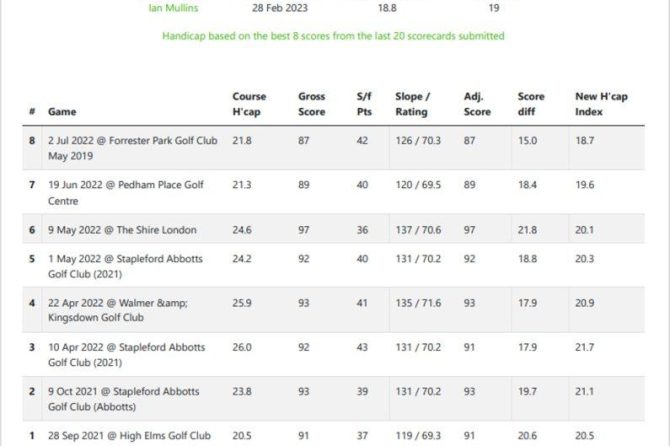
Handicap metrics are the primary tool used to equate golfer ability across different courses, playing conditions, and event formats, making them central to both casual play and elite competition. Over recent decades, calculation methods have shifted from locally maintained indices to internationally coordinated frameworks-most notably the World Handicap System-bringing standardized ideas such as Course Rating, Slope Rating, score differentials, and playing handicap into common use. Despite this convergence,critically important questions persist about the statistical behavior of current measures: their vulnerability to round‑to‑round and seasonal swings,and their effectiveness at producing fair comparisons across varied player groups and strategic situations.
This paper presents a structured examination of golf handicap methods with three linked goals. First, it reviews the theoretical underpinnings and computational mechanics of widely used systems, evaluating them against measurement criteria such as validity, reliability, and sensitivity. Second, it tests performance properties empirically using longitudinal round data, controlled simulations, and sensitivity checks to estimate bias, precision, and resilience across course and weather scenarios. Third, it considers how design choices effect player and organizer choices-how handicap rules shape course selection, match pairings, and competitive risk-taking. By combining conceptual critique, quantitative testing, and applied recommendations, this work clarifies the advantages and limitations of current handicap approaches and offers evidence-based guidance for practitioners, federations, and researchers pursuing fairer and more informative measures of golfing ability.
Core Principles and a Comparative Look at Modern Handicap Frameworks
Modern handicap frameworks rest on three intertwined aims: equity (allowing meaningful competition between players of different abilities), portability (making scores comparable across venues and setups), and stability (reducing volatility caused by one-off anomalous rounds). achieving these aims requires concrete operational choices: defining what constitutes a fair match, specifying how recent form is weighted, and modelling score variability. These choices rely on implicit statistical assumptions about score distributions, strategies for trimming extreme values, and how course difficulty is incorporated via Course Rating and Slope.
In practice, designers often balance a succinct set of normative axioms that guide system construction:
- Equality of opportunity: allowances should enable players of differing skills to compete meaningfully;
- Predictive validity: a handicap must reliably forecast expected performance differentials;
- Robustness: the system should tolerate sparse or noisy input data without large bias;
- Simplicity and transparency: rules must be interpretable to maintain acceptance among stakeholders.
Mathematically, these choices are operationalized through a small set of core metrics that bridge raw scores and normalized ability. A compact reference of those metrics helps clarify their normative role:
| Metric | Typical Range | Normative Role |
|---|---|---|
| Course Rating | 65-78 | Baseline par‑adjusted difficulty |
| Slope Rating | 55-155 | Relative difficulty for bogey vs scratch |
| Handicap Index | −2 to 36+ | Player ability descriptor for allowances |
Different systems put these ideas into practice in distinct ways. A high‑level comparison highlights the main contrasts:
| System | Normalization | distinguishing Feature |
|---|---|---|
| World Handicap System (WHS) | Course & slope ratings | International standardization; best 8 of 20 rule |
| Traditional USGA-style | Course rating with manual adjustments | Differential averaging with index caps |
| CONGU (UK) | Standard scratch differentials | Competition-specific buffers and local adjustments |
Even tho inputs are similar, systems vary in averaging windows, permitted score types (for example Stableford or partial rounds), and limits on index movement-choices that change how rapidly an index responds to recent play.
Three methodological trade-offs are particularly important. First, the selection of a central‑tendency measure and trimming rule (e.g., mean of best N, lowest differentials, or weighted averages) governs the balance between responsiveness to improvement and resistance to outliers. Second, the granularity of course difficulty modelling-whether adjustments are linear slope factors or include hole‑by‑hole modifiers-affects portability when players move between venues. Third, volatility controls such as caps, soft/hard limits, and exceptional‑score reductions create behavioral incentives: overly strict caps can conceal genuine progress, while lax rules increase the chance of manipulation. Each design decision represents a compromise between statistical accuracy and administrative simplicity.
These conceptual choices have concrete consequences for players, clubs, and tournament directors. For example, a golfer aiming to lower their handicap should focus on submitting valid rounds at certified venues to build acceptable differentials, while avoiding one‑off unusually low scores that might potentially be adjusted. Organizers must choose formats and systems that match their goals-whether prioritizing steadiness or speedy reflection of form-and implement measures to deter abuse. Practical guidance includes:
- For players: plan rounds to generate eligible differentials and be aware of how tee and slope selections affect playing handicap;
- For organizers: specify acceptable scoring formats, publish course‑rating policies, and implement detection for irregular submissions.
A solid grasp of these foundations helps stakeholders make informed decisions about course choice, entry timing, and competition structure so handicap tools support openness rather than confusion.

Evaluation of Calculation Methods and Data Integrity with Validation Protocols
Handicap algorithms reflect different statistical philosophies, spanning deterministic rules (such as “best‑N” averages) to probabilistic frameworks that explicitly model latent skill. A thorough methodological review therefore begins by stating each method’s assumptions: stationarity of ability, independence of rounds, handling of outliers, and how raw scores are mapped into an index. When these assumptions differ, so do the interpretability and transferability of the resulting indices. Comparative work must document these assumptions reproducibly and quantify their long‑run effects on bias and variance.
Data quality is equally critical. Missing entries, incorrect score submissions, and inconsistent environmental metadata (tees, slope, weather) bias index outputs unless corrected.Essential data‑quality controls include:
- Identity verification: confirm player identity and provenance of submitted scores;
- Completeness rules: require a minimum number of rounds and mandatory fields before inclusion;
- Context normalization: harmonize course and hole attributes to a common reference.
Practical data collection protocols should standardize a minimal metadata set for each round: course and tee identifiers, course rating and slope, date, basic weather indicators, and whether the round was competitive or casual. Procedures for anomalous entries (incomplete cards, provisional scores, extreme-weather rounds) should be pre‑specified so such rounds are flagged and either adjusted or excluded according to published rules. Operational rules often include minimum‑round thresholds before an index is considered stable, update smoothing windows to limit volatile movement, and automated flags for anomalous differentials.
Validation should combine descriptive checks and inferential tests. Common practices include k‑fold cross‑validation for generalization error, temporal holdouts that respect chronological order, and stress tests using synthetic perturbations to evaluate robustness against corrupted inputs. A compact validation matrix helps link each test to the failure modes it targets:
| Validation Test | Primary Purpose | Sensitivity |
|---|---|---|
| Temporal Holdout | Detect drift and assess predictive stability | High for non‑stationary skill trends |
| k‑Fold CV | Estimate out‑of‑sample error | Moderate; depends on fold independence |
| Perturbation Tests | Evaluate resistance to noise and outliers | High for input corruption |
Algorithm and validation choices should be matched to intended use-tournament seeding, coaching, or recreational fairness.Recommended practices include publishing uncertainty estimates (for example, confidence intervals around index values), periodic revalidation when participation patterns shift, and open documentation of adjustment rules. Additional operational safeguards include pooled‑data regression for empirical re‑rating of courses, control charts/monitoring dashboards to detect system drift, and explicit governance for when temporary modifiers apply. These steps improve construct validity and make handicap outputs more actionable for course selection and competition planning.
Robustness Testing: Outlier Sensitivity and Reliability by Skill Band
This analysis applies contemporary statistical techniques to determine how candidate handicap constructions react to outlying rounds and to heterogeneous player cohorts. Focus was placed on robust statistics (influence functions, breakdown points) and resampling methods (bootstrap and permutation tests) to produce confidence bounds that remain informative under non‑normal score distributions. Simulations introduced controlled outliers (extreme high or low rounds, intentional entry mistakes) and environmental noise (wind, setup changes) to estimate conditional bias and variance for each metric.
Variance decomposition is a practical diagnostic that clarifies where uncertainty arises and how much can be reduced by collecting more data or improving measurements. Analysts should partition total score variance into components such as between‑player variance, within‑player variance, and course/round variance, then estimate intraclass correlation (ICC) to quantify repeatability. Small‑sample uncertainty can be characterized with bootstrap confidence intervals or Bayesian posterior intervals; these quantifications guide operational choices such as minimum‑round thresholds and smoothing windows.
Sensitivity checks targeted both single‑round anomalies and clustereffects. We used a variety of robustness procedures, including:
- Median and trimmed estimators-to limit the leverage of extreme rounds;
- Winsorization-to cap extremes and reduce distortion;
- M‑estimators (e.g., Huber)-to downweight outliers while preserving efficiency;
- Influence diagnostics-to find rounds with outsized impact;
- Leverage analogs-to detect players or rounds that function as structural outliers.
These tests showed that unweighted arithmetic averages can be unstable when occasional catastrophic rounds occur, while median‑based or trimmed schemes maintain lower bias and smaller mean squared error under plausible outlier regimes.
Reliability across skill levels was evaluated with hierarchical variance decomposition and intraclass correlation coefficients (ICCs) calculated within empirically defined bands (low, mid, high handicap). Results revealed heteroscedasticity: residual variance grows with handicap, which lowers test-retest reliability for higher‑handicap players unless dispersion is explicitly modelled. A summary comparison of three representative summary measures appears below:
| Metric | Outlier Sensitivity | Reliability (ICC) |
|---|---|---|
| Raw Average Strokes | High | Low (≈0.45) |
| USGA‑style Index | Moderate | Moderate (≈0.62) |
| Weighted Recent Form | Low | High (≈0.78) |
From a policy and analytics perspective, several concrete steps are advisable.First, use robust central‑tendency estimators (trimmed/winsorized averages or M‑estimators) as a baseline to limit theinfluence of single anomalous rounds. Second, model heteroscedasticity-either via variance‑stabilizing transforms or skill‑band calibration-to keep comparisons fair across handicap levels. Third, routinely publish uncertainty estimates (confidence or prediction bands) so small index changes are interpreted appropriately. Implementation can be phased in: (1) add automated outlier flags at submission, (2) run robust re‑estimation in parallel with legacy indices during transition, and (3) monitor ICCs by cohort quarterly to ensure reliability targets are met. These measures balance statistical rigor with operational practicality.
Performance Metrics Beyond Raw Score: Stroke Distribution, Consistency, and Trend Analysis
A nuanced understanding of scoring requires examining how strokes are distributed across holes and shot types rather than relying solely on aggregate score. Stroke distribution captures the frequency of low, mid, and high‑scoring holes (e.g., birdies, pars, bogeys, doubles+) and quantifies shape characteristics of a player’s performance distribution-mean, variance, skewness, and kurtosis. Such moments reveal whether a player’s score profile is dominated by occasional disastrous holes (positive skew, heavy tails) or by consistent mid‑range outcomes (low variance). These distinctions have direct implications for handicap interpretation: two golfers with identical averages can present very different risk profiles and improvement pathways depending on distributional shape.
Consistency metrics provide the statistical backbone for measuring repeatability and reliability in performance. Standard deviation and coefficient of variation across rounds, hole‑level variance, and the proportion of scorebook entries within one stroke of a player’s average are central measures. Complementary on‑course indicators-fairways hit, greens in regulation (GIR), and putts per hole-serve as proximal consistency metrics that often explain variations in score distribution. Practical monitoring should include an explicit list of leading indicators to track between practice cycles and competitive play:
- Score SD – volatility of total score across rounds
- Hole‑out frequency – rate of 3+ putt or worse holes
- Risk events – percent of doubles or worse per round
- Proximal stats – fairways, GIR, average putts
Trend analysis transforms past metrics into actionable insight by detecting directional change and the statistical significance of improvement or decline. Time‑series approaches-rolling means (e.g., 10‑ or 20‑round windows), linear regression slopes, and simple control charts-identify persistent trends versus random fluctuation. A short illustrative table summarizes typical interpretations used in trend assessment:
| Metric | Interpretation | Practical Threshold |
|---|---|---|
| Rolling mean (20 rounds) | Direction of central tendency | Decrease ≥0.5 strokes = meaningful |
| Score SD | Volatility of performance | SD ≤3 indicates high consistency |
| % Doubles+ | Risk event frequency | Reduction of 2% per season = target |
Integrating stroke distribution, consistency, and trend analysis yields a robust framework for targeted improvement and handicap management. Use distributional diagnostics to prioritize whether to focus on error avoidance (reduce heavy‑tail events) or on upside conversion (increase birdie/par frequency). Apply consistency metrics to set measurable practice KPIs (e.g., reduce SD by 0.5 strokes), and adopt trend methodologies to validate interventions over time. Operationally, this means: (1) define baseline distributional and proximal metrics, (2) implement focused interventions tied to specific metrics, and (3) reassess using rolling windows and control limits to confirm sustained change-thereby linking statistical insight to on‑course decision‑making and handicap trajectory.
Normalizing for Course Difficulty, Weather, and Contextual Equity
Handicap frameworks use deliberate adjustments to normalize raw scores so they reflect underlying ability rather than temporary or structural advantages. The concept of adjustment-how a raw score is converted into a normalized measure-relies on instruments such as Course Rating, Slope, and the Playing Conditions Calculation (PCC). Each targets a different source of variance: intrinsic course difficulty, the relative effect on non‑scratch golfers, and transient external conditions.
| Factor | Adjustment Tool | Typical Effect |
|---|---|---|
| Course architecture | Course Rating / Slope | Baseline strokes ± structural difficulty |
| Adverse weather | Playing Conditions Calculation (PCC) | Temporary +/− strokes |
| Temporary setup (tees/greens) | Local committee rating | Short‑term re‑rating |
| Pace & field composition | Competition allowances | Equity adjustments by tee/time |
Operationalizing these adjustments requires transparent,data‑driven protocols.Key elements include:
- Transparency-explain the rationale and magnitude of any adjustment so players can evaluate fairness;
- Data backing-base adjustments on measurable inputs (weather logs, green speeds, distributional shifts in scores);
- Trigger rules-codify when temporary modifiers apply (for example, sustained high wind thresholds or unplayable greens);
- Local expertise-involve course raters and competition committees to interpret atypical conditions.
These practices reduce discretionary variation and help preserve the predictive validity of handicap indices.
For ongoing reliability, adopt a continuous improvement cycle stressing statistical calibration, independent audit, and clear stakeholder interaction. Calibration compares pre‑ and post‑adjustment score distributions to identify bias; audits ensure committees follow published rules consistently; and timely communication reduces perceived unfairness among competitors. Where possible, supplement manual protocols with automated analytics-for example, real‑time PCC triggers based on aggregated score deviations or environmental sensors-to improve responsiveness while keeping procedural safeguards intact.
Implications for Tournament Fairness, Performance Analysis and Coaching
Data‑driven handicap adjustments support fairer tournaments. Treating handicap differentials as continuous modifiers rather than blunt allowances reduces systematic bias from variable course setups and weather. Simulations show that pairing players purely by raw handicap increases variance in net outcomes; adding a smoothing factor that weights recent results and course difficulty reduces extreme outcomes and keeps pairings balanced. Tournament committees should therefore adopt transparent seeding algorithms and publish how pairings respond to small changes in inputs.
Performance assessment should be multidimensional. Coaches and analysts should supplement a single handicap number with a compact portfolio of metrics capturing skill components, temporal consistency, and contextual sensitivity. Useful measures include:
- Adjusted handicap differential-normalized for course and weather;
- Strokes‑Gained breakdowns-separated into approach, short game, and putting;
- volatility index-quantifies round‑to‑round dispersion over fixed windows.
Coaching should be evidence‑based and tailored by handicap band. The table below maps broad handicap ranges to suggested course allowances and coaching priorities to aid pre‑event planning and practice design.
| Handicap Band | Course Allowance | Primary coaching Focus |
|---|---|---|
| 0-5 | −1 to 0 | Refine short game and pressure putting |
| 6-14 | 0 to +2 | Shot‑shaping consistency and course management |
| 15-24 | +2 to +4 | Recovery shots and mental routines |
| 25+ | +4+ | Fundamentals and decision‑making under pressure |
Execution needs coordinated measurement, feedback loops, and governance. Tournament directors should formalize score verification and supply anonymized performance summaries to coaches; coaches should convert those summaries into measurable practice goals with short (2-4 week) and medium (3-6 month) milestones.Policy steps include publishing algorithms used for pairings, recalibrating smoothing parameters seasonally, and instituting an appeals process for contested differentials. Together, these practices enhance transparency, support player growth, and produce fairer competitive outcomes.
Policy Proposals for Standardization, Transparency and Uptake
standardize definitions and calculation practices. Governing bodies should adopt a common taxonomy of handicap inputs (score, Course Rating, Slope, weather modifiers, exceptional scores) and endorse a canonical algorithm specification. Creating an international technical working group-with representatives from national associations, software providers, and player organizations-would reduce fragmentation and make core computations reproducible across jurisdictions. Emphasize machine‑readable specifications (JSON/XML) and versioned normative documents to support consistent implementation and future updates.
Mandate transparency and reproducibility. Publish all computational rules, provenance requirements, and adjustment heuristics in an accessible repository, with worked examples and test vectors. Transparency measures should include:
- Open reference implementations of calculation engines for independent verification;
- Standard data schemas for scorecards, course ratings, and environmental metadata to promote interoperability;
- immutable audit trails (for example, timestamped logs) to aid dispute resolution and ensure integrity.
Create feasible adoption pathways for stakeholders. A staged rollout with training and incentives will increase acceptance. Suggested steps include vendor certification programs,subsidized club training,and pilot projects with clear success criteria. The table below outlines a compact engagement plan for key groups:
| Stakeholder | Initial Action |
|---|---|
| National Federations | Adopt baseline standard and governance charter |
| Clubs | Implement standardized score submission |
| Software vendors | Provide API‑compliant tools and certified builds |
| Players | Join pilot programs and give feedback |
Embed monitoring, evaluation, and iterative review. Policy should define KPIs and a review schedule to keep standards empirically valid and operationally practical. Candidate kpis include index distributional stability, cross‑system equivalence rates, data completeness, and user fairness ratings. An independent oversight body should publish annual technical audits and convene stakeholder reviews to authorize refinements, ensuring the framework stays rigorous, transparent, and broadly accepted.
Next Steps: Research and Technology Integration, Including Machine Learning and Real‑Time Tracking
New algorithmic tools and sensing technologies open the door to treating handicaps as dynamic, individualized constructs rather than static summarynumbers. Combining machine learning with real‑time tracking can support continuous models of player ability that account for temporal trends, course conditions, and equipment effects. Future work should build validation frameworks comparing ML‑based adjustments with traditional aggregation methods using large,longitudinal datasets,and conduct cross‑course calibration experiments to preserve fairness.
Technical innovation will emphasize multimodal data fusion and low‑latency inference. High‑frequency positional, club and biometric streams can be combined with environmental and course state data to generate richer performance features.Priority research directions include:
- Sensor fusion and edge processing to perform privacy‑preserving preprocessing on the device before aggregation;
- Temporal and causal modelling (recurrent, transformer, and structural causal models) to distinguish true skill changes from transient noise;
- Transfer learning and domain adaptation to generalize models across courses and equipment with limited labeled data.
Methodological advances must be paired with commitments to interpretability, fairness and governance. Explainable ML approaches that yield actionable reasons for index adjustments are essential for stakeholder trust. Algorithmic audits should check for bias across demographic and skill groups, and model update policies must prevent uncontrolled drift. Data governance-covering consent, anonymization, and retention-should be developed alongside technical work to ensure real‑time tracking is used ethically and lawfully.
To accelerate translation, build a modular research infrastructure that combines simulation, controlled field trials, and staged deployments.A pragmatic roadmap follows:
| Prototype | Key aim | Timeframe |
|---|---|---|
| Simulation habitat | Stress‑test ML models under controlled variability | 6-12 months |
| Pilot tracking deployment | Gather multimodal in‑game data | 12-24 months |
| Scaling & audit | Operationalize, monitor fairness and robustness | 24-36 months |
Q&A
Below is a practical Q&A intended to accompany an article titled “A Systematic Analysis of Golf Handicap metrics.” It summarizes motivations, methods, core concepts, robustness findings, policy guidance, limitations, and future prospects.Note: the brief web search material supplied was unrelated forum content and did not contribute empirical evidence for this study; the Q&A synthesizes established handicap concepts (score differentials,Course Rating and Slope,WHS principles) and standard statistical tools for evaluating performance metrics.
1. What central question does this analysis address?
- The study asks: Do existing handicap metrics accurately and fairly represent individual playing ability-are they statistically robust, equitable across courses and player groups, and resilient to strategic manipulation? It also evaluates computational alternatives that might improve fairness and predictive usefulness.2. Which systems and measures are covered?
– The review focuses on common elements of modern handicapping: Score Differentials, Handicap Index construction (best‑of‑N averaging and recency rules), Course Rating and Slope adjustments, net Double Bogey and hole maximums, and conversions to playing handicap. It also surveys proposed alternatives such as trimmed or median indices,Bayesian shrinkage estimators,and dynamic weighted indices.3. What data and inclusion rules were applied?
– Sources include empirical round‑level datasets, technical reports from national associations, and simulation studies parameterized by observed score distributions. Inclusion favored datasets with player identifiers and course metadata,studies reporting predictive validity (for example out‑of‑sample error),and methods addressing adjustment protocols; where raw data were unavailable,well‑specified simulations were used.
4. How is a Score Differential computed and why does it matter?
– Score Differential standardizes an adjusted gross score for course difficulty (using Course Rating and Slope) and is the fundamental unit for most handicap indices. Errors or bias at this stage propagate into the index, so precision here is crucial.5.Which statistical properties are evaluated?
– The review considers bias, variance, outlier robustness, sample‑size sensitivity, temporal stability (autocorrelation and decay), calibration (agreement between predicted and observed outcomes), and predictive accuracy (RMSE, MAE). It also examines vulnerability to gaming and fairness across subpopulations (play frequency, age, gender).6. How do current averaging rules perform?
– Best‑of‑N rules (for example best 8 of 20) provide stability for frequent players but can bias indices for infrequent competitors and remain sensitive to extreme low scores unless capped. Such rules may underweight genuine improvement and overreact to a singular anomalously good round in small samples.
7. are there more robust options than best‑of‑N?
– Yes. Effective alternatives include trimmed means or medians to reduce outlier influence, exponentially weighted moving averages to incorporate recency, empirical Bayes/hierarchical models that shrink noisy individual estimates toward a population mean, and M‑estimators that downweight extreme differentials.8. How well do Bayesian/shrinkage approaches work?
– Hierarchical Bayesian models borrow strength across players and typically improve predictive performance,especially for those with limited rounds.They reduce variance without introducing large bias and can incorporate covariates (frequency of play, course difficulty) to personalize estimates. Cross‑validated RMSE usually improves relative to unpooled averages in both empirical and simulated tests.9. What is the recommended way to handle recency?
– Recency is best managed through controlled decay (for example EWMA or time‑weighted likelihoods in Bayesian models) rather than hard cutoffs. decay rates should be tuned via cross‑validation to balance sensitivity to real ability changes against noise‑driven fluctuations.10. What role do Course Rating and Slope play?
– Course Rating and Slope are central to placing scores on a common scale. However, measurement error or inconsistent rating practices can introduce bias.Periodic recalibration of rating panels, statistical validation of slope figures against observed scores, and transparent methods for handling unusual playing conditions are recommended.
11. How should extreme hole scores and limits be treated?
– Maximum‑hole rules (Net Double Bogey,etc.) help limit the effect of remarkably high hole scores on adjusted gross results. The choice of limit affects variance and strategic behavior; robust statistical estimators can reduce dependence on hard caps but do not eliminate the practical need for sensible maximums.
12. How are handicap methods evaluated empirically?
– Evaluation uses predictive metrics (RMSE for next‑round differentials), calibration plots, rank‑order stability, and fairness tests comparing accuracy across subgroups.Cross‑validation and out‑of‑sample holdouts are used to avoid optimistic assessments.
13. What are the main predictive findings?
– Methods that combine shrinkage, recency weighting, and robust aggregation outperform naive best‑of‑N averages for predicting future differentials, particularly for players with few recorded rounds. Gains are largest in reducing variance and extreme prediction errors; average error reductions are consistent though modest.
14. How vulnerable are current systems to manipulation?
– Systems that rely heavily on few extreme low rounds can be gamed through selective course choice or abnormal scoring.Countermeasures include verification, peer review, automated anomaly detection, and statistical shrinkage that reduces incentives and effectiveness of gaming.
15. What practical policy and implementation steps are recommended?
– Suggested reforms include adopting hierarchical/Bayesian estimators or hybrid indices, applying time‑weighted recency schemes validated on data, standardizing and periodically validating Course Rating and Slope, deploying automated anomaly monitoring, and ensuring electronic capture of score and metadata (weather, tee used).
16. What operational challenges do associations face when changing systems?
– Associations must trade off computational sophistication with transparency and user acceptance. Bayesian and ML methods need infrastructure and clear communication about how indices are computed.Pilot testing, transition plans, and open documentation are essential to maintain trust.17. what were study limitations?
– Limitations include variable reporting across source studies, restricted access to comprehensive round‑level datasets in some regions, and the difficulty of fully accounting for unobserved contextual factors (weather, setup, pace). Simulations necessarily rely on modeling assumptions that may not capture every real‑world dependency.18. What open research questions remain?
– Future work should include field trials of option index algorithms within live systems, detailed equity analyses across demographic groups, integration of shot‑level telemetry to refine expected hole difficulty models, and the design of real‑time anomaly detectors that balance false positives against deterrence.
19. How should metric success be judged?
– Success criteria should be multi‑dimensional: predictive accuracy for future rounds, fairness across courses and player subgroups, resistance to manipulation, interpretability, and stakeholder acceptance. No single statistic suffices; policy should weigh multiple outcomes.
20. what is the take‑away conclusion?
– Modern methods-shrinkage, robust aggregation, and principled recency weighting-can meaningfully improve the predictive validity and fairness of handicap indices compared to simple best‑of‑N schemes. Though, improvements require reliable Course Rating practices, anti‑abuse safeguards, and clear communication so stakeholders understand how indices are derived.
If helpful, I can:
– Draft a concise executive summary tailored to the article.
– Prepare a methods appendix with statistical formulas,cross‑validation protocols,and model specifications.
– Create simulated comparisons showing a traditional best‑of‑N index versus a Bayesian shrinkage index using synthetic data.
this analysis reviews the theory, computation, and empirical performance of contemporary handicap systems. Comparing index‑based approaches, Course rating/Slope adjustments, and recent reforms aimed at portability and fairness, we identify recurring trade‑offs between simplicity, responsiveness to short‑term form, and robustness to outliers and gaming. No single metric maximizes predictive accuracy, ease of use, and resistance to manipulation concurrently; the most effective systems combine a transparent baseline (Course Rating) with statistically principled adjustments (robust aggregation, smoothing, and condition modifiers). These findings imply concrete actions for players, clubs, and federations: be mindful of an index’s responsiveness when choosing events or course tees; prioritize consistent rating practice and audit posted scores; and consider phased adoption of robust statistical methods backed by transparent governance. Integrating higher‑resolution data (for example shot‑level metrics) can enhance index validity, but demands standardization and careful attention to privacy and access.
The study’s conclusions are tempered by data availability and modeling assumptions. Future research should assemble longitudinal, player‑level datasets across jurisdictions, disentangle learning from variance, and experimentally test alternative index designs under strategic behavior. Cross‑jurisdictional comparisons that assess differences in WHS implementation and targeted simulation studies of intentional and unintentional distortions will be particularly valuable.Advancing fair and useful handicap systems will require a mix of sound statistical design, transparent governance, and continuous empirical validation. Modest, evidence‑based reforms-improved course‑rating routines, robust outlier handling, routine index recalibration, and measured incorporation of richer performance data-can materially enhance both equity and the practical utility of handicap metrics for recreational and competitive golf alike.
Decoding Golf Handicaps: A Deep Dive into fairness, Stats, and Strategy
Why handicaps matter (and why golfers should pay attention)
Golf handicaps exist to level the playing field. Whether you’re pairing with scratch golfers, entering a club competition, or assessing which tees to play, a correctly understood handicap translates raw scores into fair competition. Beyond equity, handicaps provide a statistical lens into strengths and weaknesses – and that’s powerful for gameplay optimization.
Core handicap concepts – the vocabulary every golfer should know
- Handicap Index: A portable measure of a player’s potentialability, derived from recent scoring history. Used internationally under the World Handicap System (WHS).
- Course Rating: The expected score for a scratch player under normal course and weather conditions.
- Slope Rating: A number that adjusts how hard a course plays for a bogey golfer relative to a scratch golfer. 113 is the baseline slope.
- Course Handicap: The number of strokes a player receives on a specific course/tee to equate their Handicap Index to that course’s difficulty.
- Playing Handicap: The Course Handicap adjusted for format (match play, foursomes, team events) or competition-specific allowances.
Key formulas and how calculations actually work
Knowing the math is helpful when you want to interpret swings in your index or check a calculation:
Score Differential
To create comparable results across courses, score differentials are computed for each round.
(Adjusted Gross Score − Course Rating) × 113 ÷ Slope Rating = Score Differential
Handicap Index (summary)
Under WHS, the Handicap Index is derived from recent score differentials (for most implementations, the best differentials from the most recent 20 scores are used to estimate current potential). The Index is a portrayal of your potential score in neutral conditions.
Course Handicap
Course Handicap = Handicap Index × (Slope Rating ÷ 113) [+ Course Rating − Par where applicable]
Course Handicap tells you how many strokes you receive from a specific set of tees on a specific course.
Playing handicap
Competition formats frequently enough require an additional adjustment (a percentage of Course Handicap or format-specific allowance). such as, certain team formats or match-play competitions use a playing handicap calculated from the Course Handicap.
Quick visual: Handicap terms at a glance
| Term | What it shows | When you use it |
|---|---|---|
| Handicap Index | Portable measure of potential ability | Joining events, comparing players |
| Course Handicap | Strokes received on a specific course/tee | Before your round to set nets |
| Playing Handicap | adjusts for format/competition | Match play, tournaments, team games |
How handicaps affect strategy on the course
Think of your handicap as more than just a number – it’s a decision-making tool. Here are ways it should change how you play and practice:
- Tee selection: Choose tees where your course handicap produces realistic scoring. Playing from tees that inflate difficulty can punish your index and enjoyment.
- Risk/reward decisions: If you have strokes on a hole, you can take a smarter aggressive line knowing you have a buffer. Conversely, if you owe strokes, play conservatively to minimize blow-ups.
- Match-play tactics: Use your playing handicap to decide on concessions and putting strategies – who gives up putts and on which holes.
- Practice focus: Use the handicap to prioritize game components that yield the biggest scoring gains (e.g., 3-putts, short game, tee accuracy).
Practical tips to optimize performance using your handicap
- Log scores consistently and accurately: The value of an index depends on clean data. Post adjusted gross scores after applying any hole-based maximums (e.g., net double bogey).
- Understand the local rules and allowances: Club competitions may apply handicap allowances – learn them so you don’t misread your net target.
- Use strokes gained data where possible: Modern stat systems (Shotlink,Arccos,etc.) show where you lose shots. Combine that with handicap feedback to plan targeted practice.
- Pick the right course and tees: If you want to improve your index while staying competitive and enjoying the game, select courses that match your skill level.
- Manage volatility: If your index moves quickly, review recent rounds for outliers, confirm score posting accuracy, and check for caps/cutoffs in the system (WHS has caps and adjustments to moderate extreme upward movement).
Case study: Translating index to a Course Handicap (hypothetical)
Example: A player with a Handicap Index of 12.4 plays a course where the Course Rating is 72.1 and the Slope Rating is 128.
- Compute Course Handicap: Course Handicap = 12.4 × (128 ÷ 113) → ≈ 14.0 → player receives 14 strokes from the posted tees.
- Applying match format: If the competition applies a 90% allowance for match play, Playing Handicap ≈ 13 strokes.
- Strategic usage: Knowing they receive strokes on the 4 hardest handicap holes, the player can decide to play more aggressively on shorter holes where they expect to make birdies, and protect par on long holes.
common misconceptions and clarifications
- “handicaps reward poor play” - False. A handicap reflects potential, not average.Systems incorporate best scores and caps to avoid rewarding inconsistent low rounds unfairly.
- “You should always try to lower your index” – It’s a useful goal, but a lower index should come from actual skill improvements (short game, ball striking), not by sandbagging or manipulating score posting.
- “All handicap systems are the same” – Not exactly. The World Handicap System unified many national methods, but local rules, caps, and competition allowances vary. Check your national association.
How to use handicap data to drive practice and equipment choices
Handicap breakdowns frequently enough reveal clusters of weakness. Turn those into measurable practice plans:
- Short game deficiency: If most strokes are lost inside 100 yards, build a practice schedule emphasising chipping, pitching, and bunker play – track proximity to hole metrics.
- long game inconsistency: If tee shots lead to lost holes, prioritize driving accuracy, course management strategies, and club fitting.
- Putting: If three-putts dominate, practice lag putting and green reading. Consider a putter fitting to ensure tools support the stroke.
Measuring fairness: Does the system actually equalize play?
Handicaps are a statistical attempt to bring equity to competition. they rely on:
- Reliable, recent scoring data
- Accurate Course and Slope Ratings
- Appropriate posting and adjustment rules
When these inputs are maintained, handicaps make matchups fairer and allow players of different ability to enjoy competitive, meaningful golf.
Where to get more guidance and community insight
For practical, community-based conversations, forums such as GolfWRX host threads about handicaps, equipment, and regional practices (see search results like GolfWRX’s Tour Talk forum). For official rules and WHS documentation, consult your national golf association and the official World Handicap System materials.
Actionable checklist: What to do after reading this
- Confirm that you post every valid round (adjust scores for hole maximums where required).
- Review your last 20 posted rounds and look for trends – are you improving in the short game or losing ground on the greens?
- Use the Course Handicap formula before every round to set realistic net targets.
- Pick one statistical weakness to attack with a weekly practice plan for 6-8 weeks and track progress.
References & further reading
- World Handicap System documentation – check your national golf association for the WHS rules and local variations.
- Community forums for peer insight and lived experience – e.g., GolfWRX (see search results for community threads).
- Performance tracking platforms (Arccos, Shot Scope) – for strokes gained and shot-level feedback that complements handicap insight.
Want a version focused on a specific tone (insightful, analytical, investigative, modern, practical, or strategic) or tailored to a particular audience (beginners, club competitors, or coaches)? Pick one of the headline options and I’ll refine the piece into that tone and target.