

Introduction
The modern game of golf places increasing demands on athletes’ musculoskeletal and neuromotor systems, requiring an integration of technical skill with sport-specific physical capacities. Recent advances in biomechanics, exercise physiology, and sports science have clarified the mechanical and physiological determinants of golf performance-namely, optimized swing kinematics, efficient energy transfer through the kinetic chain, and the development of strength, power, mobility, and endurance profiles that support repeatable, high-velocity ball striking while minimizing injury risk.An evidence-based approach to golf fitness therefore necessitates a synthesis of multidisciplinary research to translate laboratory findings into practical, individualized training strategies for players across the competitive spectrum.
This article synthesizes contemporary literature on golf-specific biomechanics and physiology and examines how these constructs inform targeted training interventions. We review biomechanical factors that underpin swing efficiency and clubhead speed, including segmental sequencing, ground reaction forces, and intersegmental coordination, alongside physiological contributors such as muscular strength, rate of force development, metabolic capacity, and tissue resilience. Emphasis is placed on the interaction between technique and physical capacity: how deficits in mobility or force production alter swing mechanics, and conversely, how technical compensation can predispose players to overload injuries.Building on this foundation, the discussion evaluates applied training methodologies-assessment-driven prescription, periodization models, strength and power development, mobility and motor control training, and conditioning for endurance and recovery-grounded in current empirical evidence. We also identify practical assessment tools and monitoring strategies to individualize programs and track adaptation. the article highlights gaps in the literature and proposes directions for future research to better integrate biomechanical analysis with longitudinal training outcomes.
By bridging mechanistic insights with applied training principles, this work aims to provide coaches, clinicians, and researchers with a coherent framework for optimizing golf-specific fitness that enhances performance while mitigating injury risk.
kinematic sequencing and rotational power in the golf swing: assessment protocols and targeted training strategies
Kinematic sequencing in the golf swing describes the coordinated timing of segmental rotations from pelvis to thorax to shoulders, arms and club – a proximal‑to‑distal transfer of angular velocity that generates maximal clubhead speed with minimal energy loss. Precise sequencing optimizes the distribution of mechanical work across segments, reduces peak joint loading and improves shot consistency.Quantifying segmental onset times, peak angular velocities and inter‑segmental delays provides a mechanistic framework for diagnosing inefficient patterns such as early arm release or insufficient pelvic rotation.
Assessment requires a combination of laboratory and field protocols to capture both accuracy and ecological validity. Laboratory measures (3D motion capture, force plates, isokinetic dynamometry) yield high‑resolution kinematic and kinetic metrics, while portable systems (wearable IMUs, radar/trackers, video analysis) enable on‑course assessment. Recommended practical tests include:
- Med‑ball rotational throw – peak velocity and power of transverse plane output.
- Vertical and horizontal force plate sweeps – timing of peak GRF and weight transfer.
- IMU sequence analysis – onset order and peak angular velocities for pelvis,thorax and club.
- Single‑leg stability and hip internal/external rotation tests – prerequisites for efficient pelvic drive.
Interpreting results focuses on timing indices and power metrics rather than isolated strength values. Key metrics to report include X‑factor separation, inter‑segmental delay (ms), peak angular velocity sequence (pelvis → trunk → arm → club), peak rate of torque development (RTD) and ground reaction impulse. The table below provides concise metrics and practical target ranges for trained male amateur to professional golfers; adjust for age, sex and injury history.
| Metric | Measurement | Practical Target |
|---|---|---|
| X‑factor separation | Degrees (thorax − pelvis at top) | 20°-45° |
| Inter‑segmental delay | Milliseconds (pelvis→trunk peak) | 30-80 ms |
| Med‑ball rotational power | Watts or throw velocity | Normed to body mass |
Targeted training should bridge neuromuscular timing with transfer‑specific power. Emphasize progressive sequencing drills and multi‑planar power development: start with controlled dissociation and anti‑rotation work (Pallof press,slow cable chops),progress to explosive loads (medicine‑ball rotational slam/throw,band resisted swings),then integrate high‑velocity,golf‑specific patterns (overspeed swings,jump‑to‑rotate drills). Training principles to follow include:
- Specificity – train transverse plane velocity and segmental timing, not only isolated strength.
- Progressive overload – increase rotational power demand before velocity demand.
- Motor variability – vary load, angle and tempo to promote robust sequencing under different contexts.
Programme prescription should be phased: a foundational phase (mobility, eccentrics, anti‑rotation), a capacity phase (max strength and hip/trunk torque), and a power‑specific phase (high‑velocity med‑ball and integrated swing drills). Typical dosing for trained golfers: 2-3 resistance sessions and 2 power/skill sessions per week, with periodic re‑assessment every 6-8 weeks using the same kinematic battery. Monitor adaptation via objective markers (IMU timing indices, force‑plate impulse, med‑ball velocity) and subjective indicators (movement quality, pain, perceived exertion) to ensure transfer and to minimize injury risk.
Neuromuscular determinants of swing consistency: motor control, timing, and cueing interventions
Effective swing consistency emerges from the integration of central motor control and peripheral neuromuscular function. At the central level, internally stored motor programs and adaptive sensorimotor mappings govern the sequencing and amplitude of multi-joint actions; at the peripheral level, motor-unit recruitment, firing rate modulation and muscle-tendon compliance determine the fidelity of force production. Clinical neuromuscular frameworks highlight that intact afferent feedback and reliable efferent commands are prerequisites for repeatable kinematics, so assessments that probe nerve-muscle integrity and proprioceptive acuity can inform individualized remediation strategies.
Temporal structure of the swing is as critical as spatial patterning. Consistent temporal coupling-often expressed as proximal-to-distal energy transfer-depends on precisely timed muscle activation and well-tuned intermuscular coordination. The stretch-shortening cycle and phase-specific eccentric control (especially in the downswing transition) optimize energy storage and release; conversely, timing deficits manifest as early release, casting, or loss of clubhead speed. Objective timing metrics (e.g., EMG onset latencies, phase durations) provide sensitive markers of performance variability and targets for intervention.
Cueing and feedback strategies materially influence motor learning and retention. Empirical motor-control work favors externally directed cues for automated performance and internal cues for corrective learning when tightly controlled. Evidence-supported cueing modalities include:
- External focus (target or effect-directed prompts to encourage automaticity)
- Augmented feedback (delayed video,chunked outcome feedback to avoid dependency)
- Rhythmic metronome cues (entrainment of phase timing and tempo)
- Proprioceptive augmentation (light touch,resistance bands to bias joint position)
These strategies should be periodized: early stages emphasize explicit instruction and slow practice; later stages emphasize variable practice with external cues to consolidate robustness under competitive pressure.
Practical neuromuscular interventions aim to reduce variance in motor output while enhancing adaptability.Key modalities include reactive drill sets, plyometric sequences to refine stretch-shortening timing, unilateral stability progressions, and biofeedback-driven sessions to recalibrate activation timing. The table below summarizes common interventions and their primary neuromuscular targets, suitable for incorporation into a general-to-specific training block:
| intervention | Primary Neuromuscular Target |
|---|---|
| Metronome-paced swings | Phase timing, tempo consistency |
| Plyometric med-ball throws | Rate of force development, SSC timing |
| EMG/Video biofeedback | Muscle onset timing, movement awareness |
maintaining swing consistency also reduces cumulative tissue load and injury risk if neuromuscular training targets identified deficits. Screening protocols-single-leg balance, trunk endurance, and reactive stepping tests-help stratify athletes for targeted interventions. Coaches should progress load and complexity only after demonstrating reliable timing and coordination under low-threat conditions, and incorporate recovery and neuromodulatory techniques (sleep, hydration, graded exposure to perturbation) to preserve motor learning gains. Emphasize measurable progression: decreased EMG co-contraction, narrowed timing variance, and improved task transfer to on-course performance as markers of successful neuromuscular modulation.
Physiological profiling for golfers: energy system demands,aerobic capacity,and recovery optimization
Contemporary physiological profiling for golf integrates the classic definition of physiology as the study of bodily function with sport-specific demands: intermittent,skill‑dominant actions embedded within prolonged low‑intensity locomotion. Elite and recreational golfers rely on three primary energy pathways across a round: the phosphagen (ATP-PC) system for maximal swing velocity, anaerobic glycolysis for repeated high‑effort practice bouts, and oxidative metabolism to sustain walking, thermoregulation, and neural recovery between shots. Quantifying the relative contribution of these systems permits targeted conditioning and reduces reliance on generalized endurance prescriptions that may blunt power development.
Assessment should therefore emphasize both peak and sustained capacities. Key laboratory and field metrics include VO2max, submaximal oxygen cost (economy), anaerobic power (e.g., 6-15 s sprint or jump tests), and repeated‑effort decay (fatigue index). Monitoring autonomic recovery via heart rate variability (HRV) and session‑RPE contextualizes readiness and cumulative load. Combining these measures yields a multidimensional profile: explosive power and rotational torque, transient anaerobic tolerance for practice surges, and aerobic base for recovery and cognitive consistency late in a round.
- Primary monitoring variables: VO2max, HRV, lactate threshold, peak rotational power, session‑RPE.
- Practical field tests: 30‑m sprint/jump battery, repeated swing sets, submaximal walk test for economy.
- Outcomes to track: swing velocity sustainability, perceived exertion across 18 holes, recovery kinetics between high‑intensity efforts.
Interventions should be periodized to prioritize concurrent development without interference: short, high‑intensity neuromuscular training and plyometrics during power phases; moderate‑intensity interval sessions to improve anaerobic buffering during competitive windows; and low‑intensity aerobic work (continuous walking, cycling) during base phases to enhance mitochondrial density and reduce fatigue accumulation. Recovery strategies that produce measurable physiological benefit include structured sleep extension, carbohydrate‑timed feeding to restore muscle glycogen after prolonged practice, and active recovery modalities that accelerate lactate clearance while preserving neuromuscular readiness.
Practical table of energy‑system emphasis across a typical 18‑hole profile:
| Phase | Dominant system | Training focus |
|---|---|---|
| Key shots (swing) | ATP-PC | explosive power, neuromuscular speed |
| Practice blocks | Anaerobic glycolysis | Repeatability, lactate tolerance |
| Walking between holes | Aerobic metabolism | Economy, recovery capacity |
Strength, power and mobility integration: exercise prescriptions to enhance performance and reduce injury risk
Integrating strength, power and mobility requires a systems-based approach that respects the golf swing as a coordinated transfer of force through the kinetic chain. Emphasis should be placed on proximal stability (core, hips) to allow distal mobility (thoracic rotation, shoulders) while controlling valgus/rotational load at the lumbar spine. Training must thus target multi-planar force production, rate of force development and movement-specific range-of-motion concurrently to improve clubhead speed and shot consistency while reducing cumulative tissue strain.
Program design follows three interdependent emphases: maximal and submaximal strength, explosive power, and joint-specific mobility. A practical exercise menu (progressive and evidence-informed) could include:
- Strength: barbell hip hinge, split squats, deadlifts (3-5 sets, 3-6 reps)
- Power: rotational medicine-ball throws, loaded jump squats, band-resisted swings (2-4 sets, 3-8 reps, high velocity)
- Mobility: thoracic rotation drills, hip internal/external rotation mobility, controlled dorsiflexion work (3-5 sets, 8-15+ reps)
Progression should prioritize quality of movement, increasing load before velocity when technique degrades.
Periodization and acute dosing must be explicit and measurable. The following table gives concise target ranges for each training focus-intended as starting guidance for intermediate golfers and adjustable based on testing and fatigue monitoring.
| Goal | Intensity | Reps | Sets | Focus |
|---|---|---|---|---|
| Strength | 70-90% 1RM | 3-6 | 3-5 | Torque & stability |
| Power | 30-60% or bodyweight | 3-8 | 2-4 | Rate of force development |
| Mobility | Bodyweight/assisted | 8-15+ | 3-5 | Range & quality |
Movement quality is both a training target and an injury-mitigation strategy. Prioritize thoracic rotation with hip dissociation, a robust hip hinge pattern to reduce lumbar shear, and scapular control to attenuate distal loading. Use eccentric overload and tempo variation to build controlled deceleration capacity-key for reducing injuries during the transition and follow-through phases of the swing. Incorporate brief neuromuscular sessions (e.g., 10-15 minute pre-practice circuits) that reinforce sequencing: pelvis → thorax → shoulders → club.
Monitoring and decision rules ensure safe progression and return-to-play. Employ objective measures such as single-leg balance/Y-balance, seated and standing rotational power (med-ball throw distance), and clubhead speed normalized to body metrics. Modify programming when asymmetries exceed normative thresholds or when pain persists beyond 48-72 hours. Recommended monitoring toolbox:
- Performance: clubhead speed, med-ball rotational throw
- Mobility/Control: T-spine rotation ROM, hip internal rotation
- Injury surveillance: symptom scores, movement screens
These metrics create explicit progression criteria (load increases, velocity targets, return-to-swing milestones) that balance performance enhancement with tissue protection.
Core stability and lumbopelvic control: assessment tools and progressive rehabilitation strategies
Efficient transfer of force in the golf swing is predicated on a stable lumbopelvic complex that coordinates trunk rotation with lower‑limb drive.Research-informed practice emphasizes that **core stability** is not static bracing but dynamic control of intersegmental motion: timely activation of deep stabilizers (transverse abdominis, multifidus, pelvic floor) and appropriate inhibition of global over‑dominant muscles. Deficits in lumbopelvic control manifest as lost clubhead speed, lateral sway, and increased spinal shear during the downswing, making targeted assessment and progressive rehabilitation essential components of performance enhancement and injury prevention.
Objective and semi‑objective assessment tools should be combined to form a reliable clinical picture. Use a multimodal battery including instrumented and manual tests to differentiate motor control deficits from strength limitations. Typical tools to include are:
- Pressure biofeedback (PBU) to quantify transverse abdominis recruitment during limb movements;
- Ultrasound imaging for feedforward timing and muscle thickness change;
- Surface EMG to compare onset timing between deep and superficial trunk musculature;
- Active Straight Leg Raise (ASLR) and Prone Instability Test for reproducible motor control impairments;
- Force‑plate and 3D motion analysis to measure center‑of‑pressure excursions, pelvic rotation symmetry, and segmental sequencing under sport‑specific loads.
Interpretation of findings should map deficits to mechanistic hypotheses that guide intervention. Such as, a delayed transverse abdominis onset with excessive contralateral hip drop suggests impaired feedforward control and frontal‑plane instability; dominant erector spinae activity with poor abdominal co‑contraction indicates strategy substitution rather than true core weakness. Clinical decision‑making must differentiate: (a) motor control impairment amenable to retraining, (b) force‑generating weakness requiring progressive overload, and (c) structural or pain‑limited patterns necessitating load modification before aggressive conditioning.
A staged rehabilitation model optimizes motor relearning and progressive loading. The following table summarizes a practical phase progression and representative interventions suitable for integration into golf conditioning programs.
| Phase | Objective | Representative Exercises |
|---|---|---|
| 1 – Activation | Restore timing of deep stabilizers | Transverse abdominis draw‑in,pelvic floor cueing,PBU drills |
| 2 – Stabilization | Maintain neutral lumbopelvic position with limb movement | Bird‑dog,dead‑bug,side plank regressions |
| 3 – Integration | Transfer control into rotational tasks | Standing chops,cable rotations,single‑leg carry |
| 4 – Sport‑Specific Loading | Improve power and resilience under swing loads | Medicine‑ball rotational throws,loaded carries,tempo‑specific swing swings |
Return‑to‑play decisions should be criterion‑based and measurable rather than time‑driven. Key monitoring metrics include **pain‑free full ROM**, symmetrical force‑plate balance (<10% asymmetry), normalized EMG onset latency relative to normative data, and progressive tolerance to swing‑specific loads without compensatory movement. Use objective progression rules (e.g., 10-20% weekly load increases, symptom monitoring) and integrate on‑course assessments to ensure transfer of control to competitive conditions. Ongoing maintenance training emphasizing variable stability and reactive control preserves the neuromuscular adaptations critical to long‑term performance and spinal health.
Lower limb mechanics and ground reaction force utilization: drills and strength exercises to improve force transfer
Efficient transfer of force from the ground to the club is mediated primarily through coordinated lower‑limb mechanics: ankle dorsiflexion/plantarflexion, knee extension, and hip extension operate in a rapid proximal sequencing that culminates in triple extension. Effective foot‑to‑ground interaction requires management of center‑of‑pressure migration and timely generation of medial‑lateral and vertical ground reaction forces (GRFs). Athletes who stabilize the pelvis and orient the limb to except and redirect GRF produce more consistent clubhead speeds with less compensatory motion in the trunk and upper limb, reducing distal overload and injury risk.
From a physiological and kinetic perspective, two properties are most relevant for golf: impulse (force × time) and rate of force development (RFD). During the downswing transition the lower limb must first absorb angular momentum eccentrically (braking phase) and then rapidly generate concentric propulsive GRFs.Training should, therefore, address eccentric control to manage deceleration, and high‑velocity concentric actions to maximize RFD and short‑duration impulse. Objective monitoring using force plates or portable inertial devices can quantify vertical GRF peaks, timing to peak force, and asymmetries that correlate with swing inefficiencies.
Practical on‑course and gym‑based drills can reprogram neuromotor sequencing and enhance reactive force utilization. Recommended progressions include:
- Step‑and‑Rotate Drill – emphasize a controlled lateral step into a simulated downswing with immediate pelvic rotation to train timely GRF application.
- Single‑Leg Hops to Stabilize – reactive eccentric absorption on landing to improve deceleration control and proprioception.
- Med‑Ball Rotational Throws – performed from a partial weight‑shift to translate unilateral lower‑limb force into transverse plane power.
- Tempo Ground‑Strike Practice – short‑range swings focusing on aggressive foot pressure into the ground at impact to sensitize plantar mechanoreceptors.
These drills prioritize transfer of laterally‑directed and vertical GRFs into rotational output and should be progressed by reducing contact time and increasing intent before adding load.
Strength interventions must develop both maximal force and the ability to express it quickly. Foundational lifts (back squat, trap‑bar deadlift, hip thrust) build absolute force capacity, while unilateral variations (Bulgarian split squat, single‑leg Romanian deadlift) correct side‑to‑side asymmetries and improve force vector specificity. Eccentric‑focused sets (3-5 sets of 4-6 slow‑eccentric reps at 70-85% 1RM) enhance deceleration control; contrast and plyometric sessions (2-4 sets of 4-6 explosive reps, 0-60 s rest) train RFD. Incorporate calf and peroneal strengthening to optimize ankle stiffness and ground coupling during the critical impact window.
| Exercise / drill | Primary Target | sample Prescription |
|---|---|---|
| Single‑Leg Hop to Stabilize | Reactive landing & eccentric control | 3×6 per leg, focus 0.2-0.4 s ground contact |
| Med‑Ball Rotational Throw | Transverse power transfer | 4×8 explosive, 2 min rest |
| Bulgarian Split Squat | Unilateral force & balance | 3×6-8 per leg, tempo 3‑0‑1 |
| Trap‑Bar Jump / Hex‑Jump | RFD and short‑duration impulse | 4×4 maximal, full recovery |
Periodization and load management for golf seasons: microcycle planning, monitoring and return to play criteria
Seasonal architecture should be defined by explicit performance and injury-prevention objectives that cascade from the annual plan to weekly execution. A typical annual framework differentiates a preparatory (pre-season) phase emphasizing strength, mobility and movement quality; a competitive phase prioritizing power, specificity and fatigue management; and a transition phase focused on recovery and long-term tissue robustness. periods of progressive overload are interleaved with planned deloads to consolidate neuromuscular adaptations while minimizing cumulative soft-tissue and lower-back stress common in high-volume swing practice. Integrating golf-specific technical work with physiological targets ensures transferability of training adaptations to on-course performance.
Microcycle construction requires intentional sequencing of session types and intensities. Weekly templates commonly distribute one high-intent power session, two to three strength or strength-endurance sessions, and 1-2 high-quality on-course or range technical sessions, with aerobic or active-recovery modalities interposed as needed. Session density and modality sequencing should respect the acute-to-chronic workload ratio concept: increase session volume or intensity incrementally and avoid concurrent maximal strength and maximal swing-loading on the same day. accessibility and athlete monitoring data should inform microcycle modifications in-season to maintain readiness.
- External load: practice hours, ball-strike counts, clubhead speed exposures
- Internal load: session-RPE, heart-rate strain, heart-rate variability trends
- Neuromuscular markers: countermovement jump, reactive strength index, grip-strength asymmetries
- subjective and clinical: pain scores, sleep, mood, stiffness
Implementing a reliable monitoring matrix enables proactive load adjustments. Use session-RPE multiplied by session duration for a simple internal-load metric and triangulate with objective neuromuscular tests performed twice weekly to detect acute decrements. Autoregulation strategies-such as velocity-based thresholds in power training, abbreviated technical sessions following high physiological stress, and micro-deloads (reduced volume but maintained intensity)-preserve crucial qualities without excessive fatigue accumulation. When feasible, small-sided randomized adjustments informed by real-time data (e.g., reducing range oversessions during HRV decrements) outperform fixed plans in-season.
Return-to-play decisions should be multi-criteria and staged, combining pain-free function, objective performance thresholds, and graded sport-specific exposures. The table below provides a concise decision matrix for clinicians and strength coaches to operationalize RTP progression. Criteria should be met in sequence: medical clearance, restoration of range of motion within 90-95% of the contralateral side, objective strength or power benchmarks (e.g., >90% of pre-injury peak force or jump height), and tolerance to incrementally increased swing loads without symptom recurrence. Emphasize controlled re-introduction to competitive workload with at least one successful simulated-competition microcycle prior to full tournament reintegration.
| Criterion | Practical Threshold |
|---|---|
| Pain | ≤1/10 at rest; no increase with swing progression |
| ROM | ≥90% functional rotation and lateral flexion |
| Strength/power | ≥90% pre-injury or normative values for role |
| Swing Tolerance | Progressive volume to tournament-level without symptom recurrence |
Implementing sport science into coaching practice: testing batteries, technology use and individualized training adaptation
Contemporary coaching practice requires a principled translation of sport science into pragmatic workflows: testing batteries must be theory-driven, psychometrically sound, and aligned with the coach’s performance model. Prioritize **validity, reliability, and sensitivity to change** when selecting measures, and embed quality-control procedures (standardized warm-ups, consistent footwear, calibrated equipment) to reduce measurement noise. Decision-making should be guided by pre-defined thresholds (e.g.,minimal detectable change) and tested within short,repeatable protocols so results can be interpreted longitudinally rather than episodically.
- Mobility & stability: thoracic rotation, hip internal/external rotation, single-leg balance.
- Strength & power: isometric mid-thigh pull or 1RM derivatives, countermovement jump (CMJ) metrics.
- Swing-specific metrics: clubhead speed, kinematic sequencing (pelvis → thorax → arms), peak angular velocities.
- force & pressure: force-plate ground reaction patterns, center-of-pressure trajectory during address and swing.
- Autonomic & workload: HRV, session-RPE, and acute:chronic workload ratios for fatigue management.
The integration of technology must be purposeful: **choose tools that address a clear coaching question**. Inertial measurement units (IMUs) and high-speed 3D motion capture are invaluable for kinematic sequencing but require standardized placement and analytical pipelines; launch monitors provide reliable ball/club metrics yet lack internal-load data; force plates and pressure insoles quantify ground interactions but are less field-portable. Combine complementary systems to triangulate constructs (e.g., IMU kinematics + launch monitor ball data + force-plate kinetics) and implement simple data-visualization dashboards to make outputs accessible to coaches and athletes.
| Test | Frequency | Primary purpose |
|---|---|---|
| CMJ (force & power) | Every 4-6 weeks | Monitor neuromuscular readiness |
| IMU swing profile | Monthly + post-intervention | Assess sequencing & technical changes |
| Thoracic rotation / hip ROM | Pre-season & as-needed | Identify mobility constraints linked to injury risk |
Individualized training adaptation emerges from iterative assessment, evidence-based prescription, and athlete-centered modulation. Use **periodized blocks** tied to testing outcomes, apply autoregulatory strategies (RIR, velocity-based thresholds) to accommodate day-to-day variability, and codify return-to-play progressions informed by objective cut-offs (e.g.,asymmetry <10%,restoration of pre-injury power within minimal detectable change). ensure meaningful translation by providing concise, criterion-based feedback to athletes and maintaining a feedback loop between coach, sport scientist, and medical staff so adaptations are ecological, lasting, and performance-directed.
Q&A
Note: The supplied web search results did not return peer‑reviewed material on golf fitness; they referenced forum posts and equipment reviews. The Q&A below is an evidence‑informed synthesis based on current biomechanical and exercise‑physiology principles commonly applied to golf performance and rehabilitation.
Q1: What is the scope and purpose of the review article “Golf Fitness: Biomechanics, Physiology, and Training”?
A1: The article integrates biomechanical determinants of the golf swing, physiological contributors to performance and endurance, and evidence‑based training interventions. Its purpose is to explain mechanisms linking movement and physiology to performance outcomes (e.g., clubhead speed, accuracy) and injury risk, and to translate those mechanisms into practical assessment and training recommendations for coaches, strength and conditioning professionals, and clinicians.
Q2: What biomechanical concepts are most relevant to golf performance?
A2: Key concepts include the proximal‑to‑distal sequencing of segmental velocities, hip‑shoulder dissociation (often referred to as “X‑factor”), stretch‑shortening cycle utilization in trunk and lower limb musculature, ground reaction force generation and transfer, timing of peak angular velocities (pelvis, thorax, arms), and balance/stability during single‑stance phases. efficient energy transfer through the kinetic chain and appropriate joint ranges of motion underpin high clubhead speed and shot control.
Q3: how does “proximal‑to‑distal sequencing” influence clubhead speed?
A3: Proximal‑to‑distal sequencing means larger, more proximal segments (pelvis, trunk) initiate motion and reach peak angular velocity before more distal segments (shoulder, forearm, club). This sequencing optimizes energy transfer, increases the resultant distal segment velocity via summation of segmental contributions, and reduces deleterious loads on distal joints when timed correctly.
Q4: What physiological traits most strongly predict golf performance?
A4: Muscular strength (particularly lower body and trunk rotational strength),rate of force development (RFD) and power (rotational and vertical),mobility (thoracic rotation,hip ROM),neuromuscular control (balance and timing),and aerobic capacity for recovery across rounds. For elite players, small improvements in rotational power and RFD are strongly associated with incremental gains in clubhead speed.
Q5: Which energy systems are used in golf?
A5: Golf shots primarily rely on the phosphagen (ATP‑pcr) system due to their short duration and high intensity. However, golf as an activity across 18 holes involves prolonged low‑intensity activity and intermittent high efforts; therefore, aerobic metabolism is important for overall endurance and recovery between shots, while anaerobic glycolysis may be relevant during consecutive high‑effort practice or during fatigue states.
Q6: What are the most common injury sites in golfers and their typical mechanisms?
A6: The lumbar spine, shoulder, elbow (medial and lateral epicondyles), and wrist are most common.Mechanisms include repeated high torsional loads (lumbar), eccentric overload and impingement (shoulder), repetitive gripping and torque (elbow/wrist), and deficits in mobility or sequencing that transfer excess loads to vulnerable joints.
Q7: What assessments are recommended to evaluate a golfer’s physical readiness?
A7: A extensive battery includes: functional movement screening relevant to golf (thoracic rotation ROM, lead hip internal rotation, ankle dorsiflexion), single‑leg balance and dynamic stability tests (Y‑Balance), strength and power tests (isometric mid‑thigh pull or IMTP, countermovement jump), rotational power tests (medicine‑ball throw velocities, rotational cable tests), and golf‑specific metrics (clubhead speed, smash factor). Pain and injury history, movement quality during swing, and fatigue response should also be assessed.
Q8: How should a training program be periodized for golfers?
A8: periodization should reflect the competitive calendar. Typical phases: preparatory (general strength, mobility, and motor control), specific (power and swing‑specific transfer, higher velocity work), pre‑competition (peak power and on‑course rehearsal), and maintenance (reduced volume, emphasis on recovery). A mesocycle model with progressive overload and deloads every 3-6 weeks is commonly used, with individualized modulation based on fatigue and competition demands.
Q9: What are the priorities in resistance training for golfers?
A9: Priorities are developing foundational strength (lower body, posterior chain, trunk), improving rotational power and RFD, and addressing unilateral control and imbalances.Strength training should include multi‑joint lifts (squat variations, deadlifts, lunges), hip hinge patterns, and trunk stability work, progressing to explosive and rotational movements (medicine‑ball throws, Olympic lift derivatives) for power transfer.
Q10: What training variables (sets, reps, frequency) are recommended?
A10: General guidance: strength-2-4 sessions/week, 3-6 sets of 3-8 reps at moderate‑to‑high intensity; hypertrophy or general conditioning-2-3 sets of 8-12 reps; power-2-3 sessions/week, 3-6 sets of 1-6 explosive reps with long rests; mobility and motor control-daily or near‑daily short sessions. Volume and intensity must be individualized based on training history, fitness level, and competitive schedule.
Q11: Which mobility and motor‑control interventions are most effective for golfers?
A11: Thoracic spine mobility exercises, hip internal/external rotation and extension mobility, ankle dorsiflexion work, and scapular control drills. Motor‑control drills emphasize stable lumbopelvic positioning during rotation, single‑leg balance under perturbation, and swing‑specific tempo control. Activation of the gluteal complex and deep trunk stabilizers (multifidus, transverse abdominis) is foundational.
Q12: How should power and swing‑specific training be integrated?
A12: Progress from general power (vertical jumps, hang cleans, kettlebell swings) to rotational power (medicine‑ball rotational throws, band resisted swings) and finally to on‑range integration (adjusted swing speed training, partial‑swing speed drills).Emphasize quality of movement,timing,and transfer to the swing,and avoid excessive high‑speed swing volume in early phases to reduce injury risk.
Q13: What role does the stretch‑shortening cycle (SSC) play in golf?
A13: the SSC contributes to rapid force production in rotational musculature and lower extremities. Efficient SSC use in the trunk and hips can augment clubhead speed via elastic energy storage and rapid eccentric‑to‑concentric transitions. Plyometrics and loaded eccentric training can improve SSC efficiency, but must be introduced progressively.
Q14: How should older golfers or those with injury histories modify training?
A14: Prioritize mobility and pain management, maintain or improve muscle mass and strength with lower absolute loads but sufficient intensity (e.g., 2-3 sets of 6-12 reps), emphasize balance and fall prevention, and include longer recovery intervals. Avoid high‑impact or high‑torsion drills until adequate control and tolerance are established. Individualized progression and collaboration with medical professionals is recommended for those with notable pathology.Q15: What warm‑up and pre‑shot routines optimize acute performance?
A15: A dynamic warm‑up that includes movement‑specific activation (glute,core),thoracic and hip mobility drills,progressive speed swings (short‑to‑full),and several practice swings at target intensity. A pre‑shot routine that standardizes tempo and breathing reduces variability and may mitigate injury risk by preparing neuromuscular patterns.
Q16: Which specific exercises have demonstrated transfer to golf performance?
A16: Evidence supports that rotational medicine‑ball throws improve rotational power and are correlated with clubhead speed; lower‑body strength and jump performance correlate with driving distance; targeted trunk strength and anti‑rotation training improve swing stability. For measurable transfer, exercises should be performed at velocities and movement patterns close to the sport demand and coupled with on‑course or swing practice.
Q17: How should progress and adaptation be monitored?
A17: Use objective metrics (clubhead speed, smash factor, countermovement jump, IMTP/RFD, GPS/IMU data) and subjective measures (RPE, perceived recovery). Track pain, swing mechanics, and on‑course statistics (distance, dispersion).Regular reassessment every 6-12 weeks is practical to evaluate efficacy and guide progression.
Q18: What are practical recommendations to reduce injury risk?
A18: Address modifiable risk factors: optimize thoracic mobility to reduce lumbar torsion, strengthen gluteal and core musculature for lumbopelvic control, correct swing faults that cause excessive lateral bending or abrupt decelerations, incorporate eccentric training to improve tissue tolerance, manage volume and recovery, and progressively load rotational activities.Q19: what are current research gaps and future directions?
A19: Needed are longitudinal randomized controlled trials that examine specific training interventions’ effects on performance and injury incidence, studies on transfer from gym‑based rotational power training to on‑course performance, sex‑specific and age‑specific programming research, and investigations of fatigue effects on swing biomechanics and injury risk under ecologically valid conditions.
Q20: What are the key practical takeaways for practitioners?
A20: 1) Focus on foundational strength (lower body, posterior chain, trunk) and rotational power; 2) Prioritize mobility (thoracic, hips, ankles) and motor control for safe energy transfer; 3) Progress training from general to specific (strength → power → swing‑specific speed); 4) Use objective monitoring to guide workload and recovery; 5) Individualize programs for age, injury history, and competitive schedule; 6) Incorporate prevention strategies for lumbar spine and upper extremity loading.
If you would like,I can convert these Q&As into a printable handout,produce a sample 8-12 week periodized program tailored to a specific player profile (e.g., amateur male 35-50, or older recreational golfer), or summarize key assessment protocols with normative benchmarks.
Closing Remarks
Note on sources: the supplied web search results pertain to golf equipment forums and training aids and do not contribute to the academic literature synthesized in this article. The following outro reflects the evidence-based, peer-reviewed research reviewed throughout the manuscript.
Conclusion and future directions
This review has highlighted that optimizing golf performance and reducing injury risk requires an integrated, evidence-based approach that synthesizes biomechanics, exercise physiology, and applied training science. Biomechanical analyses clarify the kinematic and kinetic determinants of effective swing mechanics-chiefly coordinated sequencing, efficient energy transfer through the kinetic chain, and appropriate use of ground reaction forces-while physiological and neuromuscular data identify the strength, power, mobility, endurance, and motor control capacities that support those mechanics across competitive contexts. Effective interventions are therefore multimodal and individualized, combining targeted mobility and stability work, rotational and hip-pelvis-lumbar conditioning, progressive power development, and sport-specific motor learning within a periodized framework.
Clinicians, coaches, and researchers should prioritize objective assessment (e.g., motion analysis, force measurement, validated physical-performance tests) to inform decision-making and to monitor adaptation and load tolerance. Injury prevention strategies must address modifiable risk factors, including asymmetries, inadequate lumbopelvic control, and training-competition load management. Translational success depends on interdisciplinary collaboration among biomechanists,exercise physiologists,strength and conditioning professionals,and medical practitioners to align performance goals with athlete health.
Future research should emphasize longitudinal and randomized intervention studies, mechanistic investigations of fatigue and overuse, subgroup analyses by sex and age, and pragmatic trials of implementation strategies in real-world coaching environments.By maintaining methodological rigor and fostering cross-disciplinary translation, the field can deliver scalable, evidence-informed programs that enhance both performance and musculoskeletal health across the golfing lifespan.
golf Fitness: Biomechanics, Physiology, and Targeted Training
Why golf fitness matters: performance, mechanics, and injury prevention
Golf fitness is more than lifting weights-it’s the intersection of golf biomechanics and exercise physiology to optimize swing mechanics, increase clubhead speed, improve consistency, and lower injury risk. By training mobility,stability,strength,and power in golf-specific ways,you can deliver more force through the ball with better sequencing,maintain posture across 18 holes,and reduce common issues like low back pain and shoulder irritation.
Key biomechanical concepts every golfer should know
- X-factor / torso separation: The differential between hip rotation and shoulder rotation at the top of the backswing. More controlled separation can increase stored elastic energy and rotational power.
- Sequencing and kinematic chain: Efficient energy transfer goes from ground → legs → hips → torso → arms → club. Faults in any link reduce speed and accuracy.
- Ground reaction forces (GRF): Pushing into the ground (especially during downswing and transition) generates rotational torque and linear speed-significant for distance.
- Center of pressure and balance: Maintaining a stable base (weight shift, foot pressure) supports consistent contact and shot shape control.
- Clubhead speed & impact sweet spot: Power is useful only if coordinated with consistent strike location-technique + fitness wins.
Physiology applied to the golf swing
Golf relies on a mix of neuromuscular coordination, fast-twitch power for the swing, aerobic endurance for walking 18 holes, and muscular endurance to maintain posture. Key physiological traits to develop:
- Explosive power: Short-duration high-intensity efforts for clubhead speed (train with medicine ball throws, rotational plyometrics, Olympic variations if appropriate).
- Strength: Especially hip, glute, posterior chain, and thoracic strength for stable rotation and impact force tolerance.
- Mobility and adaptability: Thoracic rotation, hip internal/external rotation, ankle dorsiflexion, and shoulder mobility for a full, pain-free swing.
- Neuromuscular control: Eye-hand coordination, timing, and balance exercises to refine sequencing and accuracy.
- Metabolic fitness: Moderate aerobic conditioning to reduce fatigue late in rounds and tournaments.
Assessment and screening: identify limitations before they limit your swing
Start any golf fitness program with a extensive screen.basic tests include:
- Range-of-motion (ROM): hip rotation, thoracic rotation, shoulder flexion/abduction, ankle dorsiflexion.
- Rotational power test: seated medicine ball rotational throw distance or standing rotational throw.
- Single-leg balance and single-leg squat quality.
- Prone plank and side-plank times for core endurance.
- Movement quality: overhead squat or lunge with rotation to check mobility + control.
Programming principles for golf-specific training
- Specificity: Train rotational power and unilateral stability to match swing demands.
- Progressive overload: Gradually increase load, speed, or complexity to drive adaptation without injury.
- Periodization: Cycle training intensity and focus around competition, with hypertrophy/strength phases followed by power/peaking phases.
- Balance of mobility & stability: Improve ROM where restricted and build stability into that new range.
- Integration with practice: Coordinate gym sessions with on-course training and technical coaching to avoid overtraining and ensure carryover.
Sample 8-week golf fitness plan (3 sessions/week)
| Week | Primary Focus | Sample Session A (Strength) | Sample Session B (Power & Mobility) |
|---|---|---|---|
| 1-2 | Foundations: mobility + unilateral strength | Goblet squats 3×8, Single-leg RDL 3×8, Plank 3x30s | Med ball rotational throws 4×6, Thoracic rotation drills, Hip CARs |
| 3-4 | Hypertrophy & stability | Split squats 4×8, Bent-over row 4×8, Pallof press 3×12 | Box jumps 5×3, Cable woodchop 4×8, Dynamic warm-up |
| 5-6 | Max strength | Back squat 5×5, Deadlift 4×5, Side plank 3x45s | Medicine ball slams 5×4, Band resisted rotation, Mobility flow |
| 7-8 | Power & peak | Speed squats 6×2 (50-60% 1RM), Reverse lunge 3×6 | Explosive rotational throws 6×4, Sprint repeats, Pre-shot routine practice |
How to plug this into a week
- Monday – Session A (Strength)
- Wednesday – Session B (Power & Mobility)
- Friday – session A (lighter) or golf practice (range + short game)
- Active recovery/walking golf on weekends or technique-focused sessions
Key exercises for golf-specific improvements
Below are high-value exercises and what they help improve:
- Half-kneeling cable chops/woodchops: Improves anti-rotation control and rotary force production.
- Single-leg Romanian deadlift (RDL): Builds posterior chain strength and balance-critical for impact stability.
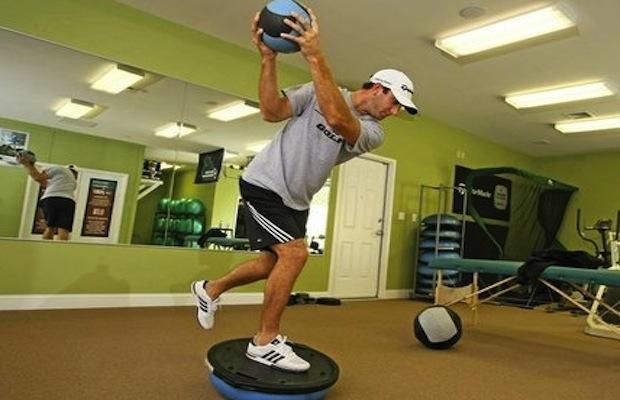
- Medicine ball rotational throws: Develops explosive rotational power that transfers directly to swing speed.
- Hip internal/external rotation drills (banded): Increases hip ROM for deeper coil and better weight transfer.
- Thoracic mobility drills (foam roll + extensions): Promotes shoulder turn and reduces compensatory lumbar motion.
- Pallof press & anti-rotation holds: Stabilizes core against unwanted rotation during the swing.
- Farmer carries / suitcase walks: Improve grip strength, core stability and posture across the round.
Warm-up and on-course activation routine
Before practice or a round, use a 10-12 minute routine to prime the nervous system and mobilize key joints:
- Dynamic general warm-up: 3-4 minutes (jumping jacks, light jog in place)
- Mobility flow: hip swings, leg swings, ankle mobilizations (2-3 minutes)
- Thoracic rotation: 8-10 reps each side with a club behind shoulders
- Rotational activations: 4-6 med ball rotational throws or cable chops at moderate effort
- Short swing feel shots: 10-15 swings with focus on sequencing and balance
Injury risk in golf and how to reduce it
Common golf injuries include low back strains, elbow tendinopathies (golfer’s elbow), shoulder impingement, and wrist issues. Prevention strategies:
- Address mobility deficits (thoracic extension, hip rotation) to reduce lumbar compensation.
- Progress strength and endurance in the posterior chain to tolerate impact forces.
- Use eccentric-focused strengthening for tendinopathies (eg, eccentric wrist curls and forearm protocols).
- Balance volume: avoid too much high-intensity practice when adding new gym stimulus.
- Regularly perform movement screens and adjust training based on pain or range loss.
Measuring progress: tests and metrics that matter
- Clubhead speed (radar/trackman) – direct correlate to distance.
- Carry distance and smash factor – golf performance outputs.
- Seated medicine ball throw distance – rotational power proxy.
- Single-leg balance time and movement quality scores – stability markers.
- Movement ROM tests (thoracic rotation,hip IR/ER) – mobility changes.
Case study: 52-year-old amateur improving swing speed and pain-free play
Player profile: 52-year-old male, 14-handicap, long-standing low back stiffness and limited thoracic rotation. Goals: add 8-10 mph clubhead speed, eliminate mid-round back ache.
- Assessment: reduced T-spine rotation (20° vs target 45°), weak glute med, poor single-leg balance.
- Intervention (12 weeks): thoracic mobility daily, three weekly strength/power sessions, progressive med ball throws, glute-focused hip thrusts and single-leg RDLs, pallof presses for core.
- Outcome: +7 mph clubhead speed, 15-yard increase in carry distance, resolution of mid-round lumbar pain, more consistent strike pattern.
Practical tips for golfers and coaches
- Pair technical coaching with fitness work-changes in swing mechanics often require neuromuscular adaptation and strength support.
- Prioritize quality over quantity: technique drills and a focused 30-45 minute gym session deliver better results than random heavy lifting.
- Track small wins: record clubhead speed, ball speed, and subjective fatigue to guide progression.
- Include unilateral and rotational work-golf is asymmetrical and so should some of your training be.
- When in doubt, consult a golf fitness professional or physiotherapist to tailor programming and handle injuries.
WordPress/CSS snippet for consistent styling (optional)
/* Add to your theme's custom CSS */


.wp-block-table.is-style-stripes tbody tr:nth-child(odd){background:#fafafa;}


.wp-block-table th{background:#0a6ebd;color:#fff;padding:8px;}


.wp-block-table td{padding:8px;border-top:1px solid #e6e6e6;}
SEO & content checklist for publishing
- Meta title: include target keywords (e.g., “Golf Fitness”, “Biomechanics”, “Golf Training”).
- Meta description: concise summary under 160 characters with keyword phrase.
- Use H1 for the main topic and H2/H3 for subtopics-include long-tail keyword variations naturally (eg, “golf-specific exercises”, “rotational power for golf”).
- Internal links: link to golf lessons, swing tips, and injury prevention posts on your site.
- External authoritative links: peer-reviewed sports science, PT guidelines, or PGA/reputable golf fitness resources.
- Use images with descriptive alt text: “golf fitness rotational drill” or “medicine ball throws for golf”.
Recommended resources and further reading
- Peer-reviewed studies on golf biomechanics and swing sequencing (search sports biomechanics journals).
- resources from golf fitness specialists and certifying bodies (Titleist Performance Institute, GGA, NASM golf specialization).
- Programming books on strength & conditioning for rotational athletes.
If you’d like,I can create a printable 8-week PDF plan tailored to your handicap,age,and training equipment-or build a video demo of the key golf-specific exercises and warm-up routine.


