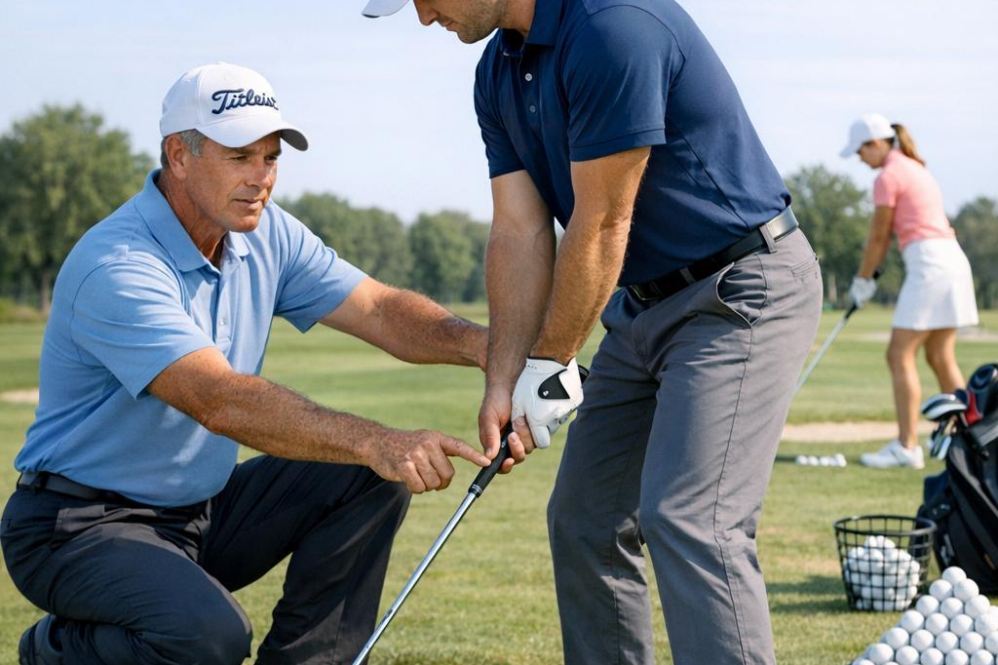
Understanding the Foundations of Davis Love III’s Driving Technique for Maximum Distance
At the core of Davis Love III’s driving technique lies a meticulously balanced setup that prioritizes both power and consistency. Love’s stance features a slightly wider than shoulder-width footprint paired with a subtle flex in the knees, promoting stability throughout the swing. The ball position is typically aligned just inside the lead heel, encouraging an upward strike on the driver that increases launch angle and reduces spin for longer carries, thereby optimizing the launch angle for his driver and maximizing carry distance. Golfers should aim for a 45-degree spine tilt away from the target to facilitate an upward strike, which is critical for reducing spin and increasing ball speed. Beginners can start by practicing this posture in front of a mirror to ingrain proper body alignment and maintain balance during takeaway. Building a rhythm that synchronizes the lower and upper body segments is essential, as Love’s smooth transition showcases how kinetic sequencing contributes to both accuracy and power. During warm-up, using alignment sticks to verify that your stance points directly at the target helps ensure your body lines don’t inadvertently push shots offline and provides a reliable baseline from which to develop a repeatable and efficient driving swing. To support this, golfers can use simple setup checkpoints-ball position inside the lead heel, shoulder-width stance, and relaxed grip pressure-to create a consistent pre-swing routine that promotes a powerful yet controlled motion.
Transitioning into the backswing, Love emphasizes a full shoulder turn to approximately 90 degrees relative to the target line while keeping the lead arm extended but relaxed. this rotation loads the core muscles effectively, creating the coil necessary for explosive clubhead speed. Intermediate and advanced players should focus on maintaining wrist hinge angles and avoiding a sway that can pull the swing off plane, which often leads to slices or hooks. Drills that encourage slow, controlled swings with pauses at key checkpoints-such as the top of the backswing-help promote muscle memory for efficient sequencing. Practical drills such as slow-motion swings with pause points at the top and halfway down, and even occasional weighted club swings, further ingrain proper timing and sequencing. Additionally, practicing under variable conditions, such as windy or uphill tee shots, compels golfers to adapt their swing dynamics without sacrificing form, a hallmark of Love’s adaptability on tour. Golfers can also experiment with subtle clubface adjustments at impact to intentionally shape shots (fade or draw), a critical skill for navigating doglegs or avoiding strategically placed hazards.
the downswing and impact positions are where Davis Love III’s strategic precision truly shines, enabling maximum distance without sacrificing control. His lower body initiates the downswing with a subtle yet decisive hip rotation that leads the arms, ensuring the clubhead approaches the ball on a slightly inside path. Achieving a lag angle of roughly 30 degrees between the shaft and lead forearm creates stored elastic energy, unleashed at impact for optimal ball speed. Golfers should practice drills like the “pump drill,” where the club is paused just before impact to reinforce lag retention. To further refine contact quality, players should also be aware of common mistakes to avoid during this phase-such as early release of the wrists, over-rotating the hips, or failing to complete a consistent weight transfer-all of which can rob the swing of both distance and accuracy. On the course,following these principles allows players to attack longer fairways confidently while maintaining shot dispersion within playable landing zones. Beyond technique, understanding wind direction, elevation changes, and fairway width helps determine when to prioritize accuracy over raw distance-such as slightly dialing back swing speed on narrow fairways with thick rough to maintain control. Combining technique refinement with intentional pre-shot routines also sharpens mental focus-helping reduce tension and promote a free-flowing swing like that of davis Love III. Selecting the right driver loft (often in the 9-12 degree range for most amateurs) and a shaft flex matched to your swing speed further optimizes launch conditions and reduces dispersion.
Unlocking the Secrets Behind His Putting Precision for Consistent Greenside Success
Mastering greenside putting begins with a solid understanding of setup fundamentals,as emphasized by Davis Love III’s teaching ideology. A consistent stance width-typically shoulder-width apart-paired with a slight knee flex and a forward tilt of the spine creates a balanced posture that promotes a smooth pendulum stroke. Proper eye alignment directly over or slightly inside the ball’s path ensures accurate visualization of the line. It’s crucial to maintain a stable lower body throughout the stroke to minimize unwanted wrist action, which often leads to inconsistent contact.Practicing with alignment sticks or mirrors can definitely help develop muscle memory for these checkpoints. Additionally,selecting the correct putter length,usually tailored so the handle rests comfortably at the mid-thigh height,supports a natural arm hang and promotes better control,a detail often overlooked by beginners but essential for repeatable precision.
Once setup fundamentals are dialed in, refining the stroke mechanics and green reading skills becomes vital for consistent success around the greens. Davis Love III emphasizes the importance of a controlled tempo that matches the length and speed of the putt, where the backswing and follow-through are balanced and of equal arc length. Incorporating a practice drill such as the “gate drill”-where two tees define the intended path of the putter head-helps improve stroke path and face angle at impact. Simultaneously, learning to read green slopes accurately by observing grass grain and subtle undulations trains the eye to anticipate breaks. Love also stresses assessing high and low points on the green and visualizing the ball’s path, sometimes using tees along the intended line to “see” the break more clearly. A practical drill to deepen this skill is to place tees along the intended line to simulate the putt’s route, allowing you to see and feel how the ball should travel toward the hole. Such as, uphill putts require a longer backswing to compensate for slower ball speed, while downhill putts demand a softer touch. A practical tip is to stand behind the ball to identify the break visually, then walk around the putt to feel the slope’s contour, integrating sensory feedback into the read. This layered approach ensures both technical and strategic proficiency, crucial under varying course conditions and green speeds.
equally significant is integrating course management principles when approaching greenside situations to maximize scoring opportunities. Davis Love III frequently enough advises golfers to select targets and shot shapes that reduce risk while enhancing confidence, such as aiming for the center of the hole on longer putts rather than the exact pin location to avoid severe breaks. For players struggling with lag putting, focusing on distance control first and using drills that emphasize pace over perfect lines builds confidence and minimizes three-putts, especially under pressure. Developing a consistent pre-shot routine that includes visualization and controlled breathing can sharpen focus and reduce tension, improving distance control. Beginners benefit from practicing putts inside 10 feet regularly to build confidence and hone feel, while low handicappers should challenge themselves with pressure drills that simulate tournament conditions, like putting for par on tough greens. Monitoring green conditions, such as wetness or grain direction after rain, also guides pace adjustments. by combining technical lessons with mental strategies and course awareness, golfers can unlock the secrets behind putting precision that leads to consistent greenside success and meaningful score reduction.
Practical Tips from Davis Love III to Build Confidence and Adapt Your Swing Under Pressure
Building confidence under pressure starts with a consistent pre-shot routine, a cornerstone of Davis Love III’s approach. He advocates for establishing a reliable setup that includes precise alignment and a relaxed grip pressure-typically around 5-6 on a 10-point scale-to maintain control without tension. Love emphasizes evaluating stance width relative to the shot type, suggesting a slightly narrower stance for finesse approach shots to enhance mobility, and a wider base for powerful drives to ensure stability. Incorporating targeted practice drills, such as the “closed-eye setup drill,” helps golfers internalize feel and balance, allowing them to trust their mechanics when nerves rise.By rehearsing this routine repetitively at the range,players develop a mental blueprint that minimizes indecision and primes the body for a repeatable swing pattern even in high-stakes scenarios.
Adapting your swing to varying course conditions is another subtle art Davis Love III excels at, and one he teaches by breaking down swing dynamics into manageable adjustments. Such as, when playing into stiff winds, Love advises reducing the angle of attack to produce a lower ball flight, which involves positioning the ball slightly back in the stance and maintaining a shallow swing plane. Conversely, softer lies require a more vertical attack angle and a ball position slightly forward to ensure crisp contact. He also stresses the importance of wrist hinge timing in these situations, recommending drills like the “pause at the top” to cultivate better control of release through impact. by incorporating these swing modifications into your practice regimen, you can seamlessly tailor your mechanics to diverse shot requirements, improving shot-making consistency and ultimately lowering scores.
Love’s strategic course management tips blend technical skill with smart decision-making, reinforcing confidence on every hole. He encourages golfers to assess risk versus reward by choosing targets that complement their strengths-such as favoring the safe, wider part of the fairway with a 3-wood rather than forcing a driver in tight drives. To translate this into practical skills, he recommends practicing trajectory control through varied tee shots and honing short game precision using lies and slopes simulated in practice bunkers or chipping areas. Implementing these strategies during rounds enables golfers to stay engaged with their game plan instead of reacting impulsively under pressure. Ultimately, the synergy of technique refinement and strategic play, as taught by Davis Love III, promotes resilience and poise, empowering golfers of all levels to perform reliably in competitive and recreational settings alike.