The follow-through portion of the golf swing is a decisive – and often undervalued - determinant of where and how a shot finishes. It represents the endpoint of a coordinated chain of joint actions,club dynamics,and neural control. Improving follow-through efficiency – defined here as refining movement economy to maximize performance and consistency – demands attention beyond hand and wrist placement at the finish. Coaches and players must address the intersegmental timing that transmits force from the feet through the hips and trunk into the club. Biomechanical research makes clear that small changes in deceleration timing, torso rotation and lower-limb support alter clubface angle at impact, launch conditions, and the consistency of shot pattern.
Core biomechanical concepts underpinning the follow-through and their effect on shot repeatability
The follow-through is the visible outcome of how well the body’s kinetic chain has been organized. When larger, proximal segments (hips and torso) generate and release energy before smaller, distal segments (arms and club), angular velocities stack favorably and deliver a cleaner impulse to the clubhead with fewer compensations. From a mechanics viewpoint, reliable follow-throughs depend on correct sequencing of body segments, sensible handling of angular momentum, and appropriate joint torque distribution so that the power created in the ground and trunk carries through impact and is dissipated smoothly in the finish.
How the body rotates and slows after contact both reflects the quality of pre-impact actions and controls post-impact behavior. Variables like pelvis‑to‑thorax separation, maximum trunk angular speed, and the timing of wrist unhinging influence face angle and swing path stability; mistimed braking leads to off-plane motion and wider shot dispersion. Keeping arms and wrists extended in a controlled manner preserves moment of inertia and reduces clubhead yaw, whereas early release or collapse on the trail side increases directional and spin variability.
Balance, ground reaction patterns and the path of the center of pressure during the finish are essential to repeatable movement. A secure base and consistent transfer of weight from the rear to the lead foot enable predictable torque generation and absorption. Practically, coaches and players can track a few high‑value indicators to judge follow‑through steadiness:
- Symmetry in GRF – shows effective drive through the ball and weight redistribution
- Pelvis-to-shoulder rotation ratio – measures sequencing fidelity between hips and torso
- COP trace – signals balance and postural control during deceleration
| Variable | Role in mechanics | Coaching prompt |
|---|---|---|
| Hip rotation | Main source of rotational torque | “Lead the chest with the hips” |
| Torso angular speed | Sets release timing | “Smooth through contact” |
| GRF pattern | Anchors the base and contributes power | “Drive onto the front foot” |
From a motor‑control standpoint, the objective is to lower harmful variability while keeping adaptive versatility. Structured, feedback-rich practice (for example, controlled slow swings, constraint-lead tasks, and quantified feedback from video or pressure sensors) encourages neural pathways that favor stable patterns. Targeted conditioning – hip and core strengthening,posterior shoulder eccentric work,and balance/proprioception training - supports the mechanical demands of a controlled finish. In short, integrating anatomy-informed strengthening with measurement-based coaching aligns force production, timing and post‑impact deceleration into a reproducible follow‑through that improves shot consistency.
timing and segment sequencing in the finish - practical drills to reinforce correct patterns
Proximal‑to‑distal sequencing remains the mechanical foundation of an effective follow‑through. A robust pattern starts with force generation at the feet and a clear ground reaction, proceeds through coordinated hip rotation and thoracic unwind, and finishes with controlled elbow extension and wrist release. This order reduces energy leakage, lessens compensatory stresses on distal joints, and preserves clubhead speed promptly after impact. Coaches should view deceleration as an active, coordinated process where muscles eccentrically regulate angular momentum rather than simply stop it – a key element for both accuracy and injury prevention.
Accurate timing between segments governs how efficiently energy moves and is dissipated. Ideally, the hips lead slightly ahead of the torso while the shoulders trail just enough to create elastic recoil. Typical timing faults include arm dominance (early arm collapse), delayed hip turn, and exaggerated late upper‑body braking – each producing predictable dispersion patterns. High‑speed video, wearable IMUs, and force‑plate data can quantify when phases begin and end and reveal overlaps or gaps that undermine performance.
Convert analysis into practice with drills that reinforce temporal cues and motor programs.Useful options include:
- Step-and-Drive - step toward the target at transition to encourage hip initiation and lead‑side rotation.
- Hold-at-Impact – a slow swing paused in the impact/early follow‑through frame to teach eccentric control of the trail musculature.
- Metronome Tempo Series – use a metronome to build consistent cadence across backswing,downswing and finish.
- Band‑assisted deceleration – a resistance band attached to the grip provides progressive eccentric demand through the finish to strengthen neuromuscular control.
Each exercise addresses a particular timing or phase fault while keeping the proximal‑to‑distal order intact.
Work progressions should start with isolated timing drills and move toward integrated, full‑speed practice with feedback. A sample escalation: begin with low‑speed, high‑focus sets (3-5 sets of 6-8 reps), add medium‑speed practice with video review, and conclude with on‑course application. Use measurable criteria (ball dispersion, tempo consistency, perceived effort) to decide when to progress.
| Drill | primary aim | Starter sets/reps |
|---|---|---|
| Step-and-Drive | Encourage pelvic initiation | 4×6 |
| Hold-at-Impact | Train eccentric control | 3×8 |
| Metronome Tempo Series | Build timing consistency | 5×10 |
How trunk rotation and leg stability shape launch and spin
Axial rotation sequencing and controlled deceleration in the finish are central to the ball’s initial direction and the orientation of its spin axis. Both empirical models and field observations show that a clear proximal‑to‑distal transfer – led by thoracic rotation and tuned by pelvic mechanics – helps keep the clubface stable at impact and reduces undesired spin. When trunk rotation is mistimed or disproportionate to lower‑limb support,small deviations in clubhead path can magnify into measurable lateral scatter and unpredictable spin changes.
Outcome control also depends on the lower limbs providing a stable yet adaptable platform that converts ground forces into rotational impulse. Observable markers of effective lower‑limb stability include:
- Stance width - alters the rotational moment arm;
- Knee flex strategy – affects how energy is absorbed and transferred;
- COP progression - indicates timing of weight shift and balance;
- Force symmetry – linked to repeatable clubface return paths.
Together these variables determine how trunk rotation is expressed at the clubhead and thus how launch angle and spin axis behave.
Representative ranges can guide intervention priorities. Typical values observed in coaching practice and biomechanical literature include:
| Parameter | Usual range | Effect on ball |
|---|---|---|
| Pelvic rotation at impact | ~20°-35° | Drives hip torque and influences draw/fade tendencies |
| Thoracic rotation at impact | ~40°-60° | Helps align the clubface and set launch angle |
| Pelvis‑thorax separation (X‑factor) | ~10°-30° | Relates to clubhead speed and spin stability |
Use these bands as starting points and adapt them to the player’s build and shot intent rather than as universal prescriptions.
To move biomechanics into training, pair rotational mobility work with multi‑segment stability drills. Priorities include progressive rotation exercises that maintain pelvis‑thorax dissociation, single‑leg loading for force symmetry, and reactive balance tasks to sharpen COP control. Rely on measurable outcomes (for instance, lower lateral dispersion or steadier spin rates) and tools such as IMUs or force plates to confirm that improvements in trunk rotation and leg stability translate into better ball flight control.
Interpreting the finish: club path, face angle and corrective approaches
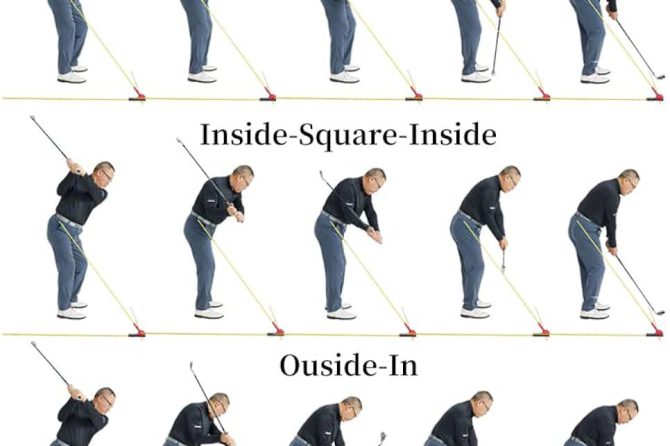
The visible finish is not the sole cause of ball behaviour but a useful indicator of the impact mechanics that preceded it. The follow‑through is the kinematic trace of what happened at impact: a balanced, repeatable finish typically signals coordinated lower‑body drive, torso rotation and hand release. Conversely, an overly open finish frequently enough accompanies an outside‑in path and an open face at impact; an excessively closed finish tends to indicate an inside‑out path and early release. Reading the finish lets coaches infer the milliseconds before and during impact.
- Ball‑flight clues: initial direction approximates club path; subsequent curvature reveals face‑to‑path relationship.
- Divot and turf interaction: Diverging divot lines point to a skewed path; very shallow or toe‑first contact suggests face tilt or dynamic loft issues.
- Finish alignment: The orientation of the clubface and final hand position (relative to the target line) provide simple kinesthetic checks.
- Release pattern: Early forearm roll versus delayed release signals tendencies toward closed or open face behaviour through impact.
Corrections should follow the diagnosis and progress from kinetic to kinematic solutions. For an outside‑in path with an open face, drills that promote an inside release and full body rotation are effective – such as, using an alignment stick outside the ball to encourage an inside takeaway, combined with a gate drill at impact to train a square close. For inside‑out/closed‑face tendencies,use tempo and wrist‑hinge drills (split‑hand swings,controlled three‑quarter motions) to delay release.Quantify change with video analysis and launch metrics: track reductions in face‑to‑path error, spin‑axis deviations and excessive curvature. Short, memorable cues (such as “rotate through” or “finish long”) help internalize timing without overly conscious interference.
| Observed cue | Likely fault | Sample corrective exercise |
|---|---|---|
| Ball starts right and slices | Outside‑in path with open face | Inside‑path alignment stick + impact gate |
| Ball starts left and hooks | Inside‑out path with closed face | Split‑hand release + impact bag |
| Thin or toe hits | Face tilt or poor contact location | Half‑swing impact focus + divot alignment |
For lasting change, place corrective work inside a structured practice flow: diagnose (video/launch data) → isolate motor control (focused drills, low reps) → reintegrate (full swings with variability) → transfer (on‑course scenarios). set objective thresholds (for example, target a measurable drop in face‑to‑path variance) to determine readiness to advance. Watch for compensations – altering path or face mechanics changes launch and physical demands – so re‑evaluate balance, posture and sequencing after each intervention to ensure gains hold under pressure.
Controlling deceleration and release to sharpen accuracy and lower injury risk
How the swing brakes after impact and how the hands release the club strongly influence face orientation and shot scatter. Proper sequencing that hands braking duties from proximal stabilizers to distal absorbers minimizes unwanted clubhead rotation at impact and improves directional control. Overly aggressive or poorly coordinated braking can trigger early hand acceleration (early release) and widen dispersion; inadequate eccentric control lets residual torque disturb face angle. Mechanically, optimizing this late phase balances angular momentum dissipation with precise distal timing to protect both performance and tissues.
Technique adjustments should focus on eccentric strength,timely muscle sequencing and perceptual cues that produce repeatable unloading. Key elements include:
- Eccentric control of the lead arm: train the lead arm musculature to lengthen through impact so wrists resist premature collapse.
- Stable core, mobile extremities: use trunk and hip braking to absorb rotational energy before it reaches the wrists and hands.
- Tempo adjustment: slightly lengthen the controlled follow‑through window to give the nervous system time to coordinate braking smoothly.
Reducing injury risk entails identifying the primary tissues that decelerate the swing and prescribing load‑specific work for their adaptation. The table below highlights priority structures, their deceleration roles and concise training targets to lower strain.
| Structure | Role in late‑swing braking | Training focus |
|---|---|---|
| Posterior rotator cuff (lead shoulder) | Eccentrically brakes internal rotation of the humerus | High‑speed eccentrics and scapular control work |
| Lead elbow flexors | Regulate forearm and wrist extension at release | Progressive eccentric loading and tempo drills |
| Obliques & deep trunk rotators | Slow torso rotation and offload force to legs | Rotational eccentrics and coordinated bracing drills |
| Gluteal muscles | Stabilize the pelvis and absorb ground reaction moments | Single‑leg strength and reactive deceleration work |
Combine objective monitoring with staged progression so technique change and tissue adaptation proceed together. Use motion capture or wearable imus to track peak angular speeds, deceleration slopes and time‑to‑peak; aim to smooth abrupt deceleration peaks while preserving necessary clubhead velocity. A pragmatic pathway is: assess (identify early hand acceleration), train (eccentric and reactive drills at submaximal speeds), integrate (tempo‑controlled on‑course reps), and manage load (periodize practice to allow tendons to adapt). Linking motor learning with tissue capacity improves accuracy and reduces cumulative injury risk.
Training approaches to sharpen proprioception and motor control in the finish
refining end‑stage swing control means addressing the sensorimotor processes that produce precise final segment alignment and safe force absorption. Field and lab measures – instrumented club data, COP traces from force plates, and joint‑position sense tests – should be used to establish baseline proprioceptive acuity and movement variability. Pay attention to how distal control (wrist and face orientation) links with proximal sequencing (pelvis‑to‑shoulder rotation) to find the weakest link in the chain. These diagnostics inform individualized programs that emphasize both accuracy and repeatability.
Choose multimodal interventions that challenge sensory feedback and motor planning. Recommended modalities include:
- unstable‑surface balance tasks (single‑leg on foam or wobble boards) to improve ankle and knee proprioception under rotational demand.
- Rotational strength and braking drills (medicine‑ball throws and catches with varied intensities) to train controlled eccentric stopping of the torso and arms.
- Variable practice (changing stance width, ball position and club length) to build adaptable motor programs and reduce dependence on a single pattern.
- Augmented feedback (real‑time video, haptic cues or visual occlusion tools) to refine timing and sensory weighting.
Introduce these in short, focused blocks to maintain neuromuscular quality and avoid fatigue that degrades proprioception.
| Phase | Primary goal | Sample prescription |
|---|---|---|
| Foundation | Static proprioception | 3x/week: single‑leg balance 3×30s |
| Integration | Dynamic control | 2x/week: med‑ball rotational throws 4×6 |
| Transfer | Task resilience | 2x/week: variable practice swings 5×10 |
Increase complexity gradually: progress from low‑perturbation to high‑perturbation tasks while adding cognitive load and course‑like constraints to bridge practice and play.
Evaluate retention and transfer routinely: use no‑feedback retention tests and on‑course transfer trials to confirm gains generalize to performance. Apply motor‑learning strategies such as faded feedback, randomized practice schedules, and moving from explicit instruction toward implicit execution to consolidate skill. Schedule periodic objective rechecks (kinematic variability, radial error, perceived control) to refine the programme and ensure the player develops both precise clubface management and robust follow‑through mechanics under competitive conditions.
Embedding follow-through work into practice routines and tactical choices on course
Structure practice to build durable motor skills by treating the follow‑through as part of the task rather than a separate cosmetic finishing pose. Favor deliberate practice cycles that combine quality repetitions with immediate feedback (video clips, coach observations, inertial data). Track objective measures – clubpath, face angle at contact, and finish posture consistency – to decide whether a technically correct finish is becoming habitual.Include variability in practice so the follow‑through remains adaptable: successful execution under diverse lies, targets and clubs strengthens the neural representation of the desired finish.
Connect technical improvements to on‑course decision making by framing the follow‑through as a controllable element in tactical choices. When selecting a shot, decide explicitly how the finish should relate to the objective - accuracy, trajectory or spin management – and pick techniques practiced under similar constraints.Use contextual interference: rehearsing finish variations under simulated pressure (timed shots, score consequences) increases the likelihood the chosen finish pattern will hold up when it counts.
use a compact practice blueprint that combines motor, perceptual and decision elements. Core components include:
- Intentional warm‑up: low‑intensity swings that emphasize rhythm and balanced finishes.
- Focused blocks: short sets (10-20 swings) concentrating on one follow‑through cue with immediate visual feedback.
- Variable transfer sets: alternate clubs, distances and lies to promote generalization.
- Pressure simulations: competitive drills or score penalties to reproduce on‑course stakes.
- Reflective consolidation: post‑session video review and notes that guide the next practice.
| Focus | Drill | Reps | Measure |
|---|---|---|---|
| Balance & Finish | Hold the finish on a mat | 3×10 | Seconds held / sway |
| Path consistency | Target‑line feed shots | 4×12 | Clubhead trace variance |
| On‑course transfer | Pressure par‑3 routine | 2-3 holes | Score / perceived control |
Q&A
Note on search results: The brief web lookup provided non‑specific dictionary entries for phrases containing “follow” rather than material directly tied to golf follow‑through science. The Q&A that follows is therefore distilled from established biomechanical and coaching knowledge relevant to improving follow‑through mechanics, presented here in a practical, practitioner‑focused format.
Q1: What does “follow‑through” describe in a golf swing?
A1: The follow‑through comprises the coordinated movements after ball contact through to the final posture. Biomechanically it is the terminal phase in which kinetic energy and angular momentum produced during the downswing are dissipated and the body returns to a balanced finish. It includes continued hip and torso rotation, arm extension, wrist deceleration and the transition to a stable stance.
Q2: Why is the follow‑through important for accuracy and repeatability?
A2: the finish mirrors the quality of pre‑impact sequencing and impact mechanics. A controlled follow‑through typically indicates correct timing,maintenance of swing plane and a stable clubface at and after impact – all factors that affect shot direction,spin and dispersion. It also helps distribute residual energy in a way that reduces inconsistent braking patterns.
Q3: Which biomechanical rules are most relevant to an effective follow‑through?
A3: Important principles are: (1) proximal‑to‑distal sequencing (energy transfer from hips to torso to arms to club); (2) managing and purposefully dissipating angular momentum; (3) effective ground reaction force transfer through the kinetic chain; (4) maintaining a consistent spine axis to protect swing plane; and (5) controlled distal deceleration to preserve tissue health and clubface stability.
Q4: What common technical faults appear in finishes?
A4: Frequent faults include early wrist release, a “chicken‑wing” deceleration, incomplete rotation or collapse on the trail side, reverse‑pivot weight patterns, excessive lateral translation and mismatched shoulder‑to‑hip rotation. Such faults frequently enough stem from earlier swing timing or impact issues.
Q5: How does the follow‑through change with different clubs or shot types?
A5: With long clubs like the driver,arcs are larger and finishes tend to be higher and more extended due to greater angular momentum. Shorter clubs and punch or low‑trajectory shots usually have abbreviated, lower finishes by design. The key across types is maintaining consistent clubface behavior and reproducible impact mechanics aligned with the shot’s objectives.
Q6: What role do the legs and trunk play in producing a desirable finish?
A6: Initiating the downswing from the hips and transferring weight onto the lead leg creates a stable base and rotational momentum.The trunk then follows in the proximal‑to‑distal chain, allowing the shoulders and arms to reach the correct velocities and align the clubhead at impact. Proper sequencing reduces compensatory upper‑limb braking and fosters a smooth, extended finish.
Q7: Which physical traits most affect follow‑through quality?
A7: Key attributes include thoracic rotation mobility, hip stability and mobility, core strength and control, shoulder girdle stability, wrist conditioning, and lower‑limb force production and absorption.Fine neuromuscular timing and proprioception are also vital.
Q8: How can a coach measure follow‑through mechanics objectively?
A8: Combine high‑speed video (face‑on and down‑the‑line), launch monitor outputs (ball flight, spin, face angle and path), inertial measurement units for angular velocity data, and force plates for GRF patterns. Compare patterns across clubs and shots and relate post‑impact mechanics to ball‑flight outcomes.
Q9: What drills reliably improve follow‑through behaviour?
A9: Effective drills include slow‑motion swings with held finishes, towel‑under‑arms or chest‑tape to promote coordinated torso‑arm motion, impact‑bag or half‑swing drills to practice extension without full load, medicine‑ball rotational throws to train proximal‑to‑distal power and mirror/video practice to correct plane and finish alignment. Progress from slow and focused to full‑speed and variable practice to support transfer.
Q10: Which coaching cues typically encourage biomechanically sound finishes?
A10: External cues work well (for example, “turn your chest toward the target” or “let the clubhead continue to the target”), paired with concise internal cues when correcting a specific fault (for example, “keep the lead arm long” to prevent early collapse). Early learning favors continuation cues (“extend through the ball”); later use finish‑hold prompts to consolidate the pattern.Q11: How do motor‑learning ideas shape practice for follow‑through improvement?
A11: Start with low‑speed, blocked practice to establish basic timing and patterning, then add variability and context constraints to build adaptability. Begin with frequent augmented feedback (video, launch data) and progressively reduce it so athletes learn to self‑detect errors. Encourage external focus and task‑relevant variability to enhance retention and transfer.
Q12: What injury risks are associated with faulty finishes?
A12: Abrupt deceleration, excessive loading through the lead knee, or compensatory spinal rotation can increase risk of lower‑back strain, shoulder issues and elbow/forearm overload. Manage practice volume, restore balanced rotational strength, improve mobility and correct sequencing to lower risk.
Q13: How should conditioning and mobility support follow‑through demands?
A13: Emphasize rotational power (medicine‑ball throws, cable chops), hip and thoracic mobility (dynamic rotations, targeted stretches), core anti‑rotation strength, and eccentric control exercises (plyometric landings emphasizing soft, controlled deceleration). Periodize the program to reflect on‑ and off‑season demands and coordinate physical training with technical practice.
Q14: What markers indicate meaningful improvement in a follow‑through?
A14: Useful indicators include reduced variability in face angle at impact, more consistent ball direction and dispersion, clearer proximal‑to‑distal angular velocity peaks, appropriate GRF sequencing (lead leg load after impact), and repeatable finish posture with balanced weight. Define meaningful change relative to the individual’s baseline and intended shot outcomes.
Q15: How does equipment affect follow‑through mechanics?
A15: Club characteristics change timing and inertia. Longer or stiffer shafts increase torque demands and can shift release timing, potentially requiring adjusted swing mechanics to keep the face under control. Grip size affects wrist mechanics and release. Fit equipment so it complements the player’s biomechanics and minimizes compensatory finish patterns.
Q16: Are there limits to how much the finish should be intentionally altered?
A16: Yes. Because the follow‑through reflects upstream mechanics, excessive tinkering with the finish alone – without addressing impact‑phase sequencing – can produce maladaptive patterns and poor transfer to on‑course performance. Interventions should be targeted, minimal and evidence‑checked against outcome measures.
Q17: When multiple faults coexist, how should coaches prioritize fixes?
A17: Tackle root causes first – those evident at or before impact (for example, flawed weight transfer, incorrect wrist hinge, or insufficient thoracic rotation). use objective data to rank interventions: treat safety issues first, then sequencing and consistency, then fine performance shaping. Follow an iterative, data‑driven approach with clear checkpoints.
Q18: What research directions would most help follow‑through coaching?
A18: Valuable studies would link specific follow‑through training programs to on‑course outcomes and injury incidence, identify timing thresholds predictive of accuracy, integrate wearable sensor analytics for real‑time feedback, and develop individualized models relating body shape and strength to optimal finish kinematics.
Q19: What immediate, practical recommendations should coaches apply?
A19: Evaluate the finish as part of the whole swing using video and launch data; prioritize thoracic rotation, hip stability and core control; use proximal‑to‑distal sequencing drills and external focus cues; progress drills from slow to full speed and from blocked to variable practice; monitor ball‑flight variability and kinematic markers; and manage load to reduce injury risk.Q20: How can players self‑track follow‑through progress between lessons?
A20: Record smartphone video from down‑the‑line and face‑on perspectives and compare to target finish positions; log shot dispersion and subjective swing feel; use simple tools (impact bags, alignment sticks) for immediate feedback; and periodically check with a launch monitor or wearable IMU to measure changes in face‑angle variability and sequencing metrics.If you prefer, I can convert these Q&As into a one‑page coaching checklist, outline progressive drill plans with measurable targets, or draft a short bibliography of key research to support the recommendations.
Refining follow‑through mechanics is central to consistent shot accuracy, predictable ball flight and long‑term musculoskeletal resilience in golf. By prioritizing coordinated sequencing, deliberate weight transfer and controlled deceleration, practitioners can cut unwanted variability and improve launch reproducibility. Objective assessment tools – high‑speed video, inertial sensors and three‑dimensional motion analysis – help identify maladaptive patterns and guide targeted interventions.
For coaches and clinicians, an individualized, progressive model works best: measure current movement patterns, address the deviations most likely to harm performance or increase injury risk, and combine motor‑learning informed drills with strength and mobility work tailored to the kinetic chain. Emphasize exercises that preserve tempo and timing under realistic loads and fatigue so improvements transfer to on‑course play.
Future work should expand longitudinal intervention trials linking specific follow‑through training to competitive outcomes, explore inter‑individual differences (age, skill level, body proportions), and define clinically meaningful thresholds in kinematic and kinetic metrics. Advances in wearable sensors and machine‑learning analytics have strong potential to scale objective assessment and deliver actionable, real‑time feedback in practice and play.
improving follow‑through mechanics requires combining biomechanical insight, systematic measurement and practical coaching. Applied consistently, this approach increases performance reliability and reduces injury risk, helping golfers extend both their effectiveness and their playing careers.

Finish Strong: Follow-Through Secrets for More Accurate Golf Shots
Pick the tone you like (technical, punchy, or player-focused)
- Finish Strong: Follow-Through Secrets for More Accurate Golf Shots (player-focused)
- Master the finish: How proper Follow-Through Transforms your swing (coaching)
- The Power of the Finish: Follow-Through Mechanics for Consistency and Control (technical)
- Follow-Through Mastery: Fine-Tune your Finish for Better Ball Flight (player-focused)
- From Impact to Follow-Through: Unlock Greater Accuracy in Your Golf Swing (technical)
- Nail the Finish: Biomechanics-Based Follow-Through Tips for Better Golf (technical)
- Finish with Precision: Optimize Your Follow-Through for Consistent Shots (coaching)
- The Art of the Finish: simple Follow-Through Tweaks That Improve Performance (player-focused)
- Perfect Your Follow-Through: The Key to Consistent Distance and Direction (coaching)
- Swing Finish Secrets: Practical Follow-Through Fixes for Immediate Betterment (punchy)
Why the follow-through matters for accuracy and control
The swing follow-through is not just an aesthetic finale - it is indeed the kinematic result of everything you did leading up to and through impact. A repeatable follow-through reflects consistent club path,correct clubface orientation at impact,and efficient energy transfer. In practical terms, a controlled follow-through improves:
- Shot direction and dispersion (accuracy)
- ball flight shape and spin (control)
- distance consistency and tempo
- Balance and injury prevention
Key biomechanics of the follow-through (technical)
1. Kinetic chain and momentum transfer
The follow-through expresses the release of energy from the ground up: legs → hips → torso → shoulders → arms → club. Proper sequencing ensures minimal variability at impact and a predictable ball launch.
2. Rotational completion
Effective follow-through requires full, but controlled, rotational completion of the hips and torso. The hips should lead the rotation and the torso should follow; the shoulders turn beyond the hips to allow the arms to extend naturally.
3. Wrist release and clubface control
The timing of the wrist release affects clubhead speed and face angle. A late, controlled release tends to square the face while preserving speed; an early flip leads to inconsistent face angles and poor accuracy.
4. Center of mass and balance
Maintaining balance during and after the follow-through indicates that forces were managed efficiently. Your head may move slightly, but staying balanced on the lead leg shows stability and quality contact.
follow-through checkpoints: What to look for on the range
- Weight transfer: ~80-90% on the lead foot at finish
- Front knee: soft and stable, not collapsing
- Chest and belt buckle: facing the target (rotational completion)
- Hands: past the lead shoulder with a relaxed forearm
- Clubhead: pointing down the target line or slightly left for a draw
- Balance: able to hold the finish for 2-3 seconds
Common follow-through faults and fixes
Fault: Swaying or sliding the lower body
Fix: Emphasize rotational pivot drills. Place an alignment stick across your hips and practice rotating without lateral sliding. Make small swings focusing on turning the belt buckle toward the target.
Fault: Early release (casting)
Fix: Use a “pump drill” – swing to transition,stop,then swing through trying to hold the angle longer. Strengthen wrist and forearm stability with slow-motion half-swings.
Fault: hanging back on the trail leg
Fix: Do step-through drills that require you to finish balanced on the front foot. Also, practice hitting shots with feet close together to force better weight transfer.
Fault: Over-rotating with a loss of balance
Fix: Control tempo and shorten the backswing until you can finish balanced. Use a mirror or video to ensure the head and chest are stable and not excessively pushed forward.
Practical drills to improve follow-through
| drill | Target | Reps |
|---|---|---|
| Step-Through Finish | Weight transfer & balance | 10-15 |
| Pump Drill | Delay release & timing | 8-12 |
| Club-Across-Hips | Hip rotation without sway | 12-20 |
| Slow-Motion Impact to Finish | Muscle memory for path & face | 6-10 |
How to use these drills effectively
- Warm up for 5-10 minutes before drill work.
- Start slow to ingrain motor patterns; speed up only when mechanics are correct.
- Record short videos (down-the-line and face-on) every 10-15 minutes to monitor progress.
- Mix drills with full shots – don’t over-isolate for too long.
Tempo, rhythm, and follow-through consistency
Tempo is the invisible glue that ties the backswing, transition, impact, and follow-through together. A smooth, consistent tempo reduces timing variability and helps reproduce the same finish. Try a 3:1 ratio (backswing:downswing) as a practice guideline – for many players that translates into a smooth takeaway and a decisive, athletic downswing leading to a controlled finish.
Targeted coaching cues by audience
Beginners
- Keep your eyes on the ball and allow your body to rotate through the shot.
- Finish with your belt buckle facing the target and hold that position for a second.
- Practice half-swings first to learn balance and weight shift.
Intermediate players
- Work on delay-release drills and the pump drill to control clubface timing.
- Use alignment sticks to check hip rotation and club path at finish.
- Integrate swing speed training to match your desired ball-flight with a stable finish.
Advanced players
- Focus on subtle wrist and forearm timing to fine-tune face angle at impact.
- Use launch monitor feedback to connect finish position with carry distance and dispersion.
- Experiment with small adjustive finishes (clubhead slightly left/right) to shape shots intentionally.
First-hand experience: a simple progressive practice plan (4 weeks)
Week 1 – mechanics and balance: 15-20 minutes of step-through and club-across-hips drills, 30 good half-swings focusing on weight transfer.
Week 2 - timing and release: add pump drills and slow-motion impact-to-finish swings, track feel with video, 40-60 full swings at 80% effort.
Week 3 - speed and repeatability: introduce 10-15 swings at 90% effort, check dispersion with a target, continue 10-15 minutes of finish-hold practice.
Week 4 – course application: simulate on-course shots, prioritize finishing position on every swing, monitor scoring and dispersion improvements.
Measuring progress: objective indicators
- Reduced shot dispersion (group size) to your intended target
- Consistent carry distances within a smaller yardage range
- Ability to hold balanced finish for 2-3 seconds after swing
- Consistent ball flight shapes when intending draws or fades
Speedy checklist to use during practice or on the course
- Did I transfer weight to my front foot?
- Is my chest/belt buckle facing the target at the finish?
- Are my hands relaxed and the clubhead past my lead shoulder?
- can I hold my finish for 2 seconds without stumbling?
- Does the ball flight match my intended target shape?
Benefits and practical tips
- Benefit – Improved accuracy: A repeatable follow-through reduces left-right dispersion and helps your target alignment.
- Benefit – better control of ball flight: subtle finish positions can definitely help you shape shots intentionally.
- Benefit – Greater distance consistency: Efficient energy transfer through to the finish reduces lost clubhead speed.
- Tip – Use short, focused practice sessions (20-30 minutes) on follow-through mechanics rather than long, unfocused range sessions.
- Tip – Get video feedback or a coach’s eye - small changes in finish often reveal bigger upstream faults.
Coaching tools and tech that help
- launch monitor – links finish positions with spin and dispersion data.
- Slow-motion camera or phone – instant visual feedback for finish checkpoints.
- Alignment sticks and impact tape – verify path and contact quality that the finish implies.
- Wearables (gyro sensors) – measure rotation speed and balance through the finish.
Shot-shaping through follow-through adjustments
Small intentional changes to your finish let you shape shots without altering the whole swing:
- Stronger finish with hands slightly left (for right-handers) – encourages a draw.
- Smoother,more open finish with hands finishing more right – encourages a fade.
- Shorter finish and compact rotation – lower ball flight for windy conditions.
Punchy practice cues you can use on the course
- “Turn, don’t slide.” – Focus on hip rotation.
- “Hold the finish.” – Check balance and stability.
- “Delay the snap.” – Prevent early release.
- “Finish tall.” – Keep chest elevated and balanced for cleaner strikes.
Resources and next steps
- Record a short finish-focused practice session and compare week-over-week.
- Try the 4-week progressive plan above and track dispersion/average distances.
- Book a lesson focusing on impact-to-follow-through sequencing for tailored biomechanics work.
If you want this article adapted to a specific audience (beginners, coaches, or advanced players) or a different tone (technical, punchy, player-focused), tell me which tone and audience and I’ll refine it with customized drills, cues, and example session plans.