In the annals of professional golf, Payne Stewart stands as a testament to the transformative power of precision. His elegant swing, unwavering focus, and meticulous attention to detail not only propelled him to major victories but also left an indomitable legacy on the sport. This article endeavors to delve deeply into Stewart’s golfing technique, elucidating the intricate interplay of biomechanics, psychology, and unwavering determination that distinguished him as a master of the fairways.
Key Components of the Payne Stewart Golf Swing
Payne Stewart’s golf swing was renowned for its precision and effortless power. By analyzing its key components, we can gain insights into the mechanics that made him one of the most decorated golfers of his era.
Stewart’s grip was a neutral overlap, with his left hand slightly below his right. This allowed him to generate a consistent clubface angle throughout the swing and control the club’s path. The swing plane was relatively flat and rotated around his body, enabling him to deliver a square clubface at impact.
The rotational sequence was a crucial aspect of Stewart’s swing. He initiated his backswing with a shoulder turn, then rotated his hips into the downswing. This timing promoted a powerful but controlled downswing that produced consistent ball striking. To optimize his impact position, Stewart employed a weight shift in which he transferred his weight onto his left leg as he approached impact. This weight transfer created a stable base for his swing and helped to generate distance.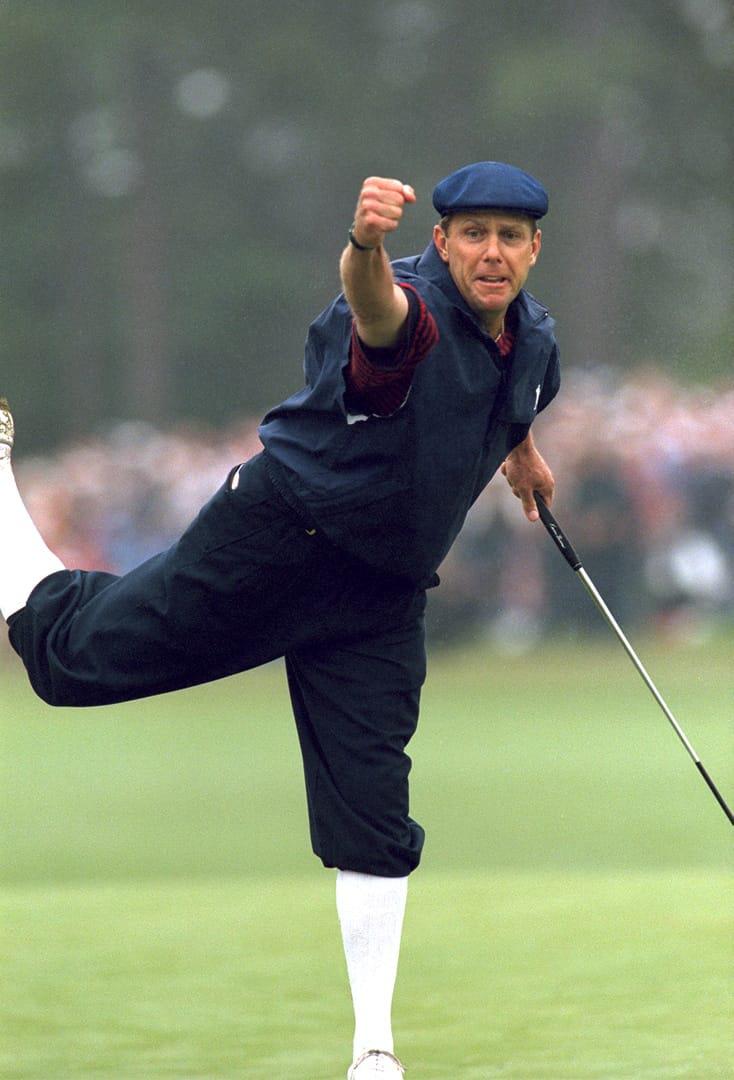
Pinpoint Analysis of Stewarts Ball-Striking Mastery
Stewarts precise ball-striking was a cornerstone of his success on the course. He consistently found the fairway, hit greens in regulation, and controlled his distance with remarkable accuracy. His ability to shape shots and control trajectory allowed him to approach the pin from a variety of angles, setting up countless birdie and eagle opportunities.
Several key factors contributed to Stewart’s ball-striking proficiency. Firstly, his swing was fundamentally sound, featuring a fluid tempo, well-balanced weight transfer, and a consistent downswing path. This solid foundation enabled him to repeat his swing with precision, producing controlled and accurate shots.
Secondly, Stewart possessed exceptional hand-eye coordination and refined feel for the golf ball. He had an innate ability to read the greens and visualize his desired shot shape. He could then execute his swing with both power and finesse, delivering pinpoint shots that landed consistently near the target.
Unlocking the Secrets of Stewarts Fairway Approach
The mechanics of Stewart’s fairway approach shot were a paradigm of precision and control. His ability to shape shots from varying distances, trajectories, and wind conditions was a testament to his exceptional technique.
Optimizing Distance Control: Stewart’s approach shots were renowned for their precise distance control. He achieved this through a combination of factors: accurate club selection, a smooth and consistent swing, and a deft touch on the greens. By finely tuning his technique, Stewart could consistently hit targets with astonishing accuracy.
Trajectory Mastery: Stewart’s fairway approaches exhibited remarkable trajectory control. He could execute high, piercing shots to clear obstacles; low, penetrating shots to run the ball along the ground; and perfectly flighted shots to land softly on the greens. This versatility allowed him to adapt to any course layout and conquer virtually any fairway shot.
* Adaptability in Windy Conditions: Stewart’s technique also excelled in challenging wind conditions. His low and controlled ball flight enabled him to navigate crosswinds with ease, while his ability to generate power and lift allowed him to overcome headwinds and attack pins from distance. These skills were instrumental in his success on windy courses like Shinnecock Hills and Muirfield.
| Wind Condition | Shot Type |
|---|---|
| Crosswind | Low, Controlled Draw |
| Headwind | High, Piercing Fade |
Dialing in Distance Control with Stewarts Putting Technique
Dialing in Distance Control with Stewart’s Putting Technique
Payne Stewart was renowned for his exceptional putting prowess, and his technique offers invaluable insights into achieving precise distance control. Central to Stewart’s approach was a consistent pre-shot routine that emphasized rhythm and visualization.
By maintaining a regular hip swivel and tempo, Stewart ensured a smooth and repeatable stroke. This rhythmic motion allowed him to develop a keen sense of the distance the ball needed to travel. Additionally, Stewart employed clear visualization techniques, imagining the arc of the ball and the desired distance it should cover. This mental imagery further honed his distance control.
Stewart’s technique also placed significant focus on wrist pronation and supination. By rotating his wrists forward and back during the stroke, he controlled the amount of backspin imparted on the ball. This enabled him to adjust the distance based on green conditions and the distance required to reach the hole.
Mastering the Subtleties of Chip and Pitch Shots
Understanding the Nuances of Short Game Artistry
Payne Stewart’s exceptional ability with chip and pitch shots was not merely a matter of raw power or finesse. Instead, it was a testament to his meticulous understanding of the subtle nuances that determine the trajectory, spin, and distance of these crucial strokes.
Precision and the Path of the Club
The path of the club is a critical factor in controlling the loft and spin of the ball. Stewart consistently struck the ball with a shallow angle of attack, ensuring a low, penetrating flight that minimized the chance of the ball ballooning or rolling excessively. Additionally, he played the ball slightly forward in his stance, allowing him to generate a crisp, downward blow that imparted backspin, creating optimal stopping power upon landing.
Manipulating Distance and Trajectory
The distance and trajectory of a chip or pitch shot are primarily determined by two factors: club selection and ball position. Stewart’s mastery of these elements is evident in the table below, which outlines his approach to various distances and slopes:
| Distance | Club Selection | Ball Position |
|———|———|———|
| Up to 30 yards | Wedge (56°-64°) | Center |
| 30-50 yards | Lofted wedge (48°-52°) | Slightly forward |
| 50-70 yards | 9-iron or wedge | Forward |
| Uphill | One club more | Center-back |
| Downhill | One club less | Forward |
By adapting these principles to his signature technique, Payne Stewart transformed the art of chip and pitch shots into a symphony of precision and artistry, leaving an indelible mark on the game of golf.
Conclusion
Payne Stewart’s golfing technique remains a testament to the precision attainable through meticulous attention to fundamentals and relentless practice. His grasp of the biomechanics of the golf swing, combined with his unwavering dedication to refining each element, yielded a level of consistency and accuracy unmatched by many of his contemporaries. His legacy as a master technician continues to inspire golfers at all levels to strive for excellence in their own games.
Furthermore, Stewart’s meticulous approach to the mental and strategic aspects of golf serves as a valuable reminder of the importance of a holistic approach to the game. By integrating physical technique, emotional control, and course management, he transcended the boundaries of mere golf skill to become a true icon of the sport.
As we close this deep dive into Payne Stewart’s golfing technique, we are left with a profound appreciation for the artistry and precision that can be achieved through a unwavering commitment to mastery. His legacy will forever be etched in the annals of golf history as a shining example of what is possible when passion, dedication, and a relentless pursuit of excellence converge.