
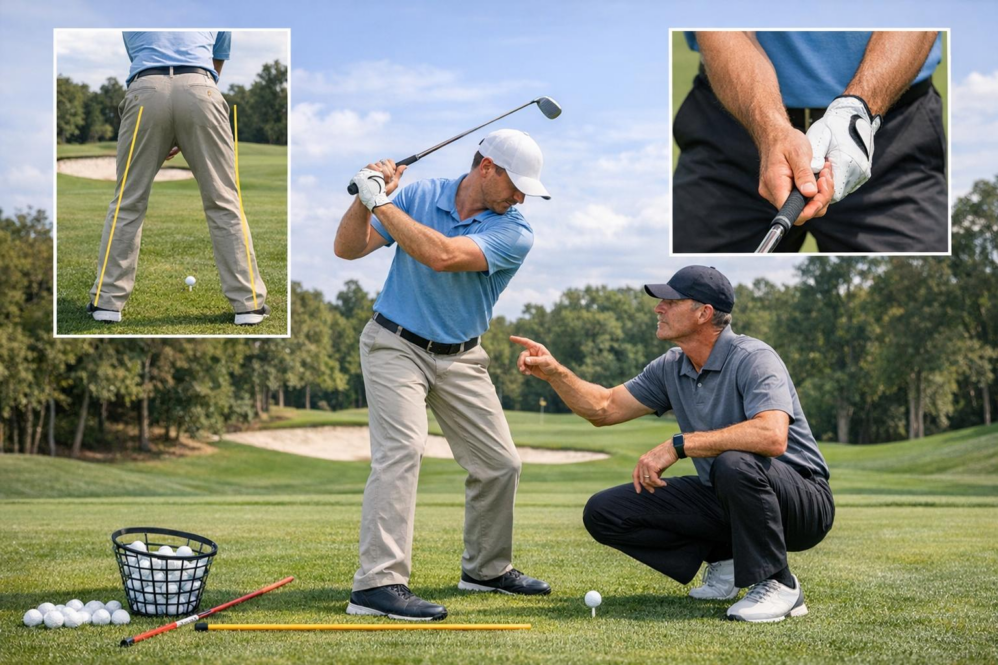
Unlocking the Foundations of Jordan spieth’s Flawless Swing
Mastering Jordan Spieth’s golf swing begins with a solid, repeatable setup that prioritizes balance and alignment. Spieth’s stance is typically shoulder-width apart, promoting a stable base that supports his fluid rotation throughout the swing. A key instructional point is maintaining a neutral grip pressure-firm enough to control the club but relaxed to avoid tension-usually measured by encouraging players to hold the grip as if holding a small bird without squeezing. His posture features a slight forward tilt from the hips with a spine angle around 45 degrees, creating an athletic position that encourages a natural coil.Beginners should focus on aligning their feet, hips, and shoulders parallel to the target line, using alignment sticks during practice to ingrain this checkpoint. For more advanced players, small adjustments in stance width or ball position-such as placing the ball just forward of center for long irons-can enhance shot accuracy and distance control on diverse course layouts, similar to Spieth’s approach during his 2015 Masters victory.
One of Spieth’s defining attributes is his “Smooth Swing Method,” emphasizing a rhythmic tempo and precise sequencing that maximize power while maintaining control. This technique involves a backswing length reaching approximately 90 degrees of shoulder turn, allowing the coiling of torso muscles without premature arm uncocking. During the downswing,Spieth’s hips lead his upper body in a synchronized rotation,which helps generate clubhead speed while avoiding lateral sway-a common error among amateurs. To develop these mechanics, golfers can practice drills such as the “Pause and Go,” where a brief pause at the top of the swing highlights sequencing and builds muscle memory for efficient weight transfer. Spieth’s short game also reflects exquisite touch and precision, utilizing a compact swing with minimal wrist breakdown and keeping the clubface square through impact, a technique especially vital on fast, undulating greens like Augusta National. Emphasizing consistent contact and trajectory control in chipping and pitching can reduce three-putts and sharpen scoring capabilities significantly.
Beyond the swing itself, Spieth’s course management and mental resilience play critical roles in transforming technique into tournament success. During the 2015 Masters, Spieth strategically targeted fairway angles and safe landing areas, employing club selection aligned to wind conditions and green contour readings. for golfers aiming to replicate this level of strategic play, maintaining a pre-shot routine that incorporates visualization, yardage verification with rangefinders, and factoring in weather elements such as crosswinds or firmness of fairways is essential. Additionally, aspiring players should cultivate the mental discipline to accept and recover from errant shots by focusing on the next play, fostering confidence and consistency under pressure. incorporating scenario-based practice sessions that simulate varying course conditions and pressure points can bridge the gap between technique and real-world application, ultimately improving overall scoring and enjoyment on the course.
How Jordan’s Putting Technique Transformed His Game at the Masters
Jordan Spieth’s putting technique transformation at the 2015 Masters underscores the importance of a consistent setup and a repeatable stroke-fundamentals that every golfer should prioritize. Spieth’s setup involves a narrow stance with feet shoulder-width apart and eyes positioned directly over the ball, promoting a true pendulum motion. This eye alignment is critical; it helps golfers read the break more accurately and maintain the intended line. Additionally, spieth employs a light grip pressure, around 3-4 on a 10-point scale, which fosters a smooth and rhythmical stroke free from tension. Aspiring players can enhance their setup by practicing with a mirror or alignment rods to verify correct posture and eye position, ensuring that the putter face starts square to the target line. This foundation sets the stage for consistent holing out under pressure.
Central to Spieth’s success on the greens is his controlled tempo and stroke mechanics, characterized by a low backswing height and a balanced follow-through. A key technical insight is his ability to maintain a steady head position and minimize wrist breakdown,generating a pendulum-like arm movement that delivers precision and distance control. For practical improvement, golfers should employ drills like the “gate drill,” placing tees just wider than the putter head to prevent excessive wrist movement and promote a pure arc path. Spieth’s approach also adapts dynamically according to course conditions, especially on Augusta’s fast greens, where he adjusted his force application to avoid skidding or bouncing. This highlights the importance of felt feedback and green reading skills to adjust putt speed and line, encouraging players to practice on varied surfaces and speeds to develop a nuanced touch.
From a strategic standpoint, Spieth’s putting transformation exemplifies integrating mental focus and course management to lower scores. His pre-putt routine emphasizes visualization and breathing techniques that enhance concentration and reduce anxiety-critical factors during high-stakes moments like the Masters. Moreover, Spieth’s keen understanding of course geometry allows him to optimize putting angles and leverage slope contours, frequently enough opting for aggressive lines combined with controlled pace to set up easy comeback putts if necessary. For golfers aiming to emulate this approach, it is essential to develop a consistent pre-shot routine and practice lag putting with distance targets to build confidence in long-range control. Incorporating these techniques creates a holistic putting game that not only improves stroke mechanics but also enhances decision-making and psychological resilience under tournament pressure.
Mastering distance Control Like Spieth on the Greens
Mastering distance control on the greens, as demonstrated by Jordan Spieth during his triumphant 2015 Masters performance, begins with a solid setup and stroke fundamentals.Spieth’s technique emphasizes a relaxed grip pressure-typically around 4-5 on a scale of 10-to promote fluidity and minimize tension throughout the stroke. His eyes remain directly over the ball, fostering an accurate read of the fall line and ensuring the clubface delivers square contact. Additionally, Spieth adopts a slightly open stance to align his body naturally toward the target and facilitate an inside-to-square stroke path, critical for controlling roll.For golfers aiming to emulate this, establishing a consistent pre-putt routine that reinforces setup consistency improves muscle memory, enabling better distance judgment across varying green speeds and slopes.
Effective distance control hinges on the interplay of swing length, tempo, and acceleration. Spieth’s signature “Smooth Swing Method” showcases how a controlled backswing paired with a rhythmic transition into the downswing can yield precise ball speed with minimal spin variation. He maintains a pendulum-like motion through the shoulders and avoids wrist breakdown, resulting in repeatable strikes that correspond predictably to pace.To practice this, golfers should focus on drills such as the gate drill, where placing two tees just wider than the putter head promotes a straighter stroke and helps regulate swing length. Additionally, varying distances can be practiced by adjusting the backswing arc-roughly 45 degrees for short taps and up to 90 degrees for longer lag putts-to internalize pace control. Maintaining acceleration through impact and finishing with a high follow-through prevents deceleration that often causes short putting errors.
Course strategy and reading green conditions are vital components that complement technical mastery. Spieth’s 2015 Masters success underscored his ability to factor in green firmness, grain direction, and wind conditions when calibrating his putt speed. Advanced players can refine this skill by learning to visualize the trajectory and expected roll by observing subtle breaks and mottling on the green surface. For beginners, starting with a simple walk-around to feel the green’s texture and slope helps develop intuition.Utilizing equipment such as putting mirrors for alignment and distance-limiting devices during practice also accelerates progress.Crucially,Spieth’s mental approach-trusting his stroke and committing fully to each putt-reduces hesitation,a common pitfall that can disrupt rhythm and distance judgment. Integrating these elements cultivates confidence and consistency, empowering golfers at all levels to replicate Spieth’s masterful control and shave strokes confidently on their own greens.
Driving with Confidence Inspired by Jordan’s 2015 Masters Strategies
Driving with confidence begins with mastering the foundational setup and swing mechanics, a critical element that Jordan Spieth exemplified during his 2015 Masters triumph. Start by ensuring a balanced stance with feet shoulder-width apart and the ball positioned slightly forward, just inside the left heel for right-handed players. This setup promotes an upward angle of attack, essential for maximizing carry and reducing spin, especially with a driver lofted around 9 to 12 degrees. Focus on a smooth takeaway that keeps the clubhead low to the ground for the first several feet, maintaining a wide swing arc. As you transition into the downswing, engage your lower body early with a controlled hip rotation to generate power and clubhead speed without sacrificing accuracy. Practice drills such as the “pause at the top” swing drill help ingrain tempo and timing, allowing golfers of all levels to develop a repeatable, injury-free driving motion.
Beyond pure mechanics, Jordan Spieth’s course management during the 2015 Masters revealed the importance of strategically selecting targets and controlling shot shape off the tee. When approaching tight fairways or doglegs, consider adopting a controlled fade or draw, depending on your natural shot tendency, to position the ball in the optimal landing zone.Use visual alignment aids and intermediate targets in the fairway to focus your aim, rather than simply pointing at the green. Additionally, account for weather conditions such as wind speed and direction, which can drastically alter ball flight-especially on Augusta National’s undulating fairways. Incorporate pre-shot routines that include visualization and wind assessment to boost confidence and consistency. For beginners,practicing with alignment sticks or cones can develop directional awareness,while advanced players should experiment with trajectory control through tee height adjustments and swing path variations to refine driving precision under pressure.
Integrating these physical skills with mental resilience was key to Spieth’s Masters success and is vital for any golfer looking to elevate their driving confidence. Establish a reliable pre-shot routine that combines deep breathing, positive self-talk, and a clear commitment to the shot, helping to alleviate tension and sharpen focus. As you practice, set measurable goals-such as hitting at least 70% fairways in practice rounds-to track progress. Utilize drills like the “fairway finder,” where you deliberately aim for narrower targets to simulate competitive conditions and improve accuracy. Remember to also evaluate your equipment setup regularly; driver shaft flex, clubhead loft, and grip size can significantly influence your control and distance. By marrying technical refinement with strategic course play and a calm mental approach, golfers can unlock driving confidence inspired by Spieth’s championship-caliber strategy, directly translating to lower scores and greater enjoyment on the course.


