
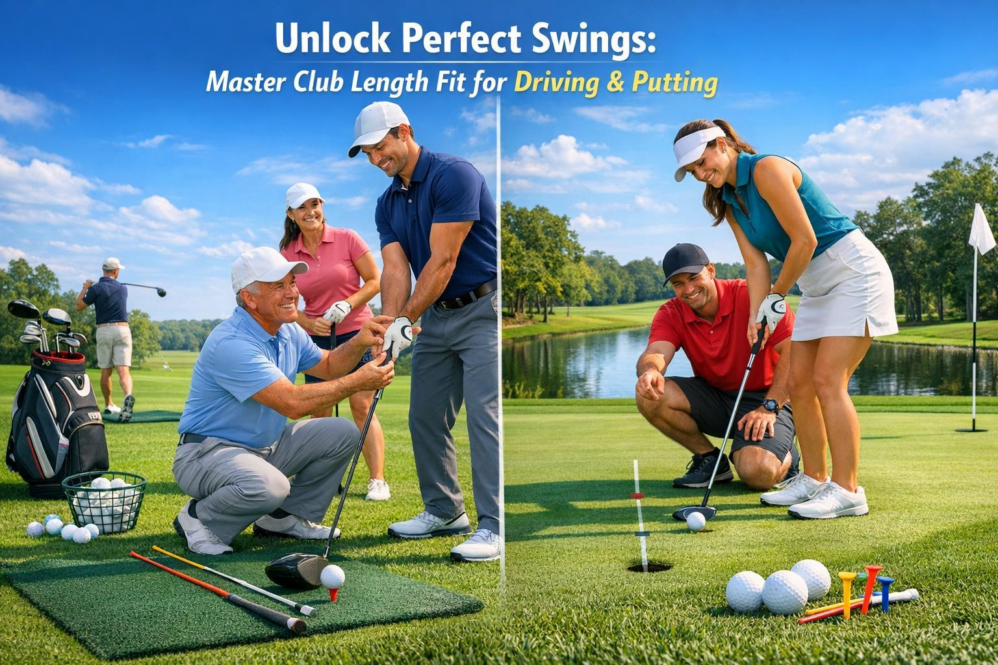
Unlock Your True Potential by Finding the Right Club Length for Driving
Selecting the appropriate club length is foundational to optimizing your driving performance, as it directly influences swing mechanics and consistency off the tee. Most standard drivers have lengths ranging from 43 to 46 inches, but tailoring this measurement to your physique and swing characteristics can unlock significant gains. For exmaple, golfers with a taller stature or longer arm span often benefit from a longer shaft, which can generate higher clubhead speed and increased driving distance. Conversely, players with a smoother, more controlled swing may find a slightly shorter club enhances accuracy and tempo control. When assessing your ideal club length, consider factors such as your wrist-to-floor measurement, posture setup, and ball position to ensure that your spine angle and swing plane remain stable throughout the swing. A proper fit will facilitate striking the ball with a consistently square clubface, reducing slices or hooks, and ultimately improving fairway hit percentage.
To put these insights into practical use, incorporate specific setup checkpoints and swing drills during practice rounds. Start by addressing the ball with your driver placed at a height allowing your lead arm to hang naturally and wrists to hinge comfortably at the top of the backswing. Use a mirror or video feedback to verify that your spine tilt remains constant and your stance width complements the club length, typically shoulder-width for most drivers. Try the following drills to acclimate to your tailored club:
- Make half swings focusing on maintaining balance and smooth transition through the strike zone.
- Practice tee shots aiming for an adjustable target zone to enhance directional control with your new setup.
- Evaluate ball flight patterns-distance, trajectory, and spin-and adjust tee height and ball position accordingly to synchronize with your club length.
By systematically adjusting your technique to the driver’s specific length,you build a repeatable swing that delivers greater consistency and leverages your biomechanical advantages.
understanding how your customized club length integrates with course strategy can markedly boost your scoring opportunities. Different holes and tee box layouts demand varying shot shapes and distances, so mastering your driver’s capabilities allows smarter decision-making. As an example, on narrow or dogleg fairways, employing a slightly shorter club may increase control and reduce the risk of errant drives into hazards, while on wide-open par 5s, a longer shaft drive that maximizes yardage could set up easier approach shots.Keep in mind weather conditions like wind direction and turf firmness affect ball rollout and carry distances, which should influence your club selection and swing aggressiveness. Regularly measure your driving accuracy, carry, and dispersion during practice and matches to establish clear performance benchmarks. Through this evidence-based approach to club length fitting and on-course submission, golfers of all levels can enhance their driving efficiency, foster confidence, and lower their scores.
How Proper Club Length Transforms Your Putting accuracy and Consistency
Achieving accurate and consistent putting begins with ensuring your putter length complements your natural posture and stroke mechanics. When a putter is correctly fitted, it allows your eyes to be positioned directly over or slightly inside the ball, which is a critical alignment for reading greens and maintaining a square putter face throughout the stroke. Most golfers benefit from a putter length that places their hands naturally just below waist height when addressing the ball, typically ranging from 33 to 35 inches depending on height and arm length. If your putter is too long, it forces you into an uncomfortable forward bend, often causing a forward press and inconsistent stroke path. Conversely, a putter that’s too short can lead to a hunched stance and restricted arm movement, increasing wrist breakdown and unwanted face rotation. Proper club length ensures a balanced setup, which directly improves the stroke arc and repeatability essential for consistently striking the ball toward your intended target line.
Integrating biomechanical insights into practice routines reinforces the benefits of ideal putter length. Such as, golfers can employ a drill where they set their eyes directly over the line of the ball and check the putter’s lie angle and grip height to confirm proper positioning. During this drill, focus on maintaining a pendulum-like stroke from the shoulders rather then relying on wrists. This setup minimizes excessive face manipulation, promoting a smoother roll and reducing skidding or jumping on impact. golfers of all skill levels should periodically reassess their putter length-especially if their posture changes due to flexibility or injury-or if they experience persistent misses to the left or right despite solid setup and alignment. By practicing with properly sized clubs, players develop muscle memory that adapts to course conditions, including slopes and grain, ultimately enhancing green-reading skills and lowering putts per round.
On the course, knowing your properly fitted club length allows confident stroke choices under varied pressure scenarios, such as long lag putts or delicate tap-ins.For instance, when facing downhill or windy conditions, a correctly fitted putter enables better control of stroke length and tempo, preventing over-hitting and costly three-putts. To build consistency, incorporate training drills emphasizing touch and distance control, like the clock drill, where you putt balls from progressively increasing distances in a circle around the hole. Additionally, use alignment aids or mirror setups during practice to visually confirm posture and eye position remain stable. Common errors-such as rocking the shoulders or lifting the head too early-can be identified and corrected when your putter length supports a natural, pleasant stance. Ultimately, this equipment adjustment ties directly into improved scoring by making your short game more reliable, reducing stress on the mental game, and allowing you to save strokes more effectively throughout your round.
- Practice the “eyes over the ball” drill daily to confirm optimal club length without guesswork
- Use video feedback to analyze stroke mechanics in relation to your fitted stance
- Experiment with lie angle adjustments in combination with correct length to fine-tune roll characteristics
- Track putting distance control and accuracy over several rounds to quantify improvement
Personalizing Your Clubs for Better Comfort, Control, and Confidence on the Course
Finding the right club length for your swing is one of the most impactful adjustments you can make to enhance comfort and control on the course. Clubs that are too long or too short can disrupt your setup posture, leading to inconsistent ball striking and inaccurate shots. As a general guideline, drivers typically range from 43.5 to 45.5 inches, while irons can vary between 35 and 39 inches depending on the club number. To personalize your clubs effectively, start by assessing your posture at address: your arms should hang naturally with a slight bend at the elbows, and your wrists should rest comfortably on the grip. Using a club that matches your height and arm length promotes a balanced stance,reducing tension and encouraging a smooth swing arc.When on the course,this translates into better ball contact and improved shot dispersion,especially in challenging lies or windy conditions.
Beyond length, proper club lie angle plays a crucial role in controlling shot direction and trajectory. Lie angle refers to the angle between the club shaft and the ground when the sole is flat at address. Custom fitting this angle ensures that the sole contacts the turf evenly, which prevents pushes, pulls, hooks, and slices. Such as, a golfer whose clubhead is leaning too far inward (upright lie) may experience shots curving left unintentionally, while a flatter lie often causes shots to move right. To fine-tune your clubs, work with a professional fitter who can measure your ball flight patterns and adjust the lie angles by increments of 1 to 2 degrees.incorporate drills such as hitting shots on a turf mat with impact tape overlays to visually confirm even sole contact, allowing you to make precise adjustments. This meticulous approach fosters more consistent directional control, an essential skill when navigating tight fairways or executing precision approach shots.
Grip size and material also significantly influence your feel and confidence throughout the round. Grips that are too thick or thin can hinder your wrist hinge and reduce feedback from the clubhead, negatively impacting shot accuracy and distance control. To identify your ideal grip size, use the ”finger test”: with your left hand on the club (for right-handed golfers), check if the ring finger comfortably fits between the fingers and palm. If it doesn’t, consider adjusting grip thickness accordingly. Choosing tackier grip materials can also help maintain control during humid or rainy conditions,preventing slippage and promoting consistent wrist angles. Practice routines that include grip pressure awareness drills will help you maintain a light but firm hold (approximately 5 out of 10 on a grip pressure scale), allowing your swing to remain fluid while maximizing clubface control. By customizing these subtle but vital aspects of your equipment, you’ll build greater confidence in your tools, enabling you to execute a wider variety of shots with precision-especially under pressure scenarios in tournament play or challenging course layouts.




