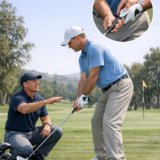
Unlock Your Best Swing by Understanding Vijay Singh’s Biomechanics
Understanding the biomechanical foundation of Vijay singh’s golf swing unlocks the door to more consistent ball striking and power generation.Singh’s swing is characterized by a well-balanced setup, emphasizing a slightly wider-than-shoulder-width stance and a solid spine angle of about 45 degrees at address. This posture allows for an efficient weight transfer and hip rotation during the swing, which is essential for producing clubhead speed without sacrificing control. Beginners should focus on establishing this setup in front of a mirror or video feedback, using alignment sticks to ensure their feet, hips, and shoulders are square to the target line. intermediate and advanced players can refine key positions such as the 90-degree left arm to clubshaft angle at the top of the backswing and the coiled torso rotation of approximately 80-90 degrees, both of which maximize stored energy for the downswing. Practicing slow-motion swings and pause drills at the transition point encourages motor learning of these biomechanical checkpoints, fostering muscle memory for use during pressure moments on the course.
Incorporating Vijay Singh’s short game techniques, especially in putting and chipping, sharpens scoring ability across all levels.His putting stroke is a model of pendulum-like wrist stability and smooth acceleration through impact, which reduces face rotation and promotes a true roll on the ball. To emulate this, golfers should try the gate drill, setting up two tees just wider than the putter head and practicing stroking through consistently without hitting the tees. Additionally, Singh’s emphasis on reading green slopes and controlling pace is critical; golfers can improve by walking around putts from multiple angles during practice rounds and consciously varying their stroke length to match diffrent distances. His chipping method involves landing the ball just past the target and using minimal wrist hinge, maintaining a steady lower body and hands ahead of the ball at impact. Practicing this through landing zone drills where the player targets specific green areas with different clubs helps develop precision and feel under varied course conditions, including firm or soft turf.
Strategic course management complements the technical mastery of swing and short game, a cornerstone of Singh’s success in tournament play. Golfers should adopt a risk-reward mindset by playing within their comfort zones and making club selections based on lie, wind, and green slope rather than pure distance. singh often leverages controlled drives with moderate trajectory, aiming for the fat part of the fairway to enable reliable approach shots. Practicing driving accuracy with the fairway target drill, which involves setting up intermediate markers 20-30 yards short of the usual driver carry target, encourages precision over sheer length. On approach shots, focus on balancing the desire for aggressive pin hunting with the realistic scoring zone-typically the front or center of the green-to minimize three-putts and recovery shots. By integrating these biomechanical insights, solid short game habits, and smart course strategies into practice routines, golfers of all skill levels can set measurable goals such as hitting 80% of fairways, reducing putts per round by one stroke, and executing lag chips within three feet of the hole, all contributing to lower scores and greater enjoyment of the game.
Putting Secrets that Elevate Your Game Consistency
Mastering the art of reading greens is foundational to consistent putting performance. Begin by assessing the slope and grain direction of the green-factors that can subtly influence ball roll and speed.Eyeing the break from multiple angles, ideally both behind and alongside the ball, helps build a extensive mental model of the putt’s path.Incorporate a simple pre-putt routine where you walk the intended line, feeling the gradient underfoot-this kinesthetic feedback sharpens your green reading instincts. When setting your stance, position the eyes directly over or slightly inside the ball to ensure an accurate perception of the putt line. Using a controlled pendulum stroke with minimal wrist movement, maintain a smooth tempo while striking the ball; this reduces yips and improves distance control. Practice drills like the “clock drill,” where you putt from varying distances around a hole, reinforce speed judgment and teach you to adjust for uphill or downhill lies, factors that are crucial on slower or faster greens.
Short putts demand both psychological calm and technical precision. To elevate consistency under pressure, focus on refining your setup fundamentals: keep a stable lower body, maintain a slight forward shaft lean of about 5 degrees, and ensure the putter face is square through impact. Developing a repeatable stroke can be enhanced with training aids such as alignment sticks or putting gates, which encourage a straight-back, straight-through path or help establish the slight arc preferable depending on your natural stroke. For beginners, emphasize a smooth acceleration through the ball rather than deceleration, which causes premature stopping and short putts. Advanced players should experiment with subtle hand and wrist pressure adjustments to optimize feel and touch, especially on breaking putts. Mental focus drills-such as visualizing the ball rolling into the cup before execution-improve confidence and reduce tension. Additionally, always factor in environmental conditions; wind or moisture can alter ball speed drastically, so adapting your stroke strength is key for low scores.
Shot-shaping on the putting green can turn challenging situations into scoring opportunities. Understanding how to purposefully influence the ball’s path allows you to navigate undulating or tiered greens more effectively. Experiment with varying the face angle and path to produce gentle draws or fades, which help the ball hug the break more naturally. A practical drill involves placing tees to create a gate to practice these curvature shots, enhancing your control in tight pin locations. Equipment choices also play a role: your putter’s balance (face-balanced vs. toe-hang), lie angle, and shaft length should complement your stroke style and physical attributes for optimal feel. Such as, taller players might benefit from longer shafts to maintain a pleasant posture, while others may find that counterbalanced putters improve stability. Ultimately, integrating these advanced short game strategies with strong green reading and mental composure boosts overall course management, empowering you to make smart decisions that consistently lower your scores.
Driving with Power and Precision Using Strategic Course Insights
Achieving both power and precision off the tee starts with mastering a consistent setup that promotes an efficient, repeatable swing. Focus on establishing a balanced stance with feet shoulder-width apart, positioning the ball just inside the left heel for right-handed golfers, to optimize the club’s low point and maximize launch angle. Incorporating a slight forward shaft lean at address helps create a downward strike on the ball, enhancing energy transfer. A smooth takeaway with a wide arc encourages clubhead speed without sacrificing control; beginners should practice slow, deliberate swings using alignment sticks to ingrain proper path and face angle. Intermediate and advanced players can refine sequencing by engaging the lower body first, followed by a full shoulder turn, generating torque to increase clubhead velocity without tension. Key drills include the “pause at the top” exercise to stabilize transition and the “step-through” drill to boost balance and weight shift, both critical for powering drives consistently while maintaining directional accuracy.
Integrating strategic course insights elevates driving from mere distance hitting to bright shot placement, heavily influencing scoring potential. before stepping up to the tee, golfers should analyze fairway widths, hazard locations, and prevailing wind conditions, using markers like **yardage books** or GPS devices to choose the ideal target line. Opting for a controlled fade or draw shape to navigate doglegs or avoid bunkers can be more effective than swinging hard for maximum distance every time.As a notable example, on narrow fairways bordered by water hazards, deliberately cuing a sweeping fade shot with an open clubface at impact can harness natural ball flight, reducing risk. Practice shaping shots by manipulating grip pressure and wrist hinge during drills that focus on the downswing path and clubface rotation. Low handicappers might integrate course management apps and situational yardages to plan tee shots that set up easier approach angles, helping reduce needless scramble shots and minimizing score volatility.
Consistent improvement in power and precision also hinges on tailored equipment choices and ongoing swing analysis. Selecting the right driver loft-typically between 9° and 12° for most amateurs-is vital, as it influences launch conditions and spin rates that affect carry and rollout. Testing shaft flex and length ensures optimal timing and control; too stiff can limit distance for slower swing speeds, while too flexible may cause accuracy issues.Regular use of launch monitors during practice sessions provides quantitative feedback on clubhead speed, ball speed, launch angle, and spin, allowing golfers to make data-driven adjustments. Off the course, strength and adaptability exercises targeting core and rotational muscles contribute to more powerful, injury-free swings. Incorporate mental strategies such as pre-shot routines and visualization to maintain focus and confidence, notably under pressure. By synthesizing technical refinement,practiced strategy,and equipment optimization,players at every level can enhance driving effectiveness dramatically,lowering their scores while enjoying the game more fully.