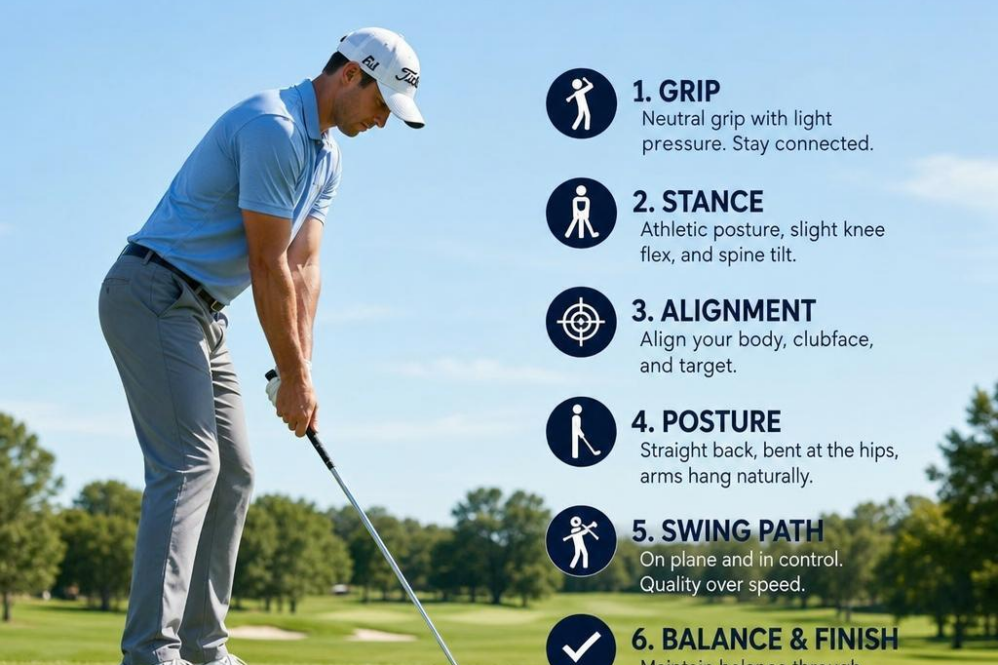
Unlock Your Golf Potential with the Science Behind the Perfect Swing
Understanding the fundamentals of the golf swing is essential for unlocking your full potential on the course. Start by focusing on a consistent setup position: feet shoulder-width apart,knees slightly flexed,and spine tilted forward at approximately 15 degrees. This foundation allows for optimal balance and power transfer during the swing. when initiating the backswing, emphasize a smooth coil of the shoulders while maintaining a stable lower body to create torque; this separation between upper and lower body generates clubhead speed for longer drives. incorporating drills such as the “pause at the top” helps cultivate a controlled transition, reducing common faults like casting or early extension. Key swing checkpoints include keeping the lead arm straight through the takeaway, ensuring the clubface remains square during impact, and finishing with balanced follow-through. For short game advancement, mastering the putting stroke involves consistent ball positioning-typically just forward of the center in your stance-and a pendulum-like motion that minimizes wrist breakdown.Practise drills like the gate drill with alignment sticks can enhance stroke path and face control, vital for reducing three-putts and improving scoring consistency.
Translating technical skills into effective course management considerably boosts scoring potential.Beyond swing mechanics, learning when to play conservatively versus attacking pins can improve your strategic decisions. For example, when faced with a narrow fairway, prioritize accurate iron approach shots over risking high-powered drives; aim to land the ball within a 10-yard radius of the target to maximize birdie opportunities. Weather factors such as wind direction or firm greens should also influence club selection and shot shape choices. Employ drills like situational shot simulations during practice rounds, where you intentionally play from uneven lies or challenging rough, to build confidence in diverse conditions. Additionally, integrating mental game techniques-such as deep breathing to maintain focus and visualizing each shot’s trajectory-enhances execution under pressure. Equipment considerations, including proper shaft flex and club loft matching your swing speed, further refine performance.By aligning biomechanics, deliberate practice routines, and smart play, golfers at all levels develop a resilient, repeatable golf game that steadily lowers scores and elevates overall enjoyment.
Putting Precision Made Simple with Proven Techniques and Practice Tips
Mastering putting precision begins with establishing a consistent and solid setup foundation that promotes control and alignment. Start by positioning your eyes directly over or slightly inside the ball to visualize the intended line, aiding in accurate read and execution. The putter face should be square to the target line at address, as even a few degrees off can significantly affect roll and distance. Focus on maintaining a stable lower body with a slight flex in the knees and a comfortable, natural grip pressure that avoids tension-induced jerks. Incorporating a pendulum-like stroke, driven smoothly by the shoulders rather than the wrists, helps create a true arc and consistent tempo. To further refine touch, practice controlling backswing length corresponding to distances on the green, using the “clock drill” – envision the putter swinging from 7 o’clock for short putts to 3 o’clock for longer ones. Regularly integrating drills such as the ladder drill, where progressively longer putts are attempted from set increments, can build both stroke consistency and confidence under pressure.
Reading greens accurately is equally crucial and benefits from synthesizing visual cues with environmental factors such as slope, grain, and wind. Begin by walking around your putt to view the line from multiple angles, which reveals subtle breaks that may not be evident from behind the ball. Realize that the ball will typically follow the downward slope, curving toward the low point influenced also by grain direction, which affects speed and ball roll; for example, putts hit against the grain tend to slow down more quickly. When approaching longer putts, break the line into segments and plan intermediate targets, allowing more manageable stroke adjustments. Practice incorporating pace control through drills like the “distance ladder,” hitting putts at varying distances with the goal of leaving the ball within a 3-foot circle from the hole. Golf masters emphasize that understanding and adapting to green speed through tools like a Stimpmeter reading can lead to precise pace judgment, crucial for lowering strokes. Combining technical setup, controlled stroke mechanics, and sophisticated green reading sharpens putting skills, enabling golfers of all levels to transform those challenging three-footers into routine taps and successfully navigate complex course conditions.
Drive Longer and Straighter by Mastering Your Body mechanics
Developing a longer and straighter drive begins with a refined understanding of your body’s biomechanics throughout the golf swing. Start by focusing on establishing a solid setup: feet shoulder-width apart, slight knee flex, and a balanced weight distribution of approximately 50/50 between your feet. This foundation promotes stability and power transfer. During the backswing,emphasize a controlled shoulder turn aiming for about 90 degrees of rotation on the lead side while keeping your lower body firm to store elastic energy.Transition smoothly into the downswing by initiating movement from your hips, allowing for an efficient kinetic chain that culminates in maximum clubhead speed at impact. Key technical checkpoints include maintaining a flat left wrist through impact and ensuring your shaft leans slightly forward to promote a desirable low-spin, penetrating ball flight. Manny golfers struggle with early extension and improper weight shift; to correct these, practice drills such as the “step and swing” where you step forward at impact to ingrain proper sequencing, or use alignment rods to reinforce path and plane consistency.
Integrating body mechanics mastery with strategic course management further enhances driving effectiveness. As an example, when approaching a tight fairway with strategic hazards, prioritize accuracy by slightly reducing swing speed to maintain control but maintain your setup fundamentals for consistency. In contrast, on wide-open holes, harness optimized launch conditions-typically a launch angle between 12-15 degrees and a spin rate near 2500-3000 rpm-to maximize carry and roll. Frequent practice routines should incorporate varied tee heights and shot shapes, such as draws and fades, to adapt your mechanics to differing course layouts and weather conditions like wind or firmness. Moreover, mental rehearsal that visualizes optimal swing sequence helps consolidate technical changes under pressure. Whether you’re a beginner learning basic sequencing or an experienced player refining peak efficiency, focus on measurable improvement through tools like swing speed radar and video analysis to track progress, ensuring your driving not only adds yards but also contributes to lower scores through improved positioning and confidence off the tee.
Integrate Course Strategy to Turn Skills into Winning Scores
Developing a strategic mindset on the golf course is essential to translating technical skill into tangible, lower scores. Start by assessing each hole through the lens of risk versus reward, considering factors such as fairway width, prevailing wind direction, and green complex contours. Such as, when facing a dogleg, position your tee shot with a 120 to 150-yard layup to avoid hazards-this approach not only preserves your ball but sets up an easier angle for your next shot. Additionally, integrate club selection based on wind and elevation changes-for instance, opting for a lower-lofted iron to combat strong headwinds or a hybrid club to navigate uneven lies. Practice routines should include simulated course scenarios where you consciously make decisions based on lie, hazard placement, and pin location rather than just shot distance. This mental rehearsal builds a catalog of reliable options that reduce impulsive mistakes under pressure.
Complementing sound course strategy with refined shot shaping can give you a critical edge when confronted with challenging layouts. Mastering the mechanics to intentionally bend shots-such as hitting a draw around a tree or a fade to skid a ball closer to the pin-requires maintaining a closed or open clubface of approximately 3 to 5 degrees relative to your swing path. Incorporate drills like the gate drill, where two tees form a narrow channel just wider than the clubhead, to improve swing path consistency and control. Additionally, integrating targeted short game exercises-such as distance control drills using various wedges-ensures that once in scoring position, you can reliably convert birdies or save pars. By harmonizing course management, shot shaping, and a pressure-tested short game, golfers at every level can move beyond mere technique and truly execute winning strategies that lower their scores consistently.