
Scoring lies at the nexus of performance measurement and strategic decision-making in golf, serving both as a quantitative summary of outcomes and a window into the underlying processes that produce them. Because scores emerge from a sequence of discrete shot decisions executed within a particular course architecture, rigorous evaluation requires methods that link shot-level behavior, player skill distributions, and course design features. Recent advances in statistical modeling and data capture-ranging from Strokes Gained frameworks to shot-level probabilistic models-enable more precise attribution of scoring outcomes to specific skills (driving, approach, short game, putting) and to situational factors such as lie, wind, and hole geometry.This article synthesizes methodological approaches used to assess golf scoring and translates analytical findings into practical strategic guidance. We compare descriptive and inferential techniques, discuss the advantages of shot-level versus aggregate metrics, and highlight model-based tools that support optimal shot selection and course management under uncertainty. Emphasis is placed on actionable insights: how players and coaches can use evidence from scoring analyses to prioritize skill development, adapt game plans to course characteristics, and make risk-reward decisions that improve expected scoring outcomes.
For clarity,the term analyze is used here in its conventional sense-“to study or determine the nature and relationship of the parts of something” (Merriam‑Webster)-and,in keeping with American English usage,the spelling “analyzing” is employed throughout.
conceptual Framework for Evaluating Golf Scoring Performance
To evaluate scoring in golf rigorously requires an explicit model that separates observable outcomes from latent skill and situational factors. The model treats a round as the outcome of interacting subsystems: the player’s underlying proficiency (technique, decision-making), the course architecture (length, hazard topology, green complexity), and transient conditions (wind, pin position, psychological state). By defining **observable indicators** (strokes gained components, putts per green, proximity to hole) and **latent constructs** (pressure-handling, strategic acumen), the framework facilitates both descriptive diagnosis and predictive inference while accommodating heterogeneity across players and venues.
Core analytical constructs are organized around measurable objectives and decision levers. Key elements include:
- Skill decomposition – isolating ball-striking, short game, and putting contributions to total score.
- Course exposure – quantifying how hole architecture accentuates or attenuates specific skills.
- context variance - measuring outcome dispersion under differing environmental and competitive states.
- Decision policy – representing shot selection as a trade-off between expected value and outcome variance.
These constructs enable targeted diagnostics and structured comparisons between rounds, players, and training interventions.
Analytical tools formalize the mapping from data to insight. Hierarchical bayesian models capture player-level heterogeneity while borrowing strength across rounds; decomposition methods (e.g.,strokes gained) apportion shot-level contributions; and dynamic programming or Markov decision processes model sequential shot-choice under uncertainty. A concise summary of evaluation metrics follows:
| Metric | Purpose | Typical Use |
|---|---|---|
| Strokes Gained | Attribute shots to skill domains | Player comparison, practice targets |
| Consistency Index | Measure variance across rounds | Stability assessment, mental training |
| Course Sensitivity | Quantify course-driven score shifts | Strategy tuning, tee selection |
Translating model outputs into practice requires explicit decision rules and measurable targets. Use estimated skill gaps to set **specific**, time-bound training prescriptions (e.g., reduce three-putt rate by X% in 12 weeks), and derive course-specific shot selection heuristics that balance expected strokes and variance (e.g., favor conservative play on high-variance greens). Scenario simulations support robust goal-setting by revealing how incremental skill improvements map to likely score distributions,thereby enabling practitioners to prioritize interventions that maximize expected scoring reduction per unit practice time.

Quantitative Methods for Isolating Skill Contributions to Score
High-resolution,shot-level records provide the quantitative backbone for separating transient luck from persistent ability. Because quantitative data is by definition numerical and structured, it supports decomposition techniques that map raw outcomes into interpretable contributions-such as converting shot outcomes into **strokes‑gained** values or distance‑adjusted scoring probabilities.Transforming counts and distances into these derived metrics creates a common currency that enables cross‑shot comparisons and aggregation across rounds, courses, and conditions.
Several statistical frameworks are commonly employed to attribute portions of total score to distinct skill domains. Key approaches include:
- Regression and generalized linear models - estimate marginal effects of shot characteristics on score;
- Hierarchical (multilevel) models – partition variance between player, round, and course levels, allowing partial pooling for small samples;
- Latent variable and factor models – infer underlying skills (e.g., “ball‑striking” vs “short‑game”) from correlated observables;
- Counterfactual simulation and expected value modeling – evaluate how option decisions change long‑term scoring expectation.
Rigorous identification requires explicit treatment of confounders and measurement error. Course difficulty, tee placement, and weather create nonrandom variation that must be modeled via fixed effects or by leveraging within‑player longitudinal panels. When natural experiments exist (e.g., tee changes or rule shifts) instrumental variables can strengthen causal claims.Additionally, quantitative research principles-hypothesis specification, out‑of‑sample validation, and uncertainty quantification-are essential to produce generalizable inferences rather than overfit explanations.
| Skill Domain | Illustrative Variance Share |
|---|---|
| Driving | 30% |
| Approach | 35% |
| Short game | 20% |
| Putting | 15% |
Presenting variance decomposition alongside confidence intervals (via bootstrapping or Bayesian posterior summaries) transforms descriptive allocation into actionable intelligence: coaches can prioritize practice time toward domains with high contribution and high improvability, while analysts can feed expected‑value outputs into on‑course decision models to recommend club selection and target bias. These quantitative methods together form a replicable pipeline for isolating skill contributions and aligning strategic interventions with statistically defensible priorities.
Course Design Variables and Their Impact on scoring Patterns
Course architecture exerts a determinative influence on scoring distribution through a combination of macro-level variables such as total yardage, par mix, and routing. Longer courses and higher proportions of par‑4/par‑5 holes increase the variance of stroke outcomes by expanding the range of feasible strategies (aggressive driving vs. conservative play). Conversely, compact layouts with intricate routing concentrate scoring around par, increasing the relative importance of approach‑shot precision and short‑game performance. Empirical analyses often show a shift in the tails of scoring distributions-more high scores on long, penal courses and more tightly clustered scores on compact, target‑style courses.
At the micro level, surface and hazard characteristics systematically modulate expected scoring. Key micro‑variables include:
- Green complexity - contour amplitude, speed and undulation affect three‑putt frequency and putt dispersion;
- Fairway width – constrains driving strategy and correlates with penalty incidence;
- rough height and bunker placement – increase the cost (in strokes) of errant tee and approach shots;
- Wind exposure and elevation - amplify stochastic shot outcomes, especially at longer distances.
These elements do not operate independently; interaction effects (e.g., narrow fairways combined with elevated greens) produce non‑linear impacts on scoring that should be modeled explicitly in multivariate performance analyses.
Quantifying the influence of design variables on scoring requires targeted metrics-strokes gained components, conditional variance by hole type, and hole‑by‑hole scoring frequencies.The following table synthesizes typical directional effects observed in course‑setting studies and tournament setups:
| Design Variable | Predicted Effect | Observed Scoring Pattern |
|---|---|---|
| Increased Yardage | Higher dispersion of scores | More bogeys/double bogeys on long holes |
| Narrow Fairways | Higher penalty incidence | Wider score variance; fewer birdies |
| Complex Greens | Increased short‑game importance | Higher three‑putt rate; elevated strokes gained: putting |
From a strategic and coaching viewpoint, recognizing these relationships enables targeted interventions: prioritize driving accuracy and conservative tee choices on narrow, penal courses; emphasize distance and trajectory control on long, exposed venues; and concentrate short‑game practice when greens are complex. Tournament planners and course managers can modulate scoring trends by adjusting tee placements, pin locations, and rough height to achieve desired competitive outcomes. Rigorous application of analytics-panel regressions, mixed‑effects models, and simulation of shot‑level outcomes-permits precise estimation of how incremental design changes will shift aggregate scoring patterns and individual performance priorities.
Shot Level Decision Analysis and Optimal Strategy Selection
Shot-level decision analysis treats each stroke as a discrete decision problem embedded in a stochastic surroundings: the lie, distance to target, hazards, and the player’s conditional skill distribution determine the posterior utility of available shot options. Using probabilistic outcome models (e.g., conditional distance-to-hole distributions and strokes-gained estimates) permits **expected value (EV)** calculations for alternative plays.Framing decisions within a Bayesian decision-theoretic structure clarifies when to favor conservative plays that minimize downside versus aggressive plays that maximize upside, particularly on holes where variance in outcomes materially affects tournament standing.
Reliable strategy selection requires systematically weighting both measurable and contextual factors. Key inputs include:
- Strokes-gained by shot type: empirical mean and variance for tee, approach, short game, and putting.
- state variables: lie/firmness, wind vector, green slope, hole location, and penalty proximity.
- Match-context: match play versus stroke play, tournament position, and player risk preference.
- Course architecture: hole design constraints that change the cost of failure (e.g.,carries over hazards).
| Shot Type | Typical EV Impact | Optimal Condition |
|---|---|---|
| Tee (Aggressive) | +0.2 to +0.5 strokes (high variance) | when leader needs up-side and carry risk is moderate |
| Approach (Course Management) | +0.1 to -0.2 (depends on pin) | When green is guarded or wind is variable |
| Recovery/Short game | +0.3 (reduces big-number risk) | When lie or hazard exposure creates high penalty risk |
Translating analysis into practice demands dynamic strategy rules and iterative learning: incorporate simulation-based policy testing (Monte Carlo rounds), update shot models with in-round telemetry, and calibrate choices to the player’s revealed risk aversion. Coaches should encode **simple heuristics** derived from the decision model (e.g., “lay up when carry probability < 70% and penalty cost > 1.0 stroke”) and evaluate them against match-situation scenarios. The most effective interventions combine rigorous metrics with actionable course-management rules that players can execute under pressure, closing the gap between analytical optimality and repeatable performance.
Risk Management, Expected Value, and Tactical Recommendations on the Course
Applying formal risk-management principles to on-course decision-making reframes shot selection as a problem of probabilistic optimization. Players should model each choice in terms of **expected value (EV)** of strokes,variance,and downside risk given lie,wind,and hazard proximities.By treating the golf hole as a stochastic process (discrete outcomes with associated probabilities), one can compute the EV for each strategy and then compare alternatives while explicitly accounting for variance and penalty tails that produce large negative scoring events.
Practical tactical recommendations follow directly from that framework.Use the following heuristics when converting EV calculations into decisions:
- Tee selection: favor options that reduce penalty-tail probability even if they slightly increase mean strokes.
- Aggression threshold: only pursue lower-EV/high-variance plays when tournament context (match status, required birdie) or your personal variance tolerance justifies the downside.
- Contextual modifiers: adjust probabilities based on wind, green firmness, and recent performance; incorporate community-sourced equipment and aid reports cautiously-forums often highlight overpromised fixes that can alter perceived shot reliability.
- Time-value of risk: prioritize minimizing disaster holes in stroke play; in match play, convert EV into win-probability impact and act accordingly.
A simple, concrete illustration clarifies the trade-off. Consider a reachable par‑5 where a conservative lay-up and an aggressive go-for-green are available. The following compact EV table (strokes expected) displays hypothetical probabilities and resulting EVs for each option:
| Option | P(Birdie) | P(Par) | P(Bogey+) | EV (strokes) |
|---|---|---|---|---|
| Conservative Lay‑up | 0.10 | 0.70 | 0.20 | 5.10 |
| aggressive Go‑for‑Green | 0.25 | 0.50 | 0.25 | 5.00 |
decision rules must combine the numeric EV with variance preferences and competitive context. If EVs are similar, prefer the option with the lower probability of catastrophic penalty in stroke play; if the tournament situation demands risk to recover strokes, accept higher variance. Incorporate strokes‑gained insights by estimating how each shot changes your expected strokes relative to field benchmarks, and update your model in real time using short‑term performance signals.maintain meta‑discipline: document outcomes, recalibrate probabilities empirically, and avoid overreliance on unverified equipment or training fixes when adjusting your risk model.
Practical Training Interventions to Translate Analytics into Lower Scores
Translating quantitative insight into field-ready change begins with prioritizing interventions by effect size and variance explained. Use shot-level analytics to isolate the highest-impact contributors to score (for example: approach proximity, short-game efficiency, or penalty frequency) and convert these into **specific performance targets**-proximate measures such as average proximity-to-hole (ft), putts per GIR, or strokes-gained segments are preferable to aggregate score alone. Framing targets as measurable, time-bound objectives (e.g., reduce three‑putt frequency by 30% in 8 weeks) creates the basis for objective evaluation and hypothesis-driven training.
The next step is designing empirically grounded practice tasks that maximize transfer to on-course play. Implement a mix of technique-focused and task-oriented drills that replicate decision-making demands and environmental constraints. Suggested components include:
- Contextualized range work: alternating practice between precision approaches and simulated course lies.
- Variable practice: randomized distances and targets to increase adaptability.
- Pressure rehearsals: scoring games, time limits, and reward/punishment structures to simulate competitive stress.
- Integrated short-game blocks: focused sessions on up-and-down scenarios from typical miss patterns revealed by analytics.
Programme structure should follow a periodized progression that aligns load, complexity, and assessment. Begin with high-repetition technical blocks to stabilize mechanics, progress to mixed-skill sessions emphasizing decision-making, and conclude each microcycle with metrics-based retention tests. The table below offers a concise mapping of intervention to target metric and recommended cadence-a template that can be adjusted to individual needs.
| Intervention | Primary Metric | Cadence |
|---|---|---|
| Approach-targeted yardage blocks | Avg proximity-to-hole (ft) | 3x/week, 30-45 min |
| Short-game under pressure | Up-and-down % | 2x/week, 20-30 min |
| Decision-making rounds (simulated) | Penalty/stroke management | 1x/week, 9-18 holes |
employ a continuous feedback loop that integrates objective measures, coach observation, and athlete self-report. Maintain a compact dashboard of 3-5 KPIs tied to interventions,set decision thresholds for program modification,and use multimodal feedback (video,launch monitor,and subjective pressure scores) to refine practice emphases. Emphasize iterative hypothesis testing-if an intervention fails to move the targeted metric within a pre-specified window, revise the task constraints, dosage, or contextual similarity until measurable transfer to lower scores is achieved.
Implementing Data-Driven round Planning and Post-Round Evaluation Protocols
Pre-round preparation should be grounded in quantitative evidence drawn from a player’s historical scoring profile, course-specific tendencies, and environmental forecasts. By translating aggregated round data into probabilistic scoring bands for each hole (e.g., expected birdie/par/bogey probabilities), coaches can construct a decision surface that aligns strategic choices with expected value. Implementing model-driven tee and approach strategies reduces the cognitive load on the player and creates a replicable template for tournament play, particularly when variability sources-wind, pin positions, and green speeds-are parameterized into the planning process.
A practical protocol converts these insights into actionable checklist items to be executed before and during the round. Typical items include:
- Selecting preferred landing zones and club ranges by hole based on dispersion statistics;
- Defining acceptable risk thresholds (e.g., when to attack vs. play conservative) using expected strokes-gained deltas;
- Pre-set contingency plans for adverse weather or unexpected course conditions;
- Real-time logging rules (what to record and at what granularity) to ensure fidelity of post-round data.
These steps create a standardized, evidence-based routine that supports consistent decision-making under pressure.
Post-round evaluation must follow a standardized, repeatable workflow to convert raw observations into learning.Essential components include rigorous shot-tracking, decomposition of performance into component KPIs (tee-to-green, approach proximity, short game, putting), and role-based analyses (player, caddie, coach). Use automated scripts or analytics dashboards to generate comparative charts (e.g., current round vs. rolling 20-round baseline) and to calculate contribution metrics such as strokes gained and dispersion-based error budgets. the emphasis is on isolating causal performance drivers rather than merely cataloging outcomes.
Integrate a concise post-round action table into coach-player debriefs to prioritize interventions and allocate practice time efficiently. The following quick-reference table can be embedded in a report or mobile debrief and updated iteratively as thresholds shift:
| Metric | Target | Action if Off-Target |
|---|---|---|
| Strokes Gained: Approach | ≥ +0.2 | Adjust yardages; focused wedge practice |
| Driving Accuracy | > 65% | Alter tee strategy; tee-shot shaping drills |
| Putting 3-10 ft | > 75% conversion | Green-reading sessions; routine timing work |
Present these findings in a concise visual format during debriefs, and convert agreed interventions into measurable micro-goals for the following practice cycle to close the loop between data and performance.
Q&A
Note on terminology
– The verb used throughout this Q&A is “analyze” (American English). The British form is “analyze”; both carry the same meaning: to examine the parts or structure of something by analysis (see Merriam‑Webster; Writing Explained).
Q1. What is the primary aim of an analytical approach to golf scoring and strategy?
A1. The primary aim is to transform raw scoring and shot-level data into actionable insights that reduce expected strokes. This involves (a) quantifying where strokes are gained or lost relative to benchmarks, (b) linking those patterns to course characteristics and player attributes, and (c) deriving optimal course management and shot-selection strategies grounded in expected-value and variance considerations.
Q2. What types of data are essential for rigorous scoring analysis?
A2. Essential data include shot-level data (club, lie, distance to hole, location on the hole), hole- and course-level attributes (par, length, hazards, green speed, pin positions, slope, wind exposure), player characteristics (skill profiles: driving distance/accuracy, approach proximity, putting strokes, scrambling), and contextual data (round conditions, tee time, tournament pressure). High-quality timestamps and metadata (device, measurement error) aid reproducibility.
Q3. Wich metrics are most informative for measuring player performance?
A3. Key metrics are: strokes gained (overall and by shot category such as off‑tee, approach, around‑green, putting), proximity to hole on approach, driving accuracy and distance, sand save percentage, scrambling rate, and putts per round. Derived measures-e.g., dispersion measures (variance of approach distances) and conditional probabilities of recovery-provide deeper insight.Q4. How does the “strokes gained” framework improve strategic decision-making?
A4. Strokes gained decomposes scoring into contributions from specific shot types, allowing coaches and players to identify high‑value improvement opportunities. It also supports counterfactual analysis: estimating how altering the frequency of certain shot types (e.g., more conservative tee shots) would change expected score given the player’s skill profile and the course context.
Q5.What statistical and modeling methods are commonly applied?
A5. Common methods include descriptive statistics, linear and generalized linear models, hierarchical/mixed‑effects models (to separate player, hole, and round effects), survival and event‑history models for hole outcomes, Bayesian methods for uncertainty quantification, and value‑of‑information or decision‑theoretic models for shot choice. Machine learning (random forests, gradient boosting) is useful for prediction but requires interpretable post‑hoc analyses for strategy.
Q6. how should one model heterogeneity between players and courses?
A6. Use hierarchical (multilevel) models that include random effects for players and courses. This structure pools information across similar units while allowing individual differences. Interaction terms (player skill × course characteristic) and nonstationary effects (form changes over time) capture nuanced heterogeneity.
Q7. How can course characteristics be quantified for analysis?
A7. Quantify through standardized variables: effective hole length (adjusted for wind and elevation), green size and slope metrics, hazard proximity indices, fairway width, rough height, and green speed (Stimp). GIS and shot-tracking data enable spatial metrics like average approach angle and landing zone density.Q8.how do risk and variance affect optimal shot selection?
A8. Optimal selection depends on both expected value and variance. Players with higher upside tolerance or superior short‑game recovery may prefer higher‑variance aggressive lines when the expected value justifies it. Risk‑adjusted decision rules (maximizing expected utility rather than raw expected strokes) incorporate player risk preferences and tournament context.
Q9. How can expected‑value calculations be operationalized for shot choice?
A9. Estimate the distribution of outcomes from candidate shots using historical shot data or simulation calibrated to the player’s skill profile and course context. Compute expected strokes after the shot (including subsequent shot distributions) and choose the option minimizing expected strokes (or maximizing expected utility if accounting for risk preferences).
Q10. how are measurable performance goals derived from analytical findings?
A10. Translate model outputs into specific, actionable targets tied to observable metrics – e.g., reduce average approach distance from 40 ft to 30 ft on par‑4s, increase up‑and‑down rate from 55% to 65% inside 60 yards, or lower three-putt rate. Goals should be SMART: specific, measurable, attainable, relevant, time‑bound, and linked to anticipated stroke gains.Q11. How can analytics guide practice allocation and coaching?
A11.Allocate practice to areas with greatest marginal return on strokes. Use value‑of-practice models to estimate expected stroke reduction per hour of practice in a domain (putting, bunker play, driving). Prioritize activities that address largest strokes‑gained deficits and that are amenable to skill improvement.
Q12.What role does simulation play in strategy development?
A12. Simulation allows evaluation of policy alternatives (e.g., conservative vs aggressive tee strategies) under uncertainty. Stochastic simulations propagate shot distributions through hole sequences to estimate scoring distributions, percentile outcomes, and risk of extreme scores-key for match play or tournament strategy.
Q13. How should analysts validate models and ensure robustness?
A13. Use cross‑validation, out‑of‑sample testing, and holdout sets by season or player. Perform sensitivity analyses for key assumptions (e.g., independence of shots, error distributions). Where possible, corroborate model predictions with controlled experiments or quasi‑experimental changes (e.g., players intentionally altering strategy).
Q14. What are common pitfalls and limitations in golf scoring analysis?
A14. Pitfalls include measurement error in shot tracking, selection bias in observational data (players may self‑select strategies), overfitting predictive models, ignoring temporal dependence (momentum, fatigue), and neglecting psychological factors. Models also may not capture situational decision drivers such as match scoring formats or opponent behavior.Q15. How can analytics be presented to practitioners (players/coaches) for effective adoption?
A15. Translate statistical findings into concise decision rules, visualizations of trade‑offs (expected strokes vs variance), and prescriptive checklists for on‑course situations. Use simple metrics (e.g., “on this hole, aim to leave yourself with ≤35 ft approach”) and simulations illustrating likely outcomes under different choices.
Q16. How do tournament context and format influence strategic recommendations?
A16. Context matters: stroke play favors minimizing expected strokes, whereas match play can reward high‑variance strategies when trailing. Tournament standing, weather, and cut considerations should be incorporated via utility functions that weight outcomes differently (e.g., avoiding a high score that risks missing the cut).
Q17. What ethical and privacy considerations arise with shot‑level data?
A17. Ensure informed consent for use of player data, secure storage, and appropriate anonymization when publishing. Proprietary tracking systems and coach‑player agreements may restrict data sharing. Analysts should be clear about model limitations and avoid overclaiming.
Q18. What are promising areas for future research?
A18. Future research includes integrating biomechanics with outcome analytics, causal inference for practice interventions, real‑time decision aids using live tracking and weather data, machine learning models that preserve interpretability, and exploration of psychological variables (pressure, decision fatigue) in strategic models.
Q19. How can small clubs or amateur players apply these methods with limited data?
A19. Use aggregated benchmarks from public shot‑link or amateur datasets to approximate skill profiles. Focus on a few high‑impact, measurable metrics (putting, proximity on approach, up‑and‑down rate), and employ simple expected‑value rules (e.g., play to a percentage of fairway width based on personal accuracy).Even modest tracking (scorecards plus notes on club choices and outcomes) enables meaningful analysis.
Q20. What is the recommended workflow for conducting an applied analysis?
A20. Recommended steps: (1) define questions and decision contexts, (2) collect and clean shot‑level and course data, (3) compute baseline metrics (strokes gained components), (4) build hierarchical predictive models and perform simulations, (5) translate findings into prescriptive targets and practice plans, (6) validate with holdout data or pilot interventions, and (7) iterate and update models as new data accrue.
Concluding remark
Analytical approaches to golf scoring bridge empirical measurement and prescriptive strategy. When grounded in quality data and robust modeling, they provide a principled basis for setting measurable goals, optimizing on‑course choices, and allocating training effort to maximize stroke reduction.
In closing, this article has examined the analytic frameworks and empirical approaches used to decompose golf scoring into its constituent components-shot execution, strategic decision-making, and course architecture-and has shown how those components interact to produce measurable scoring outcomes. Consistent with standard definitions of “analyze” (i.e., to study the nature and relationship of the parts of a whole), the methods presented emphasize disaggregation of performance into discrete, quantifiable elements so that causal relationships between player skills and course features can be rigorously evaluated.
The strategic insights derived from this analysis underscore two practical imperatives: first, that intentional shot selection and adaptive course management grounded in probabilistic thinking can materially reduce scoring variance; and second, that coaching and practice programs should be aligned to the specific skill profiles that most strongly predict scoring on the courses a player contests.For course architects and tournament organizers, the findings highlight how design choices alter risk-reward tradeoffs and thus influence both strategy and competitive balance.Limitations of the present treatment-such as data sparsity in amateur populations, context dependence of match- versus stroke-play formats, and the evolving role of technology in data collection-suggest clear directions for future research. Advancements in high-resolution shot-tracking, longitudinal player monitoring, and causal inference methods will enable more precise prescriptions for both individual and systemic improvement.
Ultimately, a rigorous, component-level analysis of scoring bridges theory and practice: it provides actionable diagnostics for players and coaches, informs evidence-based training interventions, and offers course designers a clearer understanding of how structural choices shape play. Embracing these analytic approaches promises to elevate decision-making on and off the course and to produce more consistent, reproducible improvements in scoring performance.
Analyzing Golf Scoring: Methods and Strategic Insights
Understanding Key Golf Scoring Metrics
To analyze your golf scoring effectively you need a reliable set of metrics. The verb “analyze” means to study or determine the nature and relationship of the parts of something – and that’s exactly what we do with golf data. Below are the foundational statistics every player should track to make data-driven improvements.
- Scoring Average – Average strokes per round.Useful as a high-level baseline for handicap and progress.
- Strokes Gained – Compares your performance on each shot or phase (tee-to-green, approach, around the green, putting) to a benchmark (tour average or target level). Essential for prioritizing practice.
- Greens in Regulation (GIR) – Percentage of holes were you reach the green in regulation or better. GIR correlates strongly with scoring opportunities.
- Fairways in Regulation (FIR) – Measures driving accuracy. FIR affects approach shot difficulty and scoring variance.
- Scrambling – Percentage of times you save par after missing GIR. Critical for damage control and short-game emphasis.
- Putts per Round / Putts per GIR – Putting efficiency measures. Combined with strokes gained: putting,this reveals green performance.
- Proximity to Hole – Average distance from the hole on approach shots; helps quantify approach quality.
How to Calculate and Use Strokes Gained
Strokes Gained is one of the most powerful frameworks to quantify where strokes are won or lost. The basic idea: compare actual strokes taken to an expected strokes value from the given distance to hole.
Simple Strokes Gained Formula
Strokes gained = Expected strokes from benchmark − Actual strokes taken
Example (approach shot):
- Benchmark expected strokes from 150 yards = 2.5
- Your actual strokes to hole = 2.0
- Strokes Gained (Approach) = 2.5 − 2.0 = +0.5
Interpretation: A positive number means you performed better than the benchmark; negative means worse.
Why Strokes Gained is Useful
- Pinpoints wich phase (driving, approach, short game, putting) contributes most to your score.
- Helps set targeted practice: if you lose the most strokes on approaches, prioritize approach work and short irons.
- Enables side-by-side comparisons with different courses, tees, or playing conditions.
Shot-Selection Frameworks: Decision-Making on Every Hole
Good course management is a string of good decisions. Below are frameworks and heuristics that turn statistical insights into smart in-play choices.
Expected Value (EV) and Risk-Reward
Every shot has an expected value – not just immediate proximity to the hole, but how the result affects the next shot and final score.Use EV to decide when to be aggressive and when to play safe.
- If an aggressive line increases birdie probability by 3% but doubles the chance of a high-number (e.g., bogey to double), calculate EV across both outcomes.
- Prefer aggression on holes where the downside is a single bogey and the upside materially improves birdie odds.
League of Strengths: Play to Your Statistical Strengths
Map your strokes-gained profile to a hole’s demands. Example:
- If you gain strokes with approach shots but lose on putting, hit to the middle of the green more often to limit long putts.
- If you hit GIR frequently but struggle around the green, focus on hitting pins for par-5s where chipping becomes a factor.
target Scoring Zones
Divide the hole into zones: tee zone, approach zone, green zone, bailout zone. For each zone define a target (carry distance,lay-up yardage,preferred landing area) and acceptable outcome ranges (miss left/right,short/long).
Course-Management Insights: How Design Affects Strategy
Understanding course design and hole architecture helps you craft a strategy that exploits weaknesses and avoids traps.
Identifying Hole Types and Strategic Responses
- Risk-Reward Par 5s – Evaluate the gap between aggressive and conservative play using strokes gained estimates. Favor aggression if your on-the-ground scrambling and short-game are reliable.
- narrow Landing Zone Par 4s – Prioritize accuracy: more FIR leads to easier approaches and higher GIR.
- Large, Sloped Greens – Attack or defend based on your putting stats. If you have poor lag putting, avoid long approach shots that leave long-range putts.
Wind, Firmness, and Recovery Lines
Take course conditions into account. Firm fairways increase roll – adjust club selection; windy days amplify the penalty of errant shots. Always plan a recovery line that minimizes strokes lost on mishits.
Practical Drill Plan Based on analytics
turn insights into practice sessions. Below is a weekly practice split driven by strokes-gained priorities.
| Priority | Focus | Session Example |
|---|---|---|
| High (Approach) | Iron accuracy, distance control | 40 wedge/iron shots 30-150 yds, proximity targets |
| Medium (Short Game) | Chipping & bunker escapes | 30 chips to 10-30 ft; 20 bunker recovery shots |
| High (Putting) | Lag & makeable putts | 15 × 10-30 ft lag putts + 50 × 6-8 ft makeables |
| Low (Driving) | Accuracy & course tee strategy | 20 drives to fairway targets; on-course tee shots |
Using Analytics to Set Realistic Goals and Track Progress
Translate metrics into outcomes. Rather of vaguely wanting to “improve putting,” set goals like:
- Increase GIR by 5% over 3 months
- Improve strokes gained: approach by +0.3 per round
- Reduce three-putts by 50% in 8 weeks
Collect data in a consistent way: same course or similar par/yardage conditions, and use apps or spreadsheets to compute moving averages and trends. Small per-round improvements compound quickly across a season.
case Study: Applying Data to Break 80
Player profile: average score 83.6, handicap ~12. Tracking reveals:
- Strokes Gained: Approach −0.4 (losing strokes)
- Strokes Gained: Putting +0.2 (strong)
- GIR 38%,FIR 55%
- Scrambling 35%
Strategy:
- Priority practice: approach distance control and club selection. Weekly 60-shot approach session focusing on 110-160 yards.
- Course strategy: on tight par 4s play conservatively to the widest part of the fairway, accepting a longer approach wedge rather than a borderline driver that risks water or OB.
- On par 5s: favor layup to safe spot giving wedge into green when lag putting is strong; aggressive only on reachable par-5s with minimal hazards.
Outcome after 6 weeks: GIR improved to 44%, Strokes Gained: Approach to −0.05, average score reduced to 79.7. Data-driven practice and conservative on-course decisions produced measurable improvement.
Advanced Techniques: Variance Management and Match-Play Tactics
Not all scoring is about averages – variance matters. Lowering variance (the spread of your scores) can be as crucial as lowering mean score.
- Variance Reduction: Emphasize conservative tee shots on high-penalty holes to reduce blow-ups. Practice scramble scenarios to salvage par more often.
- Match-Play Adjustments: In match play, you may intentionally increase variance on a single hole to pressure an opponent. use your strengths to force errors (e.g., attack when you have reliable short-game recovery).
When to Trade Off Distance for Accuracy
Use the following rules of thumb:
- Trade distance for accuracy when expected penalty (water, OB, severe slope) exceeds the average advantage from extra distance.
- Keep distance when you can still hit a high-percentage approach shot and your short game is reliable.
Golf Data Tools and Apps Worth Using
Modern technology makes capturing and analyzing data straightforward.Look for tools that record shot locations, distances, and outcomes and can compute strokes gained:
- Shot-tracking apps (for mapping and proximity metrics)
- Putting analyzers (tempo and green-reading aids)
- Stat-tracking spreadsheets or platforms that compute strokes gained and trend graphs
Practical Tips to Implement Analytics on the Course
- keep it simple. Begin with 4 metrics: score,FIR,GIR,putts. Add more as you get comfortable.
- Use a pre-shot routine tied to your decision framework – e.g., always choose a point on the hole that aligns with your target zone before selecting club.
- Review one stat after each round and pick one focused drill for the next practice.
- Play “scoring practice” rounds where the goal is to minimize mistakes rather than hit maximum distance or attempt heroic shots.
- Communicate your strategy to playing partners – it helps you stay accountable to your chosen game plan.
short Reference Table: Metrics, Meaning, Action
| Metric | What it Shows | Immediate Action |
|---|---|---|
| Strokes Gained: Approach | Approach shot effectiveness | Practice distance control & club selection |
| Strokes Gained: putting | Putting efficiency | Lag putting + makeable putts practice |
| GIR | How often you hit the green | Improve consistency or target center of green |
Final Practical Checklist for Your Next Round
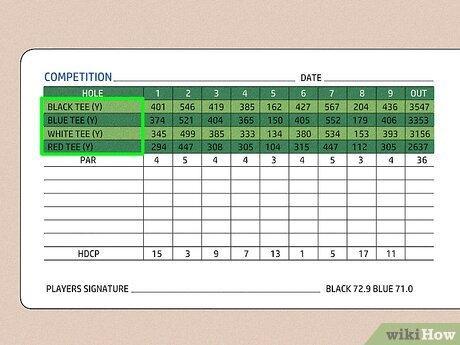
- Review course scorecard and identify 3 holes with highest penalty risk.
- Decide on a conservative/ aggressive plan for each based on your stats.
- Set a single round goal tied to a metric (e.g., “reduce three-putts this round”).
- Record key data (FIR, GIR, putts) immediately after the round for reliable tracking.
Applying rigorous analysis to golf scoring turns subjective hunches into repeatable strategies.Track the right metrics, practice with purpose, and adapt your shot selection to the course design – those are the reliable steps toward lower scores and smarter course management.