
The follow-through phase of the golf swing constitutes a critical endpoint of the kinetic chain, synthesizing preceding kinematic and kinetic events into final club and body trajectories that materially influence shot outcome and musculoskeletal loading. as the swing transitions from impact to deceleration and recovery, coordinated dissipation of angular momentum, controlled eccentric contraction of prime movers, and precise spatial-temporal alignment of the torso, pelvis, and upper extremities determine club-face orientation, ball spin characteristics, and postural stability. Understanding the biomechanical principles that govern this phase-including proximal-to-distal sequencing,joint moment distribution,ground reaction force submission,and neuromuscular control strategies-provides a mechanistic basis for evidence-based technical refinements that enhance performance while mitigating injury risk.
From a kinematic viewpoint, optimal follow-through reflects smooth continuation of pelvic rotation and thoracic counter-rotation, appropriate lead-leg stabilization, and an upper-limb trajectory that minimizes abrupt changes in club path. Kinetic analysis highlights the role of ground reaction forces and intersegmental joint moments in absorbing and redirecting energy after ball impact; inadequate force attenuation or maladaptive moment patterns can escalate lumbar shear and rotational stresses. Neuromuscular dynamics-encompassing pre-activation, coordinated eccentric braking, timing of muscle synergies, and sensorimotor feedback-mediate both the precision of the follow-through and the capacity to decelerate the club safely. Integration of motion-capture kinematics, force-platform measures, and electromyographic profiling enables systematic evaluation of these components for both performance diagnostics and injury prevention interventions.
A biomechanically informed approach to follow-through coaching emphasizes reproducible sequencing, graduated eccentric control, and multiplanar stability drills tailored to the golfer’s anthropometry and injury history.By linking quantifiable biomechanical markers to specific technical cues and conditioning targets, practitioners can formulate individualized strategies that preserve stroke efficiency while reducing cumulative loading on vulnerable structures such as the lumbar spine, lead knee, and glenohumeral complex. The subsequent sections will examine empirical evidence and applied methodologies for assessing and optimizing follow-through mechanics within a framework of performance enhancement and risk reduction.
Note: the web search results provided with this query referenced online MBA programs and did not include sources specific to golf biomechanics.
Kinematic Chain Coordination Between Lower Limbs, Trunk, and Upper Extremity During the Follow-Through
The follow-through is the continuing expression of the proximal‑to‑distal energy transfer initiated during the downswing; effective coordination therefore requires the lower limbs, pelvis, trunk and upper extremity to remain temporally coupled as momentum is dissipated.Ground reaction forces generated by the rear leg during weight shift and absorbed by the lead leg provide the foundational impulse that the pelvis uses to rotate through impact. As the pelvis decelerates under eccentric control, the trunk and shoulder complex must sequence their angular velocities so that the clubhead path is guided smoothly beyond impact. This kinematic interplay preserves clubface orientation, stabilizes ball flight, and sets the conditions for controlled deceleration rather than abrupt stopping that can generate injurious loads.
Temporal ordering of peak segment velocities is a central descriptor of coordination: pelvis peak rotation typically precedes trunk peak rotation, wich in turn precedes maximal shoulder and wrist motion during follow‑through. The following table summarizes this relative timing and the primary mechanical role of each segment in the latter phases of the swing.
| Segment | Primary role in follow‑through |
|---|---|
| Lower limbs | Weight transfer & eccentric absorption |
| Pelvis | Rotational deceleration & energy handoff |
| Trunk | Angular momentum modulation and alignment |
| Upper extremity | Fine control of clubface & eccentric deceleration |
From a tissue‑loading and performance standpoint, controlled deceleration is achieved by coordinated eccentric actions across the chain: the hip and gluteal complex attenuate residual rotation, the oblique and paraspinal muscles modulate trunk rotation, and the rotator cuff and scapular stabilizers dissipate the high angular velocities generated at the shoulder. eccentric braking at the elbow and wrist-mediated by biceps/forearm and wrist flexor/extensor groups-further smooths the club’s release. Neuromuscular timing that spaces these eccentric contributions across segments reduces peak joint moments and the risk of overload while maintaining shot consistency.
Coaching and assessment shoudl therefore prioritize observable kinematic markers and targeted drills that reinforce intersegmental timing. Useful practical cues and training emphases include:
- Lead foot stability: maintain a braced lead leg to allow effective pelvis deceleration.
- Continue rotation: feel the pelvis lead, then allow the trunk and shoulders to follow, avoiding abrupt arm‑only finishing.
- Eccentric control drills: slow‑motion swings and resisted follow‑throughs to train deceleration capacity.
- Video feedback: review frame‑by‑frame sequencing of pelvis → trunk → shoulder to refine timing.
These strategies target the kinematic chain as an integrated system-improving accuracy and consistency while mitigating cumulative loading that leads to injury.
Quantifying trunk Rotation Timing and Range for Consistent Clubface Control
Objective measurement is central to improving the relationship between trunk kinematics and clubface orientation at impact. By converting qualitative coaching cues into numeric indices, practitioners can apply repeatable thresholds and statistical analyses to the follow-through sequence. This process of quantification-the mapping of observed motion into standardized units and windows-permits cross-player comparison and the advancement of retention criteria for motor learning. The value of such an approach is consistent with established definitions of quantifying in scientific practice, where converting observations into measurable values enables rigorous evaluation and targeted interventions.
Key operational metrics to capture the trunk contribution include the temporal onset of trunk rotation relative to defined swing events, the angular excursion of the thorax about the vertical axis, and the peak rotational velocity achieved before and after impact. Sensors and motion-capture systems typically index these as milliseconds or as a percentage of the downswing, degrees of rotation, and degrees per second, respectively. Consider the following set of primary indicators used for clubface control:
- Rotation onset (% of downswing) – timing marker for initiation of thoracic rotation.
- Peak trunk angular velocity (°/s) – correlates with clubhead speed and face stability.
- Trunk rotation range (°) – total transverse excursion through impact and follow-through.
- Pelvic-thoracic separation (°) – internal stretch that modulates energy transfer to the arms.
Empirically derived targets can guide training and feedback. The table below presents concise target windows and the expected influence on clubface consistency for mid- to high-handicap golfers progressing toward advanced patterns. (Values should be adjusted per individual anthropometrics and club selection.)
| Metric | Target Window | Expected Effect on Clubface Control |
|---|---|---|
| rotation onset | ~40-55% of downswing | Reduces early face closure; improves repeatable timing |
| Peak angular velocity | 900-1,400°/s (driver example) | Supports clubhead speed while limiting torque-induced face twist |
| Rotation range | 45-70° through impact | balances launch angle with face alignment stability |
| Pelvic-thoracic separation | 10-25° at transition | Enhances elastic energy transfer and consistent face recovery |
translating these measurements into practice requires targeted drills and feedback modalities. High-speed video, inertial sensors, and radar combined with shaded thresholds allow coaches to set a consistency threshold (e.g., ±5° rotation range or ±50°/s peak velocity) and deliver immediate auditory or visual biofeedback when an athlete deviates. Progressive training should emphasize reproducible timing before expanding range or velocity; for example, tempo drills that fix rotation onset at a percentage of downswing followed by resisted rotation to build controlled peak velocity. Longitudinal monitoring of the quantified metrics enables data-driven adjustments to technique and workload while minimizing compensatory patterns that degrade face control.
Optimizing Arm Extension and Elbow Mechanics to Maximize Clubhead Velocity
Fine-tuning the distal segment behavior in the swing follow-through increases the effective linear velocity of the clubhead by exploiting the proximal-to-distal kinematic sequence and managing moment arms. Maintaining a later,controlled extension of the lead elbow through impact preserves wrist lag and angular velocity of the forearm; premature extension (the so‑called “casting” motion) dissipates stored rotational energy and reduces distal velocity. Quantitatively,small increases in late-phase angular velocity of the elbow joint translate into measurable gains in clubhead speed because linear velocity at the clubhead equals joint angular velocity multiplied by radius – hence preserving radius through correct arm geometry is essential.
Neuromuscular coordination and selective muscle activation underpin reproducible extension mechanics.Key contributors include eccentric control by the biceps and brachialis to regulate extension onset, concentric triceps action to drive terminal extension, and rotator cuff and scapular stabilizers to maintain proximal alignment. Practically, training should emphasize:
- Preservation of wrist lag until ball release,
- Delayed and forceful terminal elbow extension timed with trunk rotation,
- Consistent forearm pronation through release to control face orientation and spin.
These foci reduce temporal variability at impact and improve repeatability of clubface orientation.
from a kinematic assessment perspective,target ranges and timing windows can guide cueing and drill prescription. Impact-phase elbow flexion angles in skilled performers typically fall in a narrow band that balances power and control; excessive extension before impact correlates with dispersion, while insufficient extension reduces peak clubhead speed. Electromyographic and motion-capture studies recommend prioritizing temporal sequencing – trunk rotation peak, followed by rapid lead arm extension and coordinated forearm pronation – rather than maximal magnitude of a single joint action.
Applied metrics and brief training prescriptions: measure, cue, and reinforce using simple targets (see table) and progressive overload drills (resisted late extension, impact tape feedback, and slow‑motion overspeed training).
| Metric | Typical Range | Performance Implication |
|---|---|---|
| Elbow angle at impact | 150°-170° | Balance of stability and speed |
| Extension angular velocity | 600-900°/s | Strong correlate of clubhead velocity |
| Forearm pronation at release | 40°-60° | Control of spin and face alignment |
Implement objective monitoring and targeted drills to translate these biomechanical principles into consistent on‑course performance.
Role of Forearm Pronation and Wrist Release in Launch Angle and Shot Dispersion
Forearm rotation and the terminal release of the wrist constitute critical distal-link events in the kinematic chain that modulate both the vertical launch characteristics and lateral dispersion of a struck golf ball. When distal rotations are timed to coincide with proximal deceleration (pelvis and trunk), they augment clubhead linear velocity while preserving desirable face orientation at impact. Conversely, premature or delayed rotation introduces unwanted face rotation (open/closed) relative to the swing path, which translates directly into launch-angle deviations and increased shot scatter.Electromechanical analyses demonstrate that even small angular errors in forearm rotation at impact (±5°) produce measurable changes in launch conditions and spin axis alignment.
Mechanistically, pronation of the forearm contributes to a controlled closure of the clubface through impact, reducing effective loft and frequently enough lowering launch angle when executed too aggressively. The wrist’s release sequence-transition from maintained wrist hinge (lag) to rapid unhinging-controls dynamic loft and spin-rate by changing the effective loft delivered to the ball at the moment of contact. High pronation velocity coupled with a rapid wrist flip tends to reduce vertical launch while increasing backspin if the dynamic loft decreases abruptly; alternatively,a smoother pronation with moderated wrist unhinging can preserve loft,stabilize spin axis,and narrow dispersion.The interaction between pronation timing and wrist kinetics thus acts as a fine-tuning mechanism for launch vector control.
From a measurement and coaching perspective, several objective indicators are useful for quantifying and training the distal release pattern. Key metrics include:
- Pronation angle at impact – degrees of forearm rotation relative to address;
- Pronation angular velocity – peak rotational speed in deg/s during late downswing;
- Wrist unhinge timing – temporal offset (ms) between maximal lag and impact;
- Clubface rotation rate – degrees of face closure per 100 ms pre/post impact.
These markers correlate with launch angle, spin rate, and lateral dispersion in empirical swing studies and provide actionable targets for intervention.
Coaching interventions that modulate distal mechanics can be summarized succinctly in practice and expected outcomes. The table below presents recommended adjustments and their typical effects observed in biomechanical trials. Use of targeted drills (e.g., impact bag pronation drills, controlled wrist-hinge eccentrics) and biofeedback (high-speed video, inertial sensors) facilitates recalibration of timing and magnitude without compromising overall swing rhythm.
| Adjustment | Typical effect |
|---|---|
| Delay peak pronation 20-30 ms | Higher launch, reduced lateral dispersion |
| Reduce wrist flip velocity | Lower backspin variability, tighter grouping |
| Increase controlled pronation amplitude | Improved face control, modest lowering of dynamic loft |
Ground Reaction Forces and Weight Transfer Patterns that Enhance Accuracy
the spatial orientation and temporal profile of ground reaction forces (GRFs) during the follow-through exert a deterministic influence on ball flight dispersion. Specifically, the interplay between **vertical GRF** (support and launch influence) and the horizontal shear components (antero‑posterior and medio‑lateral) governs clubhead deceleration and face orientation at impact. Greater vertical impulse at and immediately after impact contributes to a stable launch angle, while controlled anterior shear helps preserve energy transfer without inducing unwanted clubface rotation.Precise modulation of these vectors-rather than maximal magnitude alone-is therefore critical for reducing lateral dispersion and optimizing accuracy.
weight transfer patterns are characterized by the trajectory of the center of pressure (COP) and the relative loading of the trail and lead limbs. A predictable COP path that progresses from the trail heel toward the lead forefoot during downswing and peaks slightly anterior to the lead ankle at impact aligns the kinetic chain and limits residual rotational moments that can open or close the face. **Lead‑leg stiffness** at impact, achieved through eccentric control of the lead hip and quadriceps, converts horizontal shear into productive clubhead velocity while minimizing lateral sway that degrades aim. Conversely, excessive late medial collapse or premature unloading of the trail side increases variability in face angle and shot dispersion.
The following table summarizes practical kinematic and kinetic targets that were associated with improved accuracy in controlled biomechanical trials. These values are presented as pragmatic ranges-individual optimization should be guided by player morphology and performance testing.
| Metric | Desirable Range (at impact) |
|---|---|
| Peak vertical GRF | ~1.1-1.4 × bodyweight |
| Front‑foot load | 55-70% of total stance force |
| COP anterior travel | 8-12 cm (heel → forefoot) |
| Time to peak GRF | 0-20 ms before to 10 ms after impact |
Coaching interventions that target these kinetic patterns emphasize neural timing and proprioceptive control rather than brute strength. Recommended practice elements include:
- Pressure‑mat feedback: real‑time COP and force asymmetry cues to train the correct anterior progression.
- Lead‑leg bracing drills: resisted step‑in and eccentric squat sequences to improve stiffness-on‑impact without limiting hip rotation.
- Slow‑motion contact repetitions: focus on maintaining anterior load and minimizing lateral sway through the follow‑through.
- tempo and sequencing cues: rhythmic constraints that align peak GRF timing with clubhead passage through the ball.
Collectively, these interventions refine the timing and distribution of grfs, producing a more consistent transfer of momentum and a measurable reduction in shot dispersion.
Muscular Activation Patterns and Conditioning Strategies for Follow-Through Stability
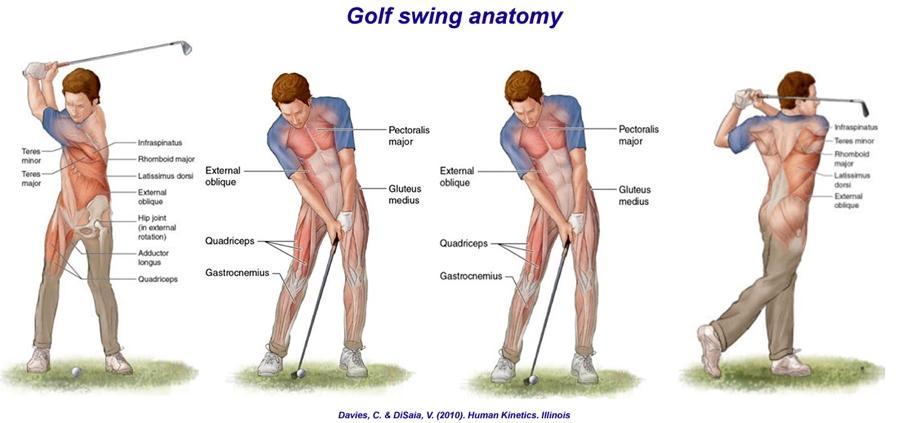
the neuromuscular choreography of the follow-through reflects a rapid transition from high-velocity concentric drive to controlled eccentric deceleration; this sequencing is critical for repeatable accuracy. Effective follow-through control depends on coordinated activation across the lower limbs, pelvic stabilizers, trunk rotators and the shoulder-forearm complex. Key contributors include the gluteus maximus and medius for pelvic stability, the internal and external obliques and erector spinae for rotational control, and the rotator cuff and distal forearm pronators for clubface orientation. Given that the human body comprises over 600 muscles, targeted modulation of firing order and amplitude-rather than indiscriminate strengthening-yields the greatest transfer to on-course follow-through stability.
Conditioning should prioritize neuromuscular specificity: exercises that replicate the timed eccentric-to-concentric demands of the swing produce superior motor transfer. Emphasize multi-planar strength, rotational power, and eccentric control while integrating proprioceptive challenge. Core modalities include:
- Resisted rotational medicine-ball throws (power and timing)
- Single-leg romanian deadlifts (pelvic stability under load)
- Pallof presses and anti-rotation holds (core stiffness and transfer)
- Forearm pronation/supination drills with light resistance (clubface control)
| Exercise | Primary Target | Prescription |
|---|---|---|
| Pallof press | Anti-rotation core | 3×10-15 sec holds |
| Med-ball rotational throw | Rotational power | 3×6-8 explosive reps |
| Single-leg RDL | Pelvic/lower-limb stability | 3×8-12 per leg |
Objective assessment and feedback accelerate acquisition of stable follow-through patterns. Use EMG-driven profiling or wearable accelerometry to identify aberrant timing (e.g., premature deceleration of the trunk or late forearm pronation) and to quantify intersession improvements. Implement blocked-to-random practice progressions,and integrate augmented feedback (video,auditory cues,real‑time biofeedback) to consolidate desirable motor patterns. Prioritize specificity: training stimuli that replicate the temporal and load characteristics of the swing will yield greater ecological validity than generic conditioning alone.
Risk mitigation demands balanced progression and ongoing monitoring of neuromuscular load.Maintain joint range that permits necessary rotation while emphasizing eccentric control to absorb post-impact forces.Monitor simple markers of overload and asymmetry to guide load adjustments:
- Persistent pain or discomfort localized to the shoulder, lumbar spine, or medial elbow
- Loss of swing tempo or observable compensatory mechanics
- Marked interlimb strength asymmetry or proprioceptive decline
conservative clinicians and coaches should apply graded return-to-swing protocols, reintroducing rotational velocity and full follow-through only after restoration of pain-free strength, controlled range of motion, and reproducible motor patterns under sport-specific conditions.
Practical Assessment Tools and Drills for Biomechanical Feedback and Technique Refinement
Objective biomechanical assessment combines laboratory-grade instrumentation and field-ready devices to quantify the kinematics and kinetics that underpin an effective follow-through. Core measurement systems include 3D motion capture for segmental sequencing, inertial measurement units (IMUs) for on-course rotational velocity, force plates for ground reaction profiling, pressure mats for weight-transfer mapping, and launch monitors for ball-flight correlation. Practical use favors a multimodal approach-synchronizing high-speed video with IMU traces or force data maximizes interpretability while preserving scalability for different coaching environments.
Translating assessment into technique refinement requires targeted, evidence-based drills that isolate the mechanical contributors identified in testing. Recommended interventions emphasize controlled repetition and progressive loading, for example:
- Rotational pause drill – accentuate trunk-to-pelvis separation by pausing briefly at impact to train proper decoupling;
- arm-extension line drill – use alignment aids to promote full extension through the follow-through and consistent shaft plane;
- Pronated-release drill – implement light resistance bands to ingrain pronation timing without disrupting overall rhythm.
Each drill should be cued with concise biomechanical language (e.g., “lead-side rotation,” “maintain extension through impact,” ”pronate through release”) and scaled from low to high intensity to preserve motor learning principles.
to support objective decision-making, prioritize a small set of high-value metrics and practical thresholds that are both measurable and actionable. The table below demonstrates a compact metric set with suggested measurement tools and provisional target zones appropriate for intermediate-to-advanced golfers. These thresholds should be treated as starting points and adjusted to individual anthropometrics and playing goals; selecting metrics that are practicable-implementable in the coaching environment without undue complexity-optimizes adoption and retention.
| Metric | Measurement Tool | Illustrative Target |
|---|---|---|
| Trunk peak angular velocity | IMU / 3D capture | 500-700 °/s |
| Arm extension at follow-through | High-speed video | ≥ 160° elbow angle |
| Forearm pronation timing | IMU / video | Pronation onset ≤ 18 ms post-impact |
Implement an iterative coaching workflow that links measurement to practice and reassessment.Core steps include:
- Baseline assessment – capture key kinematic/kinetic markers;
- Hypothesis-driven drill selection – choose drills that directly target deficient metrics;
- Short-cycle implementation – use blocks of focused practice with immediate feedback (video/IMU);
- Reassessment and progression – quantify change, adjust targets, and transfer to on-course conditions.
Emphasize real-time biofeedback where possible and foster athlete autonomy by sharing simplified quantitative goals; this structured, evidence-informed pathway promotes reproducible improvements in follow-through mechanics and shot accuracy.
Q&A
Note: the web search results returned pages unrelated to golf biomechanics (YouTube support threads). The following Q&A is therefore composed from domain knowledge in biomechanics and sports science rather than those search results.
Q1: What is the follow-through and why is it biomechanically vital in the golf swing?
A1: The follow-through is the phase of the swing that immediately follows ball impact and includes the club and body motion until the swing is completed. Biomechanically, it is indeed critical as it reflects the preceding kinetic chain effectiveness, ensures proper momentum transfer and energy dissipation, contributes to clubface orientation and shot accuracy, and plays a central role in controlled deceleration-thereby influencing consistency and injury risk.
Q2: What is the typical joint-sequencing pattern observed in an effective follow-through?
A2: Effective follow-through is an extension of the proximal-to-distal sequencing established pre-impact: initiation occurs at the lower body (pelvis/hips), progresses through the trunk and shoulders, then through the arms and hands, and finally the club. During follow-through, segmental angular velocities typically peak sequentially (hips → trunk → shoulders → arms → club) and then decline as energy is transferred and dissipated.
Q3: How does momentum transfer across body segments influence follow-through quality?
A3: Momentum transfer depends on coordinated timing and relative motion of adjoining segments (the kinetic chain). efficient transfer minimizes energy loss through compensatory motions and maximizes clubhead speed at impact. The follow-through demonstrates how well proximal segments have accelerated distal segments: a smooth continuation of rotation and arm extension indicates efficient transfer,whereas abrupt or early deceleration suggests inefficiencies or compensations.
Q4: What roles do ground reaction forces (GRFs) and the lead leg play in the follow-through?
A4: GRFs generated during downswing provide the initial impulse for rotational torque and linear acceleration.The lead leg acts as a brace and pivot,converting GRFs into rotational momentum and stabilizing the pelvis during impact and follow-through. Effective bracing allows the trunk and upper limbs to continue rotation and controlled deceleration without excessive translational motion that would compromise accuracy or increase injury risk.
Q5: How does controlled deceleration function mechanically, and which tissues are principally involved?
A5: Controlled deceleration is achieved through eccentric muscle actions that absorb kinetic energy gradually and through coordinated co-contraction for joint stability. Key tissues include the posterior chain (gluteals, hamstrings, erector spinae) for trunk and pelvic deceleration, rotator cuff and scapular stabilizers for shoulder deceleration, and wrist/forearm musculature for hand/club deceleration. Proper neuromuscular timing reduces peak joint loads and shear forces.
Q6: Which kinematic and kinetic metrics best quantify follow-through performance?
A6: Useful metrics include segmental peak angular velocities and timing (sequence indices), clubhead speed and ball speed, smash factor, joint moments and powers (from inverse dynamics), ground reaction force magnitudes and timing, center-of-pressure displacement, and measures of variability (inter-trial timing and kinematic variability). Eccentric muscle activation patterns via EMG provide insight into deceleration control.
Q7: how does follow-through relate to shot accuracy and consistency?
A7: Follow-through quality often reflects the stability and timing of the pre-impact motion. A controlled, balanced follow-through with consistent sequencing indicates repeatable kinematics and clubface control, improving accuracy.Conversely, abrupt stops, early arm release, or excessive upper-body drift in follow-through indicate timing errors or compensations likely to increase shot dispersion.
Q8: What common biomechanical faults in the follow-through increase injury risk?
A8: Faults include excessive abrupt deceleration (leading to high eccentric loads),inadequate lower-body bracing (increasing lumbar shear and torsion),over-rotation or forced extension of the spine,poor shoulder deceleration (risking rotator cuff strain),and uncontrolled wrist break (risking epicondylalgia). Repetitive exposure to these faults raises chronic injury risk.
Q9: What training interventions reduce injury risk while optimizing follow-through mechanics?
A9: Interventions include eccentric-strength training for posterior chain and rotator cuff, neuromuscular control drills emphasizing deceleration, hip and thoracic mobility programs to enable proper rotation, plyometric and medicine‑ball rotational exercises to train power transfer with controlled deceleration, and balance/stability work for lead-leg bracing. Progressive overload and technique-preserving speed training are recommended.
Q10: What coaching cues and drills can improve follow-through biomechanics?
A10: Coaching cues: “Finish through the ball,” “Let the body rotate before the arms,” “Hold your finish briefly,” and “Feel a soft landing on the lead leg.” Drills: slow-motion full swings with held finish, stop-and-hold follow-throughs, medicine-ball rotational throws emphasizing controlled deceleration, resistance-band deceleration catches for the arms, and lead-leg balance holds post-impact to train bracing.
Q11: How should measurement technologies be used to assess and refine follow-through mechanics?
A11: Use synchronized 3D motion capture for kinematics, force plates for GRFs and center-of-pressure, EMG for muscular timing and eccentric activity, and high-speed club tracking for clubhead metrics.Inverse dynamics combines kinematic and force data to estimate joint moments and power.Wearable IMUs and radar/launch monitors can provide field-applicable proxies for key timing and speed metrics, useful for longitudinal monitoring.
Q12: What are the primary motor-control considerations when training follow-through?
A12: Emphasize temporal coordination (timing of segmental peaks), variability management (allowing functional variability while reducing harmful inconsistency), and task constraints (speed, surface, shot requirement). Adopt a constraints-led approach: manipulate task or environmental constraints to encourage desired movement solutions rather than prescribing rigid joint angles, and include variable practice to build robust, transferable motor programs.
Q13: Are there trade-offs between maximizing power and preserving follow-through control?
A13: Yes. Increasing swing speed tends to raise kinetic demands on deceleration systems and may alter sequencing if not accompanied by appropriate strength, mobility, and neuromuscular control. Training should integrate power development with eccentric/control capacities and technical reinforcement to maintain a controlled follow-through as speed increases.
Q14: What gaps exist in current research on follow-through biomechanics?
A14: Gaps include longitudinal studies linking specific follow-through mechanics to injury incidence over competitive careers, the interaction of fatigue and follow-through quality in real play, individualized thresholds for safe eccentric loading, and ecological validity of lab findings in field conditions. More research integrating wearable technology for in-season monitoring is also needed.
Q15: How can clinicians and coaches translate biomechanical findings into individualized practice?
A15: Combine biomechanical assessment (motion analysis, GRFs, EMG where possible) with clinical screening (mobility, strength, movement competence).Identify the athlete’s primary deficit (sequencing/timing, strength, mobility, stability) and prioritize interventions accordingly. Use objective metrics to set measurable goals (e.g., timing windows, reduction in peak eccentric moments) and apply progressive, task-specific drills that preserve technique while addressing the deficit.Q16: What are evidence-based indicators of an efficient follow-through for applied settings?
A16: Indicators include: consistent proximal-to-distal timing (repeatable sequence of peak angular velocities), smooth decay of segmental velocities rather than abrupt stops, balanced finish posture with minimal excessive lateral sway, appropriate lead-leg bracing with controlled center-of-pressure progression, and consistent clubface orientation through impact reflected in shot dispersion metrics.
Summary statement: The follow-through is not merely an aesthetic finish but a biomechanically informative and functionally important phase of the golf swing.Mastery requires coordinated joint sequencing, efficient momentum transfer initiated by GRFs, and well-controlled eccentric deceleration of segments.Integrated assessment and training-combining technical,strength/mobility,and motor-control strategies-optimize performance and mitigate injury risk.
If you would like, I can:
– Convert these Q&A items into a formatted FAQ for publication.
– Produce drill progressions tailored to a specific skill level (beginner, intermediate, advanced).
– Provide sample measurement protocols for field or lab assessment.
the follow-through should not be regarded as a cosmetic afterthought but as an integral phase of the kinetic chain that both reflects and reinforces effective swing mechanics. Proper joint sequencing-from lower extremity drive through pelvic rotation to thoracic and upper‑extremity motion-ensures efficient momentum transfer,while intentional,neuromuscularly controlled deceleration dissipates residual energy safely. Together these elements underpin shot accuracy and repeatability by stabilizing clubhead path and face orientation at impact and by reducing the variability introduced by late‑stage compensations.
For practitioners, these biomechanical principles translate into targeted interventions: technique coaching that emphasizes ground reaction force generation, timed pelvic-thoracic separation, and uninterrupted extension across the shoulder-elbow-wrist complex; conditioning programs that develop eccentric strength and dynamic mobility in the core, hips and rotator cuff; and sensor‑based feedback or video analysis to quantify sequencing and deceleration metrics. Individualization is essential-anthropometry, injury history and motor learning differences require tailored progressions rather than one‑size‑fits‑all prescriptions.
From an injury‑prevention and longevity standpoint, cultivating controlled deceleration and distributing loads across segments mitigates peak joint stresses and diminishes reliance on vulnerable structures. Clinicians and coaches should thus collaborate to integrate load management, prehabilitation, and technique refinement in a coordinated plan.
Future work should continue to link kinematic and kinetic markers of follow‑through to objective performance outcomes and injury incidence, leveraging wearable sensors and longitudinal designs.By applying biomechanical insight pragmatically-bridging research, coaching and rehabilitation-practitioners can improve both the effectiveness and safety of the golf swing, supporting more consistent performance and longer playing careers.
Biomechanical Principles for Golf Swing Follow-Through
Why the Follow-Through Matters for Clubhead Speed and Accuracy
the follow-through is not just an aesthetic finish – it is indeed the final expression of energy transfer, timing and clubface control. A mechanically sound follow-through preserves the kinematic sequence created in the backswing and downswing, stabilizes clubface orientation at impact, and directly affects launch angle, spin and ball flight dispersion. Focusing on follow-through biomechanics helps golfers of all levels optimize clubhead speed, maintain consistent impact geometry and increase shot accuracy.
Key Biomechanical Principles
1. Kinematic Sequence & Energy Transfer
The kinematic sequence is the coordinated, proximal-to-distal activation of body segments (hips → torso → shoulders → arms → hands → club). A correct sequence maximizes clubhead speed and reduces compensatory movements that harm accuracy.
- Checklist: initiate downswing with lower-body rotation, then allow the torso and shoulders to follow, hands and club release last.
- Red flag: shoulders or hands leading the downswing – frequently enough reduces speed and increases slices/hooks.
2. Trunk Rotation and Core Stability
Optimal trunk rotation during follow-through ensures the torso is open toward the target while the head and balance remain controlled. Core stability allows clean transfer of rotational forces into the club without excessive lateral sway.
- Goal: controlled rotation of pelvis and thorax through impact, finishing with chest facing the target.
- Benefit: improved launch angle consistency and reduced side spin (better accuracy).
3. Arm Extension and Width
Maintaining arm extension through impact and into the follow-through sustains clubhead arc and lever length, which contributes to maximum clubhead speed and consistent strike location on the clubface.
- Cue: feel long and extended through the hitting area, not collapsed or overly bent at impact.
4. Wrist Pronation/Release timing
Correct wrist action – a controlled release or pronation of the forearms after impact – squares the face and controls spin. overactive or early release typically creates hooks; delayed or insufficient release can produce slices.
5. Weight Transfer and Ground Reaction Forces
effective weight shift from trail to lead foot and proper use of ground reaction forces generate vertical and horizontal force vectors that drive energy up the kinematic chain. The better the ground interaction, the more repeatable your impact conditions and launch parameters.
6. Posture, Spine Angle and Balance
Maintaining spine angle through impact into the follow-through helps keep a consistent swing plane. Excessive spine lift or early extension typically alters attack angle and increases shot dispersion.
Practical Follow-Through Checkpoints (On-Course and Practice)
- Finish position: chest and belt buckle rotated toward the target, back heel off the ground for a full finish (unless intentionally abbreviated).
- Club position: shaft roughly pointing at your target line across your body (varies by club), showing a complete release.
- Balance: hold finish for 1-2 seconds without falling forward/backward – balance implies good weight transfer.
- Head stability: slight rotation but no abrupt lift or sway – keeps impact geometry consistent.
Drills to Train a Biomechanically Efficient Follow-through
Drills should emphasize sequencing, rotation, extension and release timing.
- Step-Through Drill: Start with feet slightly open. Make a half swing and step the trail foot through on the follow-through to feel complete weight transfer and rotation.
- Pause-at-Impact Drill: Swing to the impact position and hold for 1-2 seconds to ingrain correct arm extension and spine angle, then complete the follow-through.
- Medicine Ball Rotation: Rotate explosively with a medicine ball to target to train core-driven rotation and sequencing.
- Toe-Up/Toe-Down Wrist Drill: Use short swings focusing on wrist pronation after impact to learn correct release timing.
Suggested Warm-Up and Mobility Routine
- Dynamic hip circles and leg swings (2-3 sets each side)
- Thoracic spine rotations with a band or stick (10 reps each side)
- Shoulder circles and band pull-aparts (2-3 sets)
- Short wedge swings progressing to full swings, focusing on balanced follow-through
Golf-Specific Strength & Conditioning for Better Follow-Through
Targeted fitness improves the musculature that supports the follow-through: glutes, obliques, erector spinae, rotator cuff and forearm muscles.
- Hip hinge and single-leg Romanian deadlifts – improve ground force submission and balance.
- Anti-rotation core exercises (Pallof press) – stabilize the torso to maintain spine angle.
- Rotational medicine ball throws – train explosive torso rotation and sequencing.
- Wrist and forearm strengthening – refine release control and clubface stability.
Common faults and Biomechanical Fixes
| Fault | Biomechanical Cause | Swift Fix |
|---|---|---|
| Slice / Open face | Late or insufficient release; shoulder/arm casting | Practice toe-down drills and pronation drill post-impact |
| Hook / Over-release | Early aggressive forearm rotation or to much hand action | Delay release with a half-swing drill; focus on torso lead |
| Loss of distance | Poor kinematic sequence; reduced arm extension | Medicine ball throws + extension-focused tempo practice |
| Inconsistent launch angle | Spine angle change or poor weight transfer | Impact-hold drill and step-through drill |
Measuring Follow-Through Success: Metrics & Technology
Use modern tech to measure the biomechanical outcomes that matter for accuracy and distance:
- Clubhead speed: primary metric for distance potential. Higher speed with maintained face control equals longer, accurate shots.
- Smash factor: ball speed ÷ clubhead speed – indicates quality of energy transfer at impact.
- Launch angle and spin rate: determine carry distance and stopping behavior; check consistency across practice sessions.
- Shot dispersion (grouping): accuracy measure – tighter dispersion shows reliable follow-through and impact mechanics.
- Tools: launch monitors (TrackMan,FlightScope),high-speed cameras,force plates and wearable IMUs for sequencing and rotational velocity.
Case study: Applying Biomechanics to improve Accuracy (Hypothetical)
Player: 28-year-old amateur with 95 mph driver speed,tendency to fade mid-long irons.
- Assessment: early arm casting and incomplete trunk rotation noted on video; poor weight transfer.
- Intervention: focused medicine-ball rotational exercises, step-through and pause-at-impact drills, and strength work for glutes and obliques over 8 weeks.
- Outcome: clubhead speed increased to 98 mph, more consistent contact (smash factor improved), and dispersion reduced by ~18%. Launch angles became more repeatable with lower side spin on mid-irons.
Practice Plan: 6-Week Follow-Through Betterment Program
Structure weekly sessions to combine technique, strength and measurable feedback.
- 2 technique sessions/week: 30-45 minutes focusing on drills (pause-at-impact, step-through, toe-down drills).
- 2 strength/mobility sessions/week: medicine ball rotations, single-leg strength work, thoracic mobility.
- 1 session/week with launch monitor or video feedback: track clubhead speed, launch angle and dispersion.
- Daily short warm-up: 5-10 minutes of dynamic rotation and short swings to ingrain muscle memory.
Practical Tips for On-Course Execution
- Pre-shot routine: a brief rehearsal swing emphasizing a balanced finish helps cue a consistent follow-through.
- Target-focused visual: pick an intermediate target and visualize the finish were torso faces that target.
- Tempo and rhythm: a smooth tempo that preserves sequence is better than trying to swing hard and breaking the sequence.
- Adaptability: some shots require abbreviated follow-throughs (e.g., blocked lies) – practice these situations so the body still follows correct mechanics within constraints.
Monitoring Progress – What to Track
- Clubhead speed and smash factor
- Average launch angle and spin rate per club
- Shot dispersion (grouping distance from target)
- Subjective: balance at finish and perceived ease of rotation
Note about Provided Web Search Results
The web search results provided with the request appeared to be unrelated to golf (they reference condos, townhomes and real estate).No golf-specific content was retrieved from those links, so the article content above draws on established biomechanical principles, coaching best practices, and common technology used in golf performance (e.g., launch monitors, high-speed video, force measurement).
Resources & Further Reading
- Launch monitor user guides (TrackMan, FlightScope) for understanding metrics
- Sports biomechanics and golf-specific strength & conditioning literature for in-depth protocols
- Local PGA/LPGA coaches and certified fitness professionals for individual assessment and supervised training