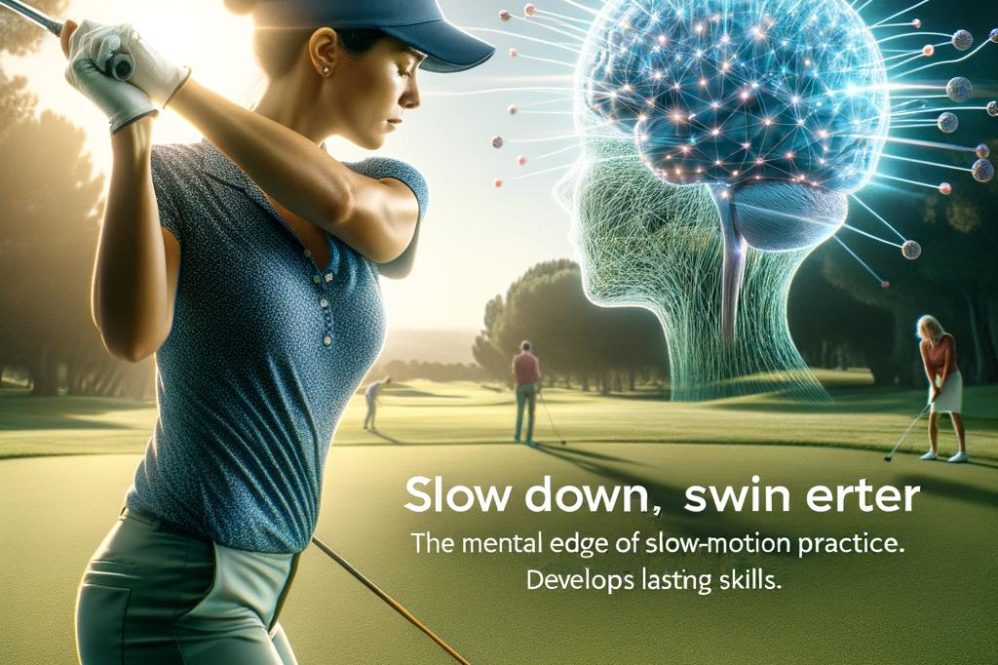
Slow‑motion swing practice now sits at the forefront of modern motor‑learning approaches for golfers, delivering benefits that go beyond mere mechanics. Framed through the lens of psychology-the scientific study of mind and behavior-this technique uses cognitive processes to speed skill acquisition, refine movement accuracy, and make performance more reliable under stress. Defined here as intentional rehearsals of the golf swing performed at markedly reduced speed, slow‑motion practice is best understood where attentional control, error‑driven learning, and sensorimotor integration meet.
Slowing the motion uncovers fine temporal and spatial cues that are frequently enough missed at full tempo, enabling clearer detection of faults, intentional adjustment of kinematics, and the building of more detailed internal movement models. These conditions support segmentation of complex sequences, better feedforward timing, and durable consolidation through concentrated, repeated work-principles consistent with neuroplasticity and deliberate practice. In addition, slow rehearsals encourage focused attention and structured variability that can translate into improved automaticity and greater robustness when returning to normal speed, while simultaneously lowering anxiety by permitting gradual exposure to difficult swing elements.
This article compiles theoretical and empirical evidence for the cognitive and psychological advantages of slow‑motion training, drawing on motor‑control research, cognitive psychology, and coaching literature. It examines how slow practice interacts with working memory constraints, the balance of implicit and explicit learning, imagery use, and confidence, and it finishes with pragmatic recommendations for embedding slow‑motion protocols into training plans that balance cognitive and biomechanical objectives.
How the Nervous System Explains Benefits of Slow‑Motion Swing Practice and Consolidation
Current models of nervous‑system function explain why deliberately decelerated movements accelerate motor learning. Reducing swing speed lowers both peripheral and central noise and better aligns outgoing motor commands with incoming sensory feedback; that improved signal‑to‑noise balance encourages synaptic changes (for example,timing‑dependent plasticity and long‑term potentiation) within sensorimotor networks.Extending the time window for detecting and correcting errors makes feedback signals more reliable and improves the accuracy of cortical and subcortical encoding of the target movement pattern.
Several neural systems interact to stabilize the adjusted motor program. primary motor cortex (M1) adapts to represent new timing and force patterns, the cerebellum refines internal forward models to reduce prediction errors, and basal ganglia circuits help automate sequences through reinforcement‑style learning. Slow‑tempo practice especially recruits cortico‑cerebellar and cortico‑striatal pathways by separating planning from rapid execution, which helps translate attention‑guided, explicit corrections into stronger, implicit motor representations.
From a cognitive‑neuroscience view, slowed rehearsal provides more opportunities for top‑down attention and working memory to shape sensorimotor processing. Learners can test hypotheses about limb paths and joint timing, perform chunking and error attribution, and then offload those corrections to procedural systems during consolidation. Computational analogies-such as layered neural networks-suggest that repeated, low‑variance input during slow practice drives network weight adjustments that produce faster, more consistent outputs once consolidation and offline replay (including sleep‑dependent mechanisms) occur.
Training recommendations that flow from these mechanisms include:
- Prioritize temporal detail: design blocks that deliberately slow the swing so error cues become easier to perceive.
- Mix sequence speeds: alternate focused slow trials with full‑tempo integration to encourage generalization.
- Include offline consolidation: allow rest or low‑cognitive tasks after slow blocks to aid stabilization.
| Neural substrate | Functional contribution |
|---|---|
| M1 | Encodes and refines motor commands; exhibits practice‑dependent reorganization |
| Cerebellum | Updates predictive models; reduces timing and kinematic errors |
| Basal ganglia | Supports automatization of sequences; reinforces prosperous patterns |
Slow Motion Practice and Proprioception: Sharpening Kinesthetic Accuracy
Purposeful, slow repetition enhances the sensory inputs that create a golfer’s internal picture of the swing. When motion is slowed, muscle spindles and joint receptors deliver clearer and longer‑lasting afferent signals that the central nervous system can sample and integrate more effectively. That richer kinesthetic information improves internal motor schemas: small errors in wrist set, shoulder turn, or weight transfer become noticeable and correctable. Over time,these higher‑fidelity internal maps support more accurate feedforward commands and steadier execution when tempo returns to normal on the course.
At both neural and cognitive levels, slow practice shifts control from fast, automatic regulation to a more controlled, evaluative mode-similar to engaging a ”slow thinking” strategy. This enables conscious tuning of interoceptive and proprioceptive signals and fortifies sensorimotor associations. Common outcomes include:
- More precise joint sequencing – clearer sense of the order and timing of body segments.
- Improved temporal checkpoints – better awareness of when key swing events occur relative to intended impact.
- Earlier error recognition – faster detection of deviations, allowing quicker corrections.
| Proprioceptive marker | Observable change |
|---|---|
| Wrist set | Reduced variability at the top of the backswing |
| Hip rotation | Smoother sequencing with fewer compensations |
| Weight shift | improved timing of lateral transfer |
These measurable shifts demonstrate how enhanced kinesthetic precision from slow practice maps onto detectable biomechanical consistency. Coaches who use concise, repeatable markers and short observational checklists can link players’ subjective proprioceptive reports to objective swing features and thus accelerate progress.
To turn sensory improvements into better on‑course results, structure slow work so it is goal‑directed and progressive. Start with single checkpoints, use short blocks of concentrated repetition, then gradually reintroduce speed while keeping sensory cues salient.Combine multiple feedback modes-brief verbal cues, video playback, and targeted imagery-and vary context to build robust sensorimotor generalization. Focus on these core steps: notice, discriminate, adjust, and automatize, using slow practice as the bridge that converts transient sensations into resilient, high‑fidelity motor memory.
Reducing Cognitive Load and Enhancing Error Detection via Deliberate Tempo Work
Deliberately slowing tempo decreases the second‑to‑second demand on working memory and frees limited attentional resources for higher‑level monitoring. By stretching the time over which sensory consequences unfold, learners can break complex motor sequences into manageable chunks, lowering concurrent cognitive load. Motor‑learning models indicate that this temporal unpacking supports deeper encoding of movement elements and helps move control from attention‑dependent modes to more stable representations.
Lower tempo also improves internal error‑detection.With longer intervals between segments, athletes receive clearer proprioceptive and visual feedback and can spot mismatches between intended and actual states more reliably. This produces more precise prediction‑error signals that drive adaptive updates to internal forward models. Key contributors to improved error detection include:
- Greater proprioceptive resolution – slower action heightens the salience of joint and muscle feedback.
- Less sensorimotor noise – temporal separation reduces overlap among competing feedback streams.
- Sharper prediction‑error mapping – clearer discrepancies speed model refinement.
Practical metrics of cognitive demand and monitoring tend to shift consistently after tempo‑focused training. The table below summarizes typical changes in succinct terms.
| Measure | Before | After Deliberate Tempo Training |
|---|---|---|
| cognitive load | High and fragmented | Lower and more consolidated |
| Error detection latency | Slower, less precise | Faster, more accurate |
| Movement variability | Higher | Reduced and more consistent |
Applying these ideas in session design delivers measurable gains for retention and pressure performance. Coaches and players should consider these implementation principles:
- Periodize tempo training – include slow phases early in learning and before full‑speed integration.
- Increase complexity progressively – start with isolated elements, then rebuild the full swing while keeping tempo cues.
- Align feedback with goals - give concise, targeted feedback during slow work to update internal models without overwhelming cognition.
Attentional Focus in Slow Repetition: Balancing Internal and External Cues
Deliberate deceleration creates a controlled setting for shifting attention between internal and external targets without the rush of full‑speed swings. By isolating segments of the movement, learners can use metacognitive monitoring to detect subtle proprioceptive differences and compare intended actions to outcomes. This focused rehearsal reduces noise in sensorimotor processing, strengthens error detection, and helps convert explicit knowledge into stable procedural skill.
cueing during slow reps should be varied deliberately to engage different learning mechanisms: internal cues increase somatosensory sensitivity and fine‑tuning, while external cues emphasize outcome‑oriented automaticity and efficiency. Use short,precise verbal prompts and rotate cue types across blocks to avoid dependence on any single attentional mode and to preserve transfer to competitive play.
- Internal – Club feel: sense the wrist hinge and shaft load during the backswing to refine proprioceptive calibration.
- Internal – Body sequencing: focus on pelvis‑to‑shoulder timing to reinforce intersegment coordination.
- External – Target line: keep attention on a landing marker to encourage automatic stroke alignment.
- External – Ball‑flight intent: picture the ball’s trajectory and landing area to bias the motor system toward outcome control.
To put this into practice, alternate blocks of slow repetitions with explicit attentional instructions and track performance variability (for example, clubhead path dispersion or launch‑angle spread) to gauge learning. After each block use a single, targeted reflection question (e.g., “Did I sense the expected shaft angle at transition?”) instead of multiple cues. Over time, systematic attentional switching, coupled imagery, and minimal external feedback support consolidation of automatic control strategies that maintain precision under pressure.
Encoding, Retrieval, and Transfer: Making Slow‑Tempo Skills Work at Full Speed
Deliberate slow repetitions change how sensorimotor information is encoded by amplifying error signals and improving the signal‑to‑noise ratio of proprioceptive input. During slow practice, learners devote more attention to discrete kinematic markers (grip tension, wrist hinge, weight shift), which produces rich multimodal encoding-visual, kinesthetic, and verbal cues becoming tightly linked to movement chunks. This richer encoding accelerates the shift from a cognitive, declarative grasp of the swing to a robust procedural program as slow reps strengthen the mapping between sensory states and motor commands.
Retrieval benefits when practice creates distinctive and retrievable cues; slow tempo deliberately produces those cues by exaggerating timing and sensory consequences. Because slow swings leave clearer internal traces, they serve as strong retrieval prompts during later practice and under pressure. Spaced slow sessions further support consolidation-through sleep‑related replay and offline stabilization-so that recovered motor patterns are less variable and more resistant to interference. Altogether, the result is a motor memory that is both accessible and stable in demanding situations.
Moving skills learned at slow tempo into full‑speed situations requires graded exposure and variability. Slow practice offers a precise scaffold for tuning timing and coordination during learning; to ensure transfer, use a tempo progression (slow → medium → target) and add contextual variations (different lies, stances, or clubs). This approach leverages specificity while maintaining generalizability, reduces maladaptive freezing, and allows flexible scaling so high‑speed execution preserves accuracy and rhythm developed at lower speeds.
Recommended elements to maximize encoding, retrieval, and transfer include:
- Chunked slow reps: isolate key phases (backswing, transition, impact) and practice at roughly half speed;
- Progressive tempo: raise speed incrementally once accuracy targets are achieved;
- Variable contexts: practice under different conditions and with perturbations to increase adaptability;
- Retrieval drills: perform short, focused full‑speed attempts without guidance to strengthen recall.
Below is a concise summary tying cognitive processes to practical outcomes:
| Process | Practical benefit |
|---|---|
| Encoding | Deeper sensorimotor maps and faster proceduralization |
| Retrieval | More salient cues and steadier recall under pressure |
| Transfer | Tempo progression supports accurate real‑time performance |
practical Session Design: Frequency, Duration, and Progression Guidelines Backed by Evidence
Effective slow‑motion practice ought to follow core motor‑learning principles-distributed practice, progressive overload, and task‑relevant variability-to maximize cognitive consolidation. By decelerating swing kinematics,learners reduce sensorimotor noise and sharpen error detection,fostering stronger internal models and more dependable feedforward control. Psychologically, these sessions emphasize focused attention and high‑quality sensory feedback-two empirically supported elements of effective practice.
Balancing training frequency with cognitive recovery prevents overload while maintaining spacing benefits for memory. A practical, evidence‑aligned framework for many players looks like:
| Stage | Sessions / week | minutes / session | Slow reps / session |
|---|---|---|---|
| Beginner | 3 | 10-15 | 30-50 |
| Intermediate | 3-5 | 15-25 | 40-70 |
| Advanced | 4-6 | 10-20 | 20-50 (mixed tempo) |
Adapt these targets to the individual: shorter, more frequent sessions are typically better cognitively than fewer long ones, and pairing slow motion with brief normal‑speed trials hastens transfer.
Progression should be measurable and intentional. Begin with isolated slow patterns that emphasize trunk‑hip sequencing and clubface control, then gradually restore speed and environmental complexity.Useful progression tactics include:
- Tempo blending – blend predominantly slow reps with occasional normal‑speed attempts to test transfer;
- Task decomposition – add one joint or action back into the pattern each week;
- Contextual interference – interleave shot types to enhance retention;
- Feedback fading – slowly remove external cues as internal models consolidate.
Validate each step against objective markers (consistency at kinematic checkpoints, subjective effort, and outcome variability).
Monitoring cognitive and behavioral indicators keeps sessions optimally challenging. Track measures such as session focus time, imagery vividness, error awareness, and self‑efficacy alongside simple performance metrics (dispersion of ball contact or alignment). Suggested tools include:
- Short video snippets for kinematic review;
- Two‑question mental‑state logs (focus & fatigue) before and after practice;
- Weekly progression checklists.
Pairing these measures with gradual increases in task complexity preserves the psychological advantages of slow practice-better motor planning, less outcome variability, and more efficient cognitive control-while ensuring sessions remain effective at producing lasting gains.
Building Resilience and Confidence with Controlled‑Tempo Training
Controlled‑tempo repetition acts as systematic psychological exposure that strengthens performance stability. By intentionally decelerating the swing, golfers create repeated, low‑threat opportunities to experience and fix errors, which reduces catastrophic thinking and unrealistic performance expectations. This process fosters a more adaptive view of variability and improves problem‑solving when conditions change: resilience becomes an evidence‑based capacity to reinterpret setbacks as informative rather than definitive.
Repeated success at reduced tempo produces concrete mastery experiences that boost task‑specific self‑efficacy. When slow practice transfers into more consistent ball‑striking during integration drills, players develop a sense of control that carries over to full‑speed play. That increased perceived competence supports an internal locus of control and dampens anxiety‑driven motor disruption, improving overall consistency. These confidence gains tend to be stable because they are grounded in observable sensorimotor learning rather than fragile outcome‑only feedback.
The technique also exercises executive functions critically important in competition-sustained attention,inhibitory control,and emotion regulation. Many practitioners notice better pre‑shot routines and lower physiological arousal when they return to normal tempo, consistent with stress‑inoculation principles. Elements that mediate these psychological improvements include:
- Focused attention drills – rehearse a single proprioceptive cue (such as, wrist hinge) at about 50% tempo;
- Controlled‑error practice - introduce small, planned perturbations to develop corrective responses;
- Regulation rehearsals – add breathing techniques and imagery into slow swings to stabilize arousal.
these practices reconsolidate motor programs within a mental context geared toward calm, goal‑directed performance.
To harness these psychological gains in a training program, use a graded plan that gradually ramps up speed and contextual difficulty while preserving the mental skills practiced at slow tempo. The three‑phase protocol below is concise and practical for weekly integration:
| phase | Tempo focus | Primary Psychological Target |
|---|---|---|
| Acquisition | Very slow (30-50%) | Error‑tolerant learning and mastery of mechanics |
| Integration | Moderate (60-80%) | Transfer of self‑efficacy and attentional control |
| Application | Full tempo (90-100%) | Stress resilience and consistent performance |
Q&A
Q1.How is “psychological” defined for slow‑motion swing work?
A1. In this article, “psychological” covers the mental processes, states, and feelings that influence motor performance-attention, perception, memory, imagery, motivation, and emotion.The emphasis is on how those cognitive and affective factors interact with motor control during deliberate practice.
Q2.What exactly is slow‑motion swing practice and how does it differ from typical practice?
A2.Slow‑motion swing practice means performing the golf swing at a considerably reduced speed (commonly around 25-50% of normal tempo) while preserving the intended kinematic sequence. Compared with full‑speed reps, slow practice offers more time for sensory sampling, conscious inspection of movement components, and breaking complex actions into smaller parts for corrective learning.
Q3.What cognitive processes underpin the benefits of slow practice?
A3. Central mechanisms are:
– Greater attentional focus: extra time to target key kinematic cues.
– Finer perceptual discrimination: improved sensing of sequencing and joint positions.
– Enhanced error detection and deliberate hypothesis testing: deviations become easier to notice and fix.
– chunking and segmentation: isolating and consolidating subunits before recombining them.
– stronger sensorimotor representations: repeated slow work sharpens internal models for planning and prediction.
Q4. How does slow practice change motor learning and retention?
A4. Slow practice helps initial encoding of accurate movement patterns and reduces large errors. When combined with variable and full‑speed practice, it supports consolidation and retention. Though, exclusive reliance on slow work risks producing context‑specific control strategies, so deliberate transfer to full speed must be trained.
Q5. Does slow practice tilt the balance between explicit and implicit learning?
A5. Yes. Slow practice often encourages explicit, verbalizable analysis and conscious monitoring, useful for error correction and forming accurate templates. Too much explicit control can hinder automatization and performance under pressure; best practice is to use slow work to establish mechanics and then shift toward implicit methods (external focus, analogies, reduced verbalization) to promote automaticity.
Q6. How does slow tempo interact with attention and cognitive load?
A6. Slower movement reduces time pressure and transient cognitive load, allowing focused attention on specific swing aspects. That said, overloading learners with many explicit details can increase cognitive load and reduce fluency, so coaching cues should be concise and prioritized.
Q7. What effect does slow practice have on imagery and motor simulation?
A7. Slow tempo enhances mental simulation fidelity. The stretched time course allows kinesthetic imagery to run alongside actual movement, strengthening shared neural circuitry between imagined and executed actions. Slow reps let practitioners compare imagined sensations with real feedback,improving internal model accuracy.
Q8. What emotional and motivational advantages come from slow practice?
A8. Psychological advantages include lower anxiety during learning (errors feel less catastrophic), increased perceived competence through steady improvements, and stronger intrinsic motivation from clearer progress signs. Structured slow practice can boost self‑efficacy by showing controllable technical gains.
Q9.Can slow practice help performance under pressure?
A9. Indirectly. When slow practice builds robust motor representations and is followed by practice at competitive speed and pressure simulations, it can enhance resilience. But if a player relies on conscious control learned during slow practice, pressure may trigger reinvestment and disrupt automatic behavior-so the need to progress toward implicit control strategies.
Q10. Which neural processes support the cognitive benefits of slow practice?
A10. slower movements yield richer sensory feedback and finer temporal coding of proprioceptive and visuomotor signals, aiding refinement of forward and inverse models in motor cortex, cerebellum, and basal ganglia. Slower timing can also improve cortico‑cerebellar error correction and promote Hebbian‑style plasticity by better aligning afferent feedback with motor commands.
Q11. How should slow‑motion practice be structured to maximize psychological gains?
A11. Practical structure:
– Start at about 25-50% of normal tempo for detailed inspection.- Use brief focused blocks (10-20 reps per targeted element) with distributed rests to avoid fatigue.
– Limit coaching cues to one or two per block (favor external focus where feasible).
– Alternate slow blocks with full‑speed reps (such as, 2 slow : 1 full‑speed) to encourage transfer.
– Include video feedback and guided imagery.
– Gradually raise tempo and add variability and pressure elements.
Q12. what measures can coaches or researchers use to track cognitive changes from slow practice?
A12.Useful assessments:
– Kinematic analyses (sequencing and timing ratios) to quantify pattern changes.
– Dual‑task or reaction‑time paradigms to evaluate automatization.
– Perceptual discrimination tasks to measure sensory acuity.
– Self‑report scales for confidence, anxiety, and perceived control.- Retention and transfer tests at full speed and under pressure to assess generalization.
Q13. What are limitations or risks of slow‑motion practice from a psychological view?
A13. Potential downsides:
– Excessive reliance on explicit strategies can impede automaticity and pressure performance.
– poorly designed slow practice may produce nontransferable timing or force patterns.
– Too much kinematic focus can reduce attention to outcome variables (distance, accuracy).
– Individual differences (novice vs.expert) moderate effectiveness; experts may need different protocols.
Q14.How should slow practice be folded into an overall coaching plan?
A14. Integration tips:
– use slow work early in acquisition or when correcting specific faults.
– combine it with contextual interference (variable practice), full‑speed rehearsals, and pressure drills to build robustness.
– Transition from explicit instruction to implicit strategies as skill consolidates.
– Tailor tempo, volume, and feedback to the athlete’s level and cognitive preferences.
Q15.What future research directions are promising for studying psychological benefits of slow practice?
A15. Recommended avenues:
- Longitudinal comparisons of mixed slow/fast schedules versus exclusive real‑time practice for transfer and retention.- Neuroimaging studies to identify neural correlates of slow‑practice consolidation.
- Investigations into individual predictors (cognitive style, anxiety) that determine optimal use of slow practice.
– Trials of protocols designed to shift learners from explicit to implicit control to maximize pressure performance.
suggested reading
– For a concise dictionary definition of “psychological,” see Cambridge Dictionary.
- For applied drills and summaries, consult recent motor‑learning reviews and evidence‑informed coaching guides.
If helpful, I can condense the Q&A into a short FAQ for publication or draft a tailored practice plan for a specific skill level (beginner, intermediate, advanced).
Slow‑motion swing practice is more than a mechanical rehearsal: it intentionally engages the cognitive systems that drive motor learning, attention regulation, and error detection. By slowing movement, players gain clearer perceptual access to kinematic cues, strengthen internal representations of the swing through focused repetition, and create conditions that support integration from explicit understanding to implicit control and more robust sensorimotor maps. These outcomes are consistent with core psychological principles of skill acquisition, attention, and memory, and help explain why deliberate slow practice can speed the shift to fluent, automatic performance under pressure.for coaches and players, the practical takeaway is to embed structured slow‑motion drills-with clear attentional goals, progressive tempo scaling, and periodic objective feedback-into training routines to optimize the cognitive mechanisms behind lasting advancement. For researchers, the psychological claims summarized here invite further empirical validation using longitudinal designs, objective kinematic monitoring, and neurocognitive measures to quantify the influence of slowed practice on consolidation, transfer, and stress resilience.
In short, slow‑motion swing practice links mind and body: it turns clearer perception into informed action and leverages established psychological mechanisms to make each swing both more precise and more dependable. Ongoing integration of theory, measurement, and applied training will refine how these cognitive benefits translate into consistent competitive success.

Slow Down, Swing Smarter: The Mental Edge of Slow-Motion Practice
Why slow-motion practice improves your golf swing
Slowing your golf swing down intentionally is not the same as hesitating or losing power. Slow-motion practice is a deliberate training method that emphasizes motor learning, error detection, and sensory feedback. When you move slowly you expose the components of your swing – sequence, clubface control, weight shift, wrist hinge and timing - to detailed perception and conscious refinement. That deliberate focus speeds up long-term learning and builds a more repeatable swing at full speed.
How it works: motor control and neural adaptation
- Increased sensory feedback: Slow movements let you feel subtle changes in clubface orientation,grip pressure,and body position that are missed at full speed.
- Improved error detection: Slower practice makes it easier to spot where timing or sequencing went wrong so you can correct it intentionally.
- Stronger motor patterns: Repeated slow, accurate reps strengthen neural pathways responsible for correct movement patterns – a principle supported by modern slow/fast systems studies in dynamical learning (see slow/fast systems literature).
- Reduced use of compensatory habits: slowing down prevents the body from defaulting to quick, ingrained compensations (e.g., over-rotation, early extension), allowing you to rewire a cleaner pattern.
Evidence & cross-disciplinary support
Although applied golf-specific randomized controlled trials on slow-motion practice are limited, principles from neuroscience, motor learning and human factors support the approach. Research and frameworks about slow/fast systems and deliberate “slow” modes of learning highlight how separating fast execution from slow, corrective practice improves performance and retention. for deeper reading see resources on slow/fast systems and slow productivity and design:
- Slow/Fast Systems overview – models that describe how slow learning processes constrain and stabilize fast behaviors.
- Slow Productivity – principles that emphasize intent, focus and deliberate practice over rushed repetition.
- Slow design Principles – useful analogies for designing practice routines that favor depth and sustainability.
- Thinker: Learning to Think Fast and slow (arXiv) – a framework that relates fast response behaviour to slow, correcting processes.
Key benefits for your golf swing (SEO keywords in context)
- Better swing tempo: Slow practice teaches you a consistent rhythm that transfers to improved tempo under pressure.
- Improved ball striking: Increased awareness of clubface control and impact position leads to straighter, more predictable shots.
- Greater consistency: Rewiring motor patterns through slow reps increases repeatability of the swing, improving consistency on the course.
- More feel and feedback: slow drills amplify proprioception (feel), so you sense subtle errors and correct them faster.
- Faster learning curve: Paradoxically, investing time in slow practice frequently enough delivers quicker long-term gains than repeatedly hitting full-speed shots with poor mechanics.
How to structure effective slow-motion practice sessions
Follow a framework that balances slow, focused practice with graded speed increases and transfer to full-speed swings.
session structure (40-60 minutes)
- Warm-up (8-10 minutes): Light dynamic stretches, short chip shots at normal speed to prime the nervous system.
- Slow rehearsal (15-25 minutes): 3-5 focused drills at 25-50% speed. Use mirrors, video or coach feedback to tune mechanics.
- Tempo integration (10-15 minutes): Gradual speed progression: 60% → 80% → full speed,each for small sets of reps while maintaining the learned feel.
- Transfer reps (5-10 minutes): Full-speed ball strikes focusing on the specific metric you trained (impact position, release, swing path).
Tempo targets and rep ranges
Below is a simple guideline you can adapt.
| Phase | Relative speed | Reps per Set | Focus |
|---|---|---|---|
| Slow rehearsal | 25-50% | 6-10 | Sequence, wrist hinge, clubface control |
| Tempo integration | 60-80% | 4-6 | Timing, weight shift, rhythm |
| transfer reps | 100% (full swing) | 3-8 | Ball strike and outcome |
Practical slow-motion drills for every golfer
1. The 4-Phase Hinge Drill (short game & full swing)
Break the takeaway, hinge, downswing, and release into four slow segments. Pause at the top of each segment to check wrist angles and clubface. This improves wrist timing and prevents flipping at impact.
2. Mirror + Metronome Tempo Drill (tempo & rhythm)
Use a metronome set to a cozy beat. Move the club on 4 beats: 1 = start takeaway, 2 = half backswing, 3 = top, 4 = impact position (slow through these at first). Video or mirror to match positions and rhythm.
3. Impact Freeze Drill (impact feel)
Swing at 40% speed and freeze your body at impact for 2-3 seconds. Observe clubface, shaft lean and left wrist. Repeat until the impact feel is consistent.
4. The One-Joint Focus Drill (isolate movement)
Pick one joint (hip turn, shoulder turn, or wrists). Move only that body part slowly through the action while keeping others still. This isolates and refines the kinematic sequence.
Progression plan: From slow rehearsals to course-ready speed
Here is a short 8-week progressive outline you can follow. Adjust volume depending on practice frequency and baseline skill.
| Weeks | Goal | Weekly Focus |
|---|---|---|
| 1-2 | Establish awareness | Slow rehearsal, 3×/week, focus on hinge & impact feel |
| 3-4 | Consistent sequencing | Tempo integration, add metronome work, 3-4×/week |
| 5-6 | Speed blending | Gradual speed increases, short full-speed transfer sets |
| 7-8 | Performance under pressure | On-course simulation, focused full-speed reps, pre-shot routine |
common mistakes and troubleshooting
- Mistake: Too much analysis, too little feel. fix: Alternate between technical slow reps and ”feel” swings where you reproduce the learned sensation without overthinking.
- Mistake: No progressive speed plan. Fix: Always increase speed gradually and only after you can reproduce the movement reliably at the slower speed.
- Mistake: Overdoing reps. Fix: Quality beats quantity. Stop a set when mechanics begin to degrade – fatigue reinforces bad motor patterns.
- Mistake: Ignoring feedback tools. Fix: Use video, impact tape, launch monitor or a coach for objective feedback to accelerate learning.
Measuring transfer: How to know slow practice is working
Objective and subjective measures help confirm transfer to your on-course performance.
Objective metrics
- Ball flight dispersion (tightening shot group)
- Impact location on the clubface (centered hits)
- Smash factor and ball speed consistency
- tempo ratio (backswing:downswing times)
Subjective metrics
- Improved feel at impact
- Confidence in setup and tempo
- Ability to reproduce the swing under mild pressure (9th hole test)
Case study snapshot (realistic training example)
A mid-handicap player struggled with inconsistent center hits and a slice. Over 8 weeks of twice-weekly slow-motion practice focused on hinge timing and impact freeze drills, they recorded:
- 30% reduction in ball dispersion (range session)
- More centered impact locations on face-impact spray
- Subjective betterment in tempo - reported easier control on windy days
Key learning: consistent, targeted slow reps + measured transfer sets produced tangible improvements in both feel and scoring during simulated rounds.
Quick practice checklist for every session
- Warm up your body and swing at normal speed for a few short shots.
- Pick 1-2 measurable goals (e.g.,”center impacts” or “consistent wrist hinge”).
- Start slow. Use 25-50% speed for focused drilling.
- Gradually increase speed only when you can reproduce the movement consistently.
- Finish with a few full-speed transfers under a pre-shot routine.
Frequently asked questions (FAQ)
will slow-motion practice make me slower on the course?
No. The goal is to build accurate motor patterns at slow speed and then blend those patterns into faster, efficient movement. When done properly, slow practice enhances full-speed performance.
How frequently enough should I do slow-motion drills?
2-4 short sessions per week (20-60 minutes) can produce meaningful gains. consistency matters more than daily volume – allow recovery for motor consolidation.
Can beginners use slow-motion practice?
Yes - beginners benefit greatly because it teaches fundamentals without masking errors with speed. Keep instruction simple and progress gradually.
Further reading and resources
To explore the theoretical underpinnings of slow/fast learning and deliberate practice, the following resources are helpful:
- Slow/Fast Systems notes
- Slow Productivity
- Slow Design Principles
- Thinker: Learning to Think Fast and Slow (arXiv)
Takeaway action (do one thing today)
Pick one slow drill (e.g., Impact Freeze) and do a focused 15-minute session. Record one slow-rehearsal clip and one full-speed transfer clip. Compare the two and note one key sensation you want to preserve when you swing faster next time.