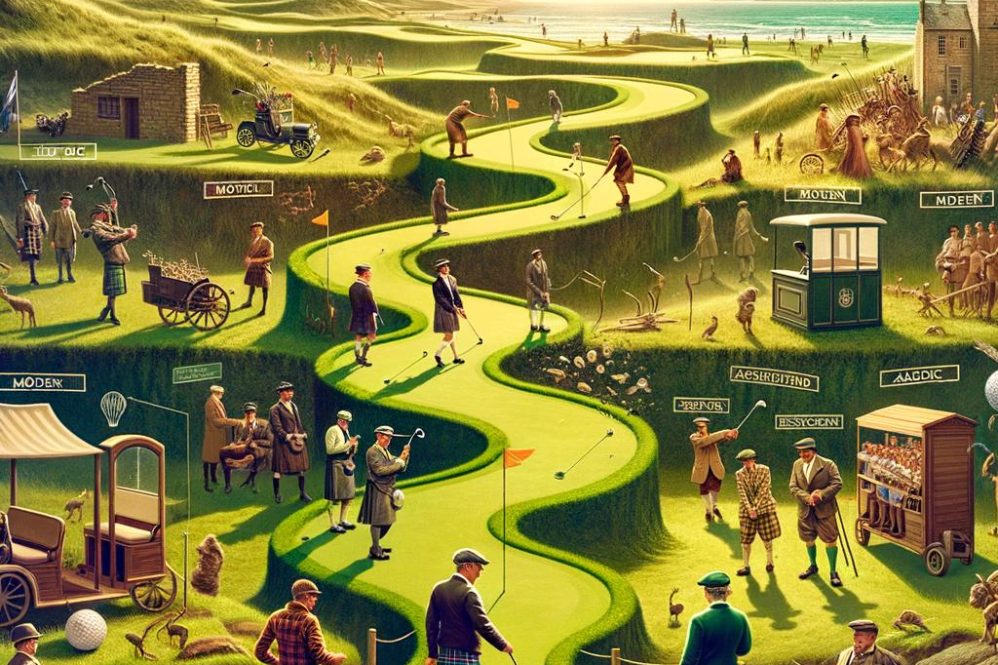
The expansion of golf from a localized leisure activity in late‑medieval Scotland to a sport played across continents reflects layered processes of technical change, organizational standardization, and shifting cultural meanings. Using an evolutionary frame-understood as branching adaptation and variation-this piece treats golf as a changing social and material phenomenon shaped by advances in equipment (balls, clubs, turf science), the formalization of rules and governance (from local customs to international authorities), and transformations in landscape architecture (from natural links to parkland, resort, and championship layouts). examining how these elements intertwined helps explain how games onc played on coastal commons at St Andrews and other Scottish ports became standardized, debated, and transmitted into very different social and environmental settings.
This analysis begins by locating the earliest written and material traces of stick‑and‑ball play in late medieval and early modern Britain and follows the slow convergence toward the conventions that took shape in the eighteenth and nineteenth centuries. It then explores the institutional consolidation of rules-how informal local practices were translated into written codes by bodies such as the Royal and Ancient Golf Club and national associations-and how rule changes both reacted to and stimulated technological innovation. Course making is treated as both craft and aesthetic practice: the movement from incidental linksland play toward deliberately composed courses tracks wider changes in leisure, land management, and the professionalization of architecture. the essay interrogates social forces-class and gender relations, imperial and commercial linkages, mass media and professional tours-that shaped who played, how the game was represented, and how it spread internationally.
Combining archaeological finds, archival sources, and histories of design with sociological and technological perspectives, this study maps ways in which rules, gear, and landscapes have shaped one another, and highlights present tensions-sustainability, equity, and globalization-that will influence golf’s next phase of development.
origins and Early Practices in Fifteenth‑Century Scotland: Material Evidence, Cultural Context, and Suggested Methods for Historical Inquiry
Material and documentary signals from fifteenth‑century Scotland point to a regularized pastime rather than a single moment of invention. Legal documents (including mid‑15th‑century royal notices referencing “golf” among pastimes) should be considered alongside recovered objects-worked wooden club fragments, primitive ball forms, and concentrated wear scars in turf-to reconstruct early practice.Archaeological contexts are often incomplete: artefacts surface in graveyards, household deposits, and dune sands rather than purpose‑built playing grounds. Consequently, rigorous stratigraphic control, where feasible radiocarbon or dendrochronological dating, and precise provenancing are vital to avoid conflating medieval recreational material with later Victorian sporting accretions.
Embedded practices and the landscape help explain the particular character of the game in Scottish records. Play developed in places where communal land rights, pastoral economies, and maritime dune systems created broad, undulating ground suitable for long strikes.At the same time, the overlaps between leisure and military readiness (archery musters) and growing urban sociability influenced who played and why. Crucial social and environmental variables to examine include:
- Landholding arrangements – common rights and parish greens that allowed public play;
- class and craft – differences in participation and leisure time between artisans and the socially privileged;
- Seasonal rhythms – ecclesiastical and agricultural calendars that structured when games occurred.
Recommended methodological pathways for robust historical research favour interdisciplinary toolkits that balance objects and context. Practical approaches include integrated landscape survey, targeted trial excavation tied to documentary locations, palaeoenvironmental cores to reconstruct dune and coastal change, and GIS‑based spatial modelling to chart historical movement across terrain. The table below pairs common methods with the insights they typically yield:
| Method | Primary Insight |
|---|---|
| Documentary analysis | Chronologies of mentions; legal and social norms |
| Landscape survey & GIS | Identification of playable topographies and access routes |
| Palaeoenvironmental coring | Dune evolution,vegetation histories,signs of human impact |
| Experimental archaeology | Functional tests of clubs,balls,and play dynamics |
Ethical and interpretive safeguards are necessary to avoid reading modern golf back into the past. Researchers should foreground community collaboration (local knowledge holders and custodians), transparent data sharing, and techniques that minimize site disturbance (for example, geophysical prospection before digging). Suggested best practices include:
- Work with local archives and tradition‑holders as active research partners;
- Report negative or ambiguous results to reduce survivorship bias;
- Publish datasets and methods openly to support replication and critique.
From Local Practice to Formal codes: Institutionalization, the R&A, and Modern Rule‑Making Principles
Origins of codification lay less in statutory ambition than in the quotidian norms of play among Scottish gentlemen and local clubs.Seventeenth‑ and eighteenth‑century “rules” were pragmatic accords-agreements about hazards, ball replacement, and order of play-often preserved in club minutes or match wagers. Those norms emphasized personal honor and sportsmanship, producing flexible, regionally varied practices; the turn to written rules reflected growing needs for consistency as inter‑club contests and longer travels became common.
Institutional centralization coalesced around organizations such as the Royal and Ancient Golf Club of St Andrews and later national associations that sought to align play across expanding geographies. Mature institutions performed three linked roles: they set technical standards for equipment and course measurement, arbitrated disputes, and produced authoritative texts that translated local customs into broadly applicable regulations. Important outcomes included uniform hole counts, codified penalty structures, and a clearer separation between rules and etiquette-changes that reduced local variation while facilitating international expansion.
- Clarity: eliminate ambiguity once resolved by precedent.
- Consistency: harmonize equipment and measurement practices across jurisdictions.
- Accessibility: preserve tradition while opening pathways to broader participation.
Contemporary rule development should be evidence‑based and pluralistic: effective governance combines historical awareness with empirical testing, stakeholder engagement, and iterative review. Practical recommendations include scheduled impact assessments for rule changes, formal channels for amateur and minority constituency input, and carefully trialed technological aids (for example, controlled use of image review or telemetry). These measures protect the sport’s tradition of fairness while keeping the rule framework transparent, resilient, and inclusive as equipment, course architecture, and global participation continue to evolve.
| Aspect | Historic Practice | Contemporary Ideal |
|---|---|---|
| Authority | local clubs & gentlemen | Global federations (R&A/USGA) |
| Dispute resolution | On‑course adjudication | Documented protocols & independant review |
| Change process | Ad hoc consensus | Consultation,pilot testing,and evaluation |
Material and technological Change: Equipment Advances,Performance Effects,and Regulatory Options
Recent progress in club and ball design-multi‑material heads,high‑modulus carbon shafts,variable thickness face engineering,and optimized dimple patterns-has produced measurable changes in performance metrics such as ball speed,spin,and moment of inertia (MOI). Empirical testing indicates these developments have generally increased average driving distances and tightened dispersion for players across ability levels, while enabling shot shapes that were once challenging to produce. From a systems viewpoint, materials science, tighter manufacturing tolerances, and aerodynamic modelling now interact with human swing mechanics to reconfigure the relationship between input (the swing) and output (ball flight), and thereby alter the envelope of skill that equipment mediates.
Accurate assessment of aerodynamic and material impacts requires standardized test methods and reproducible lab conditions.Launch monitor and wind‑tunnel studies show that modest changes in face stiffness or dimple geometry can produce large shifts in carry and roll. The table below summarizes typical directions of effect observed in controlled studies-illustrative rather than exhaustive-and indicates the core metrics that regulators should monitor.
| Innovation | Typical performance effect | Primary Measurement |
|---|---|---|
| Variable face thickness | ↑ ball speed (especially on off‑centre strikes) | Coefficient of restitution (COR) |
| Carbon composite heads/shafts | ↑ launch potential,↓ mass for redistributing weight | MOI,launch angle |
| Optimized dimple designs | ↑ carry,↓ spin at higher velocities | Drag coefficient,spin rate |
The effects on competitive integrity are complex: gear that materially increases performance can widen gaps between well‑funded competitors and casual players,necessitate changes to course setup,and complicate historical comparisons of records. Policy responses should be transparent and evidence driven. suggested measures include:
- Performance thresholds: enforceable caps on COR, overall distance windows, and spin ranges;
- Standardized testing: reproducible protocols for aerodynamic and materials characterisation;
- Disclosure rules: requirements for manufacturers to declare construction methods and key materials for models used in competition;
- Tiered equipment classes: optional divisions or equipment categories for different competition levels to protect accessibility and historical comparability.
implementing these policies requires collaborative governance connecting manufacturers, federations, university labs and independent test houses. Priorities should include longitudinal monitoring programs, investment in neutral testing infrastructure, and periodic reviews tied to empirical thresholds rather than one‑off fixes. Such a framework balances encouragement of innovation with protection of player skill as the primary determinant of outcome, while remaining adaptable to accelerating technological change.
How Course Design Has Shifted: Strategic Architecture, Typologies, and Site‑Sensitive Best Practice
Design thinking has moved from predominantly punitive, prescriptive layouts to subtler strategies that reward decision making and shot selection. Early twentieth‑century architects began replacing uniform, penal hazards with measured placements that encourage strategic options; this lineage underlies today’s focus on risk‑reward corridors, multiple landing zones, and visual targets. Empirical analysis of play and advances in turf science have clarified how bunkers,fairway shaping,and green complexes can function as strategic devices rather than solely as punishment.
Different landscapes-coastal links, heathland, parkland, and arid/desert settings-call for distinct design responses. The table below summarizes core typologies and the principal design priorities for matching strategy to site:
| Typology | Key Features | design Priority |
|---|---|---|
| Coastal Links | Wind exposure, dune topography, firm turf | Emphasize line and the ground game |
| Heathland | Low scrub, rolling turf | Routing and sightlines |
| Parkland | Mature tree belts, softer playing surfaces | Frame strategic corridors |
| Arid/Desert | Sparse vegetation, visual framing | Water‑sensitive routing and conservation |
Contemporary best practice stresses site‑sensitive design that pairs ecological stewardship with adaptable challenge. Core recommendations include:
- Limit large earthworks to retain natural drainage and micro‑contours;
- Use native planting to lower irrigation needs and support biodiversity;
- Create flexible corridors offering multiple play options for varied skill levels;
- Prioritize water‑sensitive routing to limit long‑term maintenance burdens.
these choices are operational imperatives-reducing lifecycle costs while enhancing strategic nuance.
For architects, combining strategic architecture, typology‑appropriate responses and enduring techniques produces resilient courses. By embedding intentional shot choices within landscapes that naturally guide play, designers can craft holes that remain memorable and adaptable under shifting climate and recreational patterns. Continuous monitoring-player feedback, turf performance metrics, and hydrological measurements-should guide iterative tweaks so the original strategic intent survives within a living, managed ecosystem.
Social Dynamics and Global Reach: Class,Gender,Colonial Legacies,and Policy Pathways for Greater Inclusion
Recent scholarship places golf inside a wider sociocultural nexus where social hierarchies and cultural practices jointly shape access and meaning. The game’s spread cannot be reduced to the transfer of techniques alone: it also depended on class‑based leisure patterns, institution building, and the production of symbolic capital. In many societies,golf functions as an index of status: membership rules,course siting,and tournament circuits reproduce forms of privilege. seeing golf as embedded in social practice highlights how tastes, norms, and resources influence not only who plays but which rules and design values are privileged in different places.
Gendered patterns of participation reveal both formal and informal barriers that persist despite rising visibility of women at elite levels. These obstacles appear across recruitment, policy, and everyday club culture. Illustrative examples include:
- Membership rules that historically advantaged male applicants or applied proxy criteria;
- Resource allocation showing unequal access to practice times, coaching, and prize money;
- Cultural expectations such as dress codes, media framing, and leadership portrayals that influence legitimacy and belonging.
Addressing these issues requires intersectional approaches: gender interacts with class,race,and local histories to produce varied experiences of inclusion and exclusion.
Colonial histories have left tangible spatial and institutional legacies shaping modern courses, governance models, and land‑use relationships. Imperial‑era clubs frequently enough became templates for elite recreation in settler and colonial administrations,transplanting exclusionary membership norms and privileging particular landscape aesthetics.the table below links historical mechanisms with common contemporary outcomes:
| Historical Mechanism | Contemporary Effect |
|---|---|
| Club‑based governance | Enduring exclusivity in decision making |
| Imported design paradigms | Homogenized aesthetics that obscure local landscapes |
| Land enclosure practices | Constrained public access and contested developments |
Policy responses must address both structural and cultural dimensions to make progress on equity. Recommended actions include:
- widening access: investment in public courses, subsidised youth programmes, and community tee times to broaden participation;
- Institutional reform: transparent membership policies, diversity targets for leadership, and audits of resource distribution within governing bodies;
- Cultural measures: integrating local landscape knowledge into design curricula, diversifying media representation, and creating mentorship pathways for underrepresented players.
Grounded in sociocultural research, these interventions recognize that altering norms, reallocating resources, and reforming institutions must proceed together to reduce entrenched inequalities and foster a more inclusive global game.
Environmental Stewardship and Adaptive Management: Biodiversity,Practical Steps,and Operational Metrics for Sustainable Courses
Modern course stewardship works best as an adaptive,evidence‑led cycle-plan,act,monitor,revise-allowing superintendents to respond to climatic variability and regulatory change. Essential monitoring should include soil moisture and salinity, rootzone health, and water‑use efficiency; these data support action thresholds for irrigation, aeration, and targeted nutrient inputs, reducing resource use while maintaining playing surfaces.
Integrating biodiversity goals into design and maintenance creates multifunctional landscapes that support native species without undermining strategic play. Measures that produce ecological gains include riparian and buffer planting, wetland rehabilitation, and variable mowing regimes in roughs to provide seasonal habitat. recommended on‑course practices are:
- Native corridors to link remnant habitats;
- Pollinator strips near practice and boundary areas;
- Selective rough management to boost structural diversity;
- Integrated pest management (IPM) prioritising monitoring and biological controls.
These steps add ecological value while enriching strategic diversity and player experience.
Operational priorities centre on technologies and policies that deliver rapid environmental returns. Investing in precision irrigation, soil moisture sensors, and drought‑tolerant turf varieties cuts potable water use and lowers operating costs.phased renovation plans that sequence habitat work and turf conversions reduce disruption to play, and certification or auditing (through recognised programmes) provides accountability and can unlock funding. performance should be tracked with concise, transparent indicators and shared annually with stakeholders to justify continued investment. Suggested KPIs include water use per round, percentage of area under native vegetation, mass of active pesticide applied per hectare, and species richness from regular biodiversity surveys. The table below links practical actions with short‑term outcomes and monitoring needs to support operational planning.
| Action | Near‑term Outcome | Monitoring |
|---|---|---|
| Install soil‑moisture sensors | Lower irrigation volumes | Daily/weekly moisture logs |
| Establish pollinator strips | higher pollinator activity | Seasonal species counts |
| adopt IPM protocols | Reduced pesticide use | Pest incidence and treatment logs |
Negotiating Heritage and Change: Governance, Commercial Pressures, and Strategic Tools to Protect Identity While Enabling Growth
Contemporary governance must balance golf’s historic character with pressures to expand participation and secure financial sustainability. Rule‑making authorities, tournament organisers, and course stewards have complementary duties: federations protect the game’s integrity and historic features, while commercial partners supply revenues that support elite competition and infrastructure. Effective stewardship depends on clear role division and a commitment to preserving provenance without freezing practice, so heritage elements endure even as formats, broadcast platforms, and fan experiences evolve.
- Clarity: open decision‑making among federations, clubs, and communities;
- Stakeholder engagement: formal consultation processes for rule or course changes;
- Tiered commercialisation: tailored approaches for elite events, grassroots activity, and heritage sites;
- Heritage impact assessment: mandatory review of cultural and design consequences before major works.
Commercial income-broadcast rights,sponsorships,hospitality-can finance conservation,youth outreach,and restorations. Left unchecked, though, commercial incentives can homogenise design, prioritise short‑term returns, and marginalise traditional clubs. Strategic measures-conditional sponsorship agreements, protected‑designation status for historically significant courses, and revenue‑sharing for community initiatives-can align market forces with conservation goals. Research pilots (for example, event templates that limit permanent change) should be trialled to test scalable solutions.
| Strategic Objective | Practical Mechanism |
|---|---|
| Safeguard course heritage | Heritage designation plus alteration review |
| Widen access | Community tee times and scholarship funds |
| Maintain revenues | Tiered commercial licences |
Putting these recommendations into practice requires an evidence‑based roadmap: baseline audits of historic fabric and community needs; pilot commercial deals with review clauses; and performance indicators that measure both financial and conservation outcomes. Governance reforms should include capacity building for smaller clubs, standardised reporting templates, and partnerships with museums and cultural bodies to document course histories. Embedding conservation metrics in commercial contracts and enhancing community stewardship can help achieve a sustainable balance of tradition and growth-maintaining authenticity while enabling responsible modernisation.
Q&A
Introduction
This Q&A frames golf’s past through an evolutionary lens-seen here as branching change and diversification over time. The following questions address origins, rule formation, course design, technological and social forces, and key contemporary debates.
1. What does ”the evolution of golf” mean here?
Answer: “evolution” is used as a descriptive metaphor for the cumulative process by which golf’s gear, rules, landscapes, institutions, and cultural meanings have diversified and adapted.This framing highlights innovation, diffusion, institutionalisation, and the selective survival of particular practices.
2. When and where did golf begin?
Answer: Golf in a recognisable, organised form emerges in late‑medieval Scotland, with documentary references to club‑and‑ball play appearing in the fifteenth century. Scotland’s coastal links-sandy,undulating ground-provided the ecological backdrop that helped the pastime become regularised.3. Were there similar games elsewhere?
Answer: Yes. Across Eurasia, earlier stick‑and‑ball pastimes predate modern golf-from medieval European ball games to older Asian stick‑ball traditions.These antecedents contributed technical and cultural templates, but Scottish environmental and social conditions (linksland, customary rights, and patronage) helped produce a distinctive form that evolved into modern golf.
4.When did the first rules appear?
Answer: Codification was gradual. By the eighteenth century,clubs and societies began drafting written rules to govern matches among members. Early club codes (often mid‑1700s) fixed basic conventions for play and scoring; over time, formal rulemaking coalesced as organisations sought standard practices for match and stroke play.
5. Which institutions have shaped the rules of Golf?
Answer: Across the nineteenth and twentieth centuries, local clubs and regional groups gave way to national and international authorities that harmonised regulations. Bodies such as the United States Golf Association and leading British clubs collaborated to produce unified rules; from the mid‑20th century onward, principal federations have worked together to publish a common code, periodically updated to address technological and practical developments (notably the joint R&A/USGA revision processes in recent decades).
6. What major rule changes have occurred?
Answer: Key shifts include formalising lost‑ball and out‑of‑bounds procedures,setting club and ball specifications,standardising play formats,revising relief and penalty rules for fairness and playability,and recent modernisations that clarified language and reduced on‑course adjudication burdens.
7.How has equipment shaped change?
Answer: Equipment evolution has been central. Early wooden clubs and feather‑filled balls gave way to gutta‑percha, wound cores, metal shafts, and later composite materials and multilayer balls-each wave altered flight, control, and distance. Governing bodies have repeatedly adjusted specifications to balance mechanical progress with preserving the intended challenge of historic courses.
8. How has course design transformed?
Answer: Design moved from incidental linksland play to intentional architecture. Nineteenth‑century professional builders formalised hazards, green forms, and routing; twentieth‑century architects emphasised strategic choices and lengthened holes to test emerging skills. In recent decades, designers have integrated environmental considerations and maintenance realities into their work.
9. Who were key architects and what did they contribute?
Answer: Critically important figures include Old Tom Morris (greenskeeping and routing), Donald Ross and Alister mackenzie (strategic greens and naturalistic shaping), Robert Trent Jones (modernising courses for longer hitting), and Pete Dye (visual drama and daring hazard placement). Together they expanded golf’s architectural vocabulary.
10.How have social forces influenced golf’s history?
Answer: Class structures, gendered expectations, imperial networks, and commercial pressures shaped access, etiquette, and institutions. Golf’s early association with elites influenced club formation and exclusivity; colonial diffusion transplanted club models abroad; professional tours and championships created careers and mass audiences; and social movements have driven gradual reforms to open participation.11. How have tournaments and professionalisation affected play and design?
Answer: Championships and tours incentivised standardised courses, spectator infrastructure, and course changes to test elite players.Tournament demands prompted course lengthening, repositioning of hazards, and the development of championship facilities, which in turn influenced equipment development and rule changes.
12. What agronomic and environmental advances matter for courses?
Answer: Progress in turfgrass science, irrigation, mechanisation, and agronomy enabled all‑season play in more climates and allowed non‑links land to host high‑quality courses. Contemporary concerns-water conservation, biodiversity, chemical inputs, and climate resilience-have driven sustainable design, native plant use, reduced turf cover, and integrated habitat planning.
13. How have race,gender,and class been addressed historically and recently?
Answer: Many clubs historically practised exclusionary membership policies; professional organisations and events often reflected social hierarchies. Over the twentieth century, legal and cultural changes and advocacy produced dismantling of explicit exclusions, the growth of women’s professional tours, and wider participation. Yet disparities in access, representation, and resources endure and remain policy and research priorities.
14. What has globalization done to golf?
Answer: Globalisation spread design ideas, tours, media distribution, and manufacturing. Local cultures adapted the game to place‑specific conditions; global investment funded resorts and tournaments; and digital platforms reshaped fan engagement. The result is a game that is both internationally standardised in elite spheres and locally varied in practice and form.
15. What are the pressing contemporary debates and likely futures?
Answer: Central debates include equipment‑driven distance increases and their impact on course integrity; environmental stewardship and water use; widening access for underrepresented populations; and the commercial model for professional golf. Expect continued rule adjustments addressing technology, broader adoption of sustainable maintenance, and institutional reforms to improve equity.
16. How should scholars study golf’s development?
Answer: Cross‑disciplinary methods are most productive: archival research on clubs and rules; material studies of equipment; landscape and environmental history for course evolution; and social history for class, race, and gender dynamics. Comparative regional studies and theoretical frames focusing on technological change,institutionalisation,and cultural diffusion illuminate processes of adaptation and resistance.
Suggested further reading and resources
– For conceptual framing on “evolution” as branching historical change, consult general reference treatments on historical processes and change.- For focused histories, consult monographs on golf’s past, biographies of leading architects, and institutional histories published by major governing bodies.
If helpful, this Q&A can be converted into an annotated academic outline, I can provide references to primary sources (foundation documents, early club rules), or expand any item here into a full short essay.
tracking golf’s path from fifteenth‑century Scottish origins to its contemporary role as a globally governed sport highlights how rules, course architecture, and cultural meanings have been continuously remade by technological advance, cross‑cultural exchange, and changing leisure norms. Early play reflected local customs and improvised landscapes; the gradual codification of rules and the professionalisation of course design marked a turn toward standardisation and wider participation. These developments illustrate a persistent tension between reverence for tradition-etiquette and provenance-and pragmatic adaptation,as equipment,maintenance practices,and governance bodies respond to new pressures and opportunities.
Reading golf’s history through an evolutionary lens clarifies mechanisms of change-not biological selection but analogous processes of variation, selection, and diversification inside social and material worlds. This perspective reveals multiple pathways-regional variants, professional circuits, gendered and youth participation trajectories-that have branched from shared antecedents. Understanding golf as an evolving cultural practice calls for attention to the balance between continuity (rules and rituals that preserve identity) and innovation (technological, economic, and ideological shifts that drive change).
Future research should deepen comparative and archival work-tracing rule books, club records, and course plans across places and periods-to better map how local practices shaped global norms. Interdisciplinary studies linking sports history, material culture, landscape studies, and sociology can further reveal how power, class, and global capital have mediated access and meaning in golf. Situating the sport in wider narratives of social change will help explain both the persistence of its traditions and the dynamics that will determine its next phase of development.

From Scottish Links to Global Greens: The Story of Golf’s Rules, Design, and tradition
Pick a tone (historic, modern, playful, academic) and I’ll refine any headline or section below for a blog, magazine feature, or social post.
Pick a Tone – Quick Samples
Below are short samples and notes for each tone tied to the eight headline options you provided. Use these as guides when choosing the voice for your article or post.
| Headline | Best Fit Tone | Sample Hook (15-25 words) |
|---|---|---|
| From Scottish Links to Global Greens | Historic / Modern | How wind-swept links gave rise to the global game – rules, design, and tradition across centuries and continents. |
| fairways Thru Time | Historic | A chronological look at changing course architecture,equipment,and etiquette from the 1500s to today. |
| Swinging Through Centuries | Playful / Historic | from featheries to modern drivers: the art of course design that’s shaped how we swing and think golf. |
| Greens & Tradition | Academic / Historic | A focused study tracing social ritual,rules evolution,and the green complex as a design focal point. |
| The Making of Modern Golf | Modern / Academic | How rules committees and course architects remade golf for the 20th and 21st centuries. |
| Tee to Green | Modern / Playful | An accessible road map to course design decisions that shape strategy from tee box to pin. |
| Blueprints of the Game | Academic / Modern | How architects, rules, and culture laid the blueprints for competitive and recreational golf. |
| Ancient Links, Modern Play | Historic / Modern | Reinterpreting the past to inform sustainable, strategic course design for today’s game. |
Modern Tone – Full Article: Golf’s Origins, Rules & Course Design (Tee to Green)
This full-length section is written in a modern, conversational tone optimized for SEO using targeted keywords such as golf history, golf course design, links golf, rules of golf, course architecture, bunkers, green complexes, and sustainable golf.
Early Origins: From Links to Organized Play
golf’s story begins on the rugged coastal links of Scotland, were simple goals -hit a ball toward a hole across natural dunes and wind- matured into rules and traditions. The early game emphasized terrain and strategy over equipment,producing the first links courses and a culture that prized creativity and resilience. As the sport spread through the British Isles and beyond,local customs were codified into formal rules that eventually led to national and international governing bodies.
The Evolution of the Rules of Golf
Two organizations -the R&A (originating from the Royal and Ancient Golf Club of St Andrews) and the USGA- played central roles in modernizing and harmonizing the rules of golf. Key rule changes that shaped play include:
- Standardization of stroke play and match play formats.
- Defining equipment limits (club loft and ball specifications).
- Rules about hazards, relief, and handling of movable/immovable obstructions.
- Recent updates addressing pace of play, player conduct, and technology (e.g., distance-measuring devices).
Course Architecture Fundamentals
Course design blends art and science. Architects consider routing, tees, fairways, hazards, green complexes, and the player experience. The goal is to produce variety, strategic choices, and reward good shot-making while being inclusive for different skill levels.
Routing and Landscape
- Routing: the flow between holes-ideally balanced for variety, safety, and pace of play.
- Topography: natural contours reduce earthwork and create authentic playing challenges.
- Wind and exposure: especially on links courses,wind becomes a central strategic element.
Tees, Fairways, and Driving strategy
- Tee box placement dictates strategy: multiple tees increase accessibility for diverse handicaps.
- Fairway width and shape influence risk-reward decisions off the tee.
- Modern design frequently enough uses targeted fairway bunkers to challenge driving accuracy rather than purely penal design.
Bunkers & Hazard Design
Bunkers are purposeful: to frame shots, influence club selection, and create visual drama. Designers think about:
- Placement relative to landing zones and approach angles.
- Depth and facial slope,which influence recovery difficulty.
- Maintenance considerations-modern eco-friendly designs use native sand and vegetation where possible.
Green Complexes and Putting strategy
greens are the climax of a hole. Green size, contouring, and surrounding features (bunkers, collection areas, run-offs) determine risk on approach and the variety of putts offered. Rolling greens that reward skill and risk calculation make holes memorable.
Balancing Difficulty and Accessibility
great modern golf course design finds a balance between challenge and playability. Strategies include:
- multiple teeing grounds to accommodate high- and low-handicap players.
- Strategic bunkering (lines of defense rather than blanket penalization).
- Fairway shaping to create both safe and risky routes to the green.
Sustainability & Environmental Stewardship
Contemporary course architects integrate sustainability into design and maintenance:
- Use of native grasses and reduced turf footprint to conserve water.
- Wetland restoration and habitat corridors for birds and pollinators.
- Irrigation efficiency, recycled water, and smart mowing practices.
SEO tip: Use long-tail keywords like “golf course sustainable design,” “links golf history,” and “rules of golf evolution” to attract targeted traffic interested in architecture and history.
Iconic Case Studies: Lessons from Famous Courses
Studying iconic courses teaches principles modern architects can adapt. Below are short case studies and what each illustrates for design beliefs.
| Course | Design Lesson | Key Feature |
|---|---|---|
| St Andrews (Links) | Embrace the land-let natural dunes dictate layout | double greens, shared fairways, wind-centric strategy |
| Pine Valley | Strategic risk-reward with dramatic hazards | Variable teeing ground angles and penal bunkers |
| Augusta-style (parkland) | Green complexes as the strategic focal points | Subtle contours and strategic approach corridors |
Playability and Pace: managing a Round
Design affects pace of play. architects and operators can manage pace by:
- Routing holes for reliable shot distribution and recovery paths.
- Positioning tee boxes and pars to reduce bottlenecks.
- Using course setup (hole locations, tee box rotation) to control difficulty without slowing play.
Practical Tips for Architects and Course Managers
Design & Construction Tips
- Minimize earth-moving-work with the grain of the land.
- prioritize drainage and turf health when shaping green complexes.
- Create walkable routes and consider cart paths that follow natural corridors.
Maintenance & Sustainability Tips
- Adopt integrated pest management to lower chemical use.
- Plant drought-tolerant roughs and native buffers to reduce irrigation needs.
- Monitor sand bunker composition and faces to reduce erosion and upkeep costs.
Practical Tips for Golfers: Reading a Hole like a designer
- Start from the green-identify the safest approach line and the most rewarding target.
- Use tee markers strategically: the forward tees shorten holes and change strategy; the back tees emphasize risk-reward.
- Pay attention to contours and wind-both alter ball flight and roll dramatically.
SEO & Social Sharing: Short Headlines and Meta Ideas
- Meta Title (recommended): From Scottish Links to Global greens - Golf History, Rules & Course Design
- Meta Description (recommended): Discover golf history, how rules shaped the game, and the course design principles behind iconic holes. Tips for architects, managers, and golfers.
- Short social headlines: “Golf Through Time: Origins, Rules & Design” – 45 characters; “The Evolution of Golf – From Links to Legacy” – 48 characters.
Which Style Do You Prefer?
Pick one and I will refine an entire version tailored for your audience:
- Historic: Rich, narrative-driven, ideal for magazine features and long-form blog posts.
- Modern: Clear, actionable, perfect for web readers and SEO-focused articles (this version above).
- Playful: Light, conversational, great for social media, newsletters, or lifestyle pieces.
- Academic: Formal,citation-ready,suitable for journals or in-depth research posts.
Want me to convert one of the eight headline options into a full article in the historic, playful, or academic tone instead? Tell me which headline and tone you want, and weather this is for a blog, magazine, or social post – I’ll deliver a polished, SEO-optimized draft ready to publish.