Equipment tuning is one of the most influential factors in contemporary golf performance, and the flex characteristics of the driver shaft are a foundational-yet frequently overlooked-element of that tuning. Shaft flex, often labeled as X‑Stiff, Stiff, Regular, Senior, and Ladies, represents the shaft’s resistance to bending under load and can be measured by dynamic frequency (CPM), static deflection tests, or engineered stiffness maps. Changes in flex alter the timing and geometry between the player’s inputs and the clubhead at impact, which in turn affects crucial ball‑flight variables such as launch angle, spin rate, ball speed and lateral dispersion.
Research and applied testing link shaft flex to both the mechanics of energy transfer and the timing sequence of the swing: a shaft that is mismatched (either too limp or too rigid) for a particular player can reduce energy‑transfer efficiency, modify the effective loft and face orientation at impact, and increase shot‑to‑shot variability. These outcomes depend on other shaft characteristics (torque, kick point, mass distribution) and player traits (clubhead speed, tempo, release timing), so selecting the correct shaft is a multidimensional fitting exercise rather than a single‑parameter tweak.this article compiles peer‑reviewed findings, controlled laboratory trials, and launch‑monitor datasets to quantify how shaft flex influences driver performance across different player types and swing styles. Using coordinated lab measurements, launch monitor analytics and biomechanical interpretation, the objectives are to (1) map the causal links through which shaft flex shifts launch windows and dispersion, (2) quantify typical performance losses from poorly matched flex choices, and (3) offer evidence‑based fitting workflows for practitioners. By blending mechanical theory with applied data, the goal is to give clubfitters, coaches and players a practical framework for pairing shaft properties with individual swings to maximize carry, accuracy and consistency.
Core mechanics of shaft flex and how it shapes driver results
A golf shaft operates as a dynamic link between the golfer and the head: it transmits rotational energy while bending elastically throughout the swing. The shaft’s bending distribution, resistance to twist and its natural vibration modes influence when the head “releases” and what the effective loft is at impact. From a biomechanical perspective, flex changes the phase timing between wrist uncocking, arm extension and head acceleration-small phase shifts produce measurable changes in impact conditions. Gradients of stiffness along the shaft (butt, mid, tip) generate non‑uniform deflection that can be as consequential as the generic flex label when predicting ball flight.
How efficiently energy is delivered to the ball depends on matching shaft behavior to the player’s kinematics. Too soft a shaft can store ample elastic energy but delay clubhead orientation at contact,frequently enough increasing spin and lowering ball speed for or else well‑timed swings; too rigid a shaft can limit beneficial tip “whip” for players with moderate tempos. The principal performance dimensions altered by flex are:
- Ball speed: affected by how cleanly energy is converted into ball velocity and by face alignment at impact.
- Launch angle: set by the dynamic loft that results from shaft bend and timing at release.
- Backspin: driven by attack angle and effective loft at contact.
- Shot dispersion: influenced by torsional stability and timing variability between swings.
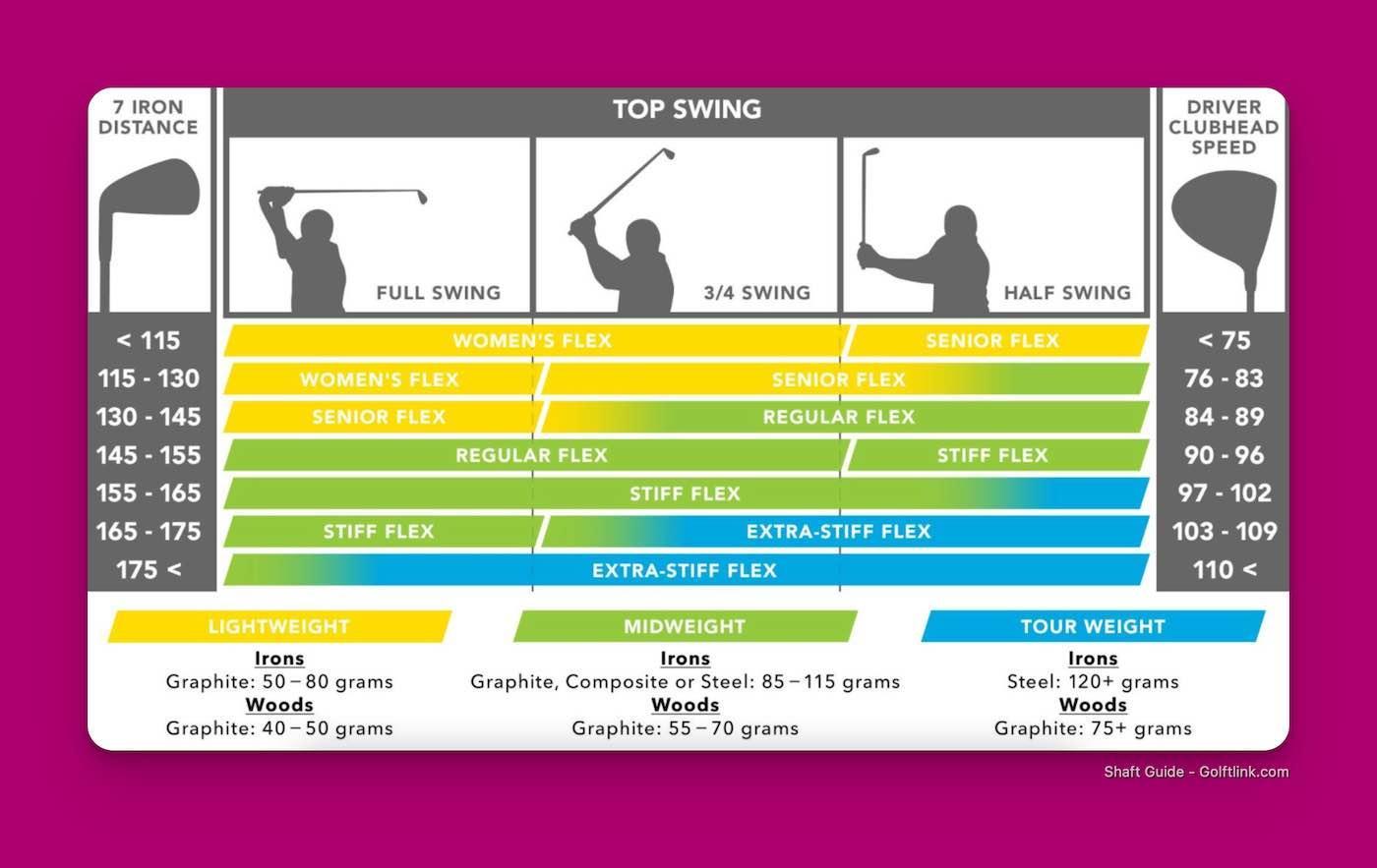
Below is a practical, empirically informed starting guide linking measured swing speed bands to general flex suggestions and associated tendencies in launch and spin. Use this as an initial hypothesis to be validated with on‑course testing and launch‑monitor verification.
| Swing speed (mph) | Typical flex | Expected launch | Spin tendency |
|---|---|---|---|
| <85 | Senior/Soft | Higher | Moderate-High |
| 85-100 | Regular/Medium | Mid | Moderate |
| >100 | Stiff/X‑Stiff | Lower-Mid | Lower |
Repeatability is often the strongest practical reason to invest time in shaft selection. players seeking tighter groupings should match tip stiffness and torque characteristics to reduce face rotation on off‑center hits. Actionable fitting steps include:
- Measure true swing tempo and peak clubhead speed with a calibrated launch monitor.
- Compare shafts that vary in butt and tip stiffness while recording launch, spin and lateral dispersion.
- Value consistency over marginal peak ball speed gains-stable impact windows on course typically produce more playable distance than one‑shot lab maxima.
Data links between shaft flex, ball speed and energy transfer
Empirical work typically uses controlled launch‑monitor trials and high‑speed capture to separate shaft bending effects from other confounders. studies either hold clubhead speed constant and swap shaft bend profiles or compare the same head with commercially available flexes while recording ball speed, launch angle, spin and the resulting smash factor (ball speed ÷ clubhead speed). Statistical approaches (mixed‑effects models, repeated‑measures ANOVA) consistently show that shaft flex explains a modest but meaningful share of variance in ball speed and energy transfer after controlling for tempo and impact location. practically, sample sizes of 20-60 swings per condition are common to detect ball‑speed differences on the order of ~0.5-1.0 mph with typical statistical power.
Mechanically, the stiffness-performance relationship is nonlinear: each swing archetype has a stiffness range that maximizes smash factor. High‑speed hitters (>105 mph) generally gain ball speed with stiffer shafts, whereas lower‑speed players (<85 mph) frequently enough benefit from softer profiles.The summary below consolidates those typical trends found across multiple fitting databases.
| Flex category | Typical Swing Speed (mph) | Smash Factor Trend |
|---|---|---|
| Ladies (L) / A | <85 | Improves with softer flex |
| regular (R) | 85-95 | Peaks around medium flex |
| Stiff (S) | 95-105 | Better with stiffer flex |
| X‑Stiff (X) | >105 | Preferred by fastest swingers |
The underlying mechanism is phase matching: the shaft must store and return elastic energy in synchrony with the hands and head. If the shaft unloads too soon or too late, internal damping consumes energy that or else would accelerate the ball, reducing ball speed and increasing dispersion. From these data, practical fitting rules emerge:
- Prioritize tempo and impact consistency when choosing flex;
- use launch‑monitor metrics (smash factor, launch angle, ball speed) averaged across multiple swings rather than single shots;
- Recognize that modest profile changes frequently enough produce measurable, player‑dependent gains-more often seen in smash factor than raw clubhead speed.
These results emphasize selecting shafts to optimize energy transfer for specific swing mechanics rather of assuming a universally better flex exists.
How flex changes launch and spin for different swing patterns
Shaft stiffness alters how much and when the shaft bends in the downswing, which changes dynamic loft and face angle at contact.Tips with higher stiffness and overall firmer flex tend to resist deflection, producing lower dynamic loft and reduced backspin for players with fast, early releases. In contrast, more flexible shafts typically yield increased stored energy and later release, often creating slightly higher launch and more spin for golfers with smoother, slower tempos.Kick point, torque and sectional stiffness interact with player kinematics to generate predictable shifts in launch angle and spin when the swing is quantified.
Practical tendencies vary by player archetype. The relationship between flex and flight is conditional on tempo, hand speed and release timing. Typical profile‑dependent behaviors include:
- High clubhead speed / early release: A stiffer tip produces a controlled release,lower launch and lower spin-favoring a penetrating flight and rollout.
- Moderate speed / repeatable tempo: Mid‑flex shafts balance launch and spin and help preserve consistency across misses.
- Low speed / late release: A softer shaft can raise dynamic loft and spin to aid carry, tho over‑flexing risks excessive dispersion.
- Variable tempo / inconsistent release: Medium stiffness with low torque can reduce variability and stabilize face orientation through impact.
Viewed from a performance‑analysis perspective, the shaft acts as an active filter between human motion and ball flight: misfits inflate launch parameter variance and can reduce both peak distance and lateral control. Such as, excessive spin from an overly flexible shaft can cut carry via increased aerodynamic drag and make shots more wind‑sensitive; conversely, a shaft that is too rigid for a player can under‑launch the ball and curtail carry despite high ball speed. Empirical fittings often reveal a convergent zone of launch and spin that maximizes carry for a given clubhead speed while minimizing variance-so measuring downswing sequencing (transition aggression, tempo and release point) is essential to identify the flex that produces a tighter launch window.
Use the compact reference below as a starting matrix; validate all fits on a launch monitor in representative conditions.
| Swing Speed (mph) | Recommended flex | Typical Launch Trend | Typical Spin Trend |
|---|---|---|---|
| 100+ | X or Stiff | Lower launch (≈10-12°) | Lower spin (≈1800-2600 rpm) |
| 90-99 | S or R/S | moderate launch (≈11-13°) | Moderate spin (≈2200-3000 rpm) |
| 80-89 | R or A | Higher launch (≈12-14°) | higher spin (≈2600-3600 rpm) |
Target minimizing spin while maintaining an optimal launch angle to maximize carry and repeatability.
Repeatability and dispersion: the accuracy tradeoffs of flex changes
True performance should be judged by repeatability statistics rather than isolated best shots. Consistency is best described by standard deviations of carry, launch angle variance and lateral dispersion. These metrics reveal how shaft behavior under dynamic loading preserves-or degrades-a player’s intended geometry at contact.in controlled tests, variance in launch conditions is the most informative indicator of how well a shaft maintains a golfer’s target impact window across swings.
Shaft bend patterns interact with tempo and release timing to shift shot patterns systematically. A more flexible profile tends to store and release energy later, which can amplify minor timing inconsistencies and increase lateral dispersion for players with erratic releases. A stiffer profile usually reduces transient twist and deflection amplitude, supporting tighter groups for players with abrupt transitions-yet excessive stiffness that doesn’t match speed can introduce face‑angle errors and reduce carry. In short, fitting is a balance: repeatability versus efficient energy transfer.
For tighter groupings and improved on‑course accuracy, adopt a structured testing program:
- Measure baseline variability using a launch monitor-collect 15-20 shots to obtain meaningful SD estimates.
- Document swing tempo and transition characteristics to predict dynamic loading on the shaft.
- Change flex incrementally (one flex step at a time) and log how dispersion statistics evolve.
- Validate findings on course to include turf interaction, wind and real‑play variability.
These steps prioritize empirical evidence over intuition in choosing flex to minimize dispersion.
Illustrative repeatability summary across flex groups (example):
| Flex | SD Carry (yd) | SD Launch (°) |
|---|---|---|
| Soft / Regular | 6-9 | 1.1-1.6 |
| Stiff | 3-5 | 0.6-1.0 |
These representative numbers illustrate that reducing deflection generally tightens groupings but can penalize peak ball speed when the shaft is mismatched.Optimal choices therefore balance statistical repeatability with acceptable energy transfer, verified through iterative measurement and on‑course validation rather than assumption.
Choosing flex by player traits: practical rules tied to speed and tempo
Selecting the right shaft flex hinges on connecting measurable player metrics to mechanical outcomes. In practice, the primary determinants are clubhead speed (measured at the head) and tempo (backswing:downswing duration ratio); secondary factors include release point, consistency and subjective feel. A shaft that is too soft tends to raise dynamic loft and spin for higher‑speed players, whereas a shaft that’s too stiff can suppress launch and reduce ball speed for slower swingers. Effective fitting emphasizes the interaction between bend profile and release timing-matching stiffness to when and how energy is passed through the impact window improves smash factor, launch angle and lateral control.
Useful clubhead‑speed bands and flex guidance
| Clubhead speed (mph) | Recommended flex | Typical launch/spin outcome |
|---|---|---|
| < 75 | Ladies / Ultra‑Soft | Higher launch, moderate spin |
| 75-85 | Senior / A | Elevated launch, controllable spin |
| 85-95 | Regular / R | Balanced launch and spin |
| 95-105 | Stiff / S | Lower launch, reduced spin |
| > 105 | Extra‑Stiff / X | Very low launch, minimal spin |
Tempo modifies these suggestions: players with smooth, late releases often do well with a slightly softer flex within their speed band because the later load amplifies shaft kick and carry; aggressive, fast tempos commonly require firmer flex to prevent excessive tip deflection and unwanted shot curvature. Additional practical cues:
- Flight too high + low spin: try one flex step softer or increase loft.
- Flight low + low carry: test a softer flex if launch is insufficient for the player’s speed.
- Excessive toe/heel dispersion: evaluate bend profile and shaft weight before changing nominal flex.
- Inconsistent smash factor: use launch‑monitor sessions to separate swing flaws from shaft effects.
A controlled fitting protocol yields the best results: record multiple swings on a launch monitor across a matrix of flexes, consistent lofts and identical head weights; analyze ball speed, launch, spin and lateral dispersion; and prioritize consistent improvements in smash factor and accuracy over marginal peak‑distance gains. When unsure, make small, incremental changes (one flex step or 5-10 g in shaft weight) to maintain predictability. Document tempo and release characteristics-these often explain why two players with identical speeds prefer different flexes-and use those notes to guide long‑term shaft choices and fine tuning.
Objective testing: tools and protocols for assessing shaft flex
Experimental evaluation should be performed in controlled settings that minimize confounders: record and stabilize temperature and humidity where possible, standardize grip and hosel torque, and equalize head weights. Shafts should undergo a standardized preconditioning cycle (repeated loading to reduce settling effects) and be mounted in calibrated jigs so that measured differences reflect true flex behavior rather than assembly variance. emphasize repeatability and document fixture parameters so results are reproducible across facilities.
Combine kinematic and dynamic measurement methods to capture global and local shaft behavior. Recommended instrumentation includes:
- 3D Doppler or photometric launch monitors (e.g., TrackMan, GCQuad) for high‑fidelity ball speed, launch and spin data;
- Shaft frequency analyzers to determine bending stiffness and modal characteristics;
- Strain gauges or fiber Bragg gratings bonded along the shaft to measure distributed bending and torsion during swings;
- High‑speed video synchronized with impact to resolve deflection timing and mode shapes.
Using multiple modalities allows cross‑validation and helps isolate the shaft’s mechanical response from the observed ball flight.
Data collection should be statistically rigorous: gather at least 30 validated impacts per shaft condition when testing human subjects, and 50+ impacts for robotic rigs to capture low‑amplitude variability. Randomize the order of shaft conditions to reduce temporal drift and maintain a consistent warm‑up between condition changes. Use automated filters to exclude off‑center strikes (via impact‑location data) and retain metadata (temperature, grip pressure, mounting torque, tester ID). For mechanical rigs, set swing‑velocity tolerances (e.g., ±0.5 m·s−1) that must be met before accepting data.
Analysis should report central tendencies and reliability: provide mean differences with 95% confidence intervals,compute intra‑class correlation coefficients for repeatability and report effect sizes (Cohen’s d) for practical significance. Apply spectral analysis to shaft strain time series to detect modal shifts as speed or launch conditions change, and use mixed‑effects models to apportion variance to shaft flex, tester and environmental factors. Include a table of instrument accuracies and calibration dates in supplementary materials to support meta‑analysis across studies. Clear documentation of calibration, filtering and statistical models is essential for objective comparison.
Putting shaft flex into a holistic fitting plan: cases and prescription
Advanced fittings treat the shaft as a dynamic energy transfer component whose stiffness profile must be matched to a player’s kinematics and target launch window. Case studies show that when flex is optimized alongside loft and head selection, golfers with identical clubhead speeds can produce materially different ball‑speed and dispersion outcomes due to tempo, release timing and shaft bend profile. Quantitative fitting therefore requires simultaneous capture of clubhead speed,attack angle,dynamic loft and spin,than selecting shafts that nudge the launch/spin envelope toward the theoretical optimum for carry and controlled roll.
Representative clinic results highlight how measured swing traits translate into flex prescriptions:
| Player | Swing Speed (mph) | Prescribed Flex | Ball Speed Δ |
|---|---|---|---|
| A (smooth tempo) | 92 | Medium‑Stiff | +1.8 mph |
| B (aggressive release) | 92 | Regular | +0.6 mph |
These examples reinforce that identical speeds do not imply identical flex needs-the ideal flex depends on tempo and release timing, not speed alone.
Practical rules derived from multiple fittings for fitters and advanced players include:
- Use dynamic metrics: Always capture attack angle, dynamic loft and spin in addition to clubhead speed.
- Profile tempo and release: Slower transitions and later releases typically favor firmer tip sections; early, aggressive releases often perform better with softer tips or lower kick points.
- Fit to the launch window: Choose a flex that shifts measured launch/spin toward the player’s optimal window for carry vs. roll and trajectory preference.
- confirm on course: Validate fitting results under real conditions since indoor improvements can be altered by wind and lie variability.
To avoid confusion, note that ”shaft” has multiple non‑golf meanings in web and reference sources (mechanical shafts, software projects sharing the name). The guidance here applies only to golf‑club shaft mechanics-material modulus, wall profile and flex gradient-and should not be conflated with unrelated usages.
Q&A
Below is a concise, practitioner‑oriented Q&A to accompany an article on how shaft flex affects driver performance. it covers definitions, mechanisms, measurable effects, fitting methods and practical recommendations for players and researchers.
Main Q&A – The Impact of Shaft Flex on Golf Driver Performance
1.what is “shaft flex” and how is it defined in the context of a golf driver?
Answer: Shaft flex denotes the effective bending stiffness of a golf shaft under dynamic swing loads.Practically, it describes how much the shaft bends and how quickly it recovers through impact.Flex is not a single number but depends on stiffness distribution (bend profile), material elastic modulus, shaft geometry and length. consumer labels (Ladies, Senior, Regular, Stiff, X‑Stiff) are qualitative; rigorous measurements use dynamic frequency (CPM), static deflection and modal analysis.
2. Through what physical mechanisms dose shaft flex affect ball launch and ball speed?
Answer: Flex changes the timing of energy return, the face orientation at impact, effective loft and tip velocity. A shaft that’s too soft for the swing can delay face closure and increase dynamic loft or produce inconsistent face angles-raising spin and reducing ball speed. A shaft that’s too stiff can impede the beneficial tip ”kick” for some players, lowering achievable clubhead acceleration. Torsional stiffness (torque) additionally controls face twist and accuracy. The net impact depends on tempo, attack angle and release timing.
3. How does shaft flex typically affect launch angle and spin rate?
Answer: Softer‑tip or more flexible shafts usually increase dynamic loft, tending to raise launch angle and often increase spin-particularly when the player’s tempo loads and releases the shaft considerably. Stiffer shafts generally reduce dynamic loft and spin for the same static loft and impact location, even though interactions with ball position and attack angle can produce exceptions.4. what are the expected effects of shaft flex on ball speed and driving distance?
Answer: A well‑matched shaft maximizes energy transfer and often increases ball speed and distance. A mismatch typically reduces ball speed because of suboptimal timing and face orientation. Typical ball‑speed penalties from poor matching range from a few tenths to several mph, which can equate to multiple yards of carry once launch and spin differences are included.
5. How should players use swing speed to guide shaft‑flex selection?
Answer: Swing speed is a useful initial indicator: generic bands often cited are <80-85 mph (Ladies/Senior), 85-95 mph (regular), 95-105 mph (Stiff), >105 mph (X‑Stiff). These are heuristics-dynamic fitting remains essential. Tempo, release timing, consistency and feel will influence the final choice.
6. what role does swing tempo and release timing play in shaft‑flex optimization?
Answer: Tempo and release determine how much energy the shaft stores and when it is indeed released. Slower tempos frequently enough allow softer shafts to be loaded effectively and exploit their kick; faster tempos typically favor stiffer shafts to avoid excessive late release and unwanted face opening.Tempo is therefore as crucial as raw speed.
7.How do bend profile, tip stiffness, and torque interact with nominal flex ratings?
Answer: Nominal flex labels conceal important variation across manufacturers. Bend profile, tip stiffness and torque noticeably influence performance: two shafts both labeled ”Stiff” may behave very differently due to differing stiffness gradients and torque. Complete fittings consider all these parameters, not just the nominal flex label.8. What empirical methods and metrics are used to assess the impact of shaft flex?
answer: Objective fitting uses launch monitors (radar or photometric) to measure ball speed, launch, spin, carry, clubhead speed, attack angle and smash factor. Shaft frequency (CPM) and lab bend tests quantify stiffness. Subjective feel and perceived dispersion supplement objective data. Rigorous protocols vary shafts while holding loft, length and head constant and collect multiple strikes to assess consistency.
9. What are common outcomes of a misfit shaft flex for a recreational player?
Answer: Outcomes include variable launch conditions (launch angle and spin changes), reduced ball speed, increased lateral dispersion (due to unpredictable face angle), less distance and reduced confidence. Misfits can also exaggerate unwanted shot shapes like hooks or slices through altered timing.
10. Are there cases where a player should intentionally deviate from the “recommended” flex?
answer: Yes-players may intentionally select a softer or firmer shaft to manipulate trajectory (e.g., slightly softer tip for more carry and higher trajectory, stiffer for lower spin and a penetrating flight).Such choices should be informed by launch‑monitor testing and acceptance of tradeoffs in consistency.11. How repeatable and player‑specific are shaft‑flex effects?
Answer: Effects are highly player‑specific because they hinge on unique swing kinematics and motor control. repeatability in the lab is strong when swings are consistent; on‑course variability reduces repeatability. Fitting protocols therefore use multiple swings and account for day‑to‑day changes.
12. What best‑practice protocol should a fitter or researcher follow when evaluating shaft flex?
Answer: Steps: (1) Measure baseline metrics (clubhead speed, tempo, attack angle). (2) use a consistent head and loft across tests. (3) Test shafts that vary flex, bend profile, tip stiffness, weight and torque while keeping length constant. (4) Collect a statistically meaningful number of strikes (e.g., 8-12 or more) and use averages and dispersion metrics.(5) analyze ball speed, launch, spin and smash factor. (6) Include subjective feedback. (7) Confirm with on‑course trials.
13. How should researchers design studies to quantify shaft‑flex effects?
Answer: Use within‑subject repeated‑measures designs to control inter‑player variance. Standardize equipment except for the shaft variable. Record high‑frequency club and ball kinematics (motion capture + launch monitor), measure shaft behavior (deflection, frequency) and report effect sizes and confidence intervals.Stratify by speed and tempo and include on‑course testing to improve ecological validity.14. What are the practical recommendations for players seeking to optimize driver performance via shaft choice?
Answer: Start with a professional dynamic fitting on a calibrated launch monitor. Use speed and tempo as initial guides but prioritize outcomes: ball speed, launch, spin and dispersion. Test several shafts with the same loft and head model. Consider weight and feel as part of the decision. Reassess if the swing changes. Budget‑limited players should use heuristics but validate with real‑play testing.
15. What key limitations, uncertainties and areas for future research remain?
Answer: Limitations include proprietary shaft specifications, day‑to‑day swing variability and limited public data linking micro‑properties of shafts to field performance.Future work should explore longitudinal adaptation to shaft changes, isolate shaft variables while accounting for head design, and build predictive biomechanical models that couple shaft dynamics with human motor behavior. Research into adaptive or variable‑flex technologies could expand optimal performance envelopes.
Summary takeaways
– Shaft flex significantly influences clubhead dynamics, face angle at impact and therefore launch conditions, ball speed and dispersion.
– The optimal flex is player‑specific and depends on clubhead speed, tempo, attack angle and release timing.
– Dynamic fitting with launch monitors and testing several shaft profiles outperforms reliance on nominal flex labels alone.
- Researchers should prefer within‑subject designs and measure both shaft dynamics (e.g., CPM) and ball‑flight outcomes.
Note on other uses of the word “shaft”
“Shaft” has multiple meanings outside golf. In mechanical engineering it refers to axles or rotating rods (see technical lexicons), and in software or product names it may designate unrelated projects. The guidance above concerns golf‑club shafts only and is not applicable to those other meanings.
If desired, exportables include:
– A one‑page, nontechnical Q&A for consumer publication.
– A step‑by‑step testing protocol for clubfitters and researchers.
- An FAQ version of the Q&A for website publication.
this synthesis demonstrates that shaft flex is a decisive component of driver performance, measurably affecting ball speed, launch angle, spin and dispersion. The interaction between a golfer’s kinematic sequencing and the shaft’s dynamic response governs energy transfer and the timing of clubhead orientation at impact. therefore, shaft flex must be considered alongside speed, tempo, attack angle and driver‑head characteristics.In practice, shaft selection should be individualized and evidence‑driven: prioritize objective launch‑monitor outputs (ball speed, spin rate, launch angle, dispersion) plus qualitative measures of feel and consistency rather than relying solely on flex labels.A correctly matched shaft improves launch conditions and repeatability; a mismatched shaft can degrade overall performance even if a single metric appears to improve. Current limitations include variability among shaft constructions (torque, kick point, wall profile), inter‑subject biomechanical differences and the largely short‑term nature of most fitting datasets; longer‑term adaptation effects remain underexplored.To advance fitting practice and scientific understanding, future work should include longitudinal studies, experiments that isolate shaft variables while controlling head geometry, and biomechanical models that predict shaft-swing interactions across player populations. Adaptive or variable‑flex shaft technologies also merit evaluation for their potential to widen optimal performance envelopes.
In closing, optimizing driver results requires an integrated approach combining precise measurement, tailored fitting and an recognition for the complex club-player system. Players, coaches and clubfitters should apply the empirical principles summarized here and contribute systematic data to refine fitting best practices over time.
Unlocking Distance: How Shaft Flex Transforms Your Driver Performance
How shaft flex affects driver performance – the big picture
Shaft flex is one of the most influential-and often misunderstood-components in driver performance. The right flex helps transfer energy efficiently,produce an optimal launch angle and spin rate,and stabilize shot dispersion. The wrong flex can cost you distance, produce inconsistent contact, or change shot shape in ways you don’t want.
Key performance metrics impacted by shaft flex
- Ball speed - Proper flex timing improves energy transfer and can increase ball speed (and smash factor) for many players.
- Launch angle - Softer shafts generally produce a slightly higher launch for the same loft, while stiffer shafts often lower launch.
- Spin rate - Flex and kick point interact with face impact timing to influence spin; softer flex can raise spin while stiffer flex can reduce it.
- Dispersion & consistency – A matched flex smooths out face orientation through impact and stabilizes shot-to-shot dispersion.
- Shot shape (hook/fade) – Flex, torque and player release affect face rotation; an ill-suited flex can exaggerate a hook or fade.
the physics (in plain English): why flex matters
The shaft bends during the swing and then whips back through the impact zone. That bending and release changes the effective loft, face angle and timing at impact. Three technical pieces to understand:
- Frequency (stiffness) – measured in cycles per minute (CPM) for custom fitters, it describes how quickly the shaft vibrates. Higher frequency = stiffer feel.
- Kick point – Where the shaft bends most; a low kick point tends to increase launch, a high kick point reduces it (all else equal).
- Torque – the shaft’s resistance to twist. higher torque can feel softer in the hands and allow more face rotation; lower torque is crisper and resists twist.
Combine these with a player’s clubhead speed, tempo, and release pattern and you’ll see why two golfers with identical swing speeds can prefer different flexes.
Quick flex guide (general starting points)
Manufacturers vary, so use this as a starting point for testing, not a final verdict.
| Swing Speed (Driver) | Typical flex Advice | Performance notes |
|---|---|---|
| < 80 mph | L (Lady) / A (Senior) | Use softer, lighter shafts to promote higher launch and spin control |
| 80-95 mph | A (Senior) / R (regular) | Regular flex suits moderate speeds and smoother tempos |
| 95-105 mph | R / S (Stiff) | Stiffer shaft improves control and reduces excessive launch/spin |
| 105+ mph | S / X (Extra Stiff) | Lower launch and spin, better stability for aggressive tempos |
Importent caveats
- Brand flex labels (R, S, X) are not standardized-one company’s Regular can feel like another’s Stiff.
- Tempo and release matter as much as raw clubhead speed. A fast-swinging player with slow transition timing might prefer a softer shaft to allow proper loading.
- Grip size, shaft weight, and loft work together with flex to influence outcomes.
Fitting protocol: how to test shaft flex with data, not guesswork
Use a launch monitor and a variety of shafts. Follow this step-by-step approach in a fitting session.
- Warm up and establish baseline – Hit 8-10 shots with your current driver or a stock reference head and shaft.Record clubhead speed, ball speed, launch angle, spin rate and dispersion.
- Test by speed bands – Swing at game-speed and two faster/slower swings. Players with fast tempo should test both smooth and aggressive swings.
- Swap shafts, keep head consistent - Test shafts with identical head/loft to isolate flex effects. Record averages and peak numbers.
- Watch smash factor and dispersion – The best shaft improves or maintains smash while tightening dispersion and producing an optimal launch/spin window.
- Prioritize ball flight and consistency over single longest shot – A shaft that produces one monstrous long shot but poorer average is rarely the best game-day option.
Target launch & spin windows (general)
- Clubhead speed 90-100 mph: Launch 12°-14°, spin 2000-3000 rpm (approx.)
- Clubhead speed 100-115 mph: Launch 10°-12°, Spin 1500-2500 rpm
- These ranges change with loft and golf ball; use them as guidelines.
Benefits and practical tips for selecting shaft flex
Benefits of a properly matched shaft
- more consistent ball speed and higher average distance
- Better dispersion and predictability off the tee
- Improved confidence-knowing your driver behaves the same shot to shot
- Potential to tune shot shape (reduce unwanted hooks/fades)
Practical tips for players
- Book a proper shaft fitting with a launch monitor; bring your gamer ball and swing at game speed.
- Don’t change only flex-test different shaft weights and kick points too.
- If you have a late release (strong hands through impact), try slightly stiffer or lower-torque options to reduce over-rotation and hooks.
- If you struggle to get the ball airborne, test a softer flex or lower-frequency shaft with a lower swingweight to help launch.
- Small flex adjustments (one step) can noticeably change launch/spin; make incremental changes rather than drastic swaps.
Case studies: real fitting outcomes
Case 1 – Moderate speed, inconsistent carry
Player: 92 mph clubhead speed, smooth tempo, frequent thin/low drives. Baseline: R shaft, launch 9°, spin 3600 rpm, average carry 230 yds.
- Change: To a slightly softer R with lower kick point and lighter weight.
- Result: Launch increased to 12°, spin dropped to 3000 rpm, average carry rose to 240 yds and dispersion tightened.
- Key takeaway: Softer/light + lower kick point unlocked more carry and better launch for this tempo.
Case 2 – High speed, hooks to the left
Player: 108 mph clubhead speed, aggressive release, baseline S shaft, launch 11°, spin 2200 rpm, shots left of target.
- Change: Stiffer (X) shaft with lower torque and slightly heavier weight.
- Result: Face rotation through impact reduced, dispersion moved right and tightened, spin dropped to 2000 rpm, average total distance increased.
- Key takeaway: For high-speed players with aggressive release, a stiffer shaft with lower torque improved control and distance.
Drills and on-course checks to validate shaft choice
- Tempo drill: Swing with a metronome (e.g., 4:1:2 tempo) and check whether your ball flight stabilizes with the chosen shaft.
- Loop test: Hit 10 balls on range at normal pace and track dispersion; the right shaft should feel more repeatable across the set.
- Course simulation: Play a 9-hole loop with the newly fitted shaft-data in practice doesn’t always equal course performance; wind and pressure reveal fit flaws.
- Feel vs. numbers: Trust data first; ‘feels great but data is worse’ usually means reexamine shaft choice.
Common myths and mistakes
- Myth: ”Stiffer = longer always.” Reality: Stiff helps some players but can reduce ball speed for others if it prevents proper loading.
- Myth: “Heavier shaft is always more stable.” Reality: Heavier can reduce swing speed and hurt distance if not matched to the player.
- Mistake: Using only one test ball type.Different balls change spin and thus the optimal shaft option.
simple WordPress CSS snippet for article styling (optional)
<style>


/* WordPress-friendly styling for this article */


.widefat { width:100%; border-collapse: collapse; margin: 1em 0; }


.widefat th, .widefat td { border:1px solid #ddd; padding:8px; text-align:left; }


.widefat th { background:#f7f7f7; font-weight:600; }


.article-tip { background:#f0f9ff; padding:12px; border-left:4px solid #2a9df4; margin:10px 0; }


</style>
When to consult a fitter or coach
See a professional if you want to optimize distance and consistency. A quality fitter uses a variety of shafts, measures launch monitor data, and considers your swing tempo, transition and release pattern. if you frequently change ball flight or have recently increased clubhead speed (fitness training, swing changes), re-testing is worthwhile.
Additional resources and next steps
- Schedule a driver fitting with a certified fitter and bring launch monitor data if you have it.
- Test multiple shafts and record averages-not just the single longest shot.
- Try small increments in flex and weight, and validate on the course.
Short checklist before you buy
- Did you test with your driver head and ball? (Yes/No)
- Are you confident the new shaft improved average ball speed and tightened dispersion? (Yes/No)
- does the ball flight match your target (launch & spin) for your swing speed? (Yes/No)
- Have you re-tested after a practice session or round? (Yes/No)
Dialing in shaft flex is one of the highest-ROI tweaks for drivers-the right match can add yards, drop dispersion and make the tee shot more predictable. Use data, test incrementally, and prioritize consistent, repeatable ball flight over chasing one long carry.