
Novice golfers commonly encounter a cluster of recurrent technical and tactical deficiencies that constrain performance, elevate injury risk, and diminish long‑term engagement with the game. Errors in grip, stance and posture, alignment, swing plane and sequencing, weight transfer, tempo control, and short‑game technique not only reduce shot consistency but also complicate the learning process by encouraging maladaptive compensation patterns. A systematic identification of these high‑frequency faults, together with targeted corrective strategies, can accelerate skill acquisition and improve both objective outcomes (accuracy, distance, dispersion) and subjective outcomes (confidence, enjoyment).
Drawing on the principles of motor learning, biomechanical analysis, and contemporary coaching practice, the following analysis isolates the eight most pervasive novice errors and pairs each with empirically grounded interventions. Each section presents the underlying causes, measurable diagnostic cues, progressive drills, and practice prescriptions designed to promote durable motor patterns. The intent is to furnish coaches, instructors, and beginning players with concise, evidence‑based guidance that supports efficient teaching, reliable self‑diagnosis, and measurable improvement on the course.
Fundamental Grip Deficiencies and Evidence Based Corrective Techniques
Common deficiencies in novice hand placement manifest as variations in grip strength (too tight or too loose), incorrect wrist hinge due to excessive palmar contact, and inappropriate rotation of the forearms that produces a persistently open or closed clubface. These errors are not merely stylistic: biomechanical analyses show that even small deviations in grip position alter the kinematic sequence of the wrists and forearms, increasing variability in clubhead path and face angle at impact. From a motor-control outlook,novices frequently adopt compensatory movements (early wrist break,lateral hand shift) that reduce repeatability and magnify shot dispersion across both short and long clubs.
Corrective strategies supported by empirical training and coaching literature emphasize incremental adjustment, augmented feedback, and constraint-led practice. Interventions that combine tactile cues with visual feedback (mirror work, video playback) and quantitative biofeedback (pressure-sensing grips) produce faster, more durable changes in grip behavior than verbal instruction alone.Crucially, correction should target both static set-up (hand position relative to the shaft and each other) and dynamic behavior (pressure modulation through the swing) to re-establish an efficient relationship between grip geometry and clubface control.
- Tactile anchoring: use a training glove or small adhesive marker to locate the lifeline at address and promote consistent finger placement.
- Pressure-periodization drill: practice swings with a pressure-sensing trainer to learn a light-to-moderate grip pressure profile (target range: 2-4 on a 10-point scale).
- Mirror + slow-motion video: immediate visual feedback to correct pronation/supination tendencies during the takeaway and at impact.
- Task constraint drills: limited-swing strokes (punch and half-shots) that emphasize clubface control over distance, facilitating motor learning transfer.
To operationalize corrective work within a practice session,apply a progressive protocol: 1) assess baseline grip metrics and error type; 2) employ a focused corrective drill for 10-15 minutes using augmented feedback; 3) transfer to closed-chain shots (short irons) and finaly to full swings while monitoring outcome measures (dispersion,face angle). The table below offers a concise reference for coach and learner to match error to an immediate drill and a measurable outcome.
| Observed error | Immediate Drill | Simple Metric |
|---|---|---|
| Too strong grip (closed face) | Reposition lead hand one knuckle back; mirror checks | Face-angle at impact (video) |
| Excessive grip pressure | Pressure trainer swings: target 2-4/10 | Subjective pressure rating |
| Hands too far in palms | Move handle into fingers; short-chip drill | Shot dispersion (3-5 shots) |
Integration into long-term skill acquisition requires avoiding over-correction and maintaining functional variability: small, consistent adjustments reinforced by outcome-based feedback lead to better retention than radical repositioning. Coaches should also inspect equipment (grip size and wear) as inappropriate grip diameter systematically biases hand placement. Emphasize concise,externally focused cues (e.g., “square the face”) rather than complex internal instructions, and prescribe distributed practice with periodic reassessment to objectively document improvement. The principal takeaway is that grip correction is a coordinated cognitive-motor process: combine evidence-based drills, measurable metrics, and progressive transfer to restore reliable clubface control.

Stance Alignment and Postural Mechanics with Practical Adjustment Drills
Postural geometry at address establishes the kinematic constraints that govern the entire swing; small deviations in spine angle or weight distribution produce amplified errors at impact. Empirical and theoretical studies of swing mechanics emphasize a maintained neutral spine, modest knee flex, and a balanced fore-aft weight split (approximately 55/45 toward the lead foot for most full shots) as principal determinants of reproducible contact.Treating stance as a structural baseline-rather than a variable to be adjusted mid-swing-reduces compensatory actions in the hips and shoulders that commonly produce slices, hooks, and inconsistent launch angles.
Clinically observable deviations can be categorized and quantified for targeted correction. Typical faults include excessive lateral sway (loss of axis of rotation), an over-rotated shoulder line relative to the target, a too-narrow or too-wide base (both affecting torque generation), and a forward-head posture that disrupts the connection between eyes, spine, and club. Each deviation correlates with measurable changes in clubhead path and face angle at impact, so diagnosis should combine visual observation with simple metrics-feet-to-shoulder-width ratio, shoulder-to-target-angle, and static balance checks-to prioritize interventions.
Practical remedial drills should be precise, repeatable, and progressively overloaded. Use fixed visual aids (alignment sticks,mirror,and a wall) to create consistent feedback loops; tactile cues (towel or grip-under-armpit) reinforce proximal stability and reduce distal flail. Emphasize low-velocity repetition to ingrain posture before introducing full-speed swings. Integrate objective feedback-smartphone video at 90 degrees to the target line, or a simple launch monitor reading-to verify changes in spine angle consistency and dispersion pattern rather than relying on subjective feeling alone.
adopt a structured practice progression: diagnostic → corrective drill → monitored repetition → integration into full swing. For novices, a session plan of short blocks (3-5 drills, 8-12 repetitions per drill, 3-4 sets) produces measurable improvements without reinforcing fatigue-induced compensations. Track simple outcome measures-shot dispersion ellipse, perceived effort to maintain address geometry, and video angle deviation-to evaluate efficacy. Over weeks, transition from conscious correction to automatic maintenance by gradually removing external aids while retaining periodic objective checks.
- Mirror Alignment Check: Set up perpendicular to your target line and verify shoulder and hip plane symmetry.
- Wall-Spine Drill: Stand with your buttocks lightly touching a wall to feel correct hip hinge and spine angle.
- Towel-Under-Armpit: Hold a folded towel to maintain connection between upper arm and torso during takeaway.
- Alignment-stick Foot Line: Place a stick along the toes to ensure feet aim and width are repeatable.
| Drill | Targeted Flaw | Suggested Duration |
|---|---|---|
| Wall-Spine | Over/under tilt | 3 × 30s holds |
| towel Connect | Arm disconnection | 4 × 10 reps |
| Alignment Stick | Aim/foot-width inconsistency | 2-3 sets of 8 swings |
Inconsistent Weight Transfer and Balance: Targeted Stability Exercises
Inconsistent lateral and vertical loading through the swing commonly manifests as thin or fat strikes, directional misses, and an inability to compress the ball reliably. From a biomechanical perspective, inconsistent weight transfer disrupts the kinematic sequence: when lower-body initiation is absent or mistimed, the torso and arms attempt to compensate, producing inefficient swing arcs. Addressing balance and transfer is therefore not cosmetic but foundational-correcting it re-establishes a repeatable force path from ground to clubhead,improving both contact quality and shot dispersion. Weight transfer, center of pressure, and stability under load are the three diagnostic targets for remediation.
Targeted stability work should be structured, progressive, and monitored. Below is a concise set of corrective drills followed by a short practice prescription to initiate neuromuscular adaptation:
- Single‑leg posture holds – 30-45 seconds per side to train static balance and pelvic control.
- Step‑and‑swing – step toward target, pause, and execute a half swing to ingrain weight shift timing.
- Medicine‑ball rotational throws – low‑velocity, controlled throws emphasizing transfer from rear foot to lead hip.
- Balance‑board half swings – reinforces center‑of‑pressure stability during transition.
| Exercise | Primary Focus | Initial Dosage |
|---|---|---|
| Single‑leg hold | Static stability | 3×30s/side |
| Step‑and‑swing | Timing of transfer | 3×8 reps |
| Med‑ball throws | Rotational power sequencing | 3×10 throws |
Progress from isolated stability to integrated swing application. Begin drills in slow motion with explicit focus on a measurable cue (for example, “feel 60% of weight on lead leg at impact”). Once the movement pattern is repeatable, increase velocity and reintroduce a full swing while maintaining the established pressure profile. Use constrained practice (restricted backswing length, reduced clubhead speed) to reduce degrees of freedom, then gradually restore complexity. Quantify progress by recording consistency of impact location on the clubface and dispersion of a 10‑ball sample at controlled tempos.
Coaching cues and self‑assessment techniques accelerate transfer to the course. Simple cues such as “lead hip toward target”, “feel the ball under the arch of the lead foot at impact”, and “quiet trail foot through transition” direct attention to stability points. Use smartphone video from down‑the‑line and face‑on angles, and pair clips with a pressure‑pad app or simple footprint markers to verify center‑of‑pressure movement. Adopt a maintenance schedule of three short stability sessions per week for six weeks, and consult a PGA professional if asymmetries persist or if compensatory patterns (excessive lateral sway, abrupt head movement) reappear despite consistent practice.
Swing Plane Deviations and Tempo Control Strategies for Consistent Contact
Deviations in the club’s travelling arc produce systematic errors at impact by altering the low‑point and the clubface’s relative orientation at contact. When the path becomes too steep or too flat, or when the hands dominate the sequence, the result is inconsistent compression, thin shots, or fat strikes. From a biomechanical perspective, reliable contact requires coordinated sequencing: a stable base, a rotation-driven backswing, and a downswing that lets the correct arc be re‑established before release. Key kinematic markers to monitor are shoulder tilt, hip turn, and wrist set; small changes at address amplify through the swing and manifest as measurable contact variance.
To remediate arc and timing issues, implement a progressive corrective protocol that emphasizes motor learning principles-simple, frequent repetitions with immediate feedback. start with a concise setup checklist (neutral spine, balanced weight, correct ball position) and progress to drills that constrain error while promoting proprioception.Useful corrective cues include feeling a single-axis rotation rather than pulling with the hands and rehearsing a shallow-to-square approach through impact. Practical corrective drills include:
- Gate drill: promotes consistent clubhead path through the hitting zone.
- Towel under the arms: encourages connected body‑arm motion and reduces casting.
- Half‑swing to impact: isolates low‑point control and reduces over‑rotation.
Tempo modulation is the control variable that links a correct arc to repeatable contact. Aim for a steady backswing-to-downswing rhythm rather than a fixed number of seconds; many players benefit from perceptual ratios (such as, a measured backswing followed by a quicker, but not rushed, transition). A metronome or synchronized foot‑tap pattern can objectively anchor timing during practice.The following speedy reference contrasts two focused tempo drills and their primary objectives:
| Drill | Primary Goal | Tempo Cue |
|---|---|---|
| Metronome Swings | Establish consistent rhythm | “1‑2‑3” (backswing:transition:downswing) |
| Pause‑at‑Top | Stabilize transition timing | Hold 0.5-1s at full turn |
design practice sessions to measure progress and to transfer corrected movement patterns to course play. Use short, focused blocks (e.g., 8-12 repetitions per drill) with objective feedback-slow‑motion video or impact tape-to identify persistent deviations. monitor for these practical indicators of improvement: more consistent divot depth, tighter dispersion patterns, and repeatable ball compression. For maintenance, incorporate a daily 10-15 minute rhythm routine that blends arc drills with tempo work, and routinely reassess using simple quantifiers (divot location, feel at impact, and ball flight) to ensure technical gains convert into reliable on‑course performance.
Ball Positioning and Club Selection Principles to Optimize Launch and Spin
A systematic approach to how the ball sits relative to the feet and which implement is chosen materially alters the initial trajectory and rotational regime imparted at impact. From a biomechanical and aerodynamic perspective, three variables dominate: **attack angle**, **club loft and speed**, and **contact location** on the clubface. Optimal outcomes are achieved when these variables are treated as a coupled system rather than isolated adjustments; for example, advancing the ball in the stance without compensating for a shallower attack can increase launch but inadvertently reduce desirable backspin, while the converse can create excessive spin and ballooning trajectories.
Translate theory into practice by adopting a concise set of rules that are repeatable under pressure. Recommended operational guidelines include:
- Forward for distance: place the ball slightly forward (inside the front heel) with low- and zero-lofted clubs to promote a positive attack and reduce spin.
- Center for control: with mid-irons, align the ball just forward of center to balance launch and spin for consistent stopping power.
- Back for precision: for wedges and pitch shots,play the ball back of center to increase descent angle and spin for faster greenside checks.
These conventions should be adjusted for player-specific swing tendencies (e.g., steep vs. shallow) and prevailing conditions like wind and turf firmness.
| Club | Ball Position | Expected Launch | Typical Spin |
|---|---|---|---|
| Driver | inside front heel | Low-mid | Low (2,000-3,000 rpm) |
| 3‑wood | Just forward of center | Mid | Mid (3,000-4,000 rpm) |
| 7‑iron | Just forward of center | Mid-high | High (5,000-7,000 rpm) |
| Wedge | Back of center | High | Vrey high (7,000+ rpm) |
Adopt an evidence-based iterative process for refinement: video analysis,launch monitor metrics,and controlled practice drills. Prioritize measuring **launch angle**, **spin rate**, and **attack angle** across several swings rather than relying on a single outcome. When discrepancies arise between expected and observed values, modify one variable at a time-first ball position, then club selection, then swing intent-to isolate causality. incorporate surface and environmental modifiers into decision matrices; as an example, firm fairways favor a slightly forward placement to exploit run, while soft conditions demand more spin and a slightly rearward setup for stopping power.
Short Game and Putting Fundamentals with Structured Practice Protocols
Precision in short-range strokes begins with reproducible setup variables: ball position, stance width and weight distribution.Emphasize a neutral to slightly open clubface for chips and a square face for putts; these face orientations are primary determinants of initial launch and roll. Consistent grip pressure and a stable lower body reduce unwanted wrist action-two common sources of error. Practitioners should internalize a concise checklist (visualize, align, breathe, commit) to reinforce a repeatable pre-shot routine; this proceduralization converts technical cues into automated performance under pressure.
Mechanical economy governs effective pitch and chip shots.Adopt a low-hand,narrow-stance posture for bump-and-run shots and a higher-hands,wider-stance approach for lofted pitches to control spin and descent angle. Focus on a unified body-turn model rather than excessive active wrist manipulation: rotation creates arc length and speed while wrists modulate only subtly. Key performance indicators to monitor in practice include landing-zone consistency,carry-to-roll ratio,and post-impact face rotation-metrics that reliably predict on-course transfer.
Putting success is primarily a function of distance control and line fidelity. Establish a pendulum-like stroke with minimal forearm supination, maintain an even stroke arc through the impact zone, and practice varying lengths of stroke to produce predictable speed. For green reading, combine slope judgment with expected ball speed to determine the optimal aim point; use visual anchors (hole-edge references or intermediary targets) to reduce cognitive load. Integrate the following practice elements into short sessions to accelerate motor learning:
- micro-distance ladder: 3-15 ft putts in 1-ft increments for speed calibration.
- Landing-zone pitching: aim for a precise 2-3 yd landing spot to train descent control.
- Pressure simulation: perform high-stakes putt repetitions with consequences (e.g., limited attempts).
Design practice with progressive overload and measurable outcomes: short, frequent sessions (15-30 minutes daily) focusing on one variable per session outperforms long, unfocused practice. Use block practice to establish baseline mechanics, then switch to random and contextual practice to enhance adaptability. The table below offers a concise weekly protocol template that is simple to implement and track with basic metrics (make percentage, dispersion, and subjective effort). Continue variability and periodic reassessment to ensure skill retention and on-course transfer.
| Session | Focus | Duration | Metric |
|---|---|---|---|
| Mon | distance control (putts) | 20 min | make % from 6-12 ft |
| Wed | Landing-zone pitches | 25 min | Landing accuracy (yards) |
| Fri | Short chips + pressure | 30 min | Up-and-down rate |
Cognitive and Strategic Errors in Course Management and Pre shot routines
Novice players frequently commit predictable mental mistakes that degrade on-course decision making and execution. Cognitive limitations such as **working memory overload**, **anchoring on previous shots**, and **confirmation bias** cause golfers to mis-evaluate risk and persist with ineffective strategies. Performance pressure amplifies attentional narrowing, shifting focus from task-relevant cues (wind angle, lie, target) to outcome worry. an academic perspective recognizes these as data-processing failures: when perceptual inputs exceed cognitive capacity, players default to heuristic responses that are often suboptimal on variable golf terrain.
Strategic missteps often stem from the absence of a structured pre-shot process and inadequate course-specific planning. Effective on-course behavior rests on concise, repeatable rituals that conserve cognitive resources. Core elements of a robust pre-shot sequence include:
- Target identification (visual and verbal)
- Risk appraisal (carry, trouble, recovery options)
- Simple visualization (one clear image)
- Physical rehearsal (waggle/feel)
- Routine cue (breath or keyword to trigger execution)
Reinforcing these elements reduces decision noise and prevents reactive, emotion-driven choices that characterize many novice rounds.
Interventions should be systematic and measurable. The following compact table juxtaposes common cognitive biases with concise mitigations suitable for practice and play (wp-block-table is-style-stripes styling recommended for theme compatibility):
| Bias | Mitigation |
|---|---|
| Anchoring | Pre-commit to current shot card |
| Outcome bias | Evaluate decision quality, not result |
| Choice overload | Limit options to 2-3 plans |
Training must translate theory into habitual practice. Use purposeful drills: simulate course walks with explicit decision rationales, practice single-point visualizations under time pressure, and employ a brief post-shot checklist to record decision fidelity (e.g., “target chosen? risk checked? cue used?”). Track adherence rates and correlate with scoring metrics to maintain an objective performance lens. Emphasize **repeatability** over complexity-small, reliable routines and simple strategic frameworks produce the greatest reductions in cognitive and strategic errors.
Q&A
Prefatory note: For clarity, “novice” is used here in the conventional sense of a beginner or someone new to golf (see general definitions of “novice,” e.g., Cambridge Dictionary, Dictionary.com). The following Q&A is structured to be academically precise and practically useful for coaches, instructors, and novice golfers seeking evidence-informed strategies to avoid common early-stage errors.
Q1: What are the primary aims of addressing novice golf errors in an instructional context?
A1: The principal aims are to (a) identify the most common technical and tactical faults that limit skill acquisition and enjoyment; (b) apply efficient, evidence-informed corrective strategies grounded in motor learning and biomechanics; and (c) prescribe practice progressions that optimize retention and transfer to on-course performance. Interventions should prioritize simple, high-leverage changes that reduce performance variability and allow the golfer to experience success early.
Q2: Which eight errors are most frequently observed among novice golfers?
A2: The eight recurrent errors are: (1) incorrect grip and excessive hand tension; (2) improper stance and poor alignment; (3) inconsistent ball position; (4) faulty posture and inadequate spine angle; (5) over-swinging and inconsistent tempo; (6) insufficient weight transfer and balance problems; (7) poor clubface control (open/closed face at impact); and (8) neglect of short-game skills and weak course-management decisions.
Q3: Error 1 – What constitutes a problematic grip and how should it be corrected?
A3: Problematic grip characteristics include excessive tension, incorrect placement of the hands on the club, and inconsistent grip pressure between hands. These lead to reduced wrist hinge, limited clubface control, and increased shot dispersion.Corrective strategies: teach a neutral grip (V’s formed by thumbs and forefingers pointing toward the right shoulder for right-handers), cue light and even grip pressure (a 3-5/10 subjective scale), and use pre-shot routines that include a grip check.Drills: hold the club with a short iron and make half swings focusing on maintaining light pressure; practice “reverse overlap” if appropriate. Measure improvement by observing reduced ball curvature and more consistent impact sound.
Q4: Error 2 – How does poor stance and alignment manifest and how can it be remedied?
A4: Poor stance/alignment often means feet, hips, and shoulders are not parallel to the intended target line, resulting in directional errors. Correction: teach alignment by using intermediate targets (e.g., an alignment stick 1-2 m in front of the ball), employ a feet-shoulder-target check sequence in the pre-shot routine, and adopt a stance width appropriate to the club (narrow for wedges, wider for drives).Motor-learning tip: use external cues (align clubface to target) and combine visual feedback (video/markers) with self-correction.
Q5: Error 3 - What problems stem from inconsistent ball position and how should novices adjust it?
A5: Incorrect ball position (too far back/forward) alters angle of attack and leads to thin or fat strikes and inconsistent launch. Correction: establish standardized ball positions relative to the lead foot-e.g., centered for short irons, slightly forward for mid-irons, and even more forward for driver. Drills: place a coin or towel as a visual marker; practice hitting half shots to feel the correct low-point. Progression: once consistent in practice, vary ball position slightly to develop adaptive control.
Q6: Error 4 – how does faulty posture affect swing mechanics and what interventions are effective?
A6: Rounded upper back, collapsed knees, or an overly upright stance compromise rotation and weight shift, reducing power and consistency.Correction: instruct a neutral spine angle with slight knee flex and hip hinge. Use physical checks (mirror or smartphone video) and proprioceptive aids (alignment rods across shoulders) to teach the posture.Progressive strengthening/flexibility work (core activation, thoracic rotation, hip mobility) supports postural improvements. Short-term drills should prioritize posture maintenance during half swings before full swings.
Q7: Error 5 – Why is over-swinging and poor tempo detrimental, and how can tempo be trained?
A7: Over-swinging leads to loss of control, timing breakdowns, and compensatory movements. Poor tempo increases variability. Train tempo with metronome-based drills (e.g., a 3:1 backswing-to-downswing rhythm) or rhythmic counting. Encourage controlled length of backswing rather than maximal effort. Use impact or strike-quality goals (solid center strikes) rather than swing length as primary performance targets.
Q8: error 6 – What are common weight-transfer and balance faults, and how are they corrected?
A8: Common faults: holding weight on the rear foot, early lateral sway, and collapsing onto the trail leg. Correct via drills that emphasize center-of-pressure movement and rotational torque: step-through drill (finish balanced on lead foot), chair-drill (limit lateral sway), and hitting shots with feet close together to promote rotational balance. Objective measure: ability to hold balanced finish for 2-3 seconds after full swing.
Q9: Error 7 – How does poor clubface control present for novices, and what strategies improve face orientation at impact?
A9: Poor clubface control yields slices, hooks, and unpredictable shot shapes. Strategies: begin with fundamentals (neutral grip, proper wrist set), use impact-focused drills (half-swing impact tape or foam ball to emphasize square contact), and apply external-focus cues (e.g., “send the clubhead to the target” rather than “rotate the hands”). Progress from visual feedback (mark impact spots) to reduced feedback frequency to promote internalization.
Q10: Error 8 – Why is neglecting the short game and course management a significant novice error, and what is the corrective approach?
A10: Over-emphasis on full-swing distance while neglecting chipping, pitching, bunker play, and putting results in poor scoring and frustration. Corrective approach: allocate practice time proportionally-research and coaching consensus recommend at least 50% of practice devoted to short game and putting for golfers focused on score improvement. Teach simple, repeatable techniques for chipping and putting (keeping the putter low on chest, pendulum stroke, landing spot for chips) and apply situational practice that simulates course decisions (e.g., layup vs. risk).
Q11: What motor-learning principles should guide instruction for novices?
A11: Use an evidence-informed blend of: (a) external focus of attention (focus on target/external effect rather than body movements); (b) variable practice to enhance transfer; (c) blocked-to-random progression (start blocked for initial skill acquisition, progress to random for retention/transfer); (d) frequent, brief practice sessions emphasizing deliberate practice and problem-solving; and (e) reduced augmented feedback over time to promote autonomous error detection. Emphasize simple, outcome-oriented goals early.
Q12: What drills and practice prescriptions produce the greatest early gains?
A12: High-leverage drills: alignment-stick setup for stance/alignment, half-swing groove drills for rhythm and balance, impact tape/foam-ball for face-centred contact, and concentric short-game routines (e.g., 20-minute putting drills focusing on distance control). Practice prescription: 3-5 short sessions per week (15-40 minutes),interleaving technical drills with situational play; include deliberate repetitions (e.g., 30-50 focused swings on a single drill) followed by variability and feedback reduction.
Q13: How should progress be assessed objectively?
A13: Use measurable outcomes: strike quality (center contact frequency), dispersion statistics (directional error and distance), consistency metrics (standard deviation of carry distance), and short-game metrics (putts per round from specific distances). Combine quantitative tracking with qualitative video analysis and periodic on-course assessments to evaluate transfer.
Q14: What are common misconceptions instructors should avoid when coaching novices?
A14: Avoid overloading novices with complex biomechanical jargon or numerous corrective cues together; resist prioritizing power/distance over fundamentals; and avoid excessive reliance on technology without integrating simple feel-based drills. Instead, prioritize a small set of individualized, high-impact cues and practice tasks that build confidence and reduce variability.
Q15: When should a novice seek professional instruction or further assessment?
A15: Seek professional coaching if progress plateaus after consistent practice (4-8 weeks), if recurring pain or mobility limitations constrain technique, or if the golfer seeks structured progression toward competitive play. A qualified instructor can provide individualized diagnostics, targeted drills, and a periodized practice plan.
Concluding recommendation: For novices,the most effective instructional strategy is to (a) prioritize a few foundational fixes (grip,posture,alignment),(b) apply motor-learning principles to practice design (external focus,variability,progressive reduction of feedback),and (c) allocate substantial practice time to the short game and putting. This combination accelerates skill acquisition, enhances on-course competence, and fosters long-term engagement in the sport.
this review of the top eight errors commonly committed by novice golfers-where “novice” denotes a beginner or those new to the sport-synthesizes technical, tactical, and cognitive factors that impede early advancement. By prioritizing fundamentals (grip, stance, alignment), adopting progressive practice routines, and integrating feedback from measurement and coaching, beginners can reduce error incidence and accelerate skill acquisition. Coaches and practitioners should tailor interventions to individual learning trajectories and monitor progress through objective metrics. Future research should evaluate the long‑term efficacy of structured training protocols and investigate how psychological and biomechanical variables interact during early learning.Ultimately, addressing these errors systematically provides a pragmatic pathway for novices to build a resilient, efficient, and transferable golf technique.
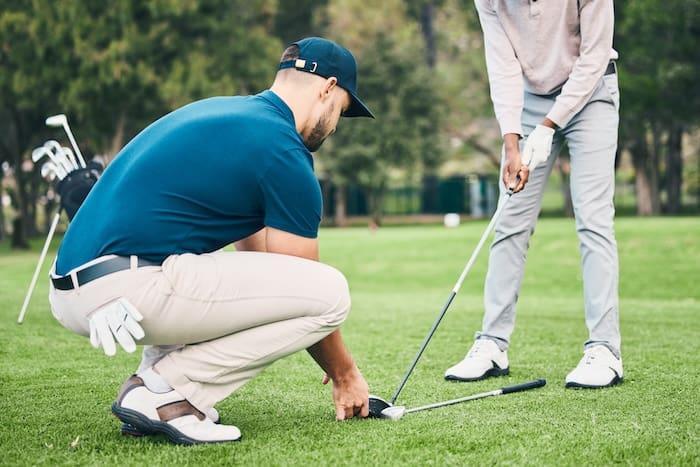
Top 8 Novice Golf Errors and Strategies for Avoidance
Error 1 – Poor Grip and Setup
The foundation of every solid golf swing is the grip and setup. A weak, overly tight, or inconsistent grip leads too slices, hooks, and poor contact. Likewise, a sloppy setup-wrong stance width, improper ball position, or misaligned shoulders-makes good swings hard to achieve.
Why it matters
- Grip and setup determine clubface control and swing path.
- Consistent setup reduces variance shot-to-shot and helps with repeatability.
Strategies for avoidance
- Learn the neutral grip: V’s formed by the thumb and forefinger point toward your trail shoulder (right shoulder for right-handers).
- Set up checklist: feet shoulder-width (driver slightly wider), knees flexed, chin up, spine angle stable, ball position relative to club.
- Use alignment aids on the range (alignment sticks or a club on the ground) every practice repetition.
Drill
- Grip and address habit drill – At the range, without swinging, grip and set up 20 times in a row, then take 10 slow half-swings keeping the setup identical.
Error 2 – Poor Alignment and Aim
Many beginners aim where they think they should instead of aligning the feet, hips, and shoulders to the target line. Small aim errors create large misses at distance.
Why it matters
- Proper alignment directs the swing path and clubface orientation at impact.
- Repeated misalignment becomes a habit that’s hard to break.
Strategies for avoidance
- practice a pre-shot routine that includes an alignment check.
- Use visual references (club laid on ground, alignment sticks) so you no exactly where your body is pointing.
- Accept a small open stance for draws or neutral for straight shots, but be consistent.
Drill
- Two-stick alignment drill – Place one stick pointing at the target and another parallel to your toes. Hit 30 shots focusing only on keeping the sticks parallel.
Error 3 – Poor Ball Position and Contact (Topping & Chunking)
Topping (hitting the top of the ball) and chunking (hitting behind the ball) often come from moving your head/balance or incorrect ball position for the club in use.
Why it matters
- Consistent ball position improves center-face contact and launch direction.
- Good contact = better distance, better spin control, and improved accuracy.
Strategies for avoidance
- Learn ball positions: driver-just inside front heel; mid-irons-center of stance; wedges-slightly back of center.
- Work on weight distribution: slightly more weight on lead foot at impact for irons; maintain balance through the shot.
- Keep your head steady and eyes on the ball until after impact.
Drill
- Impact bag or towel drill – Practice making solid, descending contact on a towel or an impact bag to ingrain hitting down on shorter irons.
Error 4 – Over-swinging and loss of Rhythm
Beginners frequently enough swing too hard,trying to force distance. Over-swinging kills tempo, coordination, and balance, leading to inconsistent strikes and big misses.
Why it matters
- Tempo and rhythm are more important than raw power for consistent shotmaking.
- Controlled swings increase accuracy; relaxed players recover more easily from mistakes.
Strategies for avoidance
- Adopt a tempo cue-count “1 (back), 2 (down & impact), 3 (finish)” or use a metronome app.
- Focus on accelerating smoothly through the ball rather than muscleing the shot.
- Practice half- and three-quarter swings to feel balance and rhythm.
Drill
- Tee drill: Hit 20 balls with a short tee under the ball to force smooth acceleration and discourage flipping at impact.
Error 5 – Neglecting the Short Game (Chipping & Putting)
Many novice golfers spend most practice time hitting drivers and irons, then wonder why they can’t score. Short game and putting account for the majority of strokes in a round.
Why it matters
- Up to 60%+ of shots in a round occur inside 100 yards; putting can save or lose strokes.
- Good short game improves confidence and scoring quickly.
Strategies for avoidance
- Structure practice sessions to include at least 40% short game work: putting, chipping, pitching, and bunker play.
- Learn distance control on the greens and practice lag putting from 30-50 feet.
- Learn basic chip shots: bump-and-run with a low-lofted club and higher-lofted pitches for soft landings.
Drill
- Clock drill – Place 6 balls around the hole (3, 6, 9, 12 o’clock etc.) at 6 feet for putting or 10-20 feet chipping; make as many as possible consecutively.
Error 6 – Poor Course Management and Shot Selection
Beginners sometimes pick low-percentage shots (trying to reach a tight fairway or carry a long hazard) and pay the penalty in big numbers. Smart course management lowers scores without improving swing mechanics.
Why it matters
- Choosing safer plays reduces penalty strokes and keeps momentum steady.
- Knowing your distances and club yardages is essential for good decisions.
Strategies for avoidance
- Play to your strengths: if your long game is shaky, use layups to set up pleasant approach shots.
- Know your average carry and roll for each club; track yardages during practice and rounds.
- Favor shots that reduce risk-aim for the fat part of the green, avoid carrying hazards unless confident.
Drill
- Clubyardage exercise – On the practice range, hit 5 balls with each club and record average carry and total distance to build reliable yardage numbers.
Error 7 – Lack of Warm-up and physical Readiness
Walking to the first tee cold frequently enough results in poor mobility, tight muscles, and inconsistent shots. A proper warm-up primes the body and mind.
Why it matters
- Warm muscles generate better rotation,balance,and contact.
- Warm-ups reduce injury risk and improve focus at the start of the round.
Strategies for avoidance
- Arrive early and spend 10-15 minutes on dynamic stretches, band work, and short swings.
- Take 10-12 balls to the range: start with wedges, move to mid/long irons, finish with a few driver swings.
- Put in 5-10 minutes of putting practice to learn the greens’ speed before your first tee shot.
Drill
- Pre-round routine – 5 minutes mobility, 10 balls wedge-to-driver, 5-10 minutes putting. Adjust for time, but keep consistency.
Error 8 – skipping Professional Instruction and Feedback
Trying to self-teach every part of the game can lead to bad habits. A few targeted lessons with a qualified coach can accelerate progress and fix ingrained mistakes faster than aimless repetition.
Why it matters
- A coach provides objective feedback, drills tailored to your swing, and accountability.
- Pro lessons prevent small flaws from becoming long-term problems.
Strategies for avoidance
- book a short swing assessment (30-45 minutes) with a PGA/LPGA instructor to identify 2-3 priority fixes.
- Use video to review swings and compare weekly-small measurable changes matter.
- Blend lessons with independent practice; apply coach-prescribed drills rather than changing everything at once.
Quick Reference Table: Errors, Fixes & Drills
| Error | Primary Fix | Simple Drill |
|---|---|---|
| Poor grip/setup | Neutral grip + alignment check | 20 grip-and-setup reps |
| Bad alignment | Use alignment sticks | Two-stick alignment drill |
| Topping/Chunking | Correct ball position & weight shift | Impact bag or towel drill |
| over-swinging | Tempo practice | Tee acceleration drill |
| Neglecting short game | Dedicated wedge & putting time | Clock drill |
Benefits and Practical Tips for Rapid Enhancement
- Short, focused practice beats long unfocused sessions-30-45 minutes with a plan is more productive than 2 hours of random hitting.
- Track one metric at a time (fairways hit, greens in regulation, putts per hole) for 4-6 rounds to measure progress objectively.
- Practice with purpose: set a target (e.g., ”today I will hit 30 solid 7-iron shots with correct ball position”).
- Record and review your swing weekly-video shows things you can’t feel.
Sample 6-Week Beginner Practice Plan (3 sessions/week)
- Week 1-2: Fundamentals focus – grip & setup (30%), alignment & ball position (30%), short game (40%).
- Week 3-4: Ball striking & tempo – controlled full swings (40%), short game (40%), alignment drills (20%).
- Week 5-6: Course play & application – play 9 holes each week focusing on course management, maintain short game practice and a weekly lesson or review.
Weekly Session Example (45 minutes)
- Warm-up & mobility: 5 minutes
- Short game: 20 minutes (chipping & 20 putts from 6-15 feet)
- Ball striking: 15 minutes (3 clubs, 10 shots each focusing on one swing feel)
- Cool down & notes: 5 minutes (record what worked and what didn’t)
First-hand Experience (Practical Insight)
Many golfers report that fixing one foundational thing-usually grip or alignment-produced the largest immediate gains. Instead of trying to overhaul everything, pick the single error that costs you the most strokes and focus on that for two weeks. Small, consistent changes compound into lower scores and more enjoyment on the course.
Additional Resources & Tools
- Alignment sticks or a spare club for setup checks.
- Impact bag or practice towel to feel strike quality.
- A simple launch monitor app or rangefinder to record carry distances.
- Video camera or phone tripod for swing replay.
Use these practical golf tips and drills consistently and you’ll see clear improvement: better ball striking, fewer penalty strokes, and faster score reduction. Focus on the fundamentals, practice with purpose, and don’t be afraid to seek a coach when progress stalls.