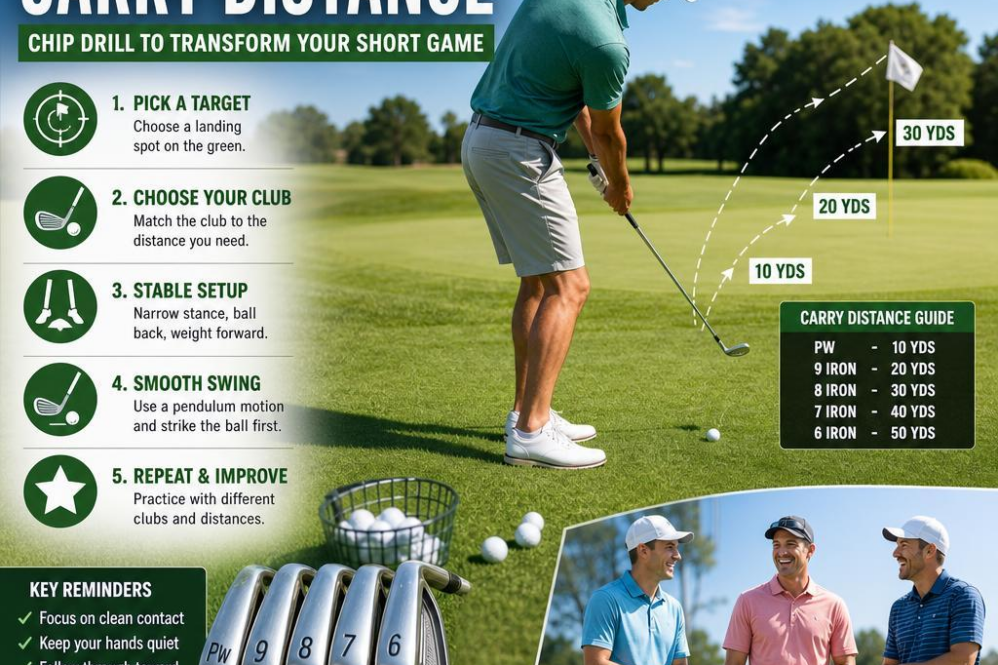
Understanding Carry Distance and Its Role in Chipping Success
Mastering carry distance in chipping begins with understanding its direct influence on ball control and shot precision. Carry distance refers to the length the ball travels through the air before landing, which is critical when targeting a precise spot on the green or avoiding obstacles such as bunkers or slopes. to develop a reliable sense of carry, start by assessing your club selection-typically a pitching wedge, gap wedge, or sand wedge, depending on the distance and lie. Setup fundamentals, including a slightly open stance and the ball positioned just back of center, encourage a downward strike that promotes crisp contact. Pay attention to swing length and tempo; a controlled,smooth stroke usually produces more consistent carry distances. Utilize drills that focus on hitting to specific targets at varying distances of 10, 15, and 20 yards, allowing you to calibrate your feel and effectively judge carry on different course conditions such as firm or soft turf.
Incorporating carry distance awareness into your course management strategy transforms how you approach short game challenges. For example,on a green with elevated edges or aggressive slopes,knowing your exact carry distance enables you to land the chip shot safely on a flat zone before the ball rolls toward the hole. When practicing, use alignment sticks or markers to simulate common course scenarios where carry distance is vital-for instance, carrying the ball over a fringe or tight fairway rough. A valuable drill is the Carry Distance Chip Drill: set multiple targets at incremental distances within chipping range, and alternate landing shots exactly on those marks. This drill sharpens both your swing control and mental visualization, helping you anticipate carry even under pressure. Advanced players might experiment with shot shaping techniques-adding slight draws or fades-to adjust carry and roll paths strategically, adapting to wind conditions or pin placements effectively.
Achieving consistency in carry distance requires deliberate practice and attention to key technical details within your short game mechanics. Focus on maintaining a steady wrist hinge through impact and a clean, descending strike to reduce unwanted spin and maximize predictable carry. Common errors like scooping or excessive flipping of the wrists often led to inconsistent launch angles and erratic carry distances-recognizing these tendencies is your first step toward correction. Equipment choices such as loft and bounce angle also play critical roles; as an example,a higher bounce wedge can definitely help in softer lies,preventing the club from digging too deep and altering carry unexpectedly. Establish measurable goals, such as landing 8 out of 10 chips within a 3-foot radius of a target set at 15 yards, to monitor progress. integrate mental cues like confident pre-shot routines and visualization of the ball’s flight path to reinforce carry distance control. By mastering this aspect of chipping, golfers across all skill levels can dial in their short game, lower scores, and face varied course challenges with greater poise and precision.
Choosing the Right Club and Adjusting Your Setup for Consistent Carry
Selecting the appropriate club for a shot begins with understanding your true carry distance under varying conditions. Carry distance - the measured distance your ball travels through the air before landing – is crucial for precise course management. To establish this baseline, incorporate the Carry Distance Chip Drill into your practice routine: chip balls from the same lie using different clubs, noting where the ball lands and rolls. This helps you systematically identify which club consistently achieves your intended carry, especially important for approach shots or navigating hazards. Additionally, incorporate adjustments for wind, elevation, and turf conditions; for example, a headwind may require selecting a club with more loft to increase carry, while downhill lies often demand clubbing down for better control.Beginners can start by using yardage books or GPS devices to gauge carry, while advanced players benefit from precise launch monitor data to fine-tune club choice.
your setup plays a pivotal role in achieving consistent carry and shot precision. Begin with a solid stance, positioning the ball relative to your feet based on club selection: typically, the ball should be centered for wedges and progressively forward for longer irons and hybrids, often about one ball forward per club length increase. Maintain a slightly open clubface when targeting higher carries or softer landings, and ensure that your weight distribution favors the front foot at impact to promote clean contact and optimal launch angle. To reinforce proper setup, incorporate these checkpoints into your pre-shot routine:
- Foot spacing: shoulder-width apart for stability, narrower for delicate chips.
- Grip pressure: light but secure to allow fluid wrist hinge and shot shaping.
- Posture: a slight knee flex with a natural spine tilt encourages consistent swing plane.
For all skill levels, practicing setup adjustments with video feedback or mirror drills helps correlate position changes with ball flight outcomes, accelerating improvement and confidence on the course.
To translate technique into measurable scoring improvements, integrate carry distance and setup awareness into your course strategy. When confronted with challenging lies or tight pin positions, reference your carry distances to avoid overreaching and rolling into trouble, such as bunkers or water hazards. Develop a routine that includes pre-shot visualization of carry landing zones and rollout, combined with targeted practice using a launch monitor or range markers to simulate course conditions. For instance, practice hitting 75, 100, and 125-yard shots repeatedly with each club, aiming for a 10-yard accuracy window. address common mistakes like inconsistent ball position, steep angle of attack, or excessive grip tension by revisiting your setup and swing tempo drills. Ultimately, marrying equipment knowledge, setup fundamentals, and situational awareness creates a reliable framework that supports lower scores through smarter shot execution and enhanced mental focus.
Mastering a Simple Chip Drill to Build Confidence and Control Over Distance
To develop confidence and control over distance in chip shots, begin with a focus on consistent setup and swing mechanics. Establish a narrow stance with your feet approximately six to eight inches apart,favoring your weight slightly on the lead foot (around 60%) to promote clean ball contact. Position the ball just back of center in your stance to encourage a downward strike, and maintain a firm but relaxed grip to ensure smooth wrist hinge. Utilize a lofted wedge, such as a 56° sand wedge, to produce optimal carry and roll.During the swing, restrict wrist movement by hinging the wrists early and maintaining the angle through impact, which helps control the chip shot’s trajectory and spin. This mechanical foundation improves precision on varying turf conditions and is essential for mastering distance control with carry shots.
Incorporate a structured drill to quantify carry distance and enhance touch around the greens. Set up targets at incremental distances-such as 5, 10, 15, and 20 yards-on a practice putting green or a flat fairway area. Begin by hitting chips aimed to carry just to the first marker, focusing solely on the carry rather than roll, then progress to longer targets. Use your observation or a launch monitor if available, to track carry distances and adjust your swing length and tempo accordingly. This setup encourages precise speed control, critical in course scenarios where hazards or uneven lies demand exact landing zones. For extensive skill progress,alternate between half and three-quarter swings,emphasizing rhythm and balance to improve consistency.
While practicing this chip drill, be mindful of common pitfalls such as decelerating before impact or excessive hand action, which can lead to fat or thin contact. Instead, maintain a smooth acceleration through the ball and keep your lead wrist firm throughout the stroke to promote crisp strikes. Integrate mental focus exercises by visualizing the ball’s flight path and landing spot, helping to reinforce your distance judgment and shot confidence under pressure. Over time,this methodical approach not only sharpens your short game precision but also aligns with smart course management-knowing when to carry hazards precisely or leave the ball near the hole for up-and-down opportunities,ultimately enhancing your scoring potential.