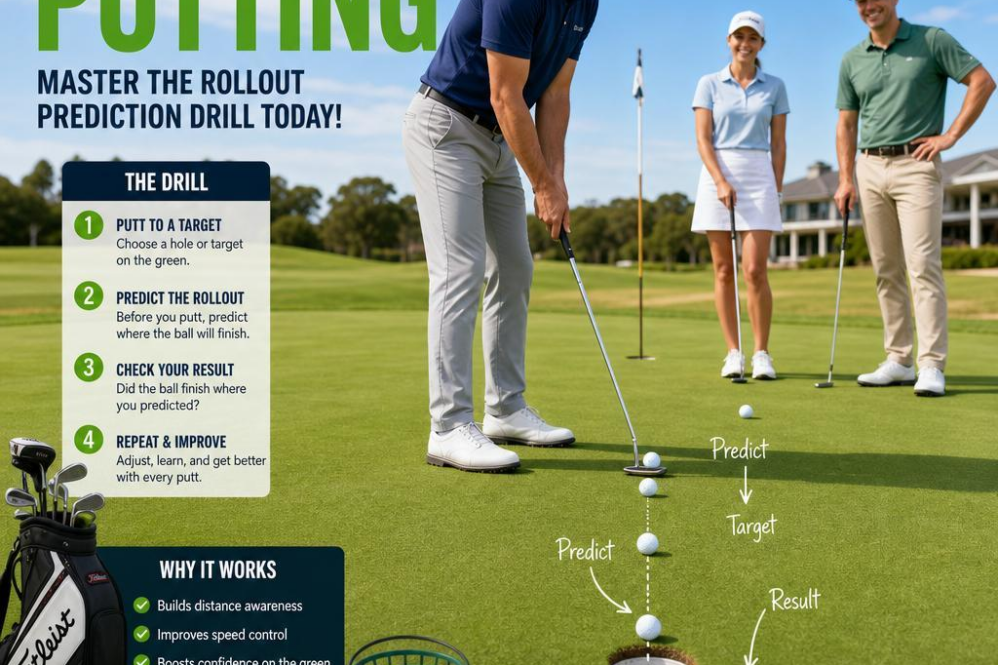
Unlock Your Putting Potential with the Rollout Prediction Drill
understanding how the ball rolls after impact is crucial to improving your putting accuracy and consistency. The Rollout Prediction Drill is designed to refine your ability to estimate the distance a putt will travel beyond the hole, dependent on green speed, slope, and stroke force. start by selecting putts between 6 to 20 feet on varying slopes-both uphill and downhill-to challenge your distance control.Pay attention to your pre-putt routine,ensuring a square putter face and smooth stroke path aligned with the intended target line. Use a mallet or blade putter that provides clear visual feedback during the stroke to enhance your setup fundamentals. This drill encourages golfers to develop an intuitive feel for how much the ball will “roll out” after the initial contact, which reflects real on-course conditions were green speed and grain vary.
To maximize the benefits of this drill, incorporate key swing and short game mechanics that directly influence rollout. Maintain a pendulum-like stroke with minimal wrist breakdown to promote a pure, consistent roll. Focus on keeping the putter face square at impact and accelerating through the ball rather than decelerating. Position your eyes directly over the ball to improve alignment and depth perception, which helps predict ball path and speed more precisely. during practise, measure your success by tracking how frequently the ball stops within a 12-inch circle beyond the hole, which signals excellent rollout prediction. additionally, analyse missed putts to identify common errors, such as pushing putts too hard or failing to read subtle breaks.For advanced players,integrating this drill with detailed green reading using Stimp readings or pace charts will elevate course strategy and decision-making for challenging conditions.
The mental aspect of rollout prediction is equally critically important. Golfers must learn to trust their stroke and the visual data gathered from the drill to build on-course confidence. When faced with pressure putts, your brain will revert to practiced feedback loops; rigorous rollout training creates a reliable sensory memory of how the ball behaves. Practice routines that simulate tournament conditions-like using a metronome to maintain stroke tempo or switching putters to adjust feel-can deepen this connection. For beginners, breaking the drill into smaller increments and gradually increasing putt length can prevent overwhelm and foster steady advancement. Simultaneously occurring, experienced players should challenge themselves with uneven lies and different green speeds to sharpen adaptability. Ultimately,mastering rollout prediction harmonizes technical proficiency and strategic judgment,unlocking significant scoring potential by reducing three-putts and improving lag-putt performance.
Discover How Reading the Green Transforms Your Putting Game
Mastering the art of reading the green begins with understanding how subtle slopes and contours affect the ball’s path.Start by assessing the overall terrain from multiple vantage points, ideally from behind the ball and directly behind the target hole. Look for visual cues such as grass grain direction, moisture patchesand any imperfections in the turf that might influence roll speed and break. A practical way to develop this skill is through the Rollout prediction drill, where you place a ball at various points on a practice green and estimate the break angle and distance before rolling it. Over time, this drill helps golfers of all levels develop an intuitive feel for how gravity and green speed interact, improving their ability to predict putt trajectories with consistent accuracy.
equally important is refining your setup routine to complement your green-reading insights. Maintaining a stable stance with a slightly open clubface aligned to the initial ball path sets the foundation for consistent stroke execution. Pay close attention to eye position-position your eyes directly over or just inside the ball to enhance perceptual alignment. From there, focus on making a smooth, pendulum-like stroke that respects the intended line and pace revealed by your green reading. For beginners, practicing shorter putts-under 6 feet-using a gate drill to ensure the putter path stays square can solidify stroke confidence. Meanwhile, advanced players should experiment with subtle wrist hinge timing and tempo changes to subtly shape putts around breaks, translating green reading into precise shot shaping. Remember that even the most accurate read can be undone by a poor stroke, so blending these fundamentals is essential for lowering scores.
Strategy on the course should incorporate your knowledge of the green’s tendencies and your own stroke reliability to manage risk and reward effectively. When faced with tricky slopes or faster conditions, consider aiming to a safer target area that minimizes the chance of a three-putt, even if it means leaving a longer, more manageable comeback putt. Incorporating environmental factors such as wind direction, temperatureand humidity into your read can also influence perceived break and speed-especially during longer putts. Practicing visualization techniques before each putt reinforces confidence and mental clarity, which are critical under pressure. Ultimately, developing your green reading not only sharpens your short game precision but transforms your overall course management, enabling smarter decisions and improved scoring performance.
Step-by-Step Guide to Practicing Rollout Prediction for Consistent Success
Understanding rollout prediction begins at your setup and club selection, which are fundamental to accurate distance control. Start by assessing the lie angle of your ball-whether it’s on firm, tight fairway grass or softer, lush turf-as this directly affects the ball’s initial launch and subsequent rollout.Such as, a firm fairway will produce a longer rollout, often adding 5 to 10 yards beyond carry distance, whereas wet or thick grass reduces rollout substantially. When practicing, use your launch monitor or markers to gauge carry versus rollout distance for each wedge at varying swing speeds. Focus on maintaining a consistent setup with your feet aligned square to the target and the ball positioned slightly back of center within your stance, which promotes a clean strike and predictable spin rates. Developing this awareness allows golfers of all levels to better predict how the ball will behave after landing, ultimately minimizing guesswork on approach shots.
Once you’ve dialed in the setup and club selection, incorporate targeted rollout drills to sharpen your feel and refine your judgment on varied course conditions. One effective practice is the “landing zone targeting” drill, where you select a fixed landing area 10 to 15 yards short of the hole and aim to land the ball precisely there, noting how far it rolls out beyond that point. Use different wedges and adjust your swing tempo incrementally to see how spin and ball speed affect rollout distances. Key swing mechanics to emphasize include a smooth acceleration through impact with a slightly descending blow to maximize backspin without sacrificing distance control. additionally, practice varying your ball trajectory through grip pressure and wrist hinge to master shot shaping, enabling you to produce lower, more penetrating shots that reduce rollout or higher, softer shots that spin more on landing. these drills translate directly to on-course strategy by enhancing your ability to select the ideal shot profile based on pin position and green firmness.
Integrating rollout prediction into your course management strategy involves adaptability and mental resilience, especially under fluctuating weather and turf conditions. Prior to each shot, consult your mental checklist: consider the wind speed and direction, recent rainfall or drynessand the green’s slope and firmness-each playing a crucial role in rollout behavior. On windy days, as an example, lower trajectory shots minimize the ball’s lift and consequent rollout, while on hard greens, accept that rollout will be significant and adjust your club choice accordingly, often opting for a higher lofted wedge or softer touch. To reinforce mental and physical coordination, maintain a pre-shot routine that includes visualizing the ball’s landing and rollout path, which has been shown to improve shot confidence and execution consistency. Remember, mastering rollout prediction is not just mechanical but also cognitive; it empowers you to reduce errant shots and lower stroke averages by making smarter, data-driven decisions on the golf course.