
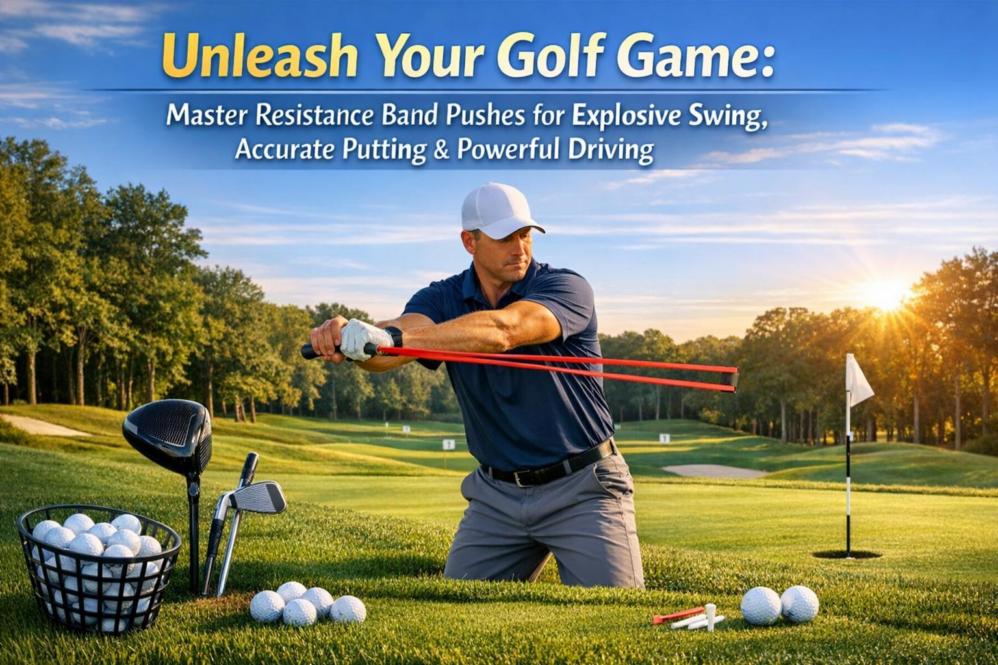
Boost Core Power with Resistance Band Pushes for an Optimized Golf Swing
Enhancing your core strength through resistance band pushes considerably improves rotational force, a vital component for a more dynamic and effective golf swing. by securing the band at waist level and executing deliberate lateral pushes, golfers activate key muscles including the obliques, transverse abdominis, and lower back, which are essential for stabilizing the torso during the swing motion. Maintaining a 90-degree bend in the knees and a neutral spine alignment throughout these exercises ensures optimal muscle engagement while minimizing injury risk. For best outcomes, perform 3 sets of 12-15 controlled, slow repetitions on each side, focusing on fluid movement rather than rapid, explosive actions. This regimen directly enhances swing reliability by supporting proper hip rotation and weight transfer-critical elements for maximizing clubhead speed and sustaining balance amid challenging course conditions like uneven terrain or gusty winds.
Incorporating resistance band pushes into your training routine also sharpens swing mechanics by fostering heightened body awareness and improved coordination between the upper and lower body segments.Beginners should concentrate on syncing the push with a simulated golf swing, visualizing the clubhead’s trajectory to develop neuromuscular connections that boost timing and precision. More experienced golfers can increase band resistance or introduce multidirectional pushes to replicate complex on-course scenarios such as shaping shots or executing controlled fades and draws.Gradually progressing from lighter to heavier bands allows measurable strength improvements that translate into longer drives and more consistent ball striking.
Beyond physical benefits, resistance band pushes cultivate muscle memory that proves invaluable during high-pressure moments like critical putts or tight approach shots. To enhance short game transfer, combine core strengthening with drills emphasizing controlled weight shifts and a stable stance. For instance, performing mini-pushes with the band while mimicking a putting stroke encourages minimal upper body movement, improving green reading and stroke consistency.Monitor your progress by tracking increases in clubhead speed and reductions in swing tempo variability using launch monitors or high-speed video analysis.Ultimately, regular resistance band training not only builds a more powerful swing but also boosts mental confidence, enabling precise shot execution and smarter course management for lower scores.
Refine Putting Accuracy by Targeting Essential Muscles with Resistance Bands
Precision in putting largely depends on the subtle control of muscles responsible for smooth, consistent strokes. Utilizing resistance bands during practice is an effective method to activate specific muscle groups such as the forearms, wrists, and shoulders, which are crucial for maintaining a steady pendulum motion. Begin with a light resistance band anchored at waist height. Assume your regular putting stance and replicate your putting stroke against the band’s resistance. This controlled tension promotes muscle activation patterns that support consistent tempo and proper face alignment, key factors for accurate putts ranging from 3 to 20 feet. Over time, this focused engagement helps eliminate common issues like wrist collapse or uneven pace, resulting in smoother strokes under pressure.
Integrating resistance band drills into a structured practice plan yields measurable improvements for golfers of all skill levels. Start with sets of 20 to 30 deliberate repetitions, concentrating on keeping the putter face square throughout the stroke and minimizing excessive hand movement. Intermediate and advanced players can increase resistance or adjust the band’s anchor point to simulate different stroke planes, mimicking the slopes and breaks found on greens.Pair these exercises with on-course practice where golfers consciously apply the muscle memory of smooth acceleration and deceleration, especially on greens with subtle contours and varying grass grain. This deliberate muscle control complements green reading skills and builds confidence in lag putting and pressure situations.
Along with enhancing physical mechanics, these drills foster mental toughness by developing a repeatable stroke that remains reliable in diverse conditions such as wind or rain, which can affect ball roll. Encourage combining resistance band training with visualization techniques-imagining the ideal putt path and pace-and translating that intent through muscle memory formed during practice. Common pitfalls like gripping too tightly or rushing the stroke often undermine putting under stress; resistance band exercises train relaxation and rhythm simultaneously.Beginners should start with low-tension bands focusing on fluidity before advancing. For low handicappers, incorporating these drills into a complete short game and course management strategy ensures precise scoring touch becomes a competitive advantage.
Increase Driving Distance and Accuracy with Regular Resistance Band Workouts
Achieving greater driving distance while maintaining control demands a blend of physical conditioning and refined swing mechanics, and resistance band training effectively develops both. Begin with exercises that boost rotational power and stability-key components of an efficient golf swing.Such as, anchor a resistance band at waist height and perform controlled torso rotations that mimic the golf swing’s twisting motion. Focus on sustaining a stable spine angle near 45 degrees and engaging core muscles throughout to enhance posture and prevent lateral sway during the downswing.This targeted approach not only ingrains muscle memory for a balanced, powerful drive but also helps avoid common faults like early extension, which can reduce both distance and accuracy.
Consistent resistance band training translates into improved tee shot control,especially under challenging conditions such as windy weather or narrow fairways. incorporate drills that replicate the explosive hip rotation and arm extension characteristic of a full swing by holding the band at shoulder height and driving through the hips while resisting backward pull. These exercises reinforce proper sequencing-the coordinated timing of hips, torso, and arms-essential for optimal energy transfer. Beginners should start with lighter resistance and slow, deliberate reps emphasizing form, while advanced players benefit from higher resistance and faster, dynamic movements that simulate course tempo. Alongside mechanical gains, this training enhances muscle endurance, enabling consistent drives even during the later stages of a round when fatigue sets in.
To maximize the benefits of resistance band workouts, integrate them with on-course strategies focused on distance and control. for example, after training, practice tee shots with ball placement slightly forward of center in your stance to promote a higher launch angle and longer carry. Combine this with visualization techniques, picturing a controlled, powerful swing supported by your band-conditioned muscles. Watch for common errors such as gripping too tightly or over-rotating,and address these by revisiting band drills that emphasize relaxed wrists and balanced hip rotation. Regularly track driving accuracy and distance using launch monitors or rangefinders to set clear goals and reinforce progress, ultimately lowering scores through enhanced driving consistency and power.

Unleash Your Golf Game: Master Resistance Band Pushes for explosive Swing, Accurate Putting & Powerful Driving
Why Resistance Band Pushes are a Game-Changer for Golfers
Improving your golf game involves more than just perfecting your technique on the course. Developing strength, mobility, and control through targeted resistance training can be the difference between a good round and a truly great one. Resistance band pushes work synergistically with your natural swing mechanics to build explosive power, enhance putting precision, and increase driving distance.
Resistance bands are versatile, affordable, and widely accessible fitness tools that can replicate golf-specific movements safely and effectively. Their elastic tension engages muscles critical for golf performance without the risks associated with heavy weights.
Biomechanics Behind Resistance Band Pushes for Golf
The golf swing comprises a kinetic chain involving the legs, core, shoulders, arms, wrists, and hands. Resistance band pushes specifically activate muscles responsible for:
- Rotational power through the hips and core
- Shoulder stability and strength for controlled swing path
- Wrist and forearm control to optimize clubface angle
By applying resistance in these planes of motion, you develop neuromuscular coordination-meaning your muscles learn to fire in the most efficient order for power and precision.
Master Resistance Band Push Exercises for Golf
1. Rotational Band Push
Targets rotational power crucial for both swing and drive.
- Anchor the band at chest height.
- Stand perpendicular to the anchor, hold the band with both hands.
- Push and rotate your torso away from the anchor, mimicking the golf swing rotation.
- Return slowly and repeat for 3 sets of 12 reps per side.
2. Forward Band Push
Improves explosiveness and driving power by training pushing muscles and shoulders.
- Anchor band behind you at waist height.
- Face away from anchor, hold bands with both hands at chest level.
- Push straight forward as if extending through the ball on a drive.
- Control back to start, 3 sets of 15 reps.
3. Putting stroke Resistance Push
Enhances putting stroke consistency by activating stabilizers and fine motor control.
- Use a loop band around your forearms.
- Simulate putting stroke movement, pushing the band outward against resistance.
- Focus on slow, steady movements, 3 sets of 20 controlled reps.
Benefits of Resistance Band Push Training for Golf
| Benefit | Impact on Golf Performance |
|---|---|
| Increased Swing Power | Generate more clubhead speed leading to longer drives |
| Improved Putting Stability | Enhanced muscle control for smoother, precise putts |
| Better Driving Accuracy | Strengthened core and shoulders promote consistent swing path |
| Reduced Injury Risk | Builds balanced muscles supporting joints and tendons |
| Portable & Affordable | Easy to integrate into home training or travel routines |
Practical Tips to Maximize Your Resistance Band Push Workouts
- Warm-up first: Begin with dynamic stretches to prepare muscles for resistance work.
- Focus on form: Maintain controlled movements to avoid injury and maximize muscle engagement.
- Consistency matters: Incorporate band exercises 3-4 times per week for noticeable improvements.
- Progress resistance: Gradually use bands with higher tension as strength builds.
- Integrate with golf drills: Combine resistance training with on-course practice for skill transfer.
- Rest adequately: Allow at least 48 hours of recovery between intense resistance sessions.
Case Study: Transforming a Mid-Handicapper’s Game with Resistance Band Pushes
John, a 45-year-old amateur golfer, had a moderately consistent swing but struggled with driving distance and putting accuracy. After integrating a 6-week resistance band push program, his key performance improvements were:
- Clubhead speed increased by 8 mph, extending drives by approximately 25 yards.
- Putting stroke became steadier, reducing three-putts by 35% during rounds.
- Noticed better muscle control leading to fewer errant slice and hook shots off the tee.
John credits the focused biomechanical training using resistance bands for translating power gains into better on-course results.
Integrating Resistance Band Pushes into Your Golf Training routine
- Start with a golf-specific warm-up: Combine band pushes with mobility drills targeting hips, shoulders, and wrists.
- Post-practice cool down: Use bands for gentle resistance to aid muscle recovery and maintain versatility.
- Off-day strength sessions: Perform resistance band pushes alongside core and balance workouts to enhance overall golf fitness.
frequently Asked Questions About Resistance Band Pushes for Golf
Q1: Can beginners use resistance bands for golf enhancement?
Absolutely! Resistance bands are beginner-amiable, allowing you to control intensity and build golf-specific strength gradually.
Q2: How long before I see results using band pushes?
With consistent training 3 times a week, many golfers notice better control and power within 4 to 6 weeks.
Q3: Do I need a gym membership for resistance band workouts?
No. Resistance bands are portable and inexpensive, perfect for home, outdoors, or travel training sessions.
Q4: Can resistance bands help with injury prevention?
Yes. They improve muscular balance and joint stability, which are critical to avoiding common golf-related injuries.


