Unlock Your Best Swing with Simple Drills That Build Consistency
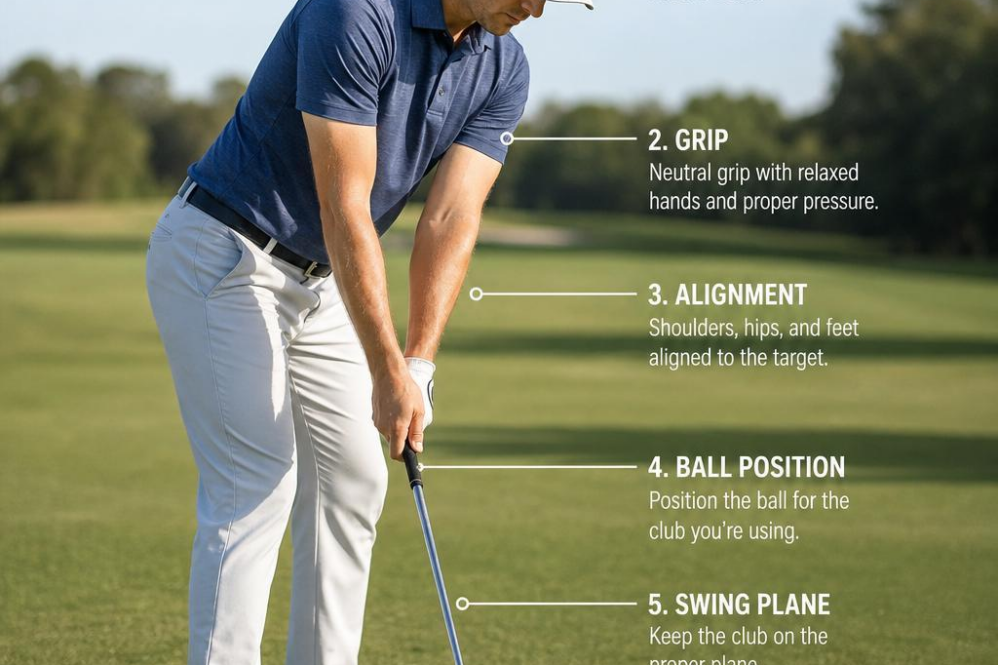
Achieving a consistent swing begins with mastering the fundamentals of setup and body mechanics. Start by positioning your feet shoulder-width apart with weight evenly distributed, maintaining a slight knee flex to promote stability throughout the motion. Align your shoulders parallel to the target line while ensuring your spine is tilted forward at approximately 20-25 degrees,which helps facilitate a natural hip rotation. Incorporate drills such as the pause at the top, where you momentarily halt your backswing to assess your position-this encourages muscle memory for correct sequencing, keeping the club on plane and reducing common errors like casting or early release. Another effective exercise involves slow-motion swings focused on wrist hinge,promoting an ideal lag to maximize clubhead speed and control during the downswing. By consistently practicing these drills, golfers can create a repeatable motion that translates directly into improved ball striking and trajectory control under varied course conditions.
Translating these mechanics into on-course success requires integrating tailored short game routines and strategic decision-making. For example, developing a reliable putting stroke thru distance control drills, such as the “ladder drill,” helps golfers better judge pace adjustments on different green speeds, a crucial skill irrespective of handicap. To complement the swing consistency improvements, incorporate targeted driving exercises focusing on tee ball placement and shot shaping to exploit hole layouts and prevailing wind conditions. Players should evaluate each tee shot’s intended shape-fade, draw, or straight-and practice drills that align clubface angle and body alignment accordingly. Additionally, maintaining a consistent pre-shot routine and visualizing the shot trajectory cultivates mental focus essential for scoring under pressure. By combining these mechanical and strategic insights,golfers enhance not only their consistency but also their ability to navigate course challenges,ultimately lowering scores and elevating overall performance.
Putting Secrets That Turn Pars into Birdies
Mastering the art of reading greens is basic to transforming pars into birdies, as understanding how subtle slopes and grain direction influence ball roll can drastically improve your putting accuracy. Begin by positioning yourself so your line of sight is low and close to the ground, allowing you to detect subtle undulations that affect break. practice the “clock drill,” where you place balls around a hole at varying distances and angles,systematically observing how the ball curves on different slopes.This drill trains your eyes to interpret green speed, break percentage, and grain influence, which vary significantly with moisture and sunlight throughout the day. Additionally, refine your setup by maintaining a square but relaxed stance with your eyes directly over or just inside the ball, ensuring your putter face aligns with your intended target line. For beginners, emphasize a smooth, pendulum-like stroke rather than power, focusing on consistent tempo and stroke length to control distance better. more advanced players can experiment with subtle wrist hinge and forward press techniques to refine feel and speed control, which prove invaluable on longer putts or sloped surfaces.
Strategic course management on the greens also plays a pivotal role in maximizing scoring potential. rather than always attacking the pin aggressively, evaluate when it’s safer to aim for the “middle” or high side of the cup, notably on difficult or fast greens where three-putts can be costly. Incorporate a pre-putt routine that involves a rapid visual scan from behind the ball, assessing the putt’s length, break, and green firmness, before a final look from behind the target aiming point. This helps solidify your line and builds confidence. Introducing drills such as the “ladder drill,” where you progressively putt balls from 3, 6, 9 feet, focusing on stopping the ball within a 12-inch circle of target distance, sharpens distance control. Furthermore, be mindful of your equipment; ensure your putter’s loft (typically between 3° to 4°) matches your stroke style for optimal launch and roll. Pay attention to the grip size and texture for tactile feedback,as this can influence stroke stability under pressure. By combining these technical adjustments and sound green-reading practices with a calm, focused mental approach, golfers at any level can enhance putting performance, converting critical opportunities into birdies more consistently and lowering overall scores.
Drive Like a Pro by Focusing on power and Precision
Developing a powerful and precise drive begins with mastering the fundamentals of setup and swing mechanics, which lay the foundation for consistent distance and accuracy off the tee. Start by positioning the ball just inside your left heel (for right-handed golfers), aligning your feet shoulder-width apart to promote balance and an efficient weight transfer through the swing. A common pitfall is an overly narrow stance,which limits rotational power; maintain a firm but relaxed grip pressure to avoid tension that inhibits fluid motion. During the takeaway, focus on initiating the clubhead smoothly along the target line, allowing your hips to begin the rotation just before your shoulders follow. This sequenced body movement optimizes the kinetic chain, generating clubhead speeds exceeding 100 mph in advanced players, and can be measured using launch monitors during practice. To refine precision, incorporate drills such as the gate drill, where two tees are placed slightly wider than the clubhead to encourage a straight, inside-to-square path and prevent slicing or hooking. Practicing with alignment sticks can further reinforce directional control, ensuring the clubface remains square to the target at impact-a crucial element for shooting lower scores and improving fairway accuracy.
As you build confidence in your swing mechanics, integrating course management strategies will magnify the effectiveness of your driving game. Recognize and adapt to various hole layouts and environmental conditions, such as prevailing wind or elevation changes, to strategically select tee height and ball position for optimal launch angle and spin control. For example, a higher tee position combined with a slightly forward ball placement can create a penetrating ball flight in windy conditions, reducing side spin and improving carry distance. Regularly practicing shot-shaping techniques-like controlled fades and draws-equips golfers to navigate hazards and position the ball advantageously for approach shots. Implement drills like the path-and-face control exercise, which emphasizes swing path modification relative to the clubface angle, building muscle memory for intentional curvature in your drives. Additionally,monitor your driver loft and shaft flex,adjusting for swing speed and tempo to maximize energy transfer; a too-stiff shaft in a moderate tempo swing frequently enough leads to inconsistent strikes and reduced distance. By combining these mechanical refinements with mental focus on commitment and visualization, golfers of all levels enhance both power and precision, ultimately lowering their stroke average and elevating their overall performance.
Combining Your Skills for a winning Round Every Time
Mastering the integration of your golf skills begins with a holistic approach that unites swing mechanics, short game finesse, and strategic course management to produce consistently winning rounds. Start by refining your setup fundamentals: ensure your stance width is approximately 1.5 to 2 times shoulder width, and the clubface aligns squarely with the target line to promote accurate contact.from here,focus on creating a repeatable swing plane through controlled tempo drills,such as the pause-at-top exercise,which helps develop muscle memory for consistent backswing positioning. complement this with targeted short game routines that emphasize speed control and precision, such as ladder drills for chipping that progressively increase your distance accuracy by 3 to 5-yard intervals. When practicing putting, integrate green reading techniques by simulating varying break angles and slopes, using tools like an alignment rod set at a 3 to 5-degree tilt to mimic real course undulations. Together, these practices cultivate the physical foundations and touch needed to confidently navigate any course condition, be it firm, fast greens or heavy rough surrounding the greens.
Beyond technique, effectively combining skills requires bright on-course strategy tailored to your strengths and the unique demands of each hole. First, adopt a mindset of calculated risk management by assessing hazards and pin positions before selecting your target and club. Such as, when confronted with a dogleg or water hazard, opt for a controlled fade or draw by adjusting your swing path and clubface angle-opening the face by 2 to 4 degrees for fades and closing by a similar margin for draws-to shape shots around obstacles rather than attempting blind power.Additionally, consistently engage in pre-shot routines that incorporate visualization and alignment checks, reinforcing your commitment to targeted execution. monitor environmental variables such as wind direction and green firmness which influence ball flight and rollout; compensate by altering your approach angle or landing area accordingly. Incorporating drills like
- Target circle practice, focusing on landing your wedge shots within a 10-foot radius,
- Scenario-based putting from multiple distances under pressure,
- and course management simulations during practice rounds-where you track outcomes of conservative vs. aggressive play-
will sharpen decision-making and adapt habits that translate into lower scores. By systematically linking technical improvements with smart tactical play, every element of your golf game elevates, making shot execution more confident and scoring potential more consistent.