unlocking the Power within Your Swing through Precise Grip and Balanced Stance
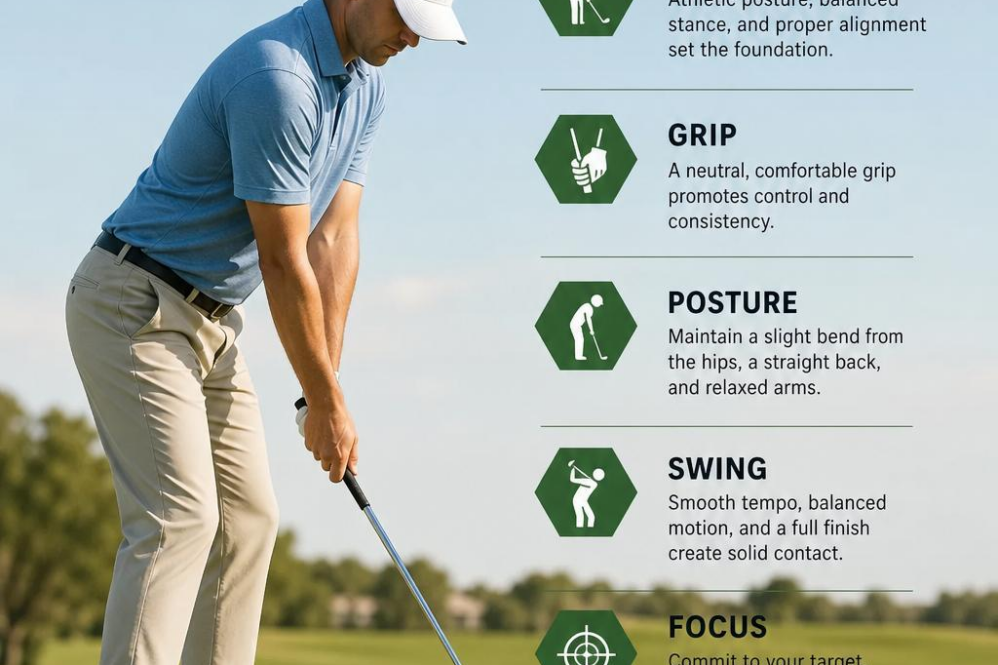
Achieving a precise grip is foundational to unlocking power and control within your golf swing. Lanny Wadkins stresses that your grip should feel firm yet relaxed, with the “V’s” formed between the thumb and forefinger pointing toward your right shoulder (for right-handed golfers). This alignment naturally promotes a square clubface at impact. To develop this, start by placing your left hand on the club so that the handle rests diagonally across the fingers rather than the palm, enhancing wrist hinge and release. Next, interlock or overlap your right pinky with the left index finger depending on comfort and hand size. Practicing this grip through simple drills - such as swinging with half-speed test shots focusing on clubface control – can greatly improve consistency. Keep in mind that a gripping pressure around a 4-5 out of 10 helps prevent tension that frequently enough restricts clubhead speed and fluidity.
Moving from the grip, a balanced stance complements your swing mechanics by providing stability and allowing efficient weight transfer. Wadkins recommends setting your feet roughly shoulder-width apart with toes slightly flared out (about 15 degrees) to encourage hip rotation. The knees should be softly flexed to maintain athletic posture, while your spine angle stays tilted forward slightly from the hips, not the waist, so your upper body remains poised over the ball. A critical checkpoint is that your weight distribution starts evenly between heels and balls of your feet – approximately 50/50 – enabling a smooth shift toward the led foot during the downswing. To build this balance, try drills such as balancing on one foot briefly at setup, then transitioning slowly into your swing sequence. this teaches body awareness and helps avoid common errors like coming over the top or losing posture through impact.
Integrating these setup fundamentals with course strategy maximizes the power generated in the swing for better scoring outcomes. As an example, Wadkins advises aligning your stance and grip adjustments with intended shot shapes to tackle real-course scenarios effectively.On a tight dogleg or windy day, a slightly weaker grip combined with a narrower stance can encourage a fade shape, offering safer margin around hazards. Conversely, a stronger grip and wider base promote a draw with added distance on open fairways. Developing the ability to control trajectory by tweaking setup details allows golfers of all levels to adapt to diverse lies and weather conditions. Additionally, emphasizing pre-shot visualization helps solidify confidence – imagine the ball flight while maintaining your setup, then execute with trust. These measurable refinements not only increase power and control but also reduce errant strokes by enhancing precision and shot selection, which are crucial for lowering scores across the board.
- Practice drills: grip pressure exercises using a grip trainer; stance balance drills with eyes closed on one foot.
- Course scenarios: Adjust grip and stance for wind, uphill/downhill lies, or narrow landing zones.
- Goals: Achieve consistent clubface square at impact; maintain stable spine angle through 72 holes.
Mastering the Rhythm of Your Swing with Practical Tempo Drills
Developing a consistent tempo is essential for mastering the rhythm of your golf swing, as it directly influences ball striking accuracy and distance control. Begin by establishing a ideal backswing-to-downswing ratio, often recommended between 3:1 and 4:1, meaning your backswing takes about three to four times as long as your downswing. This balance fosters fluid motion and prevents rushing through the shot, which can cause mishits and loss of power. Lanny Wadkins emphasizes the importance of a smooth transition point where rhythm remains uninterrupted; try to feel the clubhead “drop” naturally into the slot at the downswing, rather than forcing it. To build this, practice slow-motion swings alongside a metronome set between 60 to 70 beats per minute. This aids in internalizing tempo variations and timing your swing consistently, whether hitting irons or drivers.
Incorporate tempo drills geared to reinforce timing under real-course pressures by varying your practice scenarios. One effective exercise is the “count and swing” drill: count “1-2” on your takeaway followed by a fast “3” through impact, sustaining a rhythmic flow. This drill keeps the rhythm but encourages an accelerating downswing as Wadkins advises for improved driving distance. Additionally, use alignment sticks and mirrors to ensure your setup fundamentals – such as shoulder turn angles near 90 degrees in the backswing and weight transfer timing – support a consistent tempo. These reference points can help golfers detect rushed or jerky motions that disrupt swing rhythm. For beginners, breaking down the swing into segments allows better tempo control, while advanced players benefit from video swing analysis coupled with launch monitor data to quantify metrics like clubhead speed and ball spin, fine-tuning their timing further.
The impact of mastering tempo extends beyond swing mechanics into strategic course management. A smooth, repeatable rhythm reduces tension during critical putts and high-pressure drives, helping maintain focus and adaptability nonetheless of weather or lie conditions. As an example, when facing gusty winds, a deliberate tempo prevents over-swinging, reducing errant hooks or slices common under stress. Practice routines should include tempo-focused drills like the “ladder drill,” where you incrementally increase swing speed while holding tempo steady to build both power and control. Ultimately, linking tempo mastery to scoring consistency means golfers can execute precise shot shapes, optimize trajectory, and enhance touch around the greens. By embracing these tempo principles and practice methodologies inspired by Lanny wadkins’ teachings, golfers at every level can develop a confident rhythm that translates into measurable improvements on the scorecard.
Navigating the Course Like a Pro by sharpening Your Club and Target Choices
Mastering club selection starts with understanding your own swing dynamics and the course layout. As Lanny Wadkins emphasizes, knowing precise distances for every club in your bag under varying conditions is critical. Begin by tracking your average carry and roll for each club during practice sessions, using a launch monitor or on-course feedback. This knowledge forms the foundation of strategic decision-making. Such as, on a par-4 with a narrow fairway bounded by hazards, choosing a less-than-driver club can improve your shot accuracy and positioning for the approach. Pay special attention to factors like wind direction, elevation changes, and turf firmness, which all affect ball flight and roll. As a practical drill, consider practicing controlled shots with your mid-irons and hybrids at incremental distances-targeting 140, 150, and 160 yards-to build trust in dialing exact yardages and adjust your setup accordingly, focusing on stance width and ball position to optimize launch angles.
Complementing club selection, target choice is equally vital in effective course management. Wadkins advocates a strategy-oriented approach where aiming points are chosen not just for distance but for angles and recovery potential. When faced with hazards or out-of-bounds stakes, identify safe zones on the fairway or green complex that reduce risk while leaving favorable next shots. As a notable example, if the pin is tucked behind a bunker, aiming for the center of the green rather than the flag increases your chance for a prosperous two-putt and avoids needless penalty strokes. This mindset translates notably well to approach shots and around-the-green scenarios, where shot-shaping skills and trajectory control become tools for navigating complex target lines. To sharpen this skill, practice visualization drills by picking various targets at the range and simulating course conditions like slope and pin location, reinforcing your ability to mentally commit to the safest yet scoring-viable target.
Improving both club and target choices goes hand-in-hand with refining short game technique and maintaining mental resilience under pressure.Lanny Wadkins frequently enough highlights that the scoring difference is made within 100 yards of the hole, so practice routines should focus on consistent contact with wedges, proper setup with a slightly open clubface for lofted shots, and mastering trajectory control using wrist hinge and tempo adjustments. Incorporate drills such as the “clock drill,” where you hit pitch shots around the green from different distances and lies at corresponding times on the clock face to improve shot variety and distance control. Additionally, develop a pre-shot routine that embeds course analysis and confident commitment to your club and target selection, helping to mitigate doubt and indecision. For golfers of all levels, adopting this combined approach results in smarter play, fewer penalties from errant shots, and ultimately, a lower scorecard driven by strategic thinking and precise execution.