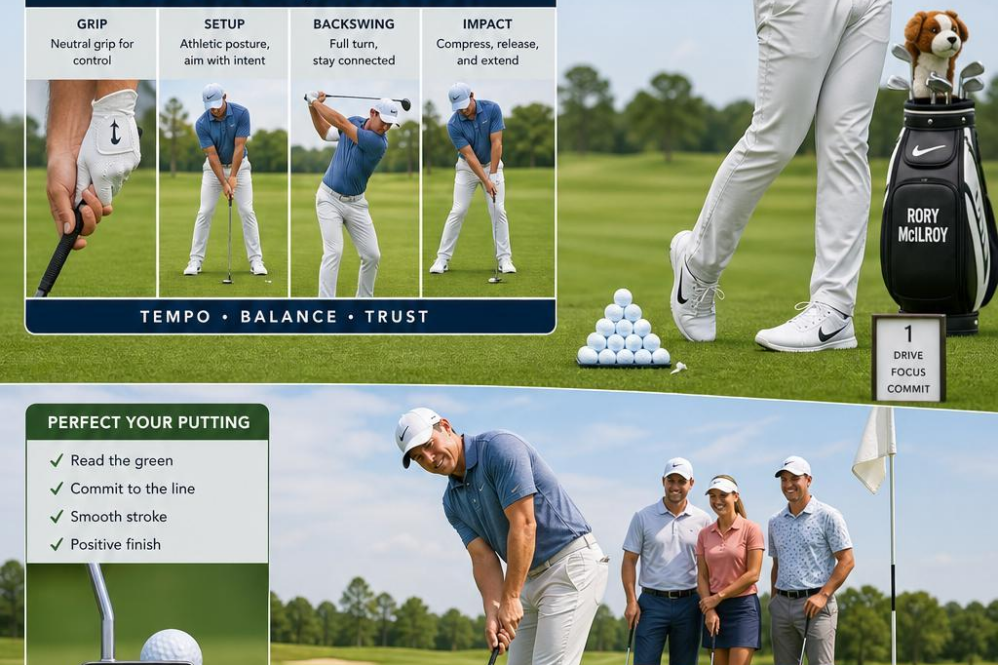
Unlock Your Swing Like Rory McIlroy by Mastering Timing and Rhythm
Achieving a swing rhythm akin to Rory McIlroy starts with mastering the synchronization of your body’s movements to develop consistent timing. Begin by focusing on your takeaway pace: initiate the backswing at a slow, controlled tempo, allowing your wrists to hinge naturally at approximately a 90-degree angle when the club reaches waist height. This controlled start encourages a smooth sequence where the hips rotate ahead of the hands, fostering powerful coil without tension. For practical submission, use a metronome set at 60-70 beats per minute to practice your swing tempo, ensuring your backswing and downswing are balanced in length and speed. Remember, rushing this transition frequently leads to loss of control or “casting” the club early, common mistakes that disrupt rhythm. Incorporating this drill on the range with mid-irons will help all skill levels internalize McIlroy’s fluid, athletic tempo that naturally builds power and accuracy.
transitioning from timing to rhythm,it’s critical to understand how weight shift integrates with swing mechanics in course scenarios. McIlroy’s technique emphasizes a gradual lateral weight transfer from the trail foot to the lead foot during the downswing, culminating in solid ball contact with a slightly forward shaft lean. This approach improves launch conditions and spin control-key for managing variable lies and weather conditions. To emulate this, practice hitting shots from diverse lies using alignment sticks to monitor foot pressure; you should feel increasing weight on your lead side by impact without over-swaying the hips.An effective drill includes slow motion swings paired with video analysis to ensure your pelvis leads the downswing, maintaining a forward pelvis tilt close to 20 degrees. This method not only boosts ball-striking consistency but also reinforces course management by allowing you to adapt your shot shape and trajectory according to pin position and wind influence.
timing and rhythm deeply impact short game precision and mental confidence-two areas McIlroy excels in under pressure. When practicing chips, pitches, or bunker shots, aim to replicate your full swing’s smooth tempo by slowing down the hand acceleration and maintaining a consistent hinge angle through impact.Short game drills such as the “clock drill,” where you chip balls around a target from varying distances and treat each shot like a full swing in miniature, reinforce muscle memory and improve feel. Additionally, situate practice sessions in simulated pressure environments, like setting score goals or competitive challenges, to strengthen mental resilience. Emphasizing rhythm even in delicate shots equips golfers of all levels with the confidence to execute under tournament or windy conditions, linking technical skill with strategic scoring and sustained focus throughout your round.
discover How Rory’s Grip and Stance Transform Your Driving Distance
Achieving a powerful and consistent driving distance starts with mastering Rory McIlroy’s refined grip and stance fundamentals. Rory advocates for a neutral yet relaxed grip pressure-neither too tight nor too loose-to maximize swing speed and control. Positioning the “V” shapes created by the thumb and forefinger of each hand so they point between the right shoulder and chin (for right-handed golfers) is critical. This alignment encourages a square clubface at impact,substantially reducing slices and hooks. Moreover, his stance promotes a shoulder-width base with knees slightly flexed and weight evenly distributed, fostering balance throughout the swing. Setting your feet approximately 6 to 10 inches apart with the ball positioned just inside the front heel allows for an upward angle of attack, a key element Rory uses to increase launch angle and optimize driving distance.
Building upon the setup, Rory’s swing mechanics emphasize an efficient transfer of power generated from the lower body through to the clubhead. He demonstrates how initiating the backswing with a smooth hip turn-not an over-rotation-creates stored energy without sacrificing control. As you transition to the downswing, focusing on a synchronized release where the hips lead the motion helps generate clubhead speed while maintaining an inside-out swing path. Practicing drills like the “step-through drill,” where golfers step forward during the downswing, can reinforce this weight transfer and sequencing concept effectively.Additionally, Rory integrates visualizing the ideal ball flight and adjusting grip pressure dynamically according to course conditions such as wind or firmness of fairways, which ensures maximum carry and roll on drives.
In real-course scenarios, adapting grip and stance to strategic goals is instrumental in gaining strokes off the tee. Rory often modifies his stance width and ball position slightly to shape shots around hazards or into prevailing winds without sacrificing power. For example,a slightly narrower stance combined with moving the ball slightly back in the stance promotes a lower ball flight to penetrate strong winds. Beginners should start by practicing with consistent setup checkpoints-such as aligning parallel to the target line using intermediate targets during warm-ups-while advanced players can experiment with subtle grip pressure variations and stance widths based on slope and lie. Incorporating these techniques not only improves driving distance but also enhances mental resilience under pressure, as confidence in your setup directly translates to performance in competitive rounds.
Putting Secrets Unveiled Learn rory’s Approach to Reading Greens and Building Confidence
Mastering green reading starts with understanding the subtle contours and grain direction that influence ball roll. Rory McIlroy emphasizes the importance of visualizing the putt as a whole, studying the slope not just near the ball but also from behind the hole. Such as, when faced with a break greater than 3 degrees, he advises aiming 6 to 12 inches outside the hole’s center on the uphill side to compensate for the curve. Practicing this skill involves walking around the green and observing breaks from multiple angles, which builds the ability to predict the putt’s path under varying light and weather conditions. Additionally, aligning the eyes directly over the ball, parallel to the target line, ensures a proper reading of the slope and minimizes parallax error-a frequent beginner mistake that distorts aim. Using these techniques helps golfers of all levels trust their read and better control pace, ultimately lowering their three-putt frequency.
Confidence in putting also stems from consistent setup fundamentals and intentional stroke mechanics, areas where Rory’s approach shines for players looking to refine their touch. He recommends starting with a well-balanced stance where feet are shoulder-width apart, knees slightly flexed, and eyes positioned above the ball to promote a pendulum-like stroke. Attention to grip pressure is critical; too tight and the stroke stiffens, too loose and the putter head may twist. A practical drill Rory uses is the “gate drill,” where tees are placed just wider than the putter blade to encourage a straight-back, straight-through stroke, preventing common errors like an inside-out or outside-in path. For intermediate players, refining acceleration through the ball with a smooth follow-through-stopping the head about six inches past impact-improves distance control. Embracing these mechanics while consistently practicing helps develop muscle memory, which builds confidence essential for sinking crucial putts under pressure.
Course strategy plays an integral role in putting success, particularly in understanding how environmental factors and hole location affect shot selection and mental approach. Rory advises adapting your strategy based on green firmness, wind direction, and pin placement. As an example, on softer greens with receptive surfaces, a more direct line with less aggressive pace is appropriate, whereas firmer conditions require additional speed to prevent the ball from stopping short. When pins are tucked on the front left of the green with a down slope, aiming for the safer center zone reduces risk and invites a simple two-putt. Developing a pre-putt routine that incorporates visualization, a deep breath, and a practice stroke aligned to the target aids in maintaining focus and composure. Golfers should incorporate these strategic insights into practice by simulating different green speeds and hole locations, measuring the results, and adjusting accordingly. Connecting these tactics with technical skill refinement makes putting more predictable,improving scoring consistency across all course conditions.