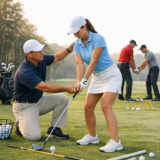
Mastery in golf extends beyond gross technical execution to a constellation of refined practices whose cumulative effects materially influence scoring and consistency. This article examines advanced subtle techniques for optimizing golf performance, synthesizing insights from perceptual-cognitive research, applied biomechanics, and elite coaching practice. Focus areas include expert green reading and visual-motor calibration, micro-adjustments to setup and strike for intentional shot shaping and spin control, and strategic course-management decisions informed by probabilistic risk-reward assessment. Special attention is given to the interaction between psychological processes-attentional control, pre-shot routines, and stress regulation-and minute motor adaptations that together yield measurable performance gains. By integrating empirical evidence with practical frameworks, the article offers practitioners and advanced amateurs actionable strategies to enhance accuracy, reduce stroke variability, and increase resilience under competitive conditions.
Precision Green Reading and Contour interpretation for Improved Putting Outcomes
High-performing putters treat green reading as an applied measurement problem rather than a guessing game. By combining systematic observation of surface grain,fall line,and micro-contour with an explicit internal scale for precision (cf. definitions of precision as exactness and repeatability), a player converts qualitative impressions into quantifiable aiming and pace decisions. This analytic stance reduces variance in decisions on breaks and speed, enabling shot selection that is both repeatable and defensible under pressure.
Field methods that support this conversion emphasize calibrated inspection and physical confirmation.Visual techniques (e.g., plumb-bobbing the line, squatting to check low-angle contours), tactile checks with the putter sole, and short test-rolls on comparable pitches are used in combination. Key observable cues include:
- Fall-line alignment: primary downhill direction within 1-3 yards of the ball
- Grain direction: subtle changes affecting speed toward or against the player
- Micro-contours: localized humps and hollows that induce lateral displacement
These cues, when recorded mentally in a consistent order, create a checklist that improves both accuracy and confidence during the pre-putt routine.
Translating contour details into execution requires explicit numeric adjustments for aim and pace. Simple,repeatable heuristics-derived from slope magnitude and green speed-help standardize responses across diffrent greens. The table below offers a concise decision matrix for short to mid-length putts; it is designed as a training reference to normalize responses and should be adapted to individual stroke feel and local Stimp readings.
| Slope (approx.) | Aim offset | Pace adjustment |
|---|---|---|
| ≤1% | Minimal (card width) | Standard |
| 1-2% | 1-2 ball diameters | Slightly firmer |
| >2% | 2+ ball diameters | Firm, commit to roll |
integrating contour interpretation into the broader routine requires deliberate practice with feedback loops. Structured drills-targeted reads followed by video or marker feedback-and outcome logging (miss direction, pace error, read accuracy) create an evidence base for incremental refinement. Emphasize two convergent goals: (1) minimize read variability through a reproducible inspection sequence and (2) calibrate stroke parameters to predictable, measured contour responses. Over time, these processes foster consistent decision-making and measurable advancement in putting outcomes.

Strategic Tee Shot Placement and Risk Management Techniques for Optimal Scoring
Optimal teeing choices are governed less by raw distance than by the geometry of the hole and the intended approach. By privileging an entry corridor that produces the most favorable angle into the green, a player converts marginal distance into tangible scoring advantage. Focus on three spatial concepts: angle of attack (how the ball approaches the fairway and green), preferred side (the side of the fairway that yields the best subsequent line), and thumbprint hazards (small hazards or ground contours that disproportionately influence the next shot). executing a tee shot to a deliberately selected landing zone routinely reduces the probability of penalty or a arduous recovery and thereby lowers expected strokes over time.
Decision psychology and risk calibration should be integrated with shot selection: treat each driving decision as an investment with expected value and variance. The industry-standard meaning of strategic-as used in lexical authorities such as Oxford and Cambridge-stresses high-level planning and position selection; apply that lens to the tee shot: choose positions that maximize the number of greens reachable in regulation while minimizing high-cost outcomes. Consider environmental modifiers (wind, firmness) and personal state (confidence, fatigue) when shifting between aggressive and conservative targets; the superior choice is not always the longest line but the one with the best risk-adjusted return.
Construct a compact decision framework and codify it for on-course consistency. Use the following checklist to guide pre-shot planning:
- target corridor: visualized 10-20 yard wide landing zone.
- Penalty slope: distance to hazard or out-of-play that converts an error into a big number.
- Approach angle: the ideal side of fairway for the next club selection.
- Environmental factor: wind, firmness, pin position.
Complement the checklist with a short reference table for speedy tactical calls:
| Zone | risk | Recommended Target |
|---|---|---|
| Left corridor | Moderate (water right) | Conservative fade 220-240 yd |
| Center | Low (longer approach) | Driver controlled draw |
| right short | High (bunker complex) | Three-quarter club to safer left |
Translate the table into on-course cues and enforce them through routine so that tactical knowledge becomes procedural rather than episodic.
Implementation emphasizes deliberate practice and measurement. Develop drills that recreate decision tension: a constrained-tee drill that forces playing to conservative corridors, a pressure-replica drill with small rewards for fairways hit, and a variable-wind simulator (use range fans or altitude adjustments). Track outcomes systematically-fairways hit, average approach distance, and penalty occurrences-and analyze them monthly to recalibrate target selection. Maintain a concise pre-shot script that includes visualization, anchor alignment, and a single risk-reward sentence; this transforms complex strategic calculus into reliable execution under stress.
Advanced Shot Shaping and spin Control Practices for Trajectory Optimization
Understanding the physics underpinning ball flight is foundational to refined trajectory control. Manipulating the relationship between **launch angle**, **spin loft**, and **clubface orientation** produces predictable variations in peak height, carry distance, and rollout. High spin loft with an open face tends to increase backspin and peak height, producing a steeper descent; conversely, a shallow attack angle and closed face can reduce spin and create a penetrating flight. Skilled golfers thus treat these variables as continuous control parameters rather than binary settings, calibrating them to environmental constraints such as wind vector and turf firmness.
Practical modification of shot shape depends on precise, repeatable micro-adjustments in technique. Emphasize the following tactical elements during practice to internalize the required kinesthetic cues:
- Face-to-path bias: small rotational changes at impact to induce controlled draw or fade.
- Angle of attack modulation: deliberate steepening or shallowing of descent to alter spin and launch.
- Ball position and stance width: subtle shifts to influence clubhead arc and contact point.
- Tempo and release timing: consistent sequencing to manage spin generation and sidespin suppression.
These micro-adjustments are best trained with immediate feedback-high-speed video or launch monitor data-so practitioners can translate sensory feeling into quantifiable outcomes.
Equipment and ball interaction are integral to spin control; optimizing these factors reduces variability. The table below summarizes typical spin ranges and the qualitative trajectory effects across common clubs, offering a concise reference for decision-making during club selection and shot planning.
| Club | Typical Spin (rpm) | Trajectory effect |
|---|---|---|
| driver | 1,200-3,500 | Low,penetrating; sensitive to face angle |
| 7‑Iron | 5,000-9,000 | Mid‑height; repeatable carry with controllable spin |
| Sand Wedge | 9,000-13,000 | High descent,quick check; optimal for stopping on firm greens |
Translating refined shot shaping into consistent on‑course performance requires an analytical pre‑shot routine and adaptive decision rules. Evaluate lie conditions, wind shear, and nearby hazards to determine whether a low, spinning approach or a high, soft‑landing shot best minimizes aggregate risk. Maintain a disciplined cognitive process-frame the choice with a simple **decision matrix** (target zone × acceptable rollout × penalty risk) and then execute a rehearsed mechanical plan. Regularly vary practice scenarios (firm/soft turf, sidehill lies, wind angles) so the neuromuscular system associates specific feel cues with predicted spin and trajectory outcomes under realistic constraints.
Cognitive Decision Making and Pre shot Routine Design to Enhance Consistency
Contemporary models of skilled performance position decision-making as an interaction between perception, memory, and controlled cognition: in short, cognition encompasses the processes by which players perceive the habitat, interpret information, and select actions (Britannica). Applying this outlook to golf reframes the pre‑shot sequence as a cognitive micro‑task that organizes attention, reduces uncertainty, and converts complex perceptual input into a single committed motor plan. From an academic standpoint, the aim is to shift decision operations from slow, capacity‑limited reasoning into fast, low‑variance execution through well‑designed routines and practiced heuristics.
Effective routines therefore specify both content and process: what the player inspects and the temporal ordering of mental and motor operations. Core elements typically include target selection, visualization, shot specification, and a commitment trigger. practical implementation often uses brief, repeatable cues that offload working memory and create stimulus-response links. Typical components are:
- Target fixation: identify a precise aim point rather than a general line.
- Outcome imagery: mentally simulate ball flight and landing.
- Technical micro‑check: one concise kinesthetic cue (e.g., “smooth tempo”).
- Execution trigger: a committed cue (e.g., breath out + address) that ends deliberation.
To connect design to measurable cognitive goals, practitioners can use simple mapping to align routine elements with targeted cognitive functions. The table below exemplifies a compact prescription using familiar WordPress table styling (class=”wp-block-table”):
| Routine element | Cognitive Aim |
|---|---|
| Target Fixation | External focus & perceptual anchoring |
| Visualization | goal depiction & anticipatory calibration |
| Controlled Breath | Arousal regulation |
| Commitment Trigger | Decision termination & automatic initiation |
Training protocols should emphasize repetition under representative pressure, graded feedback to reduce prediction error, and periodic mental rehearsal to strengthen associative links.outcome metrics-dispersion,pre‑shot duration variance,and subjective decisional confidence-provide objective indices of routine consolidation and consistency over time.
Biomechanical Micro Adjustments in grip Stance and Tempo for Incremental Performance Gains
Subtle biomechanical modifications can produce statistically meaningful improvements when implemented with rigorous measurement and feedback. Small changes-on the order of 1-3° in wrist or forearm rotation, 5-15 mm in putter arc width, or 50-150 ms in transition timing-regularly translate to reduced face-angle variance and improved launch conditions when replicated consistently. From a systems perspective, these adjustments act on three primary vectors: sensorimotor alignment (eye-hand-putter geometry), force-time characteristics (grip pressure and acceleration profile), and postural constraints (center of mass and base of support). By treating each micro-adjustment as a controlled experimental variable, the practitioner can quantify incremental gains and avoid overcompensation that typically accompanies larger, less precise changes.
A focused taxonomy of grip alterations emphasizes reproducibility and sensory cues. Recommended micro-changes include slight palmar pressure redistribution (e.g., a 10-20% shift from the top hand to the lead hand), minimal supination/pronation (~1-2°) to influence face wrap, and targeted reduction of static gripping force to lower co-contraction in the forearm. Practical implementation should use objective tools-pressure mats or simple grip force meters-and stepwise validation: implement one micro-change,record 30-50 putts,analyze dispersion and face-angle bias,then iterate. Suggested tactile cues for training:
- “Feather the lead palm” – reduces excessive wrist torque
- “Anchor the knuckles” – stabilizes lateral deviation without gripping harder
- “Match soft pressures” – equalize forces between hands to promote linear stroke
These cues, when paired with instrumentation, provide reproducible inputs for biomechanical optimization.
Postural micro-adjustments refine the kinetic chain supporting the stroke and reduce variability under pressure. Key variables are ball position relative to the lead eye (≤10 mm shifts can alter perceived aim),stance width (25-50 mm adjustments change base stiffness),and weight distribution (a 5-10% forward/back shift modulates rotational inertia). Implement an iterative alignment protocol: (1) establish a baseline using alignment rods and a laser pen, (2) apply a single stance modification, (3) perform a randomized block of short and mid-length putts, and (4) compute changes in left-right dispersion and miss distance. Useful stance checks include:
- vertical spine angle alignment with the sternum as a reference
- consistent heel-to-toe pressure ratio
- repeatable eye-over-ball coordinate measured from an external marker
These postural micro-adjustments constrain degrees of freedom and allow more stable control of the putter path.
Tempo and transition fine-tuning primarily control the impulse profile delivered to the ball. Target metrics include backswing-to-downswing ratios, total stroke duration, and peak acceleration timing. Typical effective ranges found in controlled testing are a 2.5:1-3.5:1 backswing:downswing time ratio and a total stroke duration of 700-1200 ms for strokes under 6 feet, with a consistent acceleration curve (smooth, unimodal) minimizing face rotation at impact.Apply a metronome or auditory cue for acquisition and then remove it to test internalization. Short tabular summary for practice targets:
| Parameter | Target | Expected Effect |
|---|---|---|
| Backswing:Downswing | 3:1 | Stable acceleration profile |
| Total Duration | 800-1000 ms | Reduced temporal variance |
| Transition Pause | 50-120 ms | Improved face control |
Complement tempo adjustments with drills that isolate timing (e.g., gated putts, rhythm drills) and record variability metrics; incremental reductions in standard deviation of impact location are the principal indicator of performance gain.
Leveraging Shot Tracking Data and Video Analysis to inform Targeted Practice Interventions
Contemporary performance optimization synthesizes high-resolution shot-tracking telemetry with systematic video capture to produce multilevel diagnostic insight. By fusing objective ball-flight data (e.g., **carry, spin rate, launch angle, dispersion**) with club- and body-centric kinematics (e.g.,**club path,face angle,pelvis rotation**),practitioners obtain a more complete phenotype of player tendencies than either modality alone. This multimodal approach improves the signal-to-noise ratio for subtle faults, enabling detection of recurrent but low-amplitude deviations that accumulate into measurable strokes-gained deficits.
Translation of these diagnostics into effective practice requires principled, targeted interventions that address the specific coupling of cause and effect revealed by the data. Interventions are most effective when they are concise,measurable and context-specific. Examples of high‑leverage practice modalities include:
- Micro-drills that isolate a single kinematic variable for 60-120 repetitions under varied constraints.
- Simulated pressure routines that replicate on‑course decision demands while monitoring outcome metrics.
- Feedback loop protocols pairing immediate video correction with delayed statistical review of shot-tracking trends.
Video serves a complementary role as a causal verifier: slow‑motion kinematic markers can be time‑synchronized with shot-tracking traces to confirm hypotheses and refine interventions. The table below offers a concise mapping used in applied settings to convert a data cue into a drillable practice prescription:
| Observed Problem | Data Cue | Targeted Drill |
|---|---|---|
| Pulls with long irons | Negative face angle at impact | Impact tape + half‑swing face control |
| Short approach misses | Low spin & low launch | Lofted tee shots + tempo drill |
| Wild dispersion | Variable club path SD | Targeted swing‑path funneling |
systematic monitoring and iterative adjustment create the closed loop necesary for durable gains. Establishing baseline distributions and pre‑specified success criteria (e.g., reduction in lateral dispersion by X%, increase in GIR probability) enables rigorous evaluation via simple statistical metrics (mean, standard deviation, confidence intervals). Coupling these quantitative KPIs with periodic retention tests and subjective readiness reports produces an adaptive practice plan that privileges transfer and long‑term retention over transient aesthetic change. Emphasizing measurable outcomes-rather than isolated technique cues-ensures that interventions remain aligned with the ultimate objective: lower scores under competitive conditions.
Periodized Training Recovery and Mental Skills Integration for Sustained Competitive Performance
Periodized frameworks for golf performance should be anchored in measurable phases that align physical conditioning, technical rehearsal, and tactical exposure with competition demands. Macrocycles (season), mesocycles (preparation, competition, transition) and microcycles (weekly plans) must explicitly schedule recovery windows to prevent cumulative fatigue and to consolidate motor learning. objective monitoring (e.g., session RPE, movement quality screens) combined with regular technical checkpoints allows practitioners to optimize the trade‑off between training stimulus and readiness for tournament play.
Recovery is not passive: it is a planned intervention integrated into every training block. Key modalities to be scheduled and periodized include:
- Sleep optimization: consolidated sleep and strategic naps after high‑intensity technical sessions.
- Nutrition timing: carbohydrate and protein windows to support neural and musculoskeletal recovery.
- Active recovery: low‑intensity movement to promote circulation and maintain motor patterning.
- Regenerative therapies: manual therapy,mobility work and brief cold/contrast exposure when appropriate.
These interventions should be dosed according to phase (e.g., higher emphasis on regenerative therapy during heavy technical volume; higher focus on sleep and nutrition during competition weeks).
Psychological skills must be periodized alongside physical recovery to sustain competitive performance. Progressive mental training-beginning with attentional control and imagery in preparatory mesocycles, moving toward arousal regulation and routine automation in competitive mesocycles-facilitates transfer under pressure. The following concise matrix illustrates the alignment of phase, primary physical objective and mental emphasis:
| Phase | physical Focus | Mental Emphasis |
|---|---|---|
| Preparation | Strength & motor patterning | Imagery, concentration drills |
| Competition | maintenance, peak readiness | Arousal regulation, routine automation |
| Transition | Regeneration | Reflection, psychological recovery |
Operationalizing these principles requires individualized load‑management and multidisciplinary collaboration. Use regular checkpoints-heart rate variability,objective practice metrics,and validated psychological questionnaires-to inform microcycle adjustments. Emphasize education so athletes can self‑regulate (e.g., modify practice intensity, prioritize sleep before a key event). When implemented coherently, the integration of periodized recovery and mental skills produces robust, resilient performance across demanding competitive calendars.
Q&A
Q1: How is the phrase “advanced subtle techniques” defined in the context of golf performance?
A1: In this context,”advanced” denotes methods that are highly developed or complex and that require refined motor,perceptual,and cognitive control beyond basic skill acquisition. The modifier “subtle” indicates that these methods produce measurable performance gains without wholesale changes to gross swing mechanics; they frequently enough operate through small adjustments in decision-making, perception, shot specification, or routine (see definitions of “advanced” for usage) [1][2].Q2: Why do subtle techniques matter for optimizing golf performance?
A2: Subtle techniques close the gap between technical capability and competitive performance. They improve on-course decision-making, reduce variance in shot outcomes, optimize stochastic elements (wind, lie, green speed), and enhance consistency under pressure. As many players already possess adequate basic mechanics, incremental, high-resolution adjustments frequently enough yield larger reductions in score than broad technique overhauls.
Q3: What categories of subtle techniques are most impactful?
A3: Key categories include: perceptual skills (advanced green reading, visual anchoring), tactical skills (strategic tee placement, risk-reward heuristics), motor micro-adjustments (tempo modulation, face-path micro-control), ball-flight engineering (trajectory and spin management), and psychological routines (pre-shot micro-routine, breath and arousal control). Each category interacts with the others and with overall course management.
Q4: How can elite players improve green-reading ability?
A4: Effective green reading combines topography, grain, green speed, landing dynamics, and visual perception. Practical steps: systematically assess slope and crown from multiple vantage points, incorporate subtle foot-feel and visual cues for grain direction, use comparative rolling drills at known speeds, and validate reads by tracking outcomes. Formalized methods (e.g., target-relative reads and staged validation practice) reduce reading errors and improve putt speed control.
Q5: What are the most effective micro-adjustments for shot shaping?
A5: Shot shaping is controlled by three high-resolution factors: clubface orientation at impact, swing path, and dynamic loft/angle of attack.Micro-adjustments include slight changes in grip pressure and rotation, nuanced stance and alignment alterations, modified ball position by a few centimeters, and targeted swing-plane biasing. These adjustments should be practiced with feedback (video or launch monitor) to quantify the relationship between input change and ball flight.
Q6: How should trajectory and spin be managed as subtle performance levers?
A6: Trajectory and spin are governed by club selection, attack angle, swing speed, and strike quality. Small, intentional changes-e.g., slight forward or back ball position, minimal forward shaft lean at impact, and optimized clubface cleanliness-can alter launch angle and spin loft predictably. Players should use controlled drills to learn how minimal technique or equipment changes affect carry, roll, stopping power, and side-spin under varying conditions.
Q7: How does psychological decision-making influence the request of subtle techniques?
A7: Cognitive biases (anchoring,loss aversion,status quo bias) and pressure-induced narrowing of attention affect tactical choices. Subtle psychological techniques-pre-shot checklists, binary decision rules (go/no-go thresholds), and simplified heuristics for risk-reduce decision noise. Additionally, micro-routines (brief, repeatable pre-shot behaviors) stabilize arousal and focus, enabling consistent execution of subtle mechanical and perceptual adjustments.
Q8: What is the role of course management when applying subtle techniques?
A8: Course management operationalizes subtle techniques into a hole-by-hole plan: selecting tee targets that maximize preferred shot shapes, identifying bailout zones, choosing approach trajectories that leave favorable putts, and planning for wind and pin placement. Subtlety lies in selecting marginal advantages (e.g., a 2-4 yard corridor that reduces a hazard penalty versus a seemingly more aggressive line that adds risk). Effective course management is analytically informed and context-sensitive (player strengths, weather, match situation).
Q9: How should practice be structured to develop these subtle skills?
A9: Practice should combine deliberate,high-repetition work on single-variable manipulations with variable,contextual practice that simulates match conditions. Recommended structure: baseline assessment, focused micro-drills with immediate objective feedback (launch monitor, camera, outcome metrics), interleaved variability to promote adaptability, and pressure simulation (time constraints, scoring games). Emphasize mastery of one subtle change before integrating multiple changes concurrently.Q10: Which objective metrics best quantify improvements from subtle techniques?
A10: Use on-course and lab metrics: strokes gained categories (approach, putting, tee), proximity to hole from approach, green-in-regulation percentages, scrambling rates, shot-dispersion statistics (grouping and bias), launch-monitor outputs (carry, total distance, peak height, spin rate, dispersion), and decision-error incidence (subjective coding of poor choices). Tracking these across practice and competition isolates whether subtle interventions translate to score improvement.
Q11: What are common pitfalls when implementing subtle techniques?
A11: Frequent pitfalls include: making multiple simultaneous changes (confounding effects), overfitting to practice conditions that do not translate on course, neglecting to quantify outcomes, underestimating psychological factors, and misattributing natural variability to intervention effects. Avoid these by single-variable testing, pre-registering expected outcomes, collecting adequate samples, and using control conditions.
Q12: How should a coach communicate subtle changes to a player?
A12: Interaction should be precise, concise, and grounded in measurable outcomes. Use objective demonstrations (video, launch monitor), small stepwise instructions, and immediate tasks for verification. Frame changes as experiment-driven: hypothesize the effect, test under controlled conditions, evaluate results, and iterate. This reduces cognitive load and increases player buy-in.
Q13: What role does equipment selection play in subtle performance optimization?
A13: Equipment can amplify or dampen subtle technique effects. Loft choices, shaft flex and torque, clubhead center-of-gravity placement, and ball compression influence spin, launch, and dispersion. Small equipment adjustments-loft changes by a degree, shaft selection for desired feel-should be validated with data to ensure they complement intended technique changes rather than mask or conflict with them.
Q14: How should players prioritize which subtle techniques to adopt?
A14: Prioritization follows an impact-by-effort matrix: (1) assess current performance deficits using objective metrics, (2) identify interventions that target the largest deficits with the lowest implementation cost and risk, (3) sequence changes from low-risk/high-impact to higher-risk refinements, and (4) reassess iteratively. For example, improving lag putting and approach proximity typically yields higher short-term payoff than marginally altering full-swing aesthetics.
Q15: How can teams or researchers evaluate the efficacy of subtle-technique interventions?
A15: Use randomized or within-subject experimental designs where feasible, standardized outcome measures, adequate sample sizes, and blinding of outcome assessors. Predefine primary endpoints (e.g., strokes gained approach) and use repeated measures to account for contextual variability. Qualitative data (player-reported confidence, perceived workload) supplement quantitative metrics and explain mechanism pathways.
Q16: What is a pragmatic implementation roadmap for an advanced player seeking to apply these techniques?
A16: Roadmap: (1) Baseline audit-collect objective performance and decision metrics; (2) Diagnostic phase-identify 2-3 high-leverage subtle interventions; (3) Controlled practice-implement single-variable drills with feedback for 2-4 weeks; (4) On-course integration-apply interventions in low-stakes rounds with pre-defined decision rules; (5) Measurement-compare pre/post metrics and adjust; (6) Consolidation-automate triumphant interventions through routine and periodic revalidation.
References and further reading note: The characterisation of “advanced” used above follows standard lexical definitions indicating highly developed or complex methods [1][2].For empirical implementation and measurement, practitioners should consult sport-science literature on motor learning, biomechanics, and decision sciences to complement these applied recommendations.
If you would like, I can convert this Q&A into a short annotated bibliography, generate sample practice plans and drills for selected items, or create a measurable 8‑week implementation protocol tailored to a specific handicap level.
the exploration of advanced subtle techniques for optimizing golf performance underscores that marginal gains-rooted in refined perceptual skills, nuanced shot-shaping, and deliberate course-management decisions-can produce meaningful reductions in stroke play and enhance competitive consistency. The synthesis presented herein demonstrates that technical proficiency alone is insufficient; optimal outcomes emerge from the integrated application of cognitive strategies (e.g., calibrated risk assessment and focused pre-shot routines), biomechanical refinements (e.g., controlled launch and spin manipulation), and situational analysis (e.g., green reading and pin-placement anticipation).
For practitioners and coaches, the practical implication is clear: training programs should prioritize transfer-oriented drills that couple motor patterning with decision-making under realistic constraints, and employ objective feedback (video, launch monitors, and performance metrics) to quantify incremental improvements. Implementing staged interventions-beginning with perceptual and strategic awareness, progressing to controlled technical adjustments, and culminating in competitive simulation-will maximize retention and on-course applicability.
From a research perspective, future work should pursue longitudinal and ecologically valid studies that measure how subtle technique interventions affect performance across varying skill levels, course designs, and competitive pressures.Multimodal investigations integrating biomechanics, cognitive psychology, and wearable sensor data will be especially valuable for isolating causative mechanisms and optimizing individualized training prescriptions.
Ultimately, the pursuit of golfing excellence demands attention to the fine-grained elements of play. By systematically incorporating the advanced subtle techniques discussed, players and coaches can cultivate a more resilient, adaptable, and analytically informed approach to the game-one that translates technical mastery into consistent on-course success.
Advanced Subtle Techniques for Optimizing Golf Performance
Micro-adjustments to the Swing: Precision over Power
High-level golf performance often comes from tiny, repeatable changes rather than wholesale swing overhauls. Focus on micro-adjustments that improve contact, consistency, and launch conditions.
Key micro-adjustments
- Grip pressure: Aim for a consistent 4-6/10 feel. Too tight kills feel and reduces clubhead speed; too light creates tension later.
- Hands ahead on short irons: A half-inch forward shaft lean at address improves compressions and spin control for better approach shots.
- Minor ball position tweaks: Moving the ball just a half-inch forward/back can change spin and launch enough to save strokes.
- Wrist set and release timing: Practice a slightly later release to reduce slices and a neutral, earlier release to tame hooks.
- Shoulder tilt and spine angle: Small tilts change the low point of the swing and can dramatically affect turf interaction.
Practical drills
- Gate drill with alignment sticks to train consistent clubface path.
- Half-swing tempo drill using a metronome app to lock in a repeatable 3:1 backswing-to-downswing tempo.
- Impact tape/foot spray feedback to learn micro-adjustment effects on strike location.
Putting: Subtle Reads,Green Speed & Confidence
Putting is as much about feel and facts processing as technique. Small, strategic changes in how you read greens and manage speed can shave multiple strokes per round.
Advanced putting techniques
- Stimp calibration: Mentally note green speed early in the round (first long putt) and adjust stroke length for pace, not force.
- Micro aim correction: Use a 1-degree alignment aid or small visual markers on the ball to correct consistent miss-direction without changing setup.
- Feel zones: Mark three pace ranges: short (<8ft), medium (8-30ft), long (>30ft). Practice each with a focus on distance control rather than line.
- Two-point read method: Read the putt from behind the ball, then from the hole to build a 3D slope picture – combine with visualization of the ball’s path.
Shot Shaping & Trajectory Control
Being able to shape a shot on command-fade, draw, high or low trajectory-gives you tactical advantage and better course management.
Subtle shot-shaping tools
- Face-to-path manipulation: Small intentional changes to face angle at impact (2-4 degrees) will consistently change curvature without altering your entire swing.
- Loft and shaft lean: Slightly opening the face and standing taller produce higher trajectories; forward shaft lean lowers spin and trajectory.
- Grip and wrist position: A slightly stronger grip makes draws easier; weaker grip helps fades.adjust by 3-5 degrees only.
Drills for trajectory control
- Targeted rope or alignment-stick drill to practice low and high flight with the same club.
- Half-swing shape practice: hit 20 balls alternating small draws and fades to train feel for face/path differences.
Tee Shot Placement & Course Management
Optimized golf performance is often more about brilliant planning than heroic shots. Subtle strategic choices lower risk and maximize scoring chances.
Course management tactics
- Target-line strategy: Pick a landing corridor and plan your tee shot to leave a preferred approach angle, even if that means using a 3-wood instead of driver.
- Club-by-club positioning: Know distances to key hazards and aim to leave your preferred yardage into the green (e.g., 100-120 yards for wedge control).
- Risk-reward math: When the reward of attacking a hazard is minimal (single stroke gain), play conservative to reduce volatility.
Template plays
Create on-course templates for common hole shapes: doglegs, short par 4s, and reachable par 5s. Predefine preferred clubs and landing spots rather than improvising.
Short Game Finesse: Chipping,Pitching & Bunker Subtleties
The short game is where subtle technique yields outsized returns. Prioritize touch, loft management, and green-side visualization.
Refined short-game techniques
- Low-runner chipping: Use less loft and a forward ball position. Slightly close the clubface and use body rotation to control distance.
- High soft pitch: Open the face and hinge the wrists early; trust landing spot rather than rolling distance.
- Bunker play-footwork & entry: Open stance and accelerate through the sand; imagine hitting the sand 1-2 inches behind the ball. small changes in stance width dramatically affect sand exit angle.
Pre-shot Routine, Visualization & The Mental Game
fine-tuned mental skills make subtle physical improvements stick. The brain is the interface between strategy and execution.
Elements of an elite pre-shot routine
- Visualize the entire flight and landing of the ball (3-5 seconds).
- Controlled breathing to regulate heart rate and tempo.
- One clear swing thought-focus on a feel (e.g., “smooth transition”), not an outcome.
- Micro-commitment anchor: a small physical action (tap the toe of the club) signaling commitment to the shot.
Mental subtleties to practice
- Process focus over score focus-evaluate execution elements rather than outcome.
- Use pre-round visualization of common scenarios to reduce on-course decision time.
- Adopt a “next-shot” mindset after any mistake to avoid negative carryover.
Practice Drills,Data,and Feedback Loops
Modern performance optimization blends feel-based practice with objective data. Use a launch monitor, shot-tracking app, or simple video to accelerate learning.
Data-driven subtle improvements
- Track dispersion patterns with each club; small consistent misses can be corrected by adjusting aim or setup by millimeters.
- Monitor ball speed and spin rate on wedges-excess spin variance frequently enough indicates inconsistent lower-body timing.
- Use split-testing: change only one variable at a time (e.g., ball position) and hit 20 shots to assess the effect.
Sample practice session (60 minutes)
- 10 min: Putting-speed work at three distances.
- 20 min: Short game-30-70 yard controlled pitches with landing spot targets.
- 20 min: Iron work-micro ball position and weight-shift drills.
- 10 min: Driver/tee shots-aim corridor practice, not max distance.
Equipment Tweaks & Ball Selection
Small changes to equipment setup and ball choice produce subtle but vital performance differences when paired with proper technique.
What to consider
- Loft and lie adjustments: Two degrees of loft or 1/4-inch lie change can affect trajectory and side-spin-use a professional fitter.
- Shaft flex and kick point: Small changes in flex tune launch and dispersion for more consistent approach shots.
- Ball compression and cover: Pick a ball that matches your swing speed and spin needs (e.g., lower compression for slower swing speeds to optimize distance and feel).
| Area | Subtle Adjustment | Expected Benefit |
|---|---|---|
| Grip | Reduce pressure to 4-6/10 | Better feel, consistent release |
| Ball Position | Half-inch forward/back | Improved launch/spin |
| Putts | Calibrate to Stimp | More 1-putts, fewer three-putts |
On-course Case Studies & Situational Templates
Applying subtle techniques under pressure differentiates consistent golfers from average players. Here are compressed case examples to emulate.
Case study: The short par-4 (hole management)
- Scenario: 340-yard par 4 with water down the right and a tight green.
- Subtle strategy: Use a 3-wood off the tee to keep left-to-right fade out of water, aim to a wide part of the fairway, and attack the pin only if the left side is pin-protecting.
- Result: Fewer penalty strokes, higher birdie probability from conservative approach angles.
Case study: Firm links-style conditions (trajectory control)
- Scenario: Strong wind and firm turf demand control.
- Subtle strategy: Move the ball back slightly,reduce loft with a forward shaft lean,and take one less club to keep trajectory low and reduce spin.
- Result: More predictable ball flight, less roll-out unpredictability, improved scoring.
Benefits & Practical Tips
- Lower scores via marginal gains: Small improvements in green reading, pace, and strike translate into saved strokes.
- Consistency: Subtle, repeatable techniques reduce high-score variance and improve scoring resilience.
- Confidence: A reliable pre-shot routine and data-backed adjustments increase on-course confidence.
Speedy practical checklist
- Warm up putting and wedges first.
- Calibrate green speed on the first long putt.
- Choose a target corridor for every tee shot.
- Record one swing variable per session and track progress for four weeks.
Further Resources & Next Steps
If your ready to implement these advanced subtle techniques for optimizing golf performance, start by choosing one area (putting, short game, or tee shot) and apply focused micro-adjustments for two weeks with measurable feedback-then iterate. Use video, launch-monitors, and a short notebook to track trends. these small, deliberate steps compound into considerably better golf.