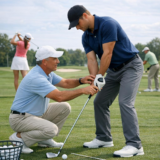
The golf swing is a complex, high‑velocity motor skill that requires the coordinated interaction of musculoskeletal structures, neural control systems, and external forces to produce repeatable ball flight with precision and power. Framed within the broader discipline of biomechanics-which applies mechanical principles to the study of living systems-analysis of the golf swing integrates kinematic description (segmental motions and timing), kinetic quantification (forces, moments, and energy transfer), and neuromuscular dynamics (muscle activation patterns and intersegmental coordination) to explain both performance outcomes and injury mechanisms. Contemporary biomechanical research, drawing on methods from motion capture, force measurement, and electromyography, provides the empirical basis for translating mechanical insight into technique refinement and targeted conditioning strategies.
This article adopts an integrative, evidence‑based viewpoint to examine how kinematic patterns (e.g.,sequencing of pelvis,torso,and club rotations),kinetic events (ground reaction forces,joint torques,and impulse generation),and neuromuscular control (timing,magnitude,and variability of muscle activation) together determine shot quality and player safety. By situating golf‑specific findings within the general principles of movement biomechanics, we aim to clarify which technical features consistently associate with improved clubhead speed, shot consistency, and reduced loading on vulnerable tissues-especially the lumbar spine and shoulder complex.
After a concise review of measurement technologies and analytic frameworks, the article synthesizes key empirical findings on swing mechanics across skill levels, highlights common technical flaws linked to performance loss and overuse injury, and evaluates intervention approaches including technique modification, neuromuscular retraining, and strength‑conditioning prescriptions. The goal is to provide clinicians, coaches, and researchers with a coherent, mechanistic foundation for evidence‑guided coaching and injury‑prevention practices that respect the multidimensional nature of the golf swing.
Conceptual Framework for Golf Swing Biomechanics: Integrating Kinematics, Kinetics, and Neuromuscular Control
Contemporary analysis frames the golf swing as an integrated motor task in which **kinematics**, **kinetics**, and **neuromuscular control** interact across multiple timescales and anatomical segments. Rather than treating position, force, and activation in isolation, a systems perspective emphasizes how segmental geometry (angles and angular velocities), external and internal forces (ground reaction forces, joint moments), and time-sensitive muscle coordination produce performance outcomes such as clubhead speed, launch conditions, and shot dispersion. This synthetic viewpoint clarifies why small changes in sequencing or timing can nonlinearly affect ball outcome and why identical kinematic patterns can yield diffrent results when kinetic or neuromuscular constraints differ.
At the kinematic level, emphasis falls on three measurable constructs: segmental sequencing, angular velocity profiles, and spatial orientation. Efficient swings demonstrate proximal-to-distal sequencing where pelvis rotation precedes thoracic rotation and arm/club acceleration; **angular velocity peaks** progress distally and are tightly timed with club release. Metrics such as peak trunk rotation, shoulder-pelvis separation (commonly termed the X‑factor), and clubhead path provide quantifiable targets for technique refinement. Precise 3D motion capture and inertial sensors allow decomposition of these variables into phase-specific descriptors useful for coaching and research.
For kinetics, the key mechanisms are force generation and transfer: **ground reaction forces (GRFs)** initiate the kinetic chain, joint moments and power flows sustain intersegmental energy transfer, and club‑hand interaction finalizes ball launch. Translational and rotational ground forces contribute to hip and trunk moments that are then converted into clubhead kinetic energy. The following table summarizes representative phase-specific kinetic priorities and relative timing (simplified for practical interpretation):
| Phase | Primary Kinetic Focus | Representative Timing (% of swing cycle) |
|---|---|---|
| Top of backswing | Load storage (eccentric hip/trunk moments) | 30% |
| Late downswing | Peak GRF & joint power transfer | 80-95% |
| Impact | Peak clubhead energy transfer | 100% |
Neuromuscular control underpins both kinematic profiles and kinetic outputs through feedforward planning, reflex-mediated feedback, and intermuscular coordination. Effective motor programs coordinate anticipatory postural adjustments and timed agonist-antagonist bursts to produce smooth energy transfer while minimizing undesirable loading. Practical consequences include the need to train:
- Temporal precision – drills that emphasize consistent downswing tempo and rhythm;
- Reactive control – perturbation-based tasks to enhance feedback stability under variable conditions;
- Muscle synergies – multi‑joint strength and rate‑of‑force development exercises targeting hip/trunk/shoulder linkages.
These interventions should be validated by EMG or field metrics to ensure transfer to swing mechanics.
Translating this framework into technique refinement and injury mitigation requires integrated assessment and targeted intervention. Coaches and clinicians should combine motion capture or wearable kinematic indices with force plates and surface EMG to identify mismatches (for example, high trunk rotation without commensurate hip power indicating compensation). Emphasize **load‑appropriate strengthening**, movement variability to enhance robustness, and technical cues that preserve safe joint ranges (particularly lumbar spine and lead shoulder). Monitoring changes with objective metrics permits progressive overload while minimizing cumulative tissue stress, thereby aligning performance gains with reduced injury risk.
Three dimensional Kinematic Patterns of the Golf Swing and Their Implications for Consistency, Accuracy, and Power
Contemporary motion-capture analyses reveal the golf swing as a coordinated, three-dimensional kinematic event in which transverse, frontal and sagittal plane motions interact continuously. Rather than a single planar motion, effective swings exhibit coupled rotations of pelvis, thorax and upper limbs, combined with controlled lateral translation and dynamic spine tilt. These coordinated patterns produce predictable clubhead trajectories and minimize unwanted degrees of freedom; thus,reproducible inter-segment timing is essential to mechanical repeatability. high-fidelity 3D data show that small deviations in rotation sequencing or out-of-plane tilt correlate with amplified variability at the clubhead, underscoring the value of multi-planar assessment for performance diagnostics.
From a consistency perspective, variability in three-dimensional timing explains a large portion of shot-to-shot dispersion. Contemporary studies emphasize **kinematic sequence stability**-the relative onset and peak velocities of pelvis, torso and distal segments-as a stronger predictor of repeatability than isolated joint ranges of motion.Measures such as cycle-to-cycle standard deviation of pelvis rotation rate and lateral COM displacement provide objective indices of motor control. Interventions that reduce timing jitter (e.g., rhythmic drills, constrained practice) typically yield measurable decreases in dispersion while preserving necessary dynamic ranges for power production.
Accuracy is intimately tied to the control of clubface orientation and the local geometry of the swing arc in three dimensions. Key measurable markers include:
- X-factor (thorax-pelvis separation) and its rate of change
- Kinematic sequence fidelity (proximal-to-distal velocity peaks)
- Frontal-plane stability (minimization of excessive lateral sway)
- Clubplane consistency at impact
| 3D Variable | Primary Accuracy Implication |
|---|---|
| X-factor timing | Face control at impact |
| Frontal sway | Left/right dispersion |
| Clubplane tilt | Launch direction consistency |
Precise modulation of these variables reduces launch-angle and spin variability and improves shot-direction predictability under variable conditions.
Power emerges from optimal three-dimensional energy transfer along the kinetic chain: force generation against the ground produces pelvis rotation which,when sequenced correctly,transfers angular momentum through the torso to the upper limb and club. The combination of transverse-plane torque, frontal-plane tilt to create an effective lever arm, and sagittal-plane flexion/extension for vertical impulse enhances net clubhead speed. Empirical findings associate greater peak separation (X-factor magnitude and velocity) and reduced time to peak distal velocity with increased ball speed, provided the athlete maintains controlled frontal-plane stability to prevent dissipative motions.
Translating these biomechanical insights into practice requires measurement-informed coaching and task-specific training.Recommended strategies include:
- Quantified assessment using 3D motion capture or validated wearables to monitor sequencing and plane deviations
- Drills targeting proximal-to-distal timing (e.g., pause/accelerate routines) and frontal-plane control (e.g., narrow-stance stability sets)
- Progressive overload that increases rotational velocity while preserving kinematic sequence fidelity
Integrating objective kinematic targets with cueing that emphasizes sequencing over isolated joint ROM leads to simultaneous gains in consistency, accuracy and power while minimizing compensatory patterns that degrade performance.
Ground Reaction Forces and Kinetic Chain Mechanics: Optimizing Lower Limb Contribution and Force Transfer to the Club
Efficient force production in the golf swing derives from coordinated interaction between the body and the ground, where the ground reaction force (GRF) vector provides the external impulse that ultimately accelerates the clubhead. The GRF should be considered as a three-dimensional vector (vertical, anterior-posterior, medial-lateral) whose magnitude and line of action change throughout the swing. Precise control of the center of pressure (COP) under each foot modulates this vector: anterior shifts and medial-lateral translations during transition and early downswing alter the mechanical advantage of the hips and trunk, while vertical GRF impulses during weight transfer contribute to the stretch-shortening cycle of hip extensors and trunk rotators.
From a kinetic-chain perspective, optimal performance requires temporal sequencing of lower-limb joint torques to create a proximal-to-distal cascade. Initiation of downswing GRF by ankle plantarflexion and knee extension establishes a stable base; rapid hip extension and external rotation then convert vertical and shear impulses into rotational momentum about the pelvis and thorax. Effective force transfer depends on intersegmental stiffness-controlled rigidity at the ankle/knee to transmit force, paired with elastic recoil of the hip-trunk complex to amplify angular velocity at the shoulders and hands. Breakdown in this sequencing either reduces clubhead speed or elevates injurious loads at the lumbar spine and lead knee.
| Phase | dominant GRF Direction | Primary Lower‑limb Contribution |
|---|---|---|
| Backswing | Medial-lateral & slight posterior | Load storage: hip external rotation, knee flexion |
| Transition | Shift to lead foot; anterior & vertical | Weight transfer, ankle plantarflexion |
| Downswing | Vertical + posterior shear toward target | Hip extension & trunk rotation transmission |
| Impact | Peak vertical & lateral stabilization | Lead-leg bracing; deceleration control |
Practical coaching and training should therefore emphasize measurable metrics and replicable interventions. Key focuses include:
- Timing drills: medicine-ball rotational throws synchronized with step/weight-shift to reinforce proximal-to-distal sequencing;
- force-quality exercises: triple-extension strength (hip, knee, ankle) and eccentric control to optimize impulse and recoil;
- Balance and COP awareness: single-leg stance and perturbation tasks to refine COP translation under dynamic loading;
- Speed-strength integration: resisted swings and contrast training to link high GRF production to coordinated trunk rotation.
These interventions should be progressed with objective feedback (force-plates, pressure insoles, or wearable IMUs) to quantify GRF direction, magnitude, and timing relative to kinematic events.
For injury prevention and long-term performance sustainability, monitoring asymmetries in GRF and aberrant shear vectors is essential. Excessive lateral shear at the lead knee or early pelvic rotation under high vertical impulse increases compressive and torsional demand on the lumbar spine; conversely, insufficient lead-leg bracing shifts loading into the upper body and increases shoulder/elbow risk. Clinicians and coaches should apply a combined approach of load management, eccentric strength development, and neuromuscular re-education informed by periodic force-assessment reports to reduce pathological loading while preserving or enhancing force transfer efficiency.
Trunk and Pelvic rotation Dynamics and Lumbar Spine Load Management: Technique Modifications to Mitigate Injury Risk
Effective swing mechanics depend on coordinated rotation of the pelvis and trunk to generate angular momentum while protecting the lumbar spine. The ideal pattern involves early pelvic rotation (hip-driven) followed by controlled thoracic rotation, producing a high intersegmental velocity differential frequently enough described as the pelvis-to-trunk sequencing or “X‑factor” separation. When sequencing is intact, ground reaction forces are translated through the hips into trunk rotation with reduced demand on lumbar segmental motion; conversely, when the lumbar spine substitutes for limited pelvic or thoracic mobility, peak angular velocities concentrate at the lumbosacral junction, increasing injurious shear and compressive loads.
Loading at L4-S1 is multifactorial: axial compression increases with high clubhead speed and late trunk deceleration, while anterior shear and flexion moments escalate with anterior pelvic tilt and early extension during the downswing. Common harmful movement patterns include reverse spine angle, excessive lateral bending toward the lead side, and abrupt early extension (loss of flexed posture), each of which multiplies moment arms and peak reaction forces at the lumbar facets and discs. Recognizing these kinematic precursors allows targeted technical changes before symptomatic overload occurs.
Practical, evidence-informed technique modifications aim to restore hip-driven rotation, preserve neutral spinal alignment, and distribute torque across larger segments. recommended changes include:
- Promote pelvic initiation: cue a subtle lead hip rotate-on descent to load the trail leg and create hip-to-trunk sequencing.
- Maintain lumbar flexion and axial neutrality: avoid spine extension through the transition and follow-through; keep a slight flexion to reduce posterior element impingement.
- limit lateral bending: increase trail knee flexion and widen stance modestly to reduce collapse toward the lead side.
- Enhance thoracic rotation: emphasize upper‑torso turn rather than increased lower back twist to achieve desired shoulder turn.
Applying these cues progressively-starting at reduced swing speed-facilitates motor relearning while containing peak spinal loads.
Implementation requires concurrent neuromuscular training to sustain technical change under load. High‑quality exercises include rotational medicine‑ball throws emphasizing hip torque transfer, single‑leg balance and reactive stabilization for controlled pelvic clearance, and anti‑extension core drills to sustain neutral lumbar posture during rotation. motor learning strategies-blocked to random practice progression, external attentional focus cues, and graded exposure to speed-optimize retention and reduce reversion to unsafe habits. For players with prior lumbar pathology, adopt a pain‑informed graduated programme coordinated with clinicians and strength coaches.
| Technique Modification | Primary Target | Expected Lumbar load Effect |
|---|---|---|
| Pelvic-first initiation | Hip/trunk sequencing | ↓ shear, ↓ peak compression |
| Maintain slight lumbar flexion | Spinal alignment | ↓ facet loading |
| Reduce lateral collapse | Frontal plane stability | ↓ asymmetric shear |
| Increase thoracic rotation | Upper torso mobility | Redistribute torque away from L5-S1 |
Integration of coaching cues, targeted mobility/strength work, and progressive on‑course application yields the best protection against chronic overload while preserving performance capacity.
Neuromuscular Timing and Muscle Activation Patterns: Motor Control Strategies and Training Recommendations for Efficient Sequencing
Precision of intersegmental timing underpins reproducible ball flight and reduced tissue load in the golf swing. Kinematic and EMG evidence converge on a consistent proximal-to-distal sequencing, where anticipatory activation of postural stabilizers (hip extensors, lumbar erectors, and deep abdominals) precedes rapid rotational torque generation. Effective motor control therefore combines feedforward postural set with context-sensitive feedback: pre-activation prepares the kinetic chain, while rapid sensory-driven adjustments correct for perturbations during transition. Training that explicitly targets these anticipatory patterns produces measurable improvements in clubhead speed and consistency without increasing peak joint loads.
Muscle activation typically unfolds in a reproducible temporal cascade: lower-limb and pelvic stabilizers activate first, followed by trunk rotators, then shoulder girdle and distal arm/wrist musculature. Representative onset timings (relative to impact) observed in laboratory studies are summarized below to aid programming and biofeedback targets. These values should be interpreted as approximate markers for sequencing rather than rigid prescriptions; individual variation and club selection modulate timing.
| Muscle Group | Typical EMG Onset (ms) |
|---|---|
| Gluteus maximus / Hamstrings | -160 to -120 |
| Lumbar erectors / Quadratus lumborum | -130 to -90 |
| Obliques / Transversus abdominis | -110 to -60 |
| Lead shoulder / Biceps complex | -50 to -20 |
| Wrist flexors / Extensors (release) | -20 to +10 |
motor learning strategies that optimize sequencing emphasize external focus, task-specific variability, and progressive constraint manipulation. Key practical methods include:
- Chunking-training subcomponents (e.g., lower‑body drive, trunk rotation, arm release) before integrating full swings;
- Tempo and rhythm drills-using metronomes or cadence calls to stabilize intersegmental timing;
- Constraint-led practice-altering equipment, stance width, or visual targets to elicit desired coordination patterns.
These approaches accelerate implicit learning of efficient neuromuscular sequences and reduce cognitive interference during performance.
Specific conditioning modalities enhance the neuromuscular substrates of sequencing: ballistic rotational medicine-ball throws to improve intersegmental power transfer, plyometric lower-body drills to raise rate of force development, and eccentric-focused trunk work to increase control during deceleration. Program recommendations for intermediate golfers include rotational medicine-ball work (3-5 sets × 6-8 reps), unilateral plyometrics (2-4 sets × 5-6 reps per leg), and eccentric trunk progressions (3 sets × 8-12 reps) executed 2-3 times weekly. Emphasize movement specificity, gradually increasing velocity and load while monitoring technique to avoid compensatory patterns.
Injury mitigation and monitoring should integrate neuromuscular assessment and retraining. Use portable EMG or wearable inertial sensors to detect asymmetries in onset timing and rate of force development; thresholds for intervention commonly include >10-15% side-to-side timing discrepancy or a marked reduction in RFD relative to baseline. Warm-up protocols that incorporate dynamic activation of hip extensors and trunk stabilizers, plus biofeedback-driven drills (visual or auditory), restore preparatory activation and reduce acute tensile loading during the downswing. Regularly reassess sequencing under fatigue to ensure durable motor patterns before increasing practice intensity.
Clubhead Speed and Ball Impact Mechanics: Torque, Angular Momentum, and Segmental Sequencing Recommendations
Generating maximal clubhead speed is fundamentally an exercise in creating and transferring angular momentum through the body‑club system. Torque is produced primarily by ground reaction forces transmitted through the lower limbs and hips, amplified by a timed proximal‑to‑distal rotation cascade. Conserving angular momentum requires minimizing energy leaks (excessive lateral sway, early arm lift) and optimizing the system’s moment of inertia (compact backswing, maintained wrist hinge) so that rotational velocity is maximized just prior to ball contact.
Effective sequencing emphasizes a reproducible temporal order: pelvis rotation leads, followed by torso rotation, then the shoulders and upper arms, with forearm and wrist release last. Skilled performers typically exhibit a measurable torso‑pelvis separation (commonly observed in the 30-50° range) at the top of the swing; maintaining that separation into the transition allows elastic recoil and higher angular velocities. Tempo and timing matter-an appropriately delayed wrist release (late foretension) can increase peak club angular velocity while preserving face control at impact.
Practical coaching recommendations for improving speed and impact mechanics include:
- Sequence fidelity: train pelvis → torso → arms → club via drills that emphasize initiating the downswing with the hips rather than the shoulders.
- Ground force utilization: develop vertical and lateral GRF through footwork and leg drive exercises to increase available torque.
- Maintain wrist angle: preserve wrist hinge until the late downswing to augment club angular acceleration.
- Impact consistency: prioritize center‑face contact and loft control over raw speed-energy transfer efficiency beats uncontrolled velocity.
| Metric | Target / Range | practical measurement |
|---|---|---|
| Pelvic rotation (downswing onset) | 40-60° total turn | 3D motion capture or video frame angle |
| Torso‑pelvis separation (X‑factor) | 30-50° | Markerless kinematics / goniometer |
| Clubhead speed (driver) | Recreational 70-95 mph; Elite 110-130+ mph | Launch monitor |
At impact, the objective is controlled de‑lofting with maximal relative velocity between club and ball; this requires face alignment, shaft lean, and a stable center of mass. Biomechanically, the bat‑ball collision is governed by the coefficient of restitution and effective mass of the clubhead-therefore, improving effective mass through a stable lead wrist and appropriate shaft loading increases ball velocity more reliably than attempting greater swing speed with poor timing. Use objective feedback (launch monitor metrics, high‑speed video) and fatigue‑managed training to ensure that increases in torque and angular momentum translate into consistent, centered impacts rather than erratic dispersion.
Injury Mechanisms, Screening Protocols, and Targeted Preventive Interventions for Golfers at Different Skill Levels
Mechanistic patterns of injury in golf arise from magnified repetitive loading and acute peak forces generated when kinematic sequencing is disrupted. The most reproducible patterns include lumbar facet and disc irritation from excessive axial rotation with limited hip dissociation; lateral and medial elbow tendinopathies related to high valgus/varus moments during impact; rotator cuff and labral overload from inadequate scapulothoracic rhythm; and wrist/hand strains from abrupt deceleration or poor impact mechanics. Biomechanically, these failures reflect mismatches between segmental angular velocities, elevated ground reaction and club-handle reaction forces, and delayed neuromuscular activation of stabilizing musculature, producing localized tissue shear, tensile, or compressive overload beyond physiologic tolerances.
Evidence-based screening should integrate objective kinematic, kinetic and neuromuscular assessments with clinical examination to reveal modifiable risk factors. Core components include:
- Trunk rotation and hip internal/external range (e.g., goniometric or mobile-sensor measures); reduced contralateral hip internal rotation predicts compensatory lumbar rotation.
- Thoracic rotation and extension capacity-assessed with seated rotation and segmental palpation for stiffness.
- Scapular control and rotator cuff endurance tests (e.g., scapular assistance, prone horizontal abduction endurance).
- Lower-limb force generation and symmetry (single-leg hop, force-plate asymmetry, or CMJ metrics) to evaluate drive-phase deficits.
- Movement sequencing and timing via 3D motion capture,IMUs,or high-speed video for pelvis-thorax angular velocity separation and X-factor dynamics.
Risk stratification must be tailored to skill and exposure. The following compact summary aligns common deficits with pragmatic screening frequency and priority targets for each cohort:
| Skill Level | Typical Deficits | Screening Cadence |
|---|---|---|
| Beginner | Limited thoracic ROM, weak core stabilization | Initial + quarterly |
| Recreational | Asymmetrical hip mobility, timing inconsistencies | Biannual or after pain onset |
| Elite/High-volume | Overuse markers, subtle kinetic asymmetries | Monthly monitoring + pre-season |
Targeted preventive interventions should be mechanistically linked to the deficits identified. Core strategies include:
- Motor-control reprogramming – swing drills emphasizing proximal-to-distal sequencing,tempo manipulation,and constrained practice to reduce deleterious timing errors.
- Neuromuscular resilience training – progressive trunk rotational power, anti-rotation bracing, and eccentric forearm strengthening to attenuate impact loads.
- Mobility and tissue-specific loading – thoracic mobilizations, hip rotational routines, and graded tendon-loading programs for elbow/shoulder tendinopathies.
- Load management – planned reductions in practice volume,objective monitoring (RPE,shot count,straight-line clubhead speed),and periodized conditioning to prevent cumulative fatigue.
Translating assessment and intervention into practice requires structured integration between coach, clinician and athlete. Use objective thresholds (e.g., asymmetry >10-15% in force measures, <30° thoracic rotation) to guide modification, employ real-time feedback tools (video, wearable IMUs) to reinforce motor patterns, and adopt staged return-to-play criteria that combine pain-free task execution, maintenance of swing kinematics under progressive loads, and validated performance metrics. Continuous re-screening and documentation of neuromuscular response to interventions optimize durability of technique changes and reduce the long-term injury burden across skill levels.
Translating Biomechanical Evidence into Coaching Cues and Practice Protocols: practical guidelines for Technique Refinement
Contemporary biomechanical research supports a coaching framework grounded in three translational principles: specificity of target kinematic/kinetic outcomes, individualization to anatomical and neuromuscular constraints, and staged motor learning progressions. Coaches should prioritize objective target parameters (e.g., peak pelvic-shoulder separation, clubhead peak velocity, peak ground reaction timing) and then select cues and drills that are demonstrably linked to those parameters. Emphasizing measurable outcomes reduces reliance on metaphorical language and enables data-driven refinement-particularly when integrating motion-capture, force-plate, or inertial sensor feedback into practice.
When mapping kinematics and kinetics to verbal and tactile cues, simplicity and external focus are most effective for skilled acquisition. Use cues that direct attention to the movement effect (e.g., “accelerate the handle through the ball” to modify clubhead kinetics) rather than internal muscle activation. Translate sequencing objectives into actionable coaching language: for proximal-to-distal power transfer, cue a deliberate initiation from the lower trunk; for impact alignment, cue a stable lead-side axis and delayed lead-hip clearance. Each cue should be accompanied by short drills that isolate the intended mechanical change and provide immediate sensory feedback.
Neuromuscular dynamics-timing, rate of force development (RFD), co-contraction patterns-should dictate practice dosage and progression. Early-stage training can emphasize low-velocity, high-repetition patterning with augmented feedback (video, auditory metronome) to establish timing; intermediate stages should introduce load and velocity demands to develop RFD (e.g., medicine-ball rotational throws, resisted swings); advanced stages should prioritize integrated, high-velocity practice under variable conditions. Employ a mix of blocked and random practice according to phase: blocked for initial patterning, random for transfer and resilience of skill under pressure.
Injury prevention and long-term joint health are integral to technique refinement. Biomechanical markers associated with elevated injury risk-excessive lumbar shear during early downswing, abrupt lead-hip collapse at impact, or asymmetrical axial loading-can be mitigated with targeted mobility, stability, and load-management strategies. Prescribe thoracic rotation mobility, segmental control exercises for the lumbopelvic region, and progressive overload principles for practice intensity. Monitor athlete-reported soreness, range-of-motion asymmetries, and cumulative swing counts to modulate exposure and reduce overuse injuries.
Operationalize these concepts with a clear assessment‑to‑practice pipeline: define the biomechanical target, choose a primary cue, select 1-2 drills, set objective metrics for progression, and schedule reassessment. Use wearable or lab-based metrics where available (e.g., pelvis angular velocity, peak vertical ground reaction force timing), and supplement with simple field measures (video frame-by-frame, ball-flight outcomes). Progression criteria should be explicit-move from technique drills to integrated, pressure-representative tasks once targets are met consistently under randomized practice conditions.
- External-focus cue: “Snap the clubhead to the ball” → improves clubhead acceleration.
- Sequencing cue: “Lead with the hips, then chest” → enhances proximal-to-distal transfer.
- Stability cue: “Hold your lead-side angle into impact” → reduces lumbar shear.
- RFD cue: “Explode through the ball” (paired with medicine‑ball throws) → increases rotational power.
| Coaching Cue | Biomechanical Target | Drill (Practice Protocol) |
|---|---|---|
| “Lead with hips” | Earlier pelvic rotation onset | Hip‑lead step drills, 3×8, low velocity |
| “Hold the angle” | Maintain torso‑hip separation at transition | Impact bag holds, 4×10s, progressive loading |
| “Snap the head” | Increase clubhead peak velocity | Med‑ball rotational snaps, 5×6, high intent |
Q&A
Q1: What is meant by “biomechanics” in the context of the golf swing?
A1: Biomechanics is the application of mechanical principles to living systems; in the context of the golf swing it refers to quantifying and interpreting the kinematics (motion), kinetics (forces and moments), and neuromuscular control that produce the movement. Foundational descriptions of biomechanics and its methods are available in the biomechanics literature and reviews (see general overviews in [1-4]).
Q2: Why is an integrated kinematic-kinetic-neuromuscular approach vital for understanding the golf swing?
A2: The golf swing is a complex, high-speed, whole-body movement. Kinematics describe segment and club trajectories; kinetics reveal the forces and joint moments that generate those motions; and neuromuscular data (e.g., electromyography, motor control analysis) explain how muscles produce and coordinate forces. An integrated approach links cause (muscle activation and force production) to effect (movement and clubhead outcome), enabling mechanistic inference for performance optimization and injury prevention.
Q3: Which kinematic variables are most relevant to performance?
A3: Key kinematic variables include clubhead speed, clubhead path and face orientation at impact, segmental angular velocities (pelvis, thorax, lead arm, wrists), X-factor (pelvis-thorax separation), and the temporal sequence of peak angular velocities (proximal-to-distal sequencing).These variables correlate with ball speed, launch conditions, and shot dispersion.
Q4: Which kinetic variables are most informative?
A4: Critically important kinetic measures include ground reaction forces (vertical and shear components), net joint moments (especially at the hips, lumbar spine, shoulders, and wrists), joint reaction forces, and external loading moments about the lumbar spine. Force-time characteristics (rate of force development) and inter-limb force asymmetries are also informative for both performance and injury risk.Q5: What neuromuscular features characterize an efficient swing?
A5: Efficient swings demonstrate well-timed muscle activation patterns that produce a proximal-to-distal sequence, effective use of the stretch-shortening cycle, and coordinated co-contraction to stabilize key joints (e.g., lumbar spine, shoulder) at critical instants. Skilled golfers show anticipatory postural adjustments and reduced unnecessary muscle activity, enabling higher clubhead speeds with economical effort.
Q6: What measurement technologies are used in research and applied analysis?
A6: Common technologies include three-dimensional motion capture (optical marker systems and inertial measurement units), force plates or instrumented insoles for ground reaction forces, electromyography (EMG) for muscle activation, instrumented clubs for clubhead metrics and shaft dynamics, and imaging or dynamometry for musculoskeletal assessment. Combining modalities yields more complete mechanistic insight.
Q7: How is the proximal-to-distal sequencing identified and why is it critically important?
A7: Sequencing is identified by temporal markers of peak angular velocities across segments (pelvis → thorax → lead arm → wrists → club). This pattern maximizes angular impulse transfer through segments, producing high clubhead speed while reducing excessive distal joint loads. Disruption of sequencing typically reduces performance and may increase injury risk due to compensatory strategies.
Q8: What are the primary injury risks associated with the golf swing?
A8: The most common injury sites are the lumbar spine, shoulder (rotator cuff and labrum), elbow (medial and lateral epicondyles), and wrist/hand. Mechanisms include repetitive high torsional and shear loading of the lumbar spine, excessive shoulder internal/external rotation moments, valgus/varus elbow loading during impact or mis-hits, and high compressive/shear forces at the wrist during abrupt decelerations.
Q9: Which biomechanical factors increase lumbar spine injury risk?
A9: Factors include large axial rotation coupled with lateral bending and extension (repeated or extreme “loaded-open” positions), high peak trunk rotation velocities without adequate pelvic rotation (increasing shear), asymmetric or abrupt ground force transfers, and inadequate core and hip control that elevate lumbar moments. Repetition and inadequate recovery exacerbate risk.
Q10: How can technique be adjusted to reduce injury risk without compromising performance?
A10: Evidence-based adjustments include: moderating excessive lateral bend and extension at the top of the backswing; encouraging balanced pelvic rotation to share load with the hips; improving proximal-to-distal sequencing to reduce compensatory distal loads; optimizing swing width and wrist hinge to reduce abrupt impact decelerations; and promoting centered strike mechanics.Any change should preserve energy transfer while reducing pathological loading.Q11: What role do physical capacities (strength,mobility,motor control) play in swing technique?
A11: Physical capacities provide the foundation for performing technical demands safely and effectively. Hip and thoracic mobility facilitate ideal rotation and X-factor; lumbopelvic stability and trunk strength attenuate injurious shear and moment loads; shoulder strength and scapular control support safe arm mechanics; and lower-limb strength and power enable effective ground reaction force generation and transfer.
Q12: How should clinicians and coaches assess golfers biomechanically?
A12: A tiered assessment is recommended: (1) clinical screen – range of motion, strength, motor control tests, and injury history; (2) field-based kinematic and kinetic screening (video, IMUs, force-sensing devices); (3) laboratory assessment for detailed analysis (3D motion capture, force plates, EMG) if indicated. Assessments should link deficits to both technique and capacity, and be repeated to track adaptation and injury risk.
Q13: What training interventions have biomechanical rationale for improving swing performance?
A13: Interventions include power and rate-of-force-development training for lower limb and trunk (to increase ground force generation and transfer), rotational medicine ball exercises to enhance segmental sequencing, thoracic mobility drills to allow thorax rotation, hip strengthening for pelvic stability, and neuromuscular training to refine timing and co-contraction patterns.Progressive overspeed and constraint-led practice can also accelerate motor learning.
Q14: How should technique changes be implemented to minimize negative transfer or injury?
A14: use incremental, monitored changes with objective metrics (clubhead speed, dispersion, segment timing, load measures). Combine technical cues with targeted physical conditioning.Allow sufficient practice volume at reduced intensity when introducing new mechanics to permit neuromuscular adaptation and avoid acute overload.
Q15: What objective markers should practitioners monitor to detect maladaptive loading?
A15: Monitor elevated lumbar spine moments and shear,abrupt spikes in ground reaction force asymmetry or rate-of-force-development,marked changes in sequencing timing (e.g., delayed trunk or arm peak velocities), increased co-contraction indicating inefficiency, and subjective markers such as pain or fatigue during/after sessions. Wearable sensors and periodic lab assessments can detect trends.
Q16: Are there population-specific considerations (junior, aging, prior injury)?
A16: Yes. Youth athletes require age-appropriate load management and emphasis on movement quality and motor learning rather than high repetition or maximal power. Older golfers often present with reduced mobility, sarcopenia, or degenerative spine changes-technique adjustments should prioritize safety, mobility, and controlled power generation. Prior injury necessitates individualized rehabilitation and tailored swing modifications to unload vulnerable structures.
Q17: What are common misconceptions about “optimal” swing biomechanics?
A17: Misconceptions include a single universal “ideal” swing; in reality, multiple biomechanically effective solutions exist across body types and skill levels.another misconception is that greater range of motion always equals better performance; uncontrolled extremes can increase injury risk. technique changes should not ignore the player’s physical capacities-technique and capacity must be matched.
Q18: How robust is the evidence base, and where are research gaps?
A18: The evidence base includes descriptive kinematic and kinetic studies, laboratory investigations of muscle activation, and applied interventions; however, gaps remain in longitudinal studies linking biomechanical metrics to injury outcomes, dose-response relationships for technique and training changes, and ecological validation of lab findings on the course. More intervention trials comparing integrated technique-plus-conditioning programs are needed.Q19: What practical recommendations emerge from biomechanical principles?
A19: Practical recommendations: use screening to identify impairments; emphasize pelvic rotation and thoracic mobility; develop segmental sequencing via targeted drills and rotational power training; monitor ground reaction force generation and symmetry; progress technique changes slowly with objective feedback; and implement load management and recovery protocols to reduce cumulative injury risk.
Q20: What future technologies or methods are likely to advance applied golf biomechanics?
A20: Advances likely include higher-fidelity wearable sensor arrays that integrate kinematics, kinetics, and muscle activity in ecological settings; machine-learning models that personalize technique recommendations from large datasets; and longitudinal monitoring platforms that relate training load, biomechanics, and injury outcomes in real time.
References and further reading:
– General biomechanics overviews and past perspective (see extensive review articles and textbooks; examples include [1-4] for foundational definitions and scope).
– Applied research articles and systematic reviews in sport biomechanics journals for detailed kinematic, kinetic, and EMG findings specific to golf.
If you would like, I can:
– Convert this Q&A into a printable FAQ for coaches or clinicians;
– Provide a short assessment protocol (tests, measures, and thresholds) for on-course screening;
– Draft sample drills and progressive training plans targeting sequencing, mobility, and power.
Key Takeaways
the biomechanical study of the golf swing-integrating detailed kinematic description, kinetic analysis of force and moment production, and neuromuscular dynamics of timing and muscle activation-provides a rigorous framework for understanding both performance determinants and mechanisms of injury. Translating laboratory-derived metrics (e.g., segmental angular velocities, ground reaction force profiles, intersegmental timing, and electromyographic patterns) into coaching cues and training interventions enables objective refinement of technique while preserving the movement variability necessary for adaptability. the cumulative evidence underscores that optimal performance arises from coordinated whole‑body mechanics rather than isolated adjustments to single joints or segments.
For practitioners and researchers, the implications are twofold.Clinicians and coaches should adopt assessment protocols that combine 3‑D motion analysis, force measurement, and neuromuscular evaluation where feasible, and interpret findings within the context of the individual golfer’s anatomy, skill level, and injury history. Emphasis on progressive, task‑specific training (including mobility, strength/power, motor control, and load‑management strategies) can reduce injury risk while enhancing stroke reproducibility and efficiency. Importantly, interventions should be guided by measurable objectives and continuous monitoring to confirm that technical changes produce the intended biomechanical and performance outcomes.
Looking forward, continued interdisciplinary research is needed to refine causal models linking specific biomechanical patterns to injury and to establish evidence‑based thresholds for safe loading and technique modification. Longitudinal and intervention trials, improved wearable and field‑based measurement technologies, and greater integration of biomechanical insights into coaching education will accelerate the translation of research into practice. By grounding technique refinement in robust biomechanical principles, the golf community can advance both performance and player health in a scientifically defensible manner.