Mastering the Fundamentals of Raymond Floyd’s Swing Technique for Consistency
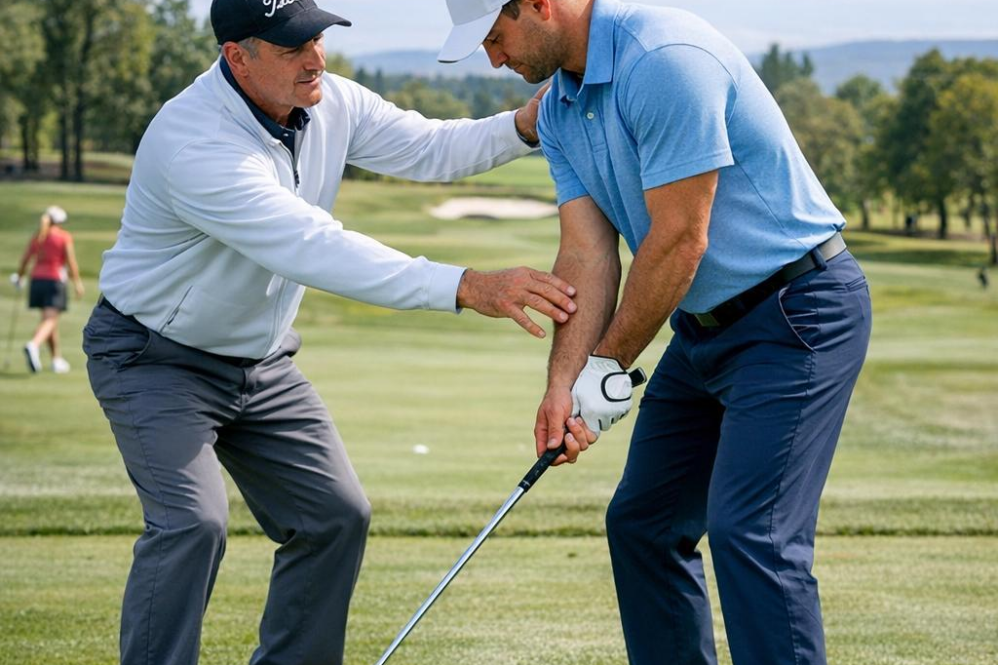
Raymond Floyd’s swing technique is celebrated for its efficient power generation and remarkable consistency, making it an excellent model for golfers aiming to refine their mechanics. A foundational element of Floyd’s swing is the compact takeaway with minimal wrist hinge during the initial phase, which promotes a stable club path and better control. Beginners should focus on maintaining a clubhead arc that stays low to the ground for the first 12 to 18 inches of the backswing, ensuring the club stays on-plane. For intermediate and advanced players, this translates to a more reliable transition, reducing the tendency to over-swing or cast. To develop this feel, try the drill of practicing slow, half swings while emphasizing a smooth, connected motion between arms and body – a method that improves tempo and sequencing similar to Floyd’s. Additionally,set up checkpoints such as keeping the lead arm straight and the clubface square at takeaway,as deviations here often lead to inconsistent ball striking and directional issues.
Building on the technical setup, Floyd’s approach also emphasizes a balanced weight transfer and a controlled hip rotation during the downswing, which helps to deliver power without sacrificing accuracy. A practical tip is to initiate the downswing by gently shifting the weight from the trail foot to the lead foot aiming for approximately 60% to 70% pressure on the front foot at impact. This encourages a descending blow, especially crucial when striking irons, fostering crisp contact and optimal launch conditions. Practice drills that promote this include using impact bags or slow-motion swings where players consciously feel their hips starting the movement before the arms follow. For low handicap golfers, refining this sequence can unlock added distance and stability through the shot. Moreover, Floyd’s compact finish position-with the body fully rotated and balanced-serves as an excellent reference point. Holding the finish for a few seconds helps golfers assess whether their swing was in control and properly sequenced.
strategically, Floyd was a master at tailoring his swings and shot choices to course conditions, especially in windy or fast green scenarios. Incorporating this mindset into your game means recognizing when to deviate from full, aggressive swings to more controlled, punch or knockdown shots that stay lower and reduce spin, enhancing accuracy and stopping power on firm or fast greens. Postured setup adjustments, like narrowing the stance and positioning the ball slightly back in the stance, help produce this more penetrating ball flight. Practicing partial swings and trajectory control drills from various lies will build confidence in these shots, which are vital under pressure during tournament play or arduous pin placements. By combining Floyd’s technical proficiency with smart course management, golfers can reduce errors, improve scoring opportunities, and adapt fluidly to different playing conditions, making consistent performance a reality.
Unlocking the Putting Secrets That Made raymond Floyd a Clutch Performer
Raymond Floyd’s mastery on the greens stems first from a fundamentally sound setup that maximizes control and feel. Begin by positioning your feet shoulder-width apart with your weight evenly distributed, allowing for a slight knee flex that supports stability. Floyd’s eyes align directly over the ball,ensuring a perpendicular line to your target helps eliminate unwanted lateral movement during the stroke. The putter face should be square at address,with your hands slightly ahead of the ball by about 1 to 2 inches to promote a smooth forward roll. Maintaining a relaxed grip pressure-like holding a tube of toothpaste without squeezing-enhances sensitivity and touch. Practicing this setup indoors with a mirror or alignment rod aids muscle memory, and focusing on a pendulum-like stroke, where the shoulders drive the putter while wrists remain quiet, is key to replicating Floyd’s consistency under pressure.
Equally important is Floyd’s strategic approach to reading greens and controlling distance, which is often overlooked by many golfers. He advocates for a thorough assessment of break,grain,and green speed before executing the putt - particularly on undulating surfaces or when whether conditions such as wind and moisture alter ball roll. For intermediate and advanced players, Floyd suggests visualizing the ball’s intended path from start to finish, factoring in slopes of 3 to 5 degrees to accurately gauge break.executing drills like the “ladder drill,” where you practice putts progressively farther from the hole focusing on consistent pace and trajectory,can build rhythm and confidence. Beginners should begin by putting to targets at 3, 6, and 9 feet to develop feel for distance control. This mental rehearsal combined with precise setup and stroke mechanics allows golfers to reduce three-putts, turning potential score leaks into scoring opportunities.
integrating Floyd’s putting methodology into course management elevates your overall game performance.know when to aggressively attack pins or when to play conservative lag putts to avoid unneeded risks on fast or slick greens-a principle Floyd mastered during pressure situations on tour. Incorporate a routine practice that replicates on-course scenarios by alternating between short, pressure putts (inside 6 feet) and long lag putts (up to 30 feet), focusing on maintaining the same stroke tempo irrespective of distance. Such as, on faster greens, slightly reduce backswing length but keep acceleration through impact consistent to prevent skid.Utilize equipment that complements stroke style – a mallet putter with a stable toe-hang can aid players who prefer a straight-back-straight-through stroke, while a blade putter suits those with a minor arc movement. By combining setup precision, green-reading savvy, and purposeful practice drills inspired by Raymond Floyd, golfers can enhance their clutch putting performance and ultimately lower their scores across diverse course conditions.
Driving Like a Pro How Raymond Floyd’s Approach Can Add Distance and Accuracy to Your Game
Raymond Floyd’s driving technique is a masterclass in blending power with precision, a balance crucial for maximizing distance without sacrificing accuracy. Central to his approach is maintaining a strong, yet controlled swing tempo, which prevents over-swinging and loss of balance. Floyd emphasizes a slightly shallower angle of attack-around 3 to 5 degrees upward-to optimize launch conditions with a driver, promoting a high launch and low spin for longer carry. Golfers should focus on a solid setup, ensuring the ball is positioned just inside the left heel (for right-handed players) and the shoulders aligned parallel to the target line. Implementing practice drills such as swinging with a metronome or recording swing tempo can definitely help beginners and advanced players alike develop a smoother, more repeatable release. By internalizing these fundamentals, golfers enhance not only their raw yardage but also their consistency off the tee in varying wind or turf conditions.
Another key insight from Floyd’s strategy is his deliberate use of shot shaping to navigate course challenges effectively. Rather than defaulting to a straight “power drive,” he advocates for mastering controlled fades and draws, which allow golfers to maneuver around doglegs, hazards, and tight fairways. Achieving these shapes requires subtle wrist angles and clubface control through impact; for instance, an intentional open clubface with a slightly outside-to-inside swing path produces a fade, while a closed face with an inside-to-outside path yields a draw. To practice these techniques, players can position alignment sticks on the range to guide intended swing planes and experiment with grip pressure adjustments. additionally, Floyd’s mentality encourages learning when to prioritize accuracy over maximum distance – a decision-making skill enhanced by scouting course layouts and playing to one’s strengths, ultimately lowering scores by avoiding penalty strokes.
Floyd’s approach also stresses the importance of integrating equipment awareness and mental focus into driving performance. The selection of a driver with the right loft-generally between 9 and 12 degrees depending on swing speed-and shaft flexibility can complement a golfer’s biomechanics to optimize launch conditions. He advises players to regularly test ball flight feedback and adjust settings accordingly during practice sessions, harnessing technology such as launch monitors for measurement of carry, spin rate, and clubhead speed. Mentally, Floyd’s routine includes pre-shot visualization and controlled breathing techniques to maintain composure, especially under pressure on signature holes. Exercises like slow, deliberate practice swings focusing on rhythm help embed a kinetic feel that translates seamlessly onto the course. By combining physical technique, equipment tuning, and mental discipline, golfers at all levels can emulate Floyd’s professional driving excellence to add both distance and accuracy to their game.