Elite-level golf excellence is produced when precise movement science,focused motor-learning methods,and smart course tactics are combined. Advances in motion analysis, validated training progressions, and pressure‑exposure practice now make it possible to convert technical tinkering into dependable scoring improvements. This piece brings together current biomechanical understanding, applied training strategies, and decision-making models to map a practical route for refining swing mechanics, increasing driving distance with control, and making putting more dependable under match conditions.
Grounded in quantitative examinations of joint motion, force transfer, and club‑ball interaction, the following sections identify the mechanical drivers of efficient swing patterns and long, accurate tee shots. Complementary material covers motor control concepts that speed skill learning and retention, and provides progressive, measurable drills to accelerate adaptation in practice and tournament settings. A dedicated short‑game and green‑reading segment focuses on repeatable stroke mechanics, pace management, and arousal control techniques that reliably influence scoring.Designed for coaches, movement scientists, and accomplished players seeking interventions backed by measurement, the article presents actionable assessment workflows, drill progressions, and on‑course rules of thumb. By connecting biomechanical diagnosis to drill-based remediation and tactical execution, the framework emphasizes quantifiable performance indicators-clubhead speed, carry dispersion, GIR conversion, and strokes gained-so teams and individuals can objectively monitor advancement over time.
Biomechanics of the Full Swing: Measured Targets and Focused Remediation
applying mechanical principles to human movement creates an impartial roadmap for improving the golf swing. Start by capturing the motion with a launch monitor and video/IMU systems to log clubhead speed, ball speed, smash factor, attack angle, dynamic loft, spin rate, and the kinematic sequence (pelvis → torso → arms → club). Practical baseline markers to monitor include: shoulder turn ≈ 80-100°, hip turn ≈ 30-45°, and an X‑factor ≈ 25-45° for players seeking a full, powerful rotation; driver attack angle for advanced golfers often sits slightly positive (~+1° to +3°), while many amateurs are closer to 0°; and a driver smash factor goal near 1.45-1.50 indicates efficient energy transfer.
Create a baseline report listing mean values, shot‑to‑shot variability and key correlations (such as, the frequency that off‑square face angles coincide with elevated side spin). Turning subjective “feel” into measured data helps coaches prioritize fixes that reduce dispersion and lift scoring metrics such as GIR and strokes gained.
When measurements reveal deficits, prescribe combined interventions: technical adjustments, physical conditioning, and eventual equipment refinement. Begin with address and setup checkpoints that are simple to verify-feet about shoulder‑width for a mid‑iron,ball one ball forward of center for mid‑iron shots,and hands slightly ahead of the ball at setup to promote solid compression. Then layer corrective drills and strength/mobility work tailored to the specific issue: if early‑extension is present, emphasize hip hinge and posterior chain activation (wall hinge drills and controlled Romanian deadlift variations); if casting/early release occurs, use impact‑target work and delayed‑release progressions to rebuild wrist retention; if rotation is limited, program med‑ball rotational throws and thoracic mobility sequences.
- Forward‑compression impact drill – execute 8-12 half swings into a soft impact pad focusing on forward shaft lean and downward strike; track resulting ball flight in full shots.
- Lower‑body initiation series - perform three sets of eight swings standing on wobble pads or low‑profile balance discs to emphasize the pelvis leading the sequence.
- Putter pendulum routine – hit 50 putts from 6-12 ft concentrating on a steady shoulder‑rock and near‑neutral wrist angle; use video feedback for face rotation analysis.
Set measurable practice objectives-such as, target a 3-6 mph increase in driver clubhead speed over 8-12 weeks accompanied by a smash factor enhancement of 0.05-0.10, reduce approach carry dispersion to ±10-15 yards, and aim to lower three‑putt frequency by roughly 30%. Only after consistent biomechanical improvement should you re‑visit loft, shaft flex/length, and lie angle so that the player’s swing, not the equipment, is the primary driver of performance changes.
integrate laboratory gains into on‑course decisions. Use scenario‑based practice to reproduce conditions: in gusts rehearse low‑trajectory controlled tee shots by moving the ball slightly back, de‑lofting the club, and shortening the arc to obtain lower launch with reduced spin; on tight par‑4s prioritize accuracy by rehearsing a three‑quarter swing with a hybrid to tighten dispersion. Adopt simple decision thresholds-if driver dispersion exceeds ±20 yards in wind, opt for a 3‑wood or long iron to protect GIR probability and avoid penalty risk. Reinforce mental routines-breath control, visualization, and consistent pre‑shot timing (as a notable example, a 3‑second address, 1‑second takeaway)-to lock in the neuromuscular patterns rehearsed in practice. For players with physical constraints, adapt technique (one‑plane variations, wider stance, reduced shoulder rotation) and individualize conditioning so mechanics remain repeatable. Link objective metrics to targeted drills, retest regularly, and translate those improvements into conservative, data‑informed course management.

Putting Precision: tempo, Read, and Feedback-Evidence‑Driven Drills
Start putting training by locking in a repeatable posture and a stroke that treats the putter as a shoulder‑driven pendulum rather than a wrist‑powered tool. Key setup checkpoints: eyes over or slightly inside the ball, a modest forward shaft lean (~2-4°) to deloft at impact, and ball placement roughly one putter‑head length forward of center for mid‑to‑long putts; use a more central ball for very short tap‑ins. Quantify wrist motion with slow‑motion video or stroke analyzers-aim for a stable shoulder rock with minimal wrist hinge (<10-15°) to reduce face rotation and improve face‑to‑path consistency.
Adopt a tempo framework such as a 2:1 backswing‑to‑forward time ratio (for example, 0.6 s backswing : 0.3 s forward) calibrated with a metronome or audible click; maintain the ratio while shortening the backswing on fast greens or very short putts. Suggested drills include:
- Metronome rhythm set - set tempo at 60-72 BPM and perform three sets of ten putts to quantify timing stability.
- Gate alignment exercise – place two tees just outside the putter path to train a square face through impact and reduce open/close deviations.
- Shoulder‑rock video check – record 20-30 seconds of slow‑motion to ensure minimal wrist break and stable upper body motion.
Thes progressions suit beginners (focus on balance and the pendulum feel) up to low handicaps (fine‑tune face rotation and tempo variability). Next, layer green reading and distance management using measurable cues: measure green speed with a Stimp or local yardage signage and adjust backswing length accordingly-on slower surfaces (<8 Stimp) increase backswing ~10-20% versus a 10 Stimp surface; on faster greens (>10 Stimp) shorten backswing and accelerate more through impact. Walk putts from behind and across the line to sense fall line and grain direction; use a systematic method (e.g., AimPoint or a two‑step slope conversion) to convert perceived slope into target feet of break.
- Short‑range clock ladder (3-12 ft): make 30 consecutive putts within a 3‑ft circle from varying angles; aim for an 80% make rate within four weeks.
- Lag ladder (20-40 ft): from three positions, hit ten putts each and count how many finish inside 3 ft; target 70-80% inside 3 ft from ~30 ft in practice.
- Three‑putt minimization simulation: play nine mock holes forcing lag putts to finish within 6 ft on all attempts longer than 20 ft; aim to reduce three‑putt frequency below 5% within a month.
Transfer requires robust feedback and pressure replication. Combine objective tools (high‑speed cameras, putting‑specific launch metrics, AimPoint numbers) with subjective pressure drills (competitive scoring games, time‑limited sets) to create immediate and delayed feedback loops. Use post‑round summaries-putts per GIR, three‑putt rate, average first‑putt distance-to define weekly targets (for example, reduce putts per GIR by 0.2). When technique faults appear-deceleration into the ball, or “flipping” at impact-address them with drills that force the desired feel: weighted‑handle follow‑through work for pace, toe‑tap or front‑foot pressure cues to discourage flipping, and gate drills to enforce face alignment.Tailor coaching entry points to learner type: visual players use slow‑motion and mirrors, kinesthetic players use weighted implements and ground cues, and auditory learners use metronome cadence. Couple physical practice with a concise pre‑shot routine,firm commitment to a read,and contingency plans for slopes and wind so putting gains reliably lower scores.
Driving: Sequence, Power, and Transfer-A Measured Approach
Maximizing driving performance is about timing force transfer from the ground through the body to the clubhead. The ideal proximal‑to‑distal sequence starts with the feet and ankles generating ground reaction, continues through the hips, then the torso, and finally the arms and club so peak angular velocity occurs near the clubhead. Think of the sequence like a multi‑gear drivetrain where each segment upshifts at the right moment to maximize output. For many players a practical guideline is ~45° of hip rotation and ~90° of shoulder turn on a full driver swing (individual variation applies) and a backswing‑to‑downswing tempo close to 3:1 to preserve timing.
- Step‑through weight shift drill – half swings stepping the trail foot through to emphasize weight transfer and separation.
- Top‑pause sequencing drill – hold the top for one second and start the downswing with the hips to feel proper initiation.
- Arm‑radius control – use an alignment stick or training ring to maintain a consistent arm‑to‑club distance and discourage early release.
Objective metrics from launch monitors-clubhead speed, ball speed, and smash factor-provide clear feedback. A realistic target when combining sequencing and conditioning is a 5-10% clubhead speed increase over 12 weeks, which typically converts to meaningful yardage gains without widening dispersion when programmed correctly.
Power development must be periodized and golf‑specific to avoid compromising control. prioritize three pillars: maximal strength (increase force capacity), explosive power (raise rate of force development), and rotational mobility (permit safe separation). A representative weekly structure could include two strength sessions (e.g., 3-5 sets of 3-6 reps at high intensity for compound lifts), 1-2 power sessions (explosive med‑ball rotational throws, jump variations or light Olympic derivatives), and daily mobility focuses targeting thoracic rotation and hip internal/external range. On the range alternate technique days (60-80 swings emphasizing sequencing and impact positions) with speed days (30-40 full‑effort swings using overspeed/underspeed implements and full rest between reps).
Common mistakes-trying to create power through the hands (early release) or failing to recover adequately-are corrected with retention drills (towel‑under‑arm, lag drills) and scheduled recovery to prevent fatigue‑driven breakdown. Scale exercises for the population: bodyweight and light med‑ball work for novices, progressive load‑velocity and monitored power metrics for skilled players. Before translating gym gains to the course, confirm equipment settings (shaft flex, loft) match the new kinematics and ensure compliance with the Rules of Golf. On course, be pragmatic-prioritize accuracy when hazards make misses costly, and only exploit distance when the reward outweighs the risk (e.g., wide fairways or reachable par‑5s). Simple on‑course adjustments-ball back in stance for penetrating wind shots, or choosing a tee box/setback that maximizes expected value-help turn added speed into lower scores.
Short‑term measurable aims could include a 10% improvement in fairway hit rate or increasing driving distance while keeping dispersion inside a defined band (for instance, ±15 yards). Combining sequencing, targeted strength/power training, and conservative on‑course choices produces sustainable gains in both length and accuracy that feed scoring improvements.
training Pathways by Level: From fundamentals to Competition Peaking
For beginners, the emphasis must be a resilient setup and reliable mechanics before adding velocity or complex shot shapes. Start with grip options (interlock or overlap) and maintain light grip pressure (roughly 4-6/10) to avoid tension. use posture references: spine tilt ~10-15°, knee flex ~15-20°, and a general weight balance near 55/45 toward the lead foot on full swings. Ball positions: driver just inside the lead heel, mid‑irons centered, wedges slightly back. Drill progression: verify alignment with a rod, rehearse a one‑piece takeaway, and pause at waist height to lock in positions.
- Alignment‑rod gate for takeaway and path
- Towel‑under‑arm to promote connection and avoid arm separation
- Impact‑pad compressions to feel forward shaft lean and solid contact
Typical faults-early extension, casting, inconsistent low point-are addressed with half‑swing tempo work (target a backswing:downswing rhythm near 3:1) before adding full speed.
The short game exerts outsized influence on scoring. For putting, train to square the face through a stroke rather than use loft changes; many modern putters have ~3-4° loft so face control is paramount. Chipping and pitching should be taught by intent: choose lower‑lofted clubs for bump‑and‑runs and higher‑lofted wedges to hold greens.Aim for crisp contact-approximately 1-2 inches behind the ball on chip strikes-and use the bounce in sand by entering a couple inches behind the ball with weight forward. Set measurable short‑game targets-e.g.,chip/pitch proximity ≤ 15-20 ft,bunker exits within 10 ft-and track them in practice to quantify improvement. Factor in environment-cold or wet conditions change spin and rollout, so adjust landing zones accordingly.
Advanced players and coaches should structure planning with periodization: a Foundation block (6-8 weeks) focused on technique and mobility, a Build block (8-12 weeks) that raises intensity and simulates pressure, and a Peak/Taper (1-2 weeks) for competition readiness. Include one recovery day weekly and at least one simulated tournament round every 7-10 days. Daily session templates: 10-15 minutes dynamic warm‑up, 30-45 minutes technical work with objective feedback, and 30-60 minutes situational practice (wind, elevation, course strategy). Use metrics such as GIR, scrambling rate, and strokes gained components to prioritize training focus.Tactical instruction favors conservative risk management-play to the fat side of fairways, choose bail‑out lines, and set lay‑up yardages when driver into hazard yields low success probabilities. Shot‑shaping is rehearsed by controlling face‑to‑path relationships: slightly closed face with an in‑to‑out path for draws, open face with an out‑to‑in path for fades-use alignment rods and intermediary markers to convert feel into reliable outcomes. Integrate mental skills-short pre‑shot routines (8-10 seconds), breathing for arousal control, and clear decision rules for provisionals or relief choices-so physiology, technique and tactics peak together in competition.
Performance Quantification: Metrics, Tracking Tools, and Benchmarks
Quality coaching begins with a quantified baseline: ball speed, launch angle, spin rate, attack angle, carry distance, dispersion, and strokes‑gained subcomponents (off‑the‑tee, approach, around the green, putting). Use validated launch monitors (TrackMan, gcquad, FlightScope, Foresight) and shot‑tracking platforms (Arccos, Shot scope, Garmin or similar systems) to measure at least 30 shots per club for statistical stability. Typical targets include a driver smash factor of 1.45-1.50 and launch angles held within ±1.5° of the player’s optimal.For wedges, aim for carry consistency within ±5 yards for low handicappers and ±10 yards for beginners.
Convert raw instrumentation outputs into on‑course planning: if your 7‑iron averages 150 yards carry with ±15‑yard lateral dispersion, avoid aggressively attacking pins protected by hazards inside that dispersion radius and plan conservative targets instead.
Design practice that blends technology, video feedback, and progressive overload. Start each session with setup and impact checkpoints-neutral spine tilt (~15°),appropriate shaft lean at address,and balanced impact weight distribution (roughly 55/45 front/back for irons)-then run diagnostics and corrective drills:
- Gate drill – tees slightly outside the clubhead to train squareness at impact.
- Plane stick drill – shaft‑aligned stick to promote a consistent backswing plane.
- Wedge clock ladder - map carry increments with abbreviated swings and record proximity outcomes.
- Tempo metronome – reinforce a stable backswing:downswing ratio (around 3:1 where it suits the player).
Record sessions with high‑frame‑rate video (≥240 fps) and compare kinematics to launch‑monitor outputs.Address recurring faults-early extension, over‑rotation, or casting-using targeted methods (wall drill, torso‑lead sequencing, towel‑under‑arm) and set short‑term goals (e.g., reduce lateral dispersion 20% in six weeks, increase GIR by 5%) with re‑testing every 3-4 weeks to demonstrate progress.
Turn technical gains into scoring advantage by mapping club distances and dispersion to hole‑specific risk‑reward charts: define lay‑up yards (e.g., 150-170 yards short of water), preferred miss directions, and safe bailout sides. Simulate pressure situations in practice where players must choose between aggressive or conservative strategies informed by their tracked metrics-players with consistent carry but wide dispersion should plan to miss short side and rely on wedge proximity to save par. Aim progression goals that combine statistics and scoring: raise GIR by 5-10%,reduce three‑putts below 8%,and lower average wedge proximity inside 25-30 ft. Track mental metrics (decision adherence, pre‑shot routine consistency) alongside physical KPIs so improvements are both measurable and transferable to competition.
Course Strategy and Skill Integration: Shot Selection, Risk Control, and Practice Transfer
Integrate setup fundamentals and club choice into intentional shot execution. A reproducible setup-correct ball position (mid‑iron 1-2 ball diameters forward of center, driver just inside the left heel), appropriate spine tilt (~5° away for driver, neutral for short irons), and balanced weight distribution (roughly 55/45 at address for iron compression)-supports reliable shot intention. Convert these checkpoints into club selection by choosing loft and trajectory that meet carry requirements and green‑holding ability-select clubs that clear hazards by at least 5-10 yards beyond the hazard margin to accommodate normal dispersion.
- Setup checkpoint drill – mark ball position and alignment sticks, take ten slow swings and confirm impact patterns align with the reference tee.
- Compression drill – perform 20 half swings with an iron aiming to take a 1-2 inch divot after the ball to feel forward shaft lean and clean contact.
When making on‑course decisions, use data-carry yardage, wind speed/direction, and green firmness-rather than only intuition. For example, into a 20 mph headwind, add 1-2 clubs or increase required carry by 10-20% and favor a lower‑trajectory shot (2-3° less loft) to reduce spin and drift. For shaping, adjust face‑to‑path relationships: to hit a controlled fade set the face slightly open (≈3-5°) to the target with a modest out‑to‑in path; to hit a draw close the face by a similar amount and feel a more inside‑out path. Use constrained drills-narrow gate sets and intermediate targets-to build these feels without losing fundamentals.
Embed the Rules of Golf into decision trees: if a ball is likely lost beyond water, play a provisional to avoid stroke‑and‑distance complications; when taking relief evaluate one‑stroke options (stroke‑and‑distance, back‑on‑line, lateral relief) to select the least risky path. By pairing measured technical modifications with explicit risk thresholds (such as,”lay up to 150-170 yards with my 7‑iron when the green is guarded”),players reduce big numbers and raise scoring consistency.
Make practice transfer by replicating course variability: alternate blocked practice to consolidate mechanics with random practice to improve decision making under pressure (as an example, 20 minutes of focused ball‑striking followed by 30 random, course‑like shots). Set quantitative targets-iron dispersion within 10-15 yards, driver fairway percentage >60% for mid‑handicaps, or a 10‑point increase in GIR over eight weeks. Include equipment checks-wedge bounce, grind, and lie-plus stance adaptations for tight lies or uneven lies. Use practice formats that create pressure (consequences for misses),random target practice,and short‑game ladders to ensure measurable gains translate to better scores. A unified approach that aligns technical metrics, risk thresholds, and realistic practice promotes consistent strategic play across skill levels.
Assessment → Action: Individualized Practice Plans with Evidence‑Based Progressions
Begin with a structured, metrics‑driven assessment across full swing, short game, putting, and course strategy. Collect launch‑monitor and video data for clubhead speed, ball speed, smash factor, attack angle, and spin rate for driver and representative irons-targets might include +1° to +3° attack angle for driver and approximately -4° to -1° for mid‑irons, depending on the player’s profile. Augment with on‑course stats-fairways hit, GIR, average proximity, and up‑and‑down rates inside 50 yards-and a technical screen covering grip pressure, stance width, spine angle, and weight balance.
- Setup checkpoints – neutral grip, face square, feet/shoulder alignment, correct ball position.
- Swing diagnostics – multi‑plane video, path vs face at impact, tempo ratio.
- Short‑game baseline – measured chip/pitch distances,bunker exit consistency,putt make rates from 3-20 ft.
Use the baseline to set measurable objectives (e.g., increase driver clubhead speed by 3-5 mph in 12 weeks, halve three‑putt frequency in eight weeks) and to build a periodized plan that follows motor‑learning sequence: start with blocked practice to create stability, move to variable practice for adaptability, then simulate competitive contexts to secure transfer.Prescribe drills with explicit criteria: to correct over‑the‑top paths, use an alignment stick across the target line with an inside‑out contact gate and impact pad work; to raise smash factor aim for ≥1.48 on driver session tests and incorporate weighted‑club tempo progressions over six weeks.
- Wedge clock drill - six balls from 20-60 yards aiming to land within a 10‑yard circle, narrowing over time.
- Putting gate & distance ladder – alternate short and long putts for 30 minutes,measure make‑rate and stroke‑length variance and reduce variance by 10% per month.
- Bunker entry practice – rehearse striking 1-2 inches behind the ball with an open face to achieve consistent splash distances to a set target.
Scale interventions by skill level: novices concentrate on impact fundamentals and controlled swings; intermediates add trajectory control and partial‑swing precision; low handicappers incorporate nuanced wind management, spin tuning, and purposeful shot‑shaping. Structure sessions into focused 15-20 minute blocks with recorded KPIs (carry variance,putting make thresholds) and corrective cues for recurring faults (wall drill and towel‑under‑arm for early extension).
Embed on‑course submission and reassessment cycles to ensure technical gains become scoring improvements. Build pressure simulations-nine holes with a target to minimize score from 100-150 yards-and apply a decision rubric in rounds that weighs risk, reward and execution probability based on recent practice KPIs. Adjust for environmental factors-reduce expected carry by 5-10% for every 10°F drop (useful as a rule of thumb) and increase spin expectations in wet turf. Reassess every 4-6 weeks with the same metrics to tune equipment (shaft flex, loft/lie, ball choice), re‑prioritize drills and set new performance targets (for example, raise GIR while keeping three‑putts below one per round).Linking measured assessment to staged practice and realistic on‑course rehearsal lets players of all levels reliably turn technical work into sustained scoring improvement.
Q&A
Note on search results: the supplied web links appear unrelated to this topic. The Q&A below is built from the article’s themes “Unlock Elite Golf Performance: master Swing, Putting & Driving Skills.”
Q1: What conceptual model underpins an “Unlock Elite Golf Performance” program?
A1: A three‑pillar model-biomechanics, skill‑specific technique (swing, driving, putting), and tactical application (course management)-underpins the program. it relies on measurement, targeted drills to remediate deficits, and objective progress tracking (kinematics and performance metrics).
Q2: How does modern biomechanics improve the full swing?
A2: Contemporary biomechanics clarifies how coordinated segment sequencing (pelvis → torso → upper limbs → club) and ground reaction forces efficiently produce clubhead speed. Focus areas include maximizing thoracic and hip range, promoting rotational dissociation (X‑factor), stabilizing the base and center of pressure, and controlling face orientation via forearm/wrist behavior at impact.
Q3: Which kinematic variables are essential for swing diagnosis?
A3: Vital metrics are peak pelvis rotation, shoulder turn, X‑factor, timing of the kinematic sequence, peak angular velocities, downswing transition timing, shaft lean and spine angle at impact. Motion capture or high‑speed video combined with launch‑monitor data yields these measures.
Q4: What technical markers define an effective driver swing?
A4: Key markers include swing width that supports speed, efficient weight transfer to lead side through impact, retained lag until late release, minimal lateral sway, consistent tee height and ball position, and an impact that produces a high smash factor with suitable spin for the player’s launch conditions.
Q5: How should driver setup and ball‑flight targets be chosen?
A5: Use launch‑monitor data to balance launch and spin for maximal carry given clubhead speed and attack angle. Couple this with course context-fairway orientation, typical wind, and hole risk-so equipment and target selection reflect what the player can reproducibly execute.
Q6: Which putting mechanics most strongly predict better scoring?
A6: Stable setup with eyes over the ball, a shoulder‑rock pendulum stroke, minimal wrist breakdown, repeatable impact acceleration, and consistent face angle at impact are primary determinants. Face angle at impact is the dominant mechanical factor for direction; path and roll control drive distance outcomes.
Q7: What drills improve putting distance control measurably?
A7: Distance ladders, clock drills for short‑range consistency, and gate drills for face control provide measurable outcomes. Track make rates and distance‑to‑hole to quantify progress.
Q8: How should training time be allocated across disciplines for scoring gains?
A8: Allocation depends on the player’s weaknesses but a common approach is heavier early emphasis on putting/short game (50-60%), 20-30% on full swing/driving, and 10-20% on situational practice and drills. Deliberate practice with immediate feedback should guide session design.
Q9: what role does course management play in converting technique into lower scores?
A9: Course management applies objective performance data (dispersion, carry distances) to minimize scoring risk: conservative club selection when hazards are penal, tee‑target strategies aligned to dispersion, and adherence to pre‑shot routines that preserve execution under pressure.
Q10: How are drills selected and progressed?
A10: Start from diagnostic assessment, prescribe constrained (single‑focus) drills, progress to variable practice, and finish with simulated transfer under pressure. Use measurable benchmarks-reduced dispersion or improved make percentages-to time progression.
Q11: What weekly metrics should coaches and players track?
A11: Track clubhead speed, carry distance, lateral dispersion, mean launch angle, spin rate, smash factor, GIR, proximity on approach, putts per round and strokes gained where available. Also log drill success rates and variability for short‑term monitoring.
Q12: How to structure a 4‑week microcycle for measurable gains?
A12: week 1-baseline testing and goal setting; Weeks 2-3-focused corrective work with progressive variability; Week 4-consolidation and transfer through on‑course simulations. Include pre/post tests and a short retention check after a brief break.
Q13: What common faults reduce repeatability and remedies?
A13: Early extension, casting, over‑rotation of the upper body, and lateral sway reduce repeatability. Correct with posture/stability drills (wall or impact pad), sequencing drills (step drill, pause at top), resistance training to alter activation patterns, and tempo‑based constrained practice.
Q14: How to integrate technology effectively?
A14: Use tech for objective baselines and trend tracking-video for kinematics, launch monitors for ball‑flight, wearables for sequencing and tempo. Limit metrics to a few meaningful variables tied to goals to avoid data overload and let expert coaching interpret results.
Q15: Evidence‑based approaches to improve putting under pressure?
A15: Simulate pressure (competitive games, constrained outcomes), reinforce a solid pre‑shot routine, use process‑oriented cues, and overlearn distance/line control. Practice under conditions resembling competition yields the best transfer.
Q16: How to apply risk‑reward calculus on holes?
A16: Estimate expected value by combining shot success probabilities (from tracked dispersion and GIR likelihood) with scoring consequences. Take aggressive lines only when marginal expected benefit exceeds marginal risk; otherwise choose the reproducible, lower‑variance option.
Q17: How should equipment be matched to elite aspirants?
A17: Fit components (shaft flex/torque, loft, face design, head geometry) to match the player’s kinematics and desired ball flight. For putters, match loft and stability to the player’s stroke arc. Use launch‑monitor fitting and on‑course verification for decisions.
Q18: What mobility and strength qualities support durable high performance?
A18: Important mobility includes thoracic rotation, hip internal/external rotation, ankle dorsiflexion, and shoulder girdle mobility. Strength/stability should emphasize glute and core function for force transfer, rotator cuff integrity for shoulder health, and lower‑body power (hip extensors) for ground reaction force production.
Q19: How are individualized prescriptions created for various skill levels?
A19: Combine assessment data (metrics, physical screen, skill tests) with goals.Novices need more hours on basics and motor patterning; advanced players require fine‑tuning, variance training and pressure transfer work. Prescriptions specify drills, volume, intensity and measurable milestones.
Q20: What realistic outcomes can players expect short‑ and long‑term?
A20: Short‑term (4-8 weeks): measurable gains in targeted metrics (reduced dispersion, increased putt make rates, modest speed gains). Long‑term (3-12 months): meaningful strokes‑gained improvements,lower scoring averages and stronger performance under pressure dependent on adherence and feedback quality.
Q21: How should effectiveness be evaluated scientifically?
A21: use pre/post designs with objective metrics, control for practice volume, track means and variability, estimate affect sizes, and evaluate transfer to on‑course results (GIR, scoring, strokes gained) to demonstrate efficacy.
Q22: Best practices for coach-player communication?
A22: Keep goals clear and measurable, give concise corrective feedback tied to data, schedule focused practice blocks, encourage player self‑review of metrics, and iterate the plan based on periodic reassessment.
If desired, this Q&A can be reformatted as a printable FAQ, individual answers expanded into short essays with specific progressions, or converted into a 4‑week sample schedule tailored to a handicap band. Select the option you prefer.
Closing summary
Unlocking elite golf performance requires a unified, evidence‑driven approach that blends biomechanical assessment, motor‑learning informed training, and situation‑specific strategy.Progress arises from reproducible mechanics, deliberate practice with progressive overload, and context‑rich transfer work. Practitioners should adopt measurable targets (clubhead speed, launch conditions, stroke consistency metrics), employ validated drills aimed at identified deficits, and rehearse decision‑making under realistic pressure.continuous empirical evaluation-through controlled testing and longitudinal tracking-will refine best practices over time.
Ultimately, elite progression is cumulative: rigorous assessment, disciplined implementation, and periodic re‑evaluation create a defensible pathway to more consistent performance and improved scoring for players across the spectrum.
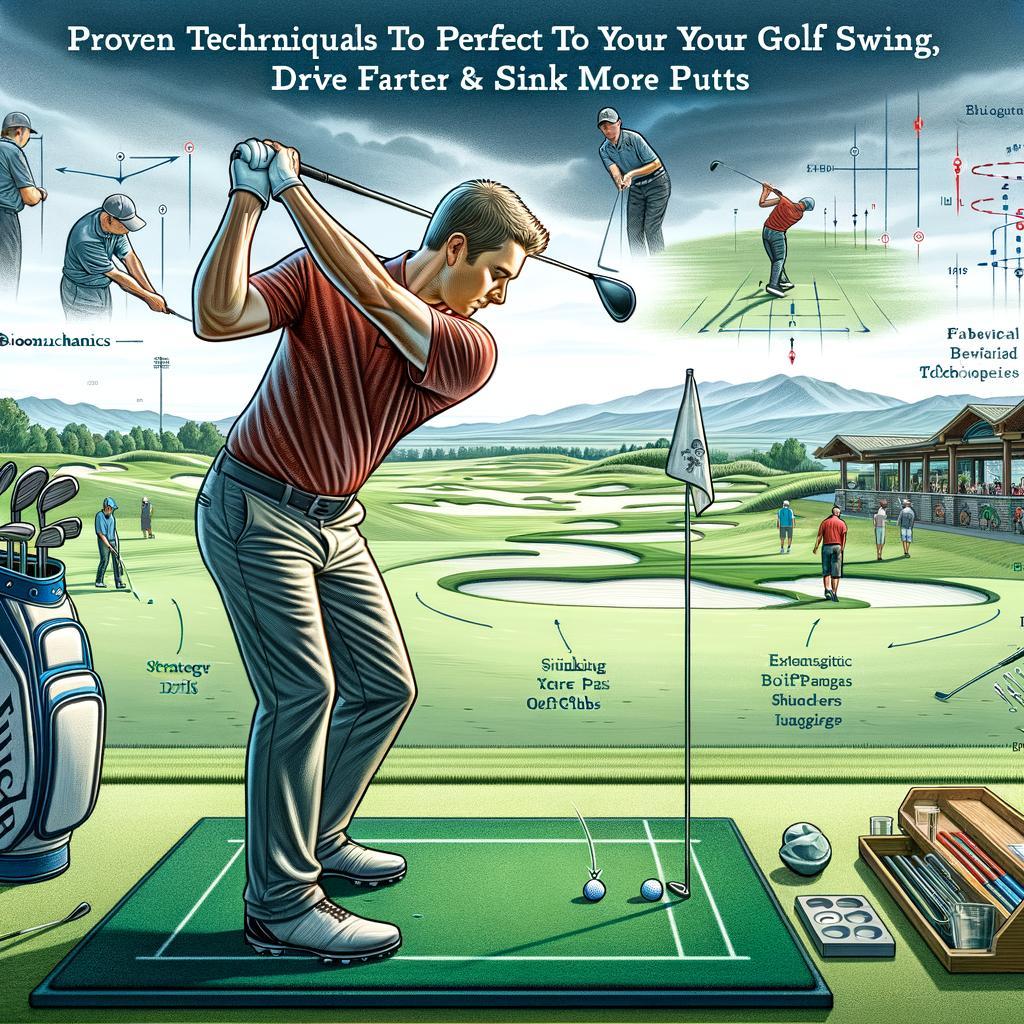
Elevate Your Game: Proven Techniques to Perfect Your Golf Swing, Drive Farther & sink More Putts
Master the Fundamentals: Grip, Setup & Alignment
Foundational elements determine repeatable success. Before chasing distance or speed, lock in a setup that produces consistent contact.
Grip
- Neutral grip: V’s formed by thumb and forefinger point toward your right shoulder (for right-handed players) - this promotes a square clubface at impact.
- Grip pressure: Hold the club at about a 4 out of 10 – too tight reduces wrist hinge and tempo, too light creates slippage.
- Check: Place a coin under your hands during a half-swing; if the coin falls, grip was too loose.
Stance & Ball Position
- Stance width: Narrow for wedges, shoulder-width for irons, wider for driver.
- Ball position: Center for short irons, progressively forward for long irons and driver (inside left heel for driver).
- Posture: Slight knee flex, hinge at hips, spine tilt away from target for driver to promote upward strike.
Alignment
- Pick an intermediate target (a blade of grass or tee) instead of the flag to align shoulders, hips, and feet.
- Use the “club on toe line” drill: lay a club along your toe line to ensure feet are parallel to target line.
Swing Mechanics: Efficient Kinematics for Power & Consistency
Power comes from sequencing and energy transfer, not brute force. Focus on efficient biomechanics to increase clubhead speed and accuracy.
Key Mechanical Concepts
- Ground force & weight shift: Start power from the ground – push into the trail foot on the takeaway, then transfer to the lead foot thru impact.
- Sequencing (kinematic chain): Hips lead, torso follows, then arms and club – train a 3:2:1 sequence for smoother acceleration.
- Rotation vs. lateral movement: Rotate around a stable axis rather than sliding sideways; excessive lateral sway causes inconsistent contact.
- Angle of attack: Slightly descending on irons, slightly ascending on driver to maximize carry and reduce spin (with driver aim for +2° to +4° upward AOA for many players).
Tempo,Rhythm & Timing
- target tempo ratio: 3:1 (backswing : downswing). Use a metronome app or count “1-2-3, GO” to ingrain timing.
- Drill: Half-swing to full-swing progression – maintain the same tempo across motions to stabilize timing under pressure.
driving: Maximize Distance with Control
Distance is a mix of clubhead speed, launch angle, spin rate, and strike quality. Optimize each variable rather than swinging harder.
driving Checklist
- Ball forward in stance, spine tilt away from target.
- Wider stance and slightly flexed knees for a stable base.
- Three-quarter coil on takeaway – don’t overswing the shoulders causing loss of connection.
- Initiate downswing with the hips to create the whip effect through impact.
- Focus on centered contact (slightly above center face for many drivers) to maximize ball speed.
Measurable Driving Goals
- Clubhead speed: Track with a radar or launch monitor. Typical amateur targets – recreational men: 85-100 mph, women: 65-80 mph. Each +1 mph of clubhead speed ≈ +2.3 yards of carry.
- Smash factor: Aim for 1.45-1.50 with driver – it’s ball speed divided by clubhead speed. Low values indicate energy is being lost due to poor strike.
- Launch angle & spin: For most players, driver launch 10°-14° with spin 2000-3000 rpm is optimal – fitting may vary these ranges.
driving Drills
- Headcover Drill: Place a headcover a few inches behind impact area; avoid hitting it to promote forward shaft lean and centered contact.
- Slow to Fast Drill: Make slow-motion swings focusing on sequence, then increase speed while keeping mechanics consistent.
- Alignment Rod Tee Drill: Place a rod on ground slightly inside target line to train inside-out path for draws.
Putting: Read, Stroke & speed Control
Putting wins strokes. Prioritize green reading, a repeatable stroke, and distance control above technical tweaking.
Putting Fundamentals
- Setup: Eye line slightly inside the ball or directly over for some players; shoulders parallel to target line; minimal wrist action.
- Pendulum stroke: Use shoulders and chest to create a fixed arc; wrists should be quiet.
- Start line vs. speed: The ball’s initial direction comes from the face angle at impact; good speed helps the ball hold the line through slopes.
Putting Drills
- Gate Drill: Place tees just wider than putter head to ensure path is square through impact.
- Clock Drill (distance control): 8-10 balls around the hole (3-6 ft, 6-10 ft, 10-20 ft); focus on making 3 fters first, then increasing distance while maintaining pace.
- Lag Putting Drill: From 50-100 ft, try to leave the ball inside a 6-10 ft circle. Track percentage of prosperous lag-inside results weekly.
Putting Metrics to Track
- Putting average per round – aim to reduce this by one stroke every 4-6 weeks.
- One-putt percentage inside 10ft – a higher percentage correlates strongly with lower scores.
Practice Plan: Drills,Measurable Metrics & weekly Schedule
Practice with purpose: track metrics,progressively overload difficulty,and balance technique,speed work,and pressure reps.
Sample Weekly Plan (3 sessions + 1 fitness)
- Session A – Range (60 mins): 15 min warm-up wedges, 30 min irons with focus on center strikes (use impact tape), 15 min driver: 50 good swings
- Session B – Short Game (60 mins): 20 min chipping, 20 min bunker, 20 min lob shots – track up-and-down attempts vs.successes
- Session C - Putting (45 mins): 15 min warm-up drills, 20 min distance control, 10 min pressure 3-putt avoidance (count successes)
- Fitness – Mobility & Power (45 mins): hip rotation, glute activation, anti-rotation core, speed-building med-ball throws
8-Week Measurable Progression
- Weeks 1-2: Baseline metrics – record average clubhead speed, smash factor, average putts, and greens in regulation (GIR).
- Weeks 3-5: Intensive drill focus (tempo, contact, lag putting). Expect 3-6% betterment in clubhead speed and 5-10% fewer putts per round.
- Weeks 6-8: consolidation & course simulation – apply skills under pressure on the course and measure scoring.
Equipment & club Fitting
Proper gear amplifies technical gains. A custom fit can reveal swing-specific shaft flex, loft, and lie needs.
- Shaft flex & weight: Match your swing tempo and speed. Too stiff reduces launch; too soft increases spin and inaccuracy.
- Loft & face angle: Optimizing loft for driver changes launch + spin dynamics – a fitter uses launch monitors to dial this.
- Grip size and putter length: Small changes in grip circumference or putter lie/length can correct face control and stroke consistency.
Golf Fitness & Mobility
Improved power, consistency, and injury prevention come from targeted mobility and strength work.
Key Areas to Train
- Rotational mobility: Thoracic spine and hips – increases turn and separation for more torque.
- Single-leg stability: Improves balance through the swing and delivers a stable impact platform.
- Explosive hip power: Med-ball rotational throws and kettlebell swings increase speed transfer.
course management & the Mental Game
smart decisions save strokes. Combine strategy with a calm pre-shot routine to execute reliably under pressure.
Course Management tips
- Play to your miss and the safe side of the fairway; avoid unnecessary risks into hazards.
- Pin management: When in doubt, aim for center of the green to maximize makeable putt percentage.
Pre-shot routine & Focus
- Consistent routine: Visualize target,take a practice swing,set,and commit – repeat the same steps shot after shot.
- breath control: Two deep inhales before address to steady heart rate and focus.
Case Study: From High 90s to Mid-80s in 10 Weeks
Player profile: Amateur male,mid-40s,handicap ~18. Baseline: average driver carry 205 yards, 36 putts/round.
- Interventions: Weekly focused practice (as above), two 30-min fitting sessions, and targeted fitness (rotational med-ball, single-leg RDLs).
- Results: Clubhead speed +6 mph (≈+14 yards carry), smash factor improved to 1.47, putts reduced to 30/round, handicap fell to ~11 in 10 weeks.
- Takeaway: Balanced training of mechanics, fitting, and fitness yields measurable, rapid gains.
Rapid reference Table: Drills & Targets
| Skill | Drill | Simple Target |
|---|---|---|
| Driver | Headcover / Smash factor | Smash ≥1.45 |
| Irons | Impact tape / Divot check | Center strikes 70%+ |
| Putting | Clock drill | 1-putt rate inside 10ft >60% |
| short Game | Up-and-down challenge | up-and-down % >40% |
Practical Tips & Quick Wins
- Warm up dynamically for 10-15 minutes before heavy swings – increases mobility and reduces injury risk.
- Use low-pressure challenges: try to make 5 of 7 mid-length putts in practice – translates to confidence on the course.
- Record video: Compare your swing to a weekly baseline to spot trends and prevent technique drift.
- Schedule periodic fitting checks after notable swing changes – equipment needs evolve with your swing.
Resources & Next Steps
- Invest in a basic launch monitor or get access at a fitting center for accurate clubhead speed, ball speed, launch angle, and spin readings.
- Create a simple tracking sheet (clubhead speed, smash factor, 1-putt rate, GIR) and review every 2 weeks.
- Book a short session with a certified coach for a targeted swing check – even 30 minutes can reveal one or two high-impact corrections.