

Putting determines scoring more than moast golfers appreciate: tiny deviations in alignment, timing, or launch translate directly into more strokes. Improving putt outcomes requires a systematic, evidence-led program – precise sensing, rigorous analysis of variability, and practice interventions proven to transfer from the range to tournament play.This article presents an integrated framework that blends high-resolution biomechanical measurement, robust statistical modeling, and cognitive-motor strategies to isolate the principal causes of inconsistency in putting and to prescribe focused remedies that improve on-course reliability.
The framework rests on three pillars.First, detailed measurement-motion capture, wearable inertial sensors, force/pressure systems, and instrumented putters-yields objective descriptions of club and body motion and of the club-ball interaction. Second, advanced analytics-hierarchical and time-series models, Bayesian estimation, and machine learning-decompose variability into within-player and between-player sources, infer latent control policies, and predict performance across contexts. Third, motor-control and cognitive techniques guide interventions that stabilize attention, optimize routines under pressure, and structure practice so learning generalizes to competition.
All components must meet strict methodological standards familiar in quantitative sciences: calibrated instrumentation, explicit uncertainty quantification, and obvious model evaluation. Prioritizing ecological validity-so lab-derived findings hold on actual greens-and pragmatic deployment for coaches and players is essential. Below we summarize measurement tools and protocols, statistical approaches for modeling shot dispersion and forecasting outcomes, practical practice designs and drills, perceptual training for green-reading, cognitive and arousal management tactics, equipment/surface considerations, and an implementation roadmap for monitoring and continual improvement.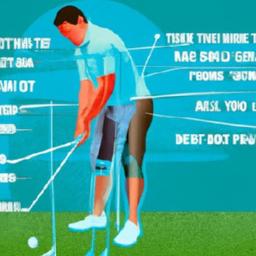
Putting biomechanics: Essential metrics and recommended measurement workflows
Analyzing the golfer-putter-ball system focuses on kinematic, kinetic and temporal indicators that directly influence aim and distance control. Core measures include putter‑head trajectory, face angle at the instant of impact, strike location on the face, temporal tempo (backswing:downswing ratio), and upper‑body/head stability. Together these describe both systematic biases (consistent left/right errors) and stochastic spread (trial‑to‑trial noise) and form the primary outcomes for evaluation. derived quantities frequently used in applied settings are stroke length,path curvature,face‑to‑path differential,peak deceleration at impact,and within‑subject dispersion measures (SD,coefficient of variation) for each variable.
Choose sensing solutions that align with the specific metrics you need and with operational constraints. Commonly used systems include 3D optical motion capture,putter‑ and body-mounted IMUs,high‑speed cameras,instrumented-putter accelerometers/gyros,and ground reaction sensors (force plates or pressure mats). because the most rapid events occur near impact,sampling density should be higher in that window to capture abrupt orientation and acceleration changes. The table below maps typical sensors to minimal sampling targets and primary outcomes to help configure practical measurement rigs.
| Sensor | Recommended Sampling | Primary Outcomes |
|---|---|---|
| 3D optical motion capture | 200-500 Hz | Putter trajectory, face orientation, joint kinematics |
| IMUs (putter & body) | 200-1000 Hz | Angular velocity, linear acceleration, timing/tempo |
| High‑speed video | 500-1000 fps | Impact timing, face angle validation, strike visualization |
| Force plate / pressure mat | 500-1000 Hz | Weight transfer, stance stability, ground reaction patterns |
Maintain consistent data hygiene: calibrate cameras and imus each session, synchronize timestamps across devices, apply reproducible sensor placement, and document filtering choices (e.g., low‑pass cutoffs determined by residual analysis). Design trials that control green speed (Stimp), set target distances and repetition counts (a common heuristic is ~30 trials per distance for stable variability estimates), randomize order, and include a standardized warm‑up to limit acute learning and fatigue. Pre-register processing pipelines and report sensor‑fusion parameters to improve reproducibility and make coaching translation straightforward.
When reducing raw data, aim for simplicity without losing explanatory detail.Report central tendencies (mean/median) and dispersion (SD, CV, RMSE) for each biomechanical metric, and evaluate reliability (ICC, SEM). For inferential work,linear mixed models account for nested structures (strokes within sessions within players); dimensionality reduction (PCA) or time‑continuous methods (statistical parametric mapping) can pinpoint when during the stroke differences arise. For coach-amiable reporting include: equipment and sampling rates; filtering and synchronization methods; trial structure and environment; and reliability indices and thresholds. This package turns biomechanical measurement into actionable targets for variability reduction.
Shot‑level modeling: describing dispersion and turning it into practical predictions
Modeling putting variability begins by mapping shot endpoints into a green‑centered coordinate frame and decomposing error into radial miss (distance from the hole) and angular deviation (directional offset from the intended line). Parametric representations (bivariate Gaussian or circular directional models) yield concise summaries-mean vectors and covariance structure-while nonparametric density estimators and mixture models capture multimodal patterns that arise from technique switches or variable surface conditions. These empirical distributions are the bridge from mechanical descriptors to performance metrics that matter on the scorecard.
To explain and forecast dispersion, build multilevel models that combine biomechanical covariates, green/environmental factors, and cognitive state indicators. Typical predictors are:
- Stroke kinematics (backswing distance,tempo ratio,face angle at impact)
- Ball launch (initial speed,spin,launch direction)
- Green geometry & condition (Stimp,slope,grain orientation)
- Psychophysiology and context (heart‑rate variability,time pressure,match importance)
Condensed,interpretable summaries support coaching and automated feedback. The example table below shows how distance bands can be summarized for model calibration and practitioner use, combining distribution descriptors and a straightforward make‑probability estimate.
| Distance Band | Mean Miss (cm) | SD (cm) | Pred. make % |
|---|---|---|---|
| Short (0-6 ft) | 16 | 11 | 88 |
| Mid (6-15 ft) | 32 | 18 | 44 |
| Long (15-30 ft) | 62 | 33 | 14 |
Actionable prediction models must report calibration and uncertainty: expected make probability with confidence or credible intervals,projected strokes‑gained against a baseline,and conditional risk under pressure. Use cross‑validation and hierarchical Bayesian methods to reduce overfitting and to propagate sensor uncertainty through to outcome intervals. Simulation tools (posterior predictive checks, match‑play simulations) let coaches compare interventions - such as, a program focused on stroke repeatability versus one emphasizing green‑reading – by estimating variance reduction and expected strokes saved, which supports individualized practice planning.
Designing practice: targeted drills, feedback scheduling, and measurable progress
High‑resolution measurement separates a putt into concrete components. By isolating face angle at impact,club path,tempo and strike location,the coach can replace subjective notes with clear numeric targets. A compact session metrics table translates sensor outputs into drill priorities:
| Metric | Sensor/Method | Interpretation |
|---|---|---|
| Face angle (deg) | High‑speed video / IMU | Primary determinant of initial ball line |
| Club path (deg) | optical tracking | Influences side curvature |
| Tempo (ratio) | Accelerometer | Key for speed consistency |
Drills should emerge from diagnostics: be specific, measurable and progressively more demanding. Combine variability training with task specificity so improvements transfer to real rounds. Typical drill families that map to the metrics above include:
- Alignment Gates – narrow visual apertures to shrink face‑angle spread;
- Randomized Distance Ladder – varying distances to train speed control and reduce tempo bias;
- strike‑zone Targets – thin tape or impact stickers to promote center contact;
- Tempo Metronome – auditory pacing to stabilise backswing:forward swing timing.
Close the loop with a intentional feedback schedule: high‑frequency augmented feedback (video replay, impact sound) is effective early in skill acquisition, while fading toward summary and self‑evaluative feedback improves retention and transfer. Implement a session plan that transitions from prescriptive cues to low‑frequency, outcome‑banded summaries once variability falls under pre‑set thresholds. Use simple statistical control rules (mean and SD of putt speed and face angle by block) to flag meaningful change, then iterate: tighten or loosen drill constraints, adjust feedback cadence, and re‑measure. This cyclical, data‑driven process targets the precise mechanisms generating inconsistency.
Perception on the green: measuring slope, grain and read reliability
Accurate green reading depends on converting surface geometry into a usable aiming and speed plan. Small slope gradients, expressed as percent grade per metre or degrees, systematically bias perceived lines and required speed adjustments. Objective measures (laser levels, digital inclinometers) should complement visual impressions as quantification replaces guesswork with trainable metrics.
Perceptual strategies can be trained as discrete skills that raise read reliability.Core tactics include:
- Global‑to‑local inspection: identify the dominant fall across the whole putt, then scan for local crowns and edges;
- Reference‑line calibration: use a stable visual reference (club shaft, putter face or distant horizon) to normalize tilt perception;
- Speed‑context adjustment: factor expected ball speed into the judged break since faster speeds reduce slope influence.
These components translate into measurable gains in alignment repeatability and reduced dispersion of missed putts in controlled tests.
To operationalize reads, adopt a concise rubric that links visual cues to a recommended adjustment index and use it to compute a read‑reliability score during practice. Compare player judgments against instrumented slope measurements to quantify accuracy and track improvement over time.
| observed Cue | Slope Range | Adjustment index | Read Reliability |
|---|---|---|---|
| Minimal tilt | 0-1% | Low | high |
| Moderate slope | 1-3% | Medium | Moderate |
| Marked crown/roll | >3% | High | Variable |
build read reliability by tracking hit/miss outcomes against quantified slope and grain direction to compute percent‑correct adjustments by slope band. Over repeated sessions, combine gaze analysis and outcome data to identify systematic perceptual biases (for example, under‑estimating subtle downhill reads or misinterpreting grain where mowing patterns cause asymmetric roll). The loop-measure, train, validate-makes green reading an empirically tractable skill rather than an intuition.
Decision rules and routines: managing cognition and arousal during competition
Modern models emphasize cognition-attention, perception and working memory-as central determinants of putt quality. These processes shape how the golfer encodes slope, gauges distance and chooses risk under time pressure. Effective control starts by constraining incoming data: remove irrelevant stimuli, prioritize the read cues that matter, and lock to a single target depiction to reduce decision noise and stabilize the motor program.
arousal affects these processes nonlinearly: a moderate activation level generally sharpens focus, while both low and excessive arousal hurt perception and selection. Convert this relationship into simple decision rules that players can apply under stress: when arousal spikes and visual clarity drops, bias toward safer speed and aiming choices; when arousal is in the optimal zone, execute normal mechanics and target selection.The rapid reference below turns this idea into an in‑round checklist.
| Arousal Level | Cognitive State | Applied Decision Rule |
|---|---|---|
| Low | Diffused attention; tentative commitment | Increase pre‑shot tempo; emphasise decisive stroke length |
| Optimal | Focused attention; clear read | execute planned stroke; maintain standard routine |
| High | Tunnel vision or anxious rumination | invoke calming routine; simplify aim and speed; consider conservative putt |
Turn cognitive control into repeatable behavior through a standardized routine. Elements to train include:
- Perceptual anchor - a single visual cue to commit to;
- Implementation intention – an if‑then plan (e.g., “If my heart rate exceeds X, then take three slow breaths”);
- Motor cue – a concise, consistent trigger for stroke initiation;
- Reset rule – an objective condition to restart the routine after two poor reads or three missed putts.
practice these components under graded pressure (short time limits, crowd noise playback, competitive scoring) and incorporate biofeedback where feasible. the goal is automation: under stress the golfer should shift from deliberation to robust, preprogrammed responses.
Equipment and greens: how putter design, ball contact and surface prep interact
Putter design deterministically influences initial launch and the subsequent roll. Variables such as face loft, moment of inertia (MOI), face stiffness, toe‑hang/face balance and overall mass distribution affect contact dynamics and energy transfer. Face loft and leading edge geometry modulate vertical launch and early skid: slightly higher lofts reduce skidding but can complicate control on very fast greens.MOI and mass allocation reduce sensitivity to off‑center strikes and preserve speed; grip diameter and shaft length change stroke mechanics and thus face orientation consistency. treat these elements as integrated performance variables rather than purely ergonomic choices.
Contact between ball and face proceeds through impact, skid, slide‑to‑roll transition and steady roll; the length of the skid and time to pure roll strongly predict distance control variability. Face texture and insert materials shape micro‑impulse transfer and rotational acceleration; therefore, evaluate putter faces on target green speeds rather than only on indoor mats. The compact comparison below summarises common face types and expected ball behavior.
| Putter Face | Contact Feature | Expected Roll Behaviour |
|---|---|---|
| Milled Steel | Uniform surface; higher energy return | Shorter skid; consistent transition to roll |
| Polymer Insert | Energy damping; softer feel | Longer contact; modestly extended skid |
| Grooved / Patterned | Controlled micro‑friction | Stabilised roll axis; reduced initial wobble |
Greens behave as complex mechanical systems: Stimp value,mowing direction (grain),moisture and microcontour geometry jointly set target launch conditions and acceptable speed error. Practical surface management reduces external variance: consistent mowing, routine rolling and sensible moisture timing smooth microtopography.Operational recommendations include:
- Standardized mowing heights on practice greens to limit speed variability.
- Routine rolling prior to precision practice to even micro contours.
- Dew and moisture management – schedule sessions when surface friction is in the target range.
- Replicate tournament Stimp during equipment testing to improve transfer validity.
For equipment selection, pair quantitative measurement with controlled green states. Use a high‑speed camera or launch monitor to record launch angle, skid length, spin and total roll‑out across a matrix of putter lofts and face types on multiple Stimp speeds. Run repeated trials (n≥10 per configuration) and report means and standard deviations for roll‑out and directional scatter. From these data choose the putter face/loft that minimizes skid and variance for the target surface and select practice balls whose behaviour matches tournament balls. Log environmental and readiness variables so future comparisons remain reproducible.
putting analytics in practice: baselines, KPIs and iterative refinement for coaches and players
Create a shared, data‑centred baseline and governance plan that assigns roles and data responsibilities. Adopt a standard measurement protocol (camera angles, sensor locations, Stimp calibration, environmental logging) so repeated assessments are comparable. Define primary KPIs (e.g., make% inside 3 m, mean miss distance when missed, strokes‑saved events) and thresholds for acceptable variation. Store raw and processed data, timestamped and normalized for green speed, in a central repository accessible to coach and player for transparent review.
Monitoring should blend automated analytics with structured human review to capture both trend signals and contextual nuance. Produce reports at multiple cadences: session (micro), weekly block (meso) and season (macro). Use visualization (control charts, trend lines) to separate signal from noise and adopt statistical decision rules (for example, sustained deviations beyond two SDs trigger technical review). Suggested monitoring items include:
- session log: putt count, surface conditions, drills performed
- Performance metrics: make rates by band, mean miss vectors, tempo variance
- Qualitative notes: confidence, cognitive state, fatigue
Model validation must be systematic and repeated after retraining or hardware changes. Validate predictive/prescriptive models with holdout sets and K‑fold cross‑validation; check calibration (predicted vs observed probabilities) and discrimination (ranking ability). Use evaluation metrics that map directly to coaching actions and risk tolerance. The minimal validation table below shows practical thresholds and triggers for intervention.
| Metric | What it measures | Action threshold |
|---|---|---|
| Mean distance to hole (missed) | Average severity of missed putts | > 0.9 m → increase pace control training |
| Putts made % (0-3 m) | Short‑range conversion | < 85% → prioritise alignment & confidence routines |
| Tempo variability (SD) | Consistency of stroke timing | High → introduce metronome/tempo drills |
Continuous improvement is implemented through controlled experiments and recorded learning cycles. treat each change as a testable intervention with a stated hypothesis, measurement window and stopping criteria. Use A/B comparisons for technique variants and sequential analysis for efficient inference. Maintain a living playbook-versioned drill libraries, annotated video exemplars and a decision log-so successes are reproducible and negative results inform further hypotheses. Schedule regular coach-player reviews with clear agendas: review recent data, validate or reject model inferences, prioritise next interventions and assign verification tasks.
Q&A
Below is a practical Q&A that complements an article titled ”Analytical Approaches to Improving Golf Putting Performance.” It synthesizes measurement, modeling and cognitive methods to reduce variability and enhance competitive consistency. Note: some methodological parallels are drawn from analytical chemistry literature (refs.1-4) because those fields emphasise instrument sensitivity, characterization of rare states and rigorous validation-principles that apply equally to sports measurement pipelines.
1) What is the central message?
A: Combining precise biomechanical sensing, sound statistical modelling and evidence‑based cognitive/motor interventions produces targeted reductions in putting variability and improves the likelihood of repeatable results under pressure.
2) which biomechanical metrics are most informative?
A: Useful variables include putter‑head kinematics (path, face angle at impact, angular velocity), contact metrics (strike location, dynamic loft, launch speed), temporal measures (backswing and downswing durations), body‑segment angles (shoulder/hip/wrist) and ground reaction patterns. Ball roll metrics (initial speed, launch direction, skid length) complement these to predict final position.
3) What measurement systems are recommended and why?
A: A practical suite includes optical motion capture for full‑body kinematics,IMUs for on‑course portability,high‑speed video for impact verification,force/pressure sensors for stance dynamics,impact sensors for precise timing and face orientation,ball trackers for launch/roll metrics,and eye‑tracking for visual attention studies. Balance resolution, ecological validity and feasibility; prioritise devices with documented error characteristics.
4) How should data be preprocessed?
A: Synchronize sensor streams, apply appropriate filtering with documented cutoffs, define reproducible event markers (address, top of backswing, impact), normalize subject‑specific metrics where appropriate, remove outliers by pre‑specified rules and estimate measurement reliability (e.g., ICC) before inferential modelling.
5) Which statistical models fit putting data?
A: Use hierarchical mixed‑effects models to account for repeated strokes within players, variance component analysis to partition noise sources, glmms for binary outcomes (make/miss), time‑series or state‑space models for sequential dependencies, Bayesian hierarchical frameworks for small samples and prior integration, and machine‑learning algorithms for predictive tasks paired with interpretability methods and strict cross‑validation.
6) How should performance be quantified?
A: Combine outcome measures (make probability, distance left after stroke, strokes‑gained) with process metrics (SD and CV of face angle, launch speed error, lateral deviation, strike location, tempo). Composite measures such as RMSE from target speed or signal‑to‑noise ratios for key kinematic indicators are helpful for comparing interventions.
7) How can putt‑to‑putt variability be reduced?
A: Measure within‑player SD and CoV, identify dominant variance sources with variance‑component models, and target interventions accordingly: centre‑contact drills with immediate feedback, tempo training with metronome cues, alignment constraints, and staged release of task constraints. Use faded feedback schedules to avoid dependence on augmented cues.
8) What cognitive strategies are supported?
A: Standardise pre‑shot routines, train a quiet‑eye gaze strategy, favour external focus cues (ball path/target), use breath or biofeedback for arousal control, and include stress‑exposure drills to inoculate performance under pressure.
9) How do you combine biomechanical feedback with cognitive training?
A: Pair objective kinematic or impact feedback with consistent cognitive prescriptions. For example, provide immediate face‑angle feedback while enforcing a prescribed pre‑shot routine and quiet‑eye behaviour, moving from frequent to intermittent feedback to encourage retention.
10) How should intervention studies be designed?
A: Use within‑subject repeated measures with counterbalancing, pre‑register hypotheses and outcomes, power analyses guided by pilot variability, ecological manipulations (green speed, slope, crowd noise), proper randomization/blinding where feasible and retention/transfer tests to measure learning beyond immediate effects.
11) How can models forecast competitive outcomes?
A: Build multilevel predictive models using biomechanical consistency measures, routine adherence, physiological markers (HRV) and context variables (Stimp, wind). Validate with out‑of‑sample tests and prospective trials; produce probabilistic outputs (chance of make from distance) to support tactical decisions.
12) What pitfalls should be avoided?
A: watch for overfitting small datasets,neglecting sensor error reporting,overreliance on sterile lab setups,excessive immediate feedback creating dependency,and assuming one technique fits all players. Many interventions have modest effects; ecological, longitudinal randomized trials are still limited.
13) how to translate findings into practical impact?
A: Convert statistical results into on‑course quantities (e.g., percent change in make chance from a specific distance, expected strokes saved per round). Report effect sizes and uncertainty, estimate the time or resource investment needed for a given performance change and present cost‑benefit tradeoffs.
14) What computational best practices should researchers follow?
A: Share code and anonymised data where possible, use nested cross‑validation for tuning, quantify uncertainty with CIs or credible intervals, report diagnostics and assumptions, and validate models prospectively across settings and populations.
15) What are priority research directions?
A: High‑priority areas include longitudinal retention studies, multimodal datasets (kinematics + EMG + eye‑tracking + physiology), personalised models for individual prescriptions, studying rare clutch states with suitable methods, and developing validated portable systems for in‑situ competition monitoring.
16) How should coaches implement these recommendations?
A: Start with a baseline using a compact sensor package (putter sensor + high‑speed video + pressure mat), identify the main sources of variation, target a small number of measurable outcomes (e.g.,impact consistency,tempo),deploy combined biomechanical and cognitive training with phased feedback reduction,and track progress using simple control charts and rolling SDs.Reassess periodically and adapt prescriptions to objective metrics.
17) What lessons from analytical chemistry apply here?
A: Analytical chemistry emphasises instrument sensitivity, characterising rare states and rigorous validation; these translate to sports measurement as the need for high‑resolution sensing, specialised methods for rare clutch events, and fully validated pipelines with quantified measurement uncertainty.
18) What ethical and practical limits matter?
A: Obtain informed consent, safeguard privacy, avoid turning play into an over‑instrumented burden, watch for equity issues in access to technology, ensure interventions do not increase injury risk, and openly communicate uncertainty in recommendations.summary statement
A disciplined, analytics‑centred approach-anchored in validated measurement, appropriate statistical models and targeted cognitive interventions-can reduce putting variability and boost transfer to competitive situations. Success depends on methodological rigor, ecological validity and individualization.Future work should prioritise multimodal, longitudinal studies and portable validated sensors to advance predictive and prescriptive capabilities.
References and further reading
– Note: methodological parallels from analytical chemistry (refs. 1-3) illustrate the importance of instrument sensitivity and method validation; those principles are useful when building validated measurement and analysis pipelines in sports biomechanics.
Bringing biomechanical measurement, statistical modelling and cognitive assessment together provides a coherent strategy for improving putting consistency. Quantifying stroke kinematics and impact dynamics, coupled with robust inferential and predictive models, identifies the key drivers of performance and enables systematic evaluation of interventions. Adding perceptual and cognitive metrics gives essential context for how internal states and decision processes modulate motor output in varied task environments.
limitations remain: individual anatomy, learning history and psychology constrain worldwide parameter thresholds; ecological validity can be compromised when lab metrics are naively projected onto tournament play; and measurement error, sensor occlusion and model overfitting reduce translational power unless explicitly addressed through validation and replication.
In practice, adopt an iterative, multidisciplinary cycle: measure baseline behavior with validated tools, apply model‑guided interventions and monitor within‑subject changes, and prioritise field studies that capture performance under genuine competitive pressure. Future progress will come from interpretable machine‑learning models, lighter validated sensing systems and systematic studies of how cognitive strategies combine with motor training to produce durable improvements in putting consistency.
When rigorous methods meet on‑course relevance and personalised prescriptions, analytical approaches can materially improve putting performance. Ongoing collaboration among biomechanists, statisticians, psychologists and coaches is essential to convert analytic insight into reliable scoring gains.

Putting Precision: Data-driven Strategies to Lower Your Score (tone: Technical)
Choose a Title & Audience – quick guidance
Below are the title options you provided with a short note on the ideal audience and tone. Tell me which you prefer and I’ll refine the full article or produce alternate tones (competitive, playful, or coach-focused).
- Putting Precision: Data-Driven Strategies to Lower Your Score – Best for data-minded amateurs and coaches who want actionable metrics.
- The Science of the Perfect Putt: Biomechanics,Stats & Mindset - Good for readers wanting a balanced mix of lab results and mental skills.
- From Stroke to Science: How Analytics Transform Putting – Data geeks and club fitters; emphasizes tech and measurement.
- Dial In Your Putting: Analytical Techniques for consistent Greens – Practical, stepwise approach for amateurs and instructors.
- Putting Under the Microscope: Reduce variability,Sink More Putts – Technical,research-centric audience.
- Master the Greens: evidence-Based Putting Performance Hacks – Kind, results-driven for weekend golfers.
- Pinpoint Putting: Combining Biomechanics and Analytics for Better Results – Coaches and high-level amateurs who use measurement tools.
- Make Every Putt Count: A Scientific Approach to Consistency – Practical and motivational for broad amateur audience.
- The analytics Advantage: Turning Data into Better Putts – Suited for analysts,coaches,and club professionals.
- Putting Performance Unlocked: Metrics, Mechanics, and the Mental Edge – Extensive, cross-disciplinary appeal.
- Precision Putting Playbook: Analytics and Psychology for lower Scores – Coachable program format for training plans.
- Green science: Optimize Your Putting with Biomechanics and Models – Academic/technical readers.
biomechanics: The mechanical baseline for consistent putting
effective putting starts with predictable kinematics. The goal: minimize unwanted degrees of freedom (wrist flick, inconsistent face angle) while preserving a repeatable pendular motion that controls face orientation and speed.
Key setup variables to standardize
- Grip: Keep grip pressure light-to-moderate; research shows excessive tension increases stroke variability. Use consistent hand placement and contact area.
- Posture & eye position: Aim for eyes roughly over or slightly inside the ball-line to improve alignment accuracy.Stable lower body reduces upper-body compensations.
- Shoulder-driven arc: A shoulder hinge (pendulum) minimizes wrist break and stabilizes putter face orientation at impact.
- Putter face control: Face angle at impact explains most lateral error. Prioritize square face through impact over path-only corrections.
- Tempo & rhythm: Consistent backswing-to-forward ratios (e.g., 2:1) reduce distance error by producing reproducible acceleration curves.
Recommended biomechanical drills
- Gate drill (short putts): place two tees to force a square-face path.
- Metronome tempo drill: use 60-80 bpm to establish a consistent stroke cadence.
- Shoulder-only drill: putt with hands across chest to feel shoulder-driven motion.
Analytics & metrics: what to measure and why
Collecting the right metrics turns practice into progress. Trackable KPIs let you isolate whether misses are due to speed,line,or mechanical inconsistency.
| Metric | Why it matters | Typical tool |
|---|---|---|
| Face angle at impact | Primary predictor of lateral miss | Optical sensor / launch monitor |
| Launch direction | Shows initial line independent of path | Putting mat sensors / camera |
| Ball speed (impact) | Distance control; correlates with 1-putt probability | Radar / pressure mat |
| impact location on face | Gear effect and energy transfer variability | High-speed camera / face sensor |
Trackable performance KPIs (season/round level): putts per round, putts per GIR, Strokes Gained: Putting, average proximity-to-hole from 3-10 ft. Use these to validate training transfer to scoring.
Green reading & surface interaction
Reading slope and pace is a cognitive-perceptual skill layered on top of mechanics. Accomplished green reading minimizes systematic line errors so your biomechanical repeatability becomes effective.
Best practices for reading greens
- Use a constant read routine: check slope visually, feel grain underfoot, and step back to visualize the fall line.
- Calibrate for speed: an identical stroke averages different results on faster greens-train at the speed you play.
- AimPoint and other systematic methods provide repeatable angle estimates. Learn one method deeply rather than constantly switching.
- confirm with short practice strokes: use a short “test” putt to sense pace and initial break.
Drills for green reading & speed control
- Three-distance ladder: from 3-6-9 ft, aim for centre of cup and record proximity-to-hole to build feel.
- Speed sensitivity drill: practice controlling a fixed release to land ball within 18 inches on varied green speeds.
Attentional control, routine & the mental edge
Cognitive factors consistently predict performance under pressure. The strongest evidence points to a compact pre-shot routine, external focus of attention, and “quiet eye” gaze behavior.
- Quiet eye: Maintain a final fixation on a small target (e.g., near the far edge of the cup or a specific seam on the ball) for 1-3 seconds prior to stroke initiation to improve accuracy.
- External focus: Focus on the ball’s intended path or impact point rather than internal mechanics; external focus tends to improve automaticity and consistency.
- Pre-shot routine: Use a 4-6 step routine (read line, pick a target, breath, rehearsed stroke) to reduce variability and stress-induced changes.
- Pressure simulation: Include formats with consequences (betting, partner watching, time pressure) to train performance under stress.
Practice planning: converting drills into measurable betterment
Structured practice that blends blocked mechanics and random contextual practice yields better transfer to rounds.
| Session Focus | Format | Example |
|---|---|---|
| Technical (biomechanics) | Blocked | 200 short-putts from 3 ft with gate |
| Distance control | Random | Pick random spots 10-40 ft; aim to leave within 6 ft |
| Pressure & simulation | competitive | Match-play points, 3-putt penalties |
Weekly plan (example):
- 2 sessions technical (30-45 minutes): focus on face control, gate drills, tempo.
- 2 sessions contextual (30-45 minutes): distance control ladder and green reading.
- 1 pressure session (game-based, 30 minutes): simulate tournament conditions.
Practical drills – quick reference
- Gate + mirror: Ensures square face and consistent eye position.
- String line drill: Visualize the ball path with a taut string on the line to refine launch direction.
- Clock drill: 8-12 balls around cup at 3-4 ft to build pressure putt consistency.
- Lag putting ladder: 15,25,35,45 ft-goal to leave inside 6 ft each time.
- One-ball challenge: Play entire hole with one ball; every miss costs a putt-great for mental control.
Case studies & first-hand observations
Example A: An amateur with inconsistent distance control reduced three-putts by 45% after 6 weeks of tempo metronome drills combined with weekly lag-ladder practice. Measured improvement: average proximity-to-hole from 30 ft improved from 12 ft to 6 ft.
Example B: A coach used face-angle feedback from a putting sensor to reduce lateral misses.By focusing on face-to-target alignment rather than path,the student cut putts from 33 to 29 per round over two months; Strokes Gained: Putting improved measurably.
Benefits and practical tips
- Reduce stroke variability to increase 1-putt probability and reduce scoring variance.
- Use metrics (face angle,ball speed,impact point) to target the largest error source; this shortens the feedback loop.
- Train pace and green-reading under the same conditions you compete on (green speed,pressure,footwear).
- Keep equipment simple: a putter that promotes consistent face control beats adding complexity with exotic setups.
Common pitfalls and how to avoid them
- Over-focusing on mechanics mid-round – rely on your pre-shot routine and external focus.
- Unbalanced practice (too many short putts only) – allocate time to lag putting and green reading.
- Ignoring data – small measurement changes (face angle or speed) compound; collect simple KPIs weekly.
Next steps – tailor this to your audience
want this article adapted for a specific audience (coaches, amateurs, data geeks, pro players)? I can:
- Produce a coach’s lesson plan with rep counts and periodization.
- Create a player-focused 8-week putting program for amateurs.
- Develop a data-geek version with recommended sensors, sampling rates, and statistical thresholds.
- Make a pro-level tactical guide with on-course routines, tournament warm-ups, and marginal gains checklist.
Pick a title from the list above and the audience/tone you want (technical, competitive, playful, coach-focused, or beginner friendly) and I’ll deliver a refined headline, meta-data, and a full tailored article or lesson plan.




