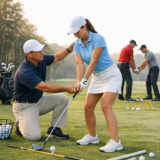
This article examines how the swing and driving techniques of Nick Price can inform reproducible pathways to elite golf performance by integrating biomechanical analysis, strategic shot selection, and evidence-based practice protocols. Price’s swing-refined under david Leadbetter beginning in the early 1980s and widely regarded as the prototypical model of the 1990s-provides a useful case study in how deliberate technical refinement, consistent kinematic sequencing, and disciplined repetition produce reliable ball striking and superior driving performance. Contemporary commentary and technical analyses characterize Price as one of the best all-around drivers of his generation, whose peak-era mechanics offer transferable principles for modern players and coaches alike.
Key technical themes to be explored include preserved body angles through the action, efficient transition timing between backswing and downswing, impact position consistency, and strategies to prevent common faults such as early extension or flipping at the hands. These elements have been highlighted in both practitioner-focused analyses of body angles and timing and in player-facing syntheses of Price’s ball-striking keys.By framing Price’s technique within a biomechanical and motor-learning context,the analysis moves beyond description to identify the causal links between specific movement patterns and outcome reliability.
Methodologically, the article synthesizes biomechanical kinematic/kinetic perspectives with empirical practice frameworks-emphasizing high-quality repetition, targeted variability, and measurable progress markers-while also situating driving strategy within shot-selection principles appropriate to competitive play. The goal is to translate diagnostic insights from Price’s model into actionable coaching cues, structured drills, and practice prescriptions that promote transfer and long-term reproducibility of elite-level swing and driving performance.
Biomechanical Foundations of Nick Price’s Swing: Kinematic Sequencing and Postural Control
Effective power delivery in a golf swing depends on proximal-to-distal kinematic sequencing, where the motion is initiated by the pelvis, followed by the torso, then the arms and finally the clubhead. In practical terms, this means the pelvis should begin rotation early in the downswing while the upper body remains slightly delayed, creating a torque cascade that produces higher clubhead speed with controlled strike. For instruction, target a pelvic rotation of approximately 30-45° through the backswing and a shoulder turn near 80-100° (measured across the chest) for a full iron swing; these ranges are consistent with elite rotation patterns and are typical of Nick Price’s technique. To feel and train the sequence, use these drills and checkpoints:
- Medicine-ball rotational throws (3 sets of 10, light-to-moderate effort) to ingrain pelvis-first initiation and improve core power transfer.
- pump drill – pause at the top and perform three short pumps focusing on rotating the hips toward the target before letting the arms release; this emphasizes the pelvis-before-arms timing.
- Impact-bag contact – practice hitting into an impact bag to feel forward weight shift and a square clubface at contact, aiming for a slight forward shaft lean of 10-20° at iron impact.
These exercises progress novices toward efficient sequencing while giving low-handicappers measurable cues to refine timing and reduce common faults such as casting or an early arm-dominated release.
Postural control is the foundation that allows the kinematic sequence to operate consistently; without a stable spine angle and balanced ground interaction, timing breaks down and so does shotmaking. At setup establish a neutral spine tilt of about 10-15° forward from vertical, knee flex approximately 10-15°, and a stance width roughly equal to shoulder width for irons (wider for long clubs), which together promote rotation rather than lateral sway. Equipment choices affect these parameters: shaft length and flex, lie angle, and clubhead mass influence your ability to maintain spine angle and achieve the desired release - a proper fitting will often reduce compensations that produce early extension or reverse pivot.For on-range checkpoints and common corrections, practice:
- Mirror or camera setup check – record address, mid-backswing, and impact to verify you maintain spine angle within ±5°; correct by re-establishing knee flex or shortening your shaft if necessary.
- Wall-posture drill – stand with your buttocks and shoulder blades lightly touching a wall, make half swings to feel the same spine angle through the motion; this reduces ‘standing up’ at impact.
- Feet-pressure feedback – use pressure-sensing mat or simple footwork drills to feel a transition from ~50/50 at address to ~60-70% rear weight at the top and then ~60-70% forward weight at impact for optimal compression.
by combining setup fundamentals with specific drills, players of all levels can systematically correct early extension, excessive sway, or an overly passive lower body, thereby improving contact quality and consistency around the greens as well as from full shots.
translate biomechanical improvements into on-course strategy and repeatable routines: Nick Price’s approach emphasizes predictable ball flight and course management – hit target-oriented shots, then play percentages rather than heroic attempts. Establish measurable practice goals such as reducing approach-shot dispersion to within 15 yards of target at a given club, or achieving wedge-distance increments of 5-7 yards through controlled swings. Incorporate situation-based drills and mental routines:
- Yardage ladder (wedge control) – hit 6-10 shots at incremental distances (e.g., 60, 70, 80, 90 yds) and log carry to tighten your yardage gaps.
- Wind and trajectory practice – on breezy days practice lowering or increasing launch (shaft lean and hand position) to control spin and landing angle; select higher-lofted clubs to hold greens into headwinds and lower trajectories for tailwinds.
- Course-management checklist – before every tee shot pick a precise target, identify trouble areas (hazards, bunkers) and commit to a club that keeps the next shot in play, remembering the USGA rule of a maximum of 14 clubs in the bag and local rules about grounding in penalty areas.
For different learning styles and physical abilities, offer visual (video feedback), kinesthetic (impact bag and medicine ball), and verbal cues (short, repeatable pre-shot routine). integrate short-game posture adjustments (more knee flex and forward weight for chips, stable lower body for bunker explosion) to ensure that biomechanical gains translate directly to lower scores and dependable course strategy.
Clubface Management and Path Optimization for Consistent Ball Striking
Begin with a repeatable setup that makes clubface management a predictable variable at impact.Set the clubface square to your target line at address by using an alignment rod or the trailing edge of the clubhead as a visual cue; for irons the toe should point slightly left of the target for a neutral to slightly closed face on shorter shots, while for driver the face should be square to the target or set slightly open when accommodating a draw bias. Transitioning into impact, adopt forward shaft lean with the hands ahead of the ball by approximately 1-2 inches for mid- and short-irons and maintain a relatively flat left wrist at contact – a hallmark of Nick Price’s teaching – to control dynamic loft and de-loft the club through impact. In addition, establish these setup checkpoints to reduce pre-shot variability:
- Grip neutral: V’s pointing between right shoulder and chin for right-handed players.
- Ball position: one ball width back of center for mid-irons; inside left heel for driver.
- Weight distribution: 55-60% on the front foot at address for iron shots progressing to more balanced for driver.
These fundamentals allow you to prioritize face orientation as the primary determinant of initial ball direction, consistent with Price’s emphasis on impact position and low‑point control.
Next, optimize the relationship between clubhead path and face angle because the face-to-path differential primarily dictates curvature. Aim for a face-to-path window of roughly ±3° to produce predictable flight (a square face to slight in-to-out path yields a controlled draw; a square face to slight out-to-in path yields a controlled fade). To train this relationship, use progressive drills that address both path and face rotation:
- Gate drill: place two tees just wider than the clubhead at mid‑backswing to promote a square face passing through impact.
- Alignment-rod path drill: lay one rod on the target line and a second rod 4-6 inches outside it, swing along the narrowing corridor to feel an inside‑out path.
- impact-bag or towel drill: strike a bag/towel to rehearse a forward, compressed impact with the clubface square and shaft lean consistent with the iron length.
For advanced players, measure improvement by tracking the % of strikes that produce a centered impact and a divot beginning 1-2 inches after the ball (mid-iron aim), and use smartphone video to quantify face and path at impact; reduce face-to-path variance toward the ±3° target to lower shot dispersion. Common faults such as casting, an overactive right hand release, or a steep over‑the‑top path should be corrected by simplifying the swing to body rotation and using half‑swing drills to re-establish the correct timing and connection.
translate technical control into strategic course management so improved ball striking results in lower scores. When wind, firmness, or pin location change the risk profile of a hole, select shots that leverage your optimized face/path relationship: for example, play a controlled fade into firm greens when side‑spin will hold the ball, or use a slightly closed face and a drawn path to get the ball to bite on back‑to‑front sloping pins as Nick Price often advocated in tournament play. Adopt measurable practice routines that mirror on‑course demands:
- Daily 20‑minute face/path session (alignment sticks + impact bag + 30 tracked shots)
- Two weekly on‑course simulations (wind conditions, forced carries) with explicit targets and club‑choice notes
- Mental pre‑shot checklist: target, trajectory, face setting, intended path
Moreover, adjust for equipment and lie: check loft/lie specifications (a 1° lie change can alter face presentation), and select a club with the appropriate loft or bounce to control spin and trajectory from native turf or tight lies. set realistic, staged goals – such as achieving 80% center-face contact in practice and reducing shots lost to poor face control by 30% over eight weeks - and combine technical drills with situational practice to ensure changes transfer from the range to competitive play.
Driving Strategy and Launch Conditions: Managing Angle of Attack, Spin, and Aerodynamics
Establishing consistent launch conditions begins with deliberate setup and an understanding of how angle of attack (AoA), spin rate, and aerodynamics interact to determine total distance and accuracy. For most drivers, aim for a launch angle in the range of 10°-14° and a spin rate near 1,800-2,500 rpm for golfers with high clubhead speed; amateurs with moderate speed should target 12°-16° launch and 2,300-3,500 rpm, recognizing that optimal numbers vary with clubhead speed and shaft choice. To move toward these targets, apply Nick Price’s emphasis on a wide arc and a balanced, athletic address: position the ball just inside the lead heel, set a slight spine tilt away from the target (about 3°-5°), and tee the ball so half to two-thirds of the ball sits above the top of the driver face to encourage an upward AoA. practice drills:
- tee-height progression – change tee height in ¼-inch increments while recording launch with a launch monitor;
- forward-ball-position drill – place a headcover just inside the trail foot and swing without hitting it to reinforce forward ball position;
- mirror-setup check – verify spine angle and shoulder plane before each swing.
These simple checkpoints build reproducible launch conditions and make aerodynamic gains predictable on real courses.
Mechanically, control of aoa and spin is achieved through coordinated lower-body sequencing, proper wrist hinge, and a controlled release rather than raw handcast. Begin with a step-by-step progression: (1) adopt a slightly wider stance and initiate the backswing with a shoulder turn while maintaining a steady head position; (2) start the downswing with a lateral weight transfer to the lead leg and a firm but not locked lead knee to create shaft lean and lag; (3) at impact, allow the driver to sweep slightly upward – for many players this is a +1° to +4° AoA – which lowers spin if loft and center-of-gravity are matched correctly. Nick Price advocated maintaining connection and width through impact to preserve clubhead speed while improving strike quality; emulate this by feeling the trail elbow close to the body in the downswing and the hands leading the clubhead through impact. Common mistakes include early extension, casting the club, and a static lower body – correct these with these drills:
- impact-bag or towel drill to train forward-shaft lean and prevent casting;
- split-stance tempo drill (half-swings with controlled hip bump) to ingrain proper sequencing;
- launch-monitor feedback sessions targeting incremental goals (e.g., reduce spin by 200 rpm per week or increase launch by 1° every two weeks).
By measuring progress with numbers and using drills that isolate faults, players of all levels can convert mechanical adjustments into lower scores.
apply these technical gains within a strategic framework that accounts for aerodynamics, course design, and changing conditions. Use wind, elevation, and fairway firmness to decide whether to pursue a higher-launch/low-spin flight for maximum carry or a penetrating, lower-spin shot that promotes roll – such as, on a firm downhill fairway with a tailwind, intentionally lower launch and spin to exploit roll; conversely, into a headwind, increase launch and reduce sidespin to preserve carry. Equipment considerations matter: optimize driver loft, shaft launch characteristics, and head center-of-gravity with a professional fitting so the club produces the intended spin and launch for your swing speed. Practice routines to simulate course scenarios include:
- windsock or fan sessions to train visual and feel-based adjustments;
- variable-teed range practice (play “wind day” and “calm day” tee heights) to adapt launch on demand;
- on-course challenge drills (e.g., par-4 tee strategy – play conservative to the widest part of the fairway vs. aggressive line over hazard) to integrate mechanics and decision-making.
In addition, cultivate the mental habits Price modeled - patient pre-shot routine and commitment to a single strategy – to translate technical proficiency into consistent scoring. With measurable goals, equipment tuned to your swing, and situational practice, golfers from beginners to low handicappers can better manage AoA, spin, and aerodynamics to lower scores and control tee shots under tournament and recreational pressures.
Progressive Training Protocols to Reproduce Elite Movement Patterns Using Motor Learning Principles
Applying motor learning principles to the full swing begins with a staged,measurable progression that emphasizes reproducible kinematics over conscious micromanagement. Start with setup fundamentals: neutral grip with 4-6/10 grip pressure, shoulder-width stance for irons and a slightly wider stance for driver (approximately 1.25× shoulder width), knee flex ~10-15°, and a spine tilt of 5-7° away from the target for longer clubs. From there, train a consistent rotation pattern-shoulder turn ≈ 90° for a full swing and hip turn ≈ 45°-while maintaining a stable head position. Use a constraints-led progression: begin with slow, exaggerated swings to ingrain the movement pattern (50% speed, focus on sequence), then progress to tempo work with a metronome (for example, a backswing-to-downswing time ratio of approximately 3:1). Integrate external-focus cues (e.g.,”push the ground away” or “send the clubhead to the target”) rather than internal limb instructions to accelerate automaticity. For measurable targets, track launch monitor metrics-carry distance, launch angle, spin rate-and set short-term goals such as consistent 7‑iron carry within ±10 yards or reducing lateral dispersion to 10 yards off the centerline on approach shots.
Short game refinement and shot-shaping should follow the same motor learning logic, progressing from constrained repetition to variability-rich practice that matches on-course scenarios. Begin with setup checkpoints: ball position (forward for driver, center for mid-irons, back of center for wedges), hands slightly ahead at impact (≈1-2 in), and correct shaft lean (approx. 4-6° forward for mid-irons). Use targeted drills that reinforce contact, loft control, and spin-examples include:
- Impact bag drill (compress and feel forward shaft lean);
- gate drill for clubpath (two tees set to the width of the clubhead);
- Clock-face wedge drill for varied distances (use clock positions to rehearse 10, 20, 30, 40-yard trajectories).
Transition to variability-based practice-randomize lies, wind angles, and shot shapes-to develop robust, adaptable motor programs. Informed by Nick Price golf lesson insights, emphasize a compact, efficient takeaway and a wide arc to produce lag and ball compression; practice shaping shots by adjusting face-to-path relationships (open face + out-to-in for fades; closed face + in-to-out for draws) while keeping setup consistent. For putting and green reading, employ repeated proximity targets (e.g., aim to leave 3-6 ft from 30 practice putts across varying slopes) and use video/KP feedback to reduce stroke variability.Remember to practice under simulated pressure-counted makes or small-stakes competition-to transfer learning to tournament conditions, always respecting the Rules of Golf when taking relief or marking the ball on the green.
synthesize technique with course management and equipment optimization to convert swing improvements into lower scores. Conduct a club-by-club audit with measurable benchmarks (carry/gap distances, dispersion circles) and adjust equipment-shaft flex, loft, and lie-so that technical improvements are supported by appropriate tools.Program practice sessions with mixed schedules:
- Blocked sessions for technical consolidation (e.g., 50 reps of a single swing change);
- Randomized sessions for transfer (e.g., simulate 9 holes with variable shots from different lies);
- Deliberate short-game sessions (30-60 minutes daily) with specific goals such as reducing average wedge proximity to under 20 ft over 50 swings).
On-course strategy should reflect the movement patterns you have trained-choose targets that favor your new shot shape, play to pleasant distances rather than maximum carry when conditions are adverse (wind, soft greens), and use conservative club selection to avoid penalty areas in line with the Rules. Address common mistakes with clear corrections: excessive lateral sway → use a towel under the trail armpit to maintain connection; early release → impact-bag and half-swing lag drills; inconsistent alignment → routine pre-shot alignment checks using two intermediate targets. Lastly, integrate mental skills-pre-shot routines, process-focused goals, and respiration control-to stabilize performance variability; combine quantitative feedback (launch monitor/KP) with qualitative cues (feel-based checkpoints) so golfers of all levels, from beginners to low-handicappers, can reproduce elite movement patterns reliably under pressure.
On Course Shot Selection and Course Management Insights Inspired by Nick Price
Begin each hole with a deliberate pre-shot process that converts course knowledge into practical shot selection. Study yardages, green contours, and prevailing wind, then decide on a primary target and a conservative bail‑out; prefer the fat part of the green over a remote pin when slope or wind increases risk. For example, on a 420‑yard par‑4 into a headwind, lay up to 110-140 yards from the green with a 7‑ or 8‑iron to a comfortable wedge distance rather than attempting to reach in two; this reduces the penalty‑area probability and increases scoring chances.To implement this routinely, use a simple checklist before every tee shot:
- Yardage and club carry (carry vs. roll; know your carry numbers by club)
- Preferred side of the fairway (account for pin locations and wind)
- Risk tolerance (when hazards or OB exist, opt for a one‑club conservative play)
Transitioning from planning to execution, adopt Nick Price‘s emphasis on clear alignment and committed target selection: set feet, hips, and shoulders parallel to the intended aim line, pick an intermediate target 10-15 yards in front of the ball, and commit to a single aggressive swing thought (such as, “sweep through” on a cut‑shot) to eliminate indecision that often leads to errant high‑risk shots.
Once shot selection is set,refine shot shape and ball‑striking through measurable swing mechanics that support your intended strategy. Begin with setup fundamentals: stance width equal to shoulder width for mid‑irons and 1.5× shoulder width for driver, ball position at center to just forward of center for irons and inside left heel for driver, and light grip pressure around 4-5/10 to allow proper release. For shaping shots, adjust two primary variables: face angle and swing path. To promote a controlled draw, strengthen the grip slightly (rotate hands 10-15 degrees clockwise for a right‑hander), close the clubface relative to the path, and shallow the downswing by initiating rotation from the torso; conversely, for a fade, weaken grip and use a slightly more outside‑in path with minimal wrist flip. Practice drills with explicit targets and measurable goals:
- Gate drill (2 alignment sticks) to rehearse path – goal: consistent ball start within 3 yards of intended line on 8/10 swings
- Partial backswing drill (¾ swings) to control arc – aim to land a 7‑iron within ±8 yards of a set target at 150 yards
- Tempo drill with metronome (3:1 backswing:downswing) – maintain tempo across 30 balls to ingrain rhythm
Common mistakes include overactive hands, casting, and poor weight transfer; correct these by rehearsing the halftime drill (stop at transition and feel centripetal force) and by recording practice sessions to confirm a weight shift from approximately 55/45 (address) to 20/80 (finish) weight distribution.
integrate short‑game precision and putting into course management decisions to save strokes under real play conditions. On approach, prioritize wedge distance control over trajectory extremes-use half‑to‑three‑quarter swings with consistent tempo to dial yardages in 10-15 yard increments; measure and chart your wedge carries during practice so you can reliably select the correct loft under pressure. For bunker and recovery shots, use the bounce: open the face, place the ball forward in your stance, and accelerate through the sand to use the club’s sole; aim to get up and down from greenside bunkers at a higher than average rate by practicing the one‑board drill (target a board placed 6-8 feet past the lip to feel entry and exit trajectories). Putting strategy should reference green speed (Stimp) and slope-read the fall from the low point to the cup and be conservative when facing subtle breaks: when in doubt, aim for a two‑putt area rather than a heroic make. Practice routines that address both technical and mental components:
- Clock drill around the hole (3-6 feet) to build confidence and reduce three‑putts by a measurable percentage
- Pitching ladder (simulate 10, 20, 30, 40 yards) with scoring to improve wedge dispersion to within ±6 yards
- Pre‑shot routine checklist (visualize, align, breathe) to manage nerves and maintain decision consistency
By combining these technical refinements with situational thinking inspired by Nick Price-emphasizing clear targets, conservative risk management, and relentless wedge control-golfers of all levels can translate practice improvements into lower scores and more resilient on‑course performance.
Integrating Putting Fundamentals with Full Swing Consistency Through Alignment, Tempo, and Pressure Simulation
Begin with a unified setup that links putting fundamentals to full‑swing consistency: establish a repeatable alignment routine, confirm clubface square to the intended target, and adopt posture parameters that translate between shots. For full swings use a stance width of approximately one to one-and-a-half shoulder widths, with the ball positioned centered for mid‑irons and 1-2 inches forward for driver; maintain a spine tilt of ~10-15° away from the target to enable proper shoulder rotation. For putting, position the ball slightly forward of center and ensure the eyes are directly over or just inside the target line so the putter face appears square at address; aim for a putter face alignment within ±1° of the target using an alignment rod or laser during practice. Nick price’s lesson insights emphasize a consistent pre‑shot routine and the use of alignment sticks to rehearse the same visual setup for both long irons and the putter; this reduces aim error and promotes transfer from practice to course.To operationalize these checkpoints, practice the following until automatic:
- Setup checkpoint: feet shoulder‑width, clubface square, weight 50/50 (putting: slightly into lead foot ~55%).
- alignment drill: two alignment rods (one on target line, one behind feet) for 10 minutes/day, reducing visual aids over time.
- equipment check: confirm putter lie and grip size with a certified fitter to avoid compensatory setup changes.
Next, synchronize tempo and swing mechanics so the feel developed on the practice green supports full‑swing timing under varying conditions. Adopt a purposeful tempo where the full swing exhibits an approximate 3:1 backswing:downswing ratio (by feel) to promote consistent transition and impact, while the putting stroke uses a smooth pendulum with near‑1:1 length‑to‑length rhythm on short putts and a slightly longer follow‑through for lagging. Transition drills include a metronome drill (set to 60 BPM: two beats for backswing, one for transition, two for downswing) and a putting metronome set to a steady pulse to ingrain shoulder‑driven motion; perform 50 reps per session and record times to create measurable progress. Common faults include early deceleration through impact, overactive wrists on the putting stroke, and inconsistent weight shift; correct these with focused drills:
- Metronome full‑swing drill: 3:1 rhythm for 25 balls, noting ball‑flight consistency and dispersion.
- Shoulder‑only putting drill: place a short towel under both armpits and stroke 30 three‑footers to reinforce pendulum action and minimize wrist break.
- One‑hand half‑swings: right‑hand only,then left‑hand only (20 each) to feel rotation and connection.
These exercises are scalable for beginners (reduced session volume, slower tempos) and advanced players (higher rep intensity, variance in length and green speed), and they directly improve timing, impact quality, and feel under diverse weather and turf conditions.
integrate pressure simulation and course management so alignment and tempo become reliable in competition. Use progressive pressure drills-such as a match‑play putting gauntlet where missed three‑footers cost a point, or a nine‑hole practice round using only one ball and tracking fairways hit, greens in regulation, and proximity to hole-to create measurable goals (for example: reduce three‑putts to ≤1 per 18, or improve 50‑yard proximity to ≤20 ft on 60% of approaches).Incorporate Nick Price’s mental focus techniques: rehearse a concise pre‑shot routine, visualize the ball flight or line, and use controlled breathing to lower heart rate before execution. Also, practice within the Rules of Golf to simulate on‑course decision making-mark and replace your ball on the green correctly (mark on the original spot and do not improve the line) and rehearse options for relief and penalty situations so rules knowledge does not break routine under pressure. For troubleshooting during rounds, employ these swift checks:
- If alignment drifts: re‑establish rod‑based setup for 5 shots and then transition back to normal sights.
- If tempo quickens under pressure: resort to a metronome breath count (inhale‑exhale, strike on the exhale) to reset rhythm.
- If lag putting is inconsistent: practice the ladder drill (10, 20, 30 ft targets) with an objective of leaving ≤3 ft 40% of the time).
By deliberately linking technical setup, measurable tempo targets, and realistic pressure scenarios, golfers of all levels can convert practice improvements into lower scores and better on‑course decision making.
Evidence Based Practice Routines and Performance Metrics for Tracking Swing and Driving Improvements
Begin with an evidence-based baseline assessment that links swing mechanics to measurable performance outcomes: record a warm-up series of 10 tracked swings per club (driver, 7‑iron, wedge) using a launch monitor or high-speed video to capture clubhead speed (mph), launch angle (°), spin rate (rpm), attack angle (°), and clubface yaw at impact (±°). In the swing itself,emphasize setup fundamentals consistent with elite instruction-neutral grip,ball position relative to stance (e.g., driver: inside left heel; 7‑iron: center to slightly forward of center), spine tilt of ~3-5° away from the target for driver, and a shoulder turn in the range of 90-110° as advocated in Nick Price lessons to store rotational energy. To translate diagnostics into practice, use these targeted drills:
- Alignment-rod plane drill (rod along the shaft on the takeaway to groove the correct swing plane)
- Impact-bag/pole drill for verifying hands-ahead impact and a descending blow with irons (aiming for an attack angle of -3° to -5° on mid‑irons)
- Smash-factor test for driver (> 1.45 target) to measure energy transfer
Transitioning from data to action, set short-term measurable goals (e.g., reduce face-angle variance to ±2°, increase ball speed by 3-5 mph) and reassess weekly to confirm motor learning and retention.
Once baseline mechanics are established, progress to technique refinement with a focus on the short game and strike quality-areas where strokes are most easily gained. Incorporate Nick Price-style ball-first compression principles for irons: practice a towel-under-arms drill to maintain connected rotation,then perform a controlled step-through drill to rehearse weight transfer and finish. For the short game, train distinct trajectories and contact types:
- Chipping (low run): narrow stance, hands slightly forward, strike the ball with a shallow divot or no divot and practice landing spots 10-20 feet from the hole
- Pitching (higher carry): open stance, hinge wrists to create a steeper attack and land within a 5‑yard proximity target
- Bunker play: enter sand 1-2 inches behind the ball with an open clubface and aggressive lower-body rotation
Set measurable practice metrics such as proximity to hole averages (e.g., within 15 ft for chips, within 25 ft for pitches) and up-and-down percentage targets (start at 30% for beginners, progress to 60%+ for low handicappers). Common mistakes-early extension, casting the club, weak weight shift-are corrected with specific exercises (gate drill for clubface control, L‑to‑L drill for wrist timing). Use blocked practice for technical edits, then switch to randomized practice to simulate on‑course decision making and enhance transfer.
integrate course strategy, equipment choices, and mental routines into the performance-tracking plan to convert technical gains into lower scores. Use on-course metrics such as Strokes Gained: Off‑the‑Tee,Strokes Gained: Approach,GIR%,and scrambling% to prioritize practice emphases; for example,if Strokes Gained: Approach is deficient,bias sessions toward mid‑iron compression and trajectory control drills inspired by Nick Price’s emphasis on precise iron play. In situational play, apply rule-based club selection: into a 430‑yard par‑4 with a crosswind, choose a controlled 3‑wood to keep dispersion within 15 yd of intended landing rather than risking a low-probability driver shot with wider dispersion. Account for weather and course firmness by adjusting target launch angle and spin-use a lower trajectory with reduced loft or stronger grip for windy conditions, and select a softer ball or higher-lofted approach club on firm links-style greens to increase stopping power. Lastly,maintain a structured practice-to-play cycle:
- Weekly testing (same conditions,same clubs)
- Quantified practice blocks (e.g., 4 × 10‑shot sets per club with defined feedback)
- Performance review (compare metrics against targets and adapt drills)
This closed-loop methodology, combining Nick Price‑inspired technical cues, precise metrics, and course-aware decision rules, creates an evidence-based pathway for measurable improvement from beginner fundamentals through low‑handicap fine tuning.
Q&A
note on search results: The provided web search results did not include material related to golfer Nick Price or the article title. They referenced unrelated subjects (Nick Fuentes, Nickelodeon). Below is a standalone,academically styled Q&A constructed to align with the article theme “Unlock Elite Performance: Master Swing and Driving with Nick price.” The Q&A synthesizes biomechanical, strategic, and evidence-based practice concepts relevant to high-performance golf coaching.
1) Q: What are the principal aims of the article “Unlock Elite Performance: Master Swing and Driving with nick Price”?
A: The article aims to (a) analyze the biomechanical characteristics of an elite golf swing as exemplified by Nick Price, (b) identify driving-specific technical elements that optimize distance and accuracy, (c) integrate strategic shot-selection frameworks, and (d) prescribe evidence-based practice protocols to create reproducible, high-performance outcomes.
2) Q: Who is Nick Price and why is his swing a useful model for study?
A: Nick Price is a highly accomplished professional golfer whose swing has been recognized for its consistency, powerful sequencing, and balance between speed and control. His swing is a useful model because it demonstrates clear temporal and kinematic patterns-efficient proximal-to-distal sequencing, stable impact geometry, and effective ground force utilization-that are instructive for biomechanical analysis and practical coaching interventions.
3) Q: Which biomechanical variables does the article identify as most relevant to elite driving performance?
A: Key variables include clubhead speed, launch angle, backspin rate, smash factor (ball speed/clubhead speed), face angle at impact, face-to-path relationship, swing plane, tempo and rhythm (downswing duration relative to backswing), hip-shoulder separation (X-factor), ground reaction forces and force vectors, center-of-pressure shifts, and segmental sequencing timing.
4) Q: How does proximal-to-distal sequencing contribute to elite ball speed and consistency?
A: Proximal-to-distal sequencing-initiating downswing with the pelvis, then torso, then arms, then club-maximizes angular velocity transfer between segments while minimizing energy dissipation. Effective sequencing optimizes clubhead angular acceleration late in the swing, improving ball speed while allowing finer control of face orientation at impact.
5) Q: What measurement tools and metrics does the article recommend for objective assessment?
A: Recommended tools include launch monitors (trackers for ball speed, launch angle, spin), high-speed videography (impact frame analysis), wearable IMUs (segmental angular velocity and tempo), force plates (ground reaction forces and COP shifts), and pressure mats.Core metrics to track are clubhead speed, ball speed, smash factor, launch angle, spin rate, clubface angle, face-to-path, and ground reaction force profiles.6) Q: Which technical features of Nick Price’s driving swing are emphasized as teachable and transferable?
A: transferable features include a compact, repeatable takeaway; maintained wrist hinge into the top; clear hip-initiated downswing with controlled lateral weight shift; maintained spine angle through impact; and minimal excessive hand manipulation at impact. Emphasis is placed on reproducible impact conditions (face square to path and optimal loft) rather than simply increasing muscular force.
7) Q: How does the article integrate shot-selection strategy with swing mechanics?
A: The article frames shot selection as an interaction between desired ball flight and reproducible impact conditions. It recommends matching targets and shot shapes to a player’s most consistent mechanical outputs (e.g., if a player reliably produces a slight fade, choose lines that accommodate that pattern) and using pre-shot planning that accounts for wind, lie, risk-reward, and green approach angles.
8) Q: What evidence-based practice protocols are proposed to develop reproducible performance?
A: Protocols include deliberate practice with clear goals, distributed practice schedules, contextual interference (mixing shot types), variability of practice to enhance adaptability, blocked practice for technical acquisition followed by random practice for transfer, progressive overload for speed training, video feedback, and regular objective testing with defined KPIs. Emphasis is on measurable progress and retention tests.9) Q: How should a coach structure a training session aimed at improving driving?
A: A representative session: (1) brief mobility and activation (10 min), (2) deliberate technical work with feedback (30 min; drills focusing on sequencing and impact), (3) speed-phase work using overspeed/underspeed drills or weighted implements (10-15 min), (4) scenario-based accuracy work (20 min; variable targets, wind simulation), and (5) cool-down and debrief with objective data review (5-10 min). Frequency and load should be individualized and periodized.
10) Q: What drills and exercises are recommended to build sequencing and power safely?
A: Recommended drills: medicine-ball rotational throws (power and coordination), impact-bag or towel-impact drills (feel for square face), step-and-drive or hip-bump drills (initiate downswing with hips), slow-motion to full-speed accelerations (tempo control), and swing-speed training using graduated overspeed tools and resistance bands. Strength and conditioning should focus on rotational strength, hip mobility, core stabilization, and lower-limb force production.
11) Q: How does the article address risk of injury and athlete durability?
A: It advocates an integrated approach combining technique optimization (reducing compensatory motions), periodized strength and mobility programming, monitoring of training load, active recovery, and screening for asymmetries. Emphasis is placed on maintaining thoracic rotation and hip mobility to reduce lumbar stress and on progressive load increases to mitigate overload injuries.
12) Q: What motor-learning cues does the article endorse for promoting reproducibility?
A: The article favors external-focus cues (e.g., ”accelerate the clubhead through the ball toward the target”) over internal cues, concise imagery that directs outcomes, and consistent pre-shot routines. It also recommends augmented feedback schedules (e.g., faded feedback) to foster independent error detection and retention.
13) Q: How are variability and adaptability incorporated into practice to prepare players for competition?
A: By integrating variable practice conditions (different lies, wind conditions, target sizes), mixed practice blocks (combining drives, long irons, recovery shots), and decision-making tasks that require real-time strategy adjustments.these methods increase transfer to dynamic competitive environments and reduce performance breakdown under pressure.
14) Q: What objective criteria should be used to determine readiness to increase training intensity or complexity?
A: Readiness criteria include consistent achievement of target KPIs (e.g., stable clubhead speed with desired smash factor and acceptable face-to-path variance), absence of pain or compensatory movement, adequate recovery indices (sleep, heart rate variability if monitored), and retention in performance after a deload. Progression should be data-informed and conservative.
15) Q: How does the article recommend evaluating transfer of practice to on-course performance?
A: Use a combined assessment of objective measures (driving accuracy and distance statistics on-course), situational performance metrics (scoring from tee shots, recovery rates), and subjective confidence/self-report.Periodic on-course simulations and competitive-like practice sessions are recommended to confirm transfer.
16) Q: What common technical faults are identified and what corrections are suggested?
A: Common faults: early extension (loss of spine angle), casting (early release of the wrist hinge), excessive lateral slide, and open/closed face at impact. Corrections: hinge-preservation drills and impact tape feedback for casting; posture-preservation and wall drills for early extension; step-hip timing drills for lateral slide; alignment sticks and mirror/video feedback for face control.
17) Q: How does psychological readiness appear in the article’s framework for reproducible performance?
A: Psychological elements include consistent pre-shot routines,arousal regulation strategies (breathing,attentional control),goal setting,and performance reflection. The article posits that biomechanical consistency is synergistic with psychological routines that reduce cognitive interference and enhance motor automaticity under pressure.18) Q: What limitations and caveats does the article identify in applying Nick Price’s model to diverse players?
A: Limitations include interindividual differences in anatomy, versatility, strength, and prior motor patterns. Coaches must adapt principles rather than adopt identical mechanics. The article cautions against forcing model-specific kinematics that conflict with an individual’s structural constraints.
19) Q: What are the recommended key performance indicators (KPIs) for monitoring progress in driving?
A: Suggested KPIs: average clubhead speed, ball speed, smash factor, median launch angle, spin rate within optimal range for the player’s launch, percentage of drives within specified dispersion circle, face-to-path standard deviation, and rate of forced recovery shots from poor tee locations.
20) Q: What is the overarching conclusion regarding producing reproducible elite performance using the article’s approach?
A: The article concludes that reproducible elite driving performance emerges from an integrated strategy: detailed biomechanical analysis to define reproducible impact conditions, targeted technical and physical interventions to produce those conditions, strategic shot selection aligning strengths to on-course demands, and rigorous, evidence-based practice protocols that develop adaptability and retention. Coaches should use objective metrics, individualized progression, and a multidisciplinary approach to translate these principles into sustained performance gains.
If you would like, I can convert this Q&A into a printable FAQ, add references to primary literature on motor learning and swing biomechanics, or tailor the Q&A to different player levels (amateur, collegiate, professional).
conclusion
This analysis has synthesized Nick Price’s technical approach to the golf swing and driving with contemporary biomechanical principles, strategic shot selection, and evidence-based practice protocols to outline a coherent pathway toward reproducible elite performance. Grounded in the empirical reality of Price’s career-three major championships, 18 PGA tour victories, multiple Player of the Year honors, and sustained periods at world No. 1-these principles demonstrate how technical consistency, purposeful practice design, and game-management strategies can combine to elevate outcomes at the highest level.
For coaches and practitioners,the practical implication is clear: isolate mechanically sound,repeatable movement patterns; structure practice around representative,high-variability drills that promote transfer; and measure progress objectively using video analysis and performance metrics. For players, the imperative is disciplined, incremental refinement-prioritizing posture, sequencing, and tempo in the swing and aligning driving strategies with course context and statistical tendencies.Future work should continue to validate these protocols across diverse player populations and integrate advances in wearable sensing and machine-learning analytics to further individualize training.Ultimately, emulating the methodological rigor exemplified by Price-rather than merely copying surface mechanics-offers the most reliable route to unlocking and sustaining elite performance.